
In this guide
A Shelly device is a relay or monitoring module that a householder can wire into an existing heating circuit to add app control, scheduling and power measurement without replacing the boiler or the wiring centre. The Shelly EM, the model with published UK specifications, is rated for a power supply of 110-240 V, 50/60Hz, carries one contactor control or a load up to 2A, and is compatible with Android, iOS, Amazon Alexa, Google Assistant, and home automation servers using MQTT, CoAP, and REST API1.
That combination is what makes the range interesting for heating. The relay switches a circuit; the local protocols mean the switching can be driven by a home hub rather than only by a manufacturer's cloud. The same device can measure what the circuit draws, which is the part most smart thermostats do not do.
The limits are as important as the capabilities. A Shelly relay does not measure room temperature by itself, does not modulate a boiler, and does not replace the boiler interlock that building regulations expect. Where a device is wired into a boiler, the maker guidance for comparable relay products is that it must be installed by a qualified electrician to ensure safety and functionality2.
What a Shelly switch does in a heating system
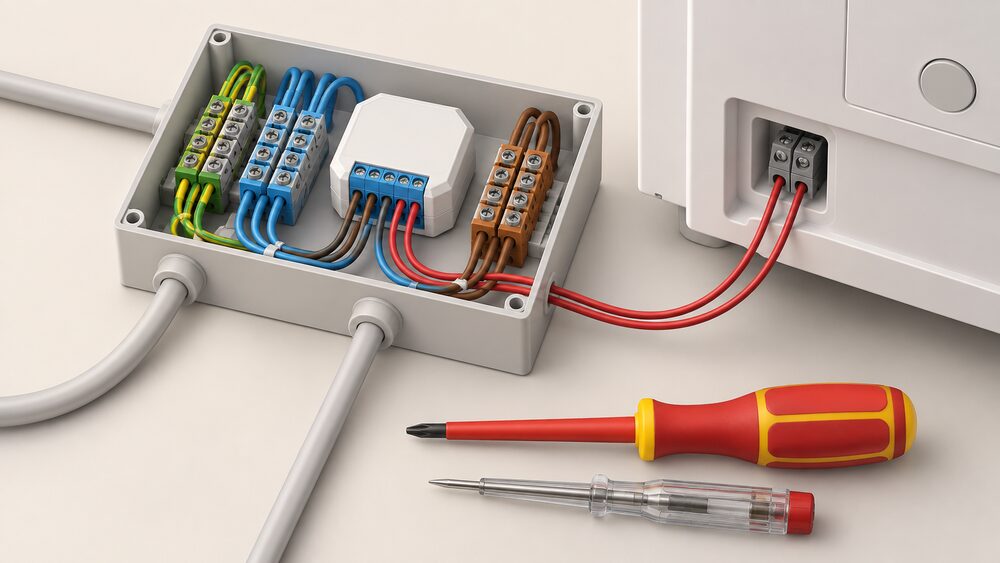
In a heating system a Shelly relay sits in the control circuit rather than in the heat source. It takes a low-voltage or mains signal and closes or opens a contact, which is the same job a room thermostat performs when it calls for heat. The maker documentation for a comparable relay product describes selecting the purpose "Central heating" in the device management for the relay, which configures it for boiler control2. That is the whole function in one line: the device becomes the switch that tells the boiler to run.
What that buys a household is a control layer that is independent of the boiler maker. Heating controls exist to control when the heating system operates and the temperature in each room4. A Shelly relay can take over the "when" part, driven by a schedule held locally or by a hub, while the boiler continues to do what it always did. The relay does not change how the boiler burns gas or how efficiently it condenses; it changes who decides when it fires.
The second function is measurement. The Shelly EM is documented for energy saving, contactor control, power monitoring, solar panels monitoring, heavy load control and preventative monitoring1. In a heating context that means a household can see what a circuit actually draws, which is useful where an immersion heater, a secondary electric heater or a pump is on the same supply. It also means the device can act on what it measures: the Shelly EM can automatically turn off the whole circuit if consumption or energy reaches the set limit1.
The dependence that remains is the boiler itself, the gas or electricity supply, and the wiring centre the relay is fitted into. A Shelly adds control and visibility; it does not change the fuel or the heat source.
Which Shelly devices suit which heating setup
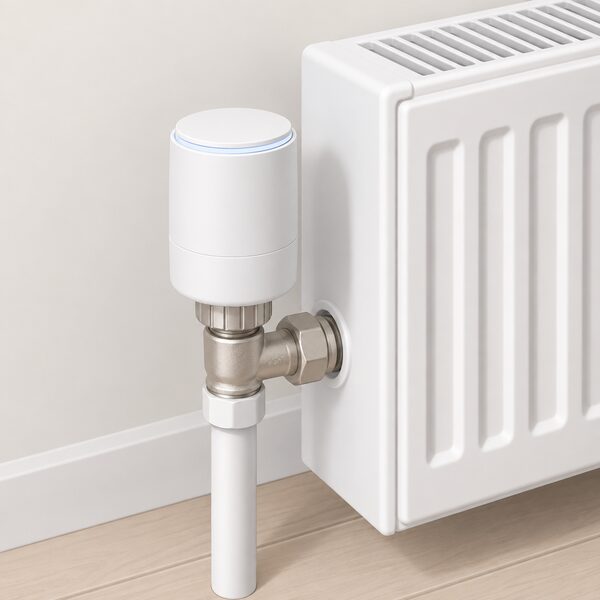
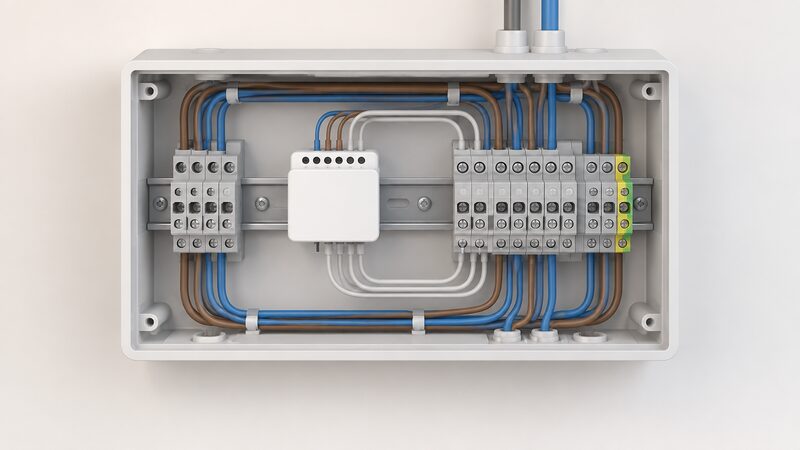
The range splits by job rather than by boiler type. A relay switches a circuit. A monitoring device measures one. A TRV controls a single radiator. Matching the device to the task is the whole decision.
| Device role | What it does | Where it fits |
|---|---|---|
| Relay with dry contact | Switches a boiler's potential-free input | Boiler control, replacing a thermostat's switching function2 |
| Shelly EM | Power monitoring and contactor control, one contactor or load up to 2A | Circuit measurement, heavy loads, solar monitoring1 |
| Shelly TRV | Learning capabilities, frost protection, child lock, on-valve controls | Individual radiators5 |
The relay route depends on the boiler. The maker guidance for a comparable product states that the boiler must have a potential-free input that enables external control through the relay, and that rooms must have radiator thermostats or room thermostats set up in the app2. Without that input, a relay cannot command the boiler directly and the household is looking at a different approach.
The EM route is about measurement rather than switching heat. Its published use cases are energy saving, contactor control, power monitoring, solar panels monitoring, heavy load control and preventative monitoring1. For a household with electric heating, that is the device that answers what a heater costs to run.
The TRV route is radiator-level. Independent guidance on electric heating sets out the choice plainly: control each heater individually or control the whole system centrally6. A Shelly TRV provides learning capabilities, frost protection, child lock and on-valve controls5. Per-radiator control is the most granular option and the most expensive to fit across a whole house.
Wiring in: dry contacts, boiler control and thermostat replacement
The wiring question is the one that decides whether a Shelly is suitable at all. A relay needs a contact to switch and a supply to run itself. The maker guidance for a comparable relay product is explicit on both: the boiler must have a potential-free input that enables external control through the relay, and the device itself requires a power supply of 230V/50Hz for operation2.
A potential-free input, sometimes called a dry contact, is a pair of terminals on the boiler that expect nothing more than a closed circuit. The boiler supplies its own switching voltage; the external device merely bridges the terminals. That is why a relay can stand in for a room thermostat: the thermostat was doing the same job. Where a boiler has no such input, the relay has nothing safe to connect to and the installation changes shape.
The boiler interlock is the part a relay does not supply on its own. Approved Document L describes a notional dwelling heating system with boiler interlock at ErP Class V7. Interlock means the boiler and pump stop when there is no demand, rather than running the pump continuously. A relay can contribute to that logic, but the interlock is a property of the whole control arrangement, not of one device.
Replacing a thermostat is therefore a wiring task with a control consequence. The switching is straightforward where a dry contact exists; the sensing is not, because a relay has no thermometer. A separate temperature sensor or a paired device is needed to close the loop. For the wider picture of how thermostats are wired and sited, room thermostats and heating control wiring set out the conventions.
Controlling heating without the cloud

The strongest argument for a Shelly in a heating system is that control does not have to pass through a manufacturer's server. The Shelly EM is documented as compatible with Android, iOS, Amazon Alexa, Google Assistant, and home automation servers using MQTT, CoAP, and REST API1. MQTT and REST are local protocols: a hub on the same network can talk to the device directly.
That matters because cloud independence is a real property, not a marketing line. Zigbee, a comparable local protocol, is documented as still working if the internet is down and not requiring connection with or communication to the cloud8. A relay driven over a local protocol behaves the same way: the schedule and the switching continue when the broadband drops.
The cloud still has a role in the Shelly ecosystem. Measurements from the Shelly EM are stored in a free cloud for 365 days, and the device keeps a 365 day built-in energy history1. So the local history and the cloud history run in parallel, and the household keeps the data even when the remote service is unavailable.
Remote access is the part that depends on the internet. Smart heating controls are described as connected to the internet and offering more functionality than conventional controls9, and most smart heating controls link to a phone, with heating controllable via smartphone, tablet or laptop, or by telling a smart speaker what you want10. That convenience is exactly the function that stops working when the connection does.
For a household weighing independence, the position is that a Shelly relay can be run entirely locally, with a hub such as Home Assistant, and still deliver scheduling and switching. The cloud becomes optional rather than structural. Home Assistant and open-source control covers the hub side, and smart home protocols for heating explains where MQTT and Zigbee sit.
Schedules, temperature sensing and hysteresis
A relay on its own has no opinion about temperature. It switches when told to. Everything that makes a heating system comfortable rather than merely switchable sits in the sensing and the schedule around it.
Heating controls help control when the heating system operates and the temperature in each room4. A Shelly relay handles the first half well: schedules can be held locally, adjusted from a hub, and triggered by conditions. The second half needs a sensor. Without one, the relay is a timer, and a timer cannot respond to a cold snap or a sunny afternoon.
Smart thermostats go further by interpreting inputs. They may interpret what you input, such as your preferred room temperature, learn from what you do, react to other data like weather forecasts, and some have a learning function that predicts behaviour from how you set and adjust heating and how you occupy the home10. A Shelly-based setup can replicate parts of that through hub automations, but the household builds the logic rather than buying it pre-made.
Hysteresis is the practical detail. A thermostat does not switch at a single temperature; it switches on below one point and off above another, with a gap between them. That gap stops the boiler short-cycling. In a hub-driven setup the household sets that gap in the automation, and setting it too narrow produces rapid cycling, while setting it too wide produces noticeable temperature swings. The relay will do exactly what it is told, which is both the appeal and the risk.
The dependence here is on the household's own configuration. A Shelly system is only as good as the automations written for it, and those automations live on a hub that needs power, a network and occasional maintenance. Heating schedules and setback covers the timing side, and thermostat temperature settings covers the setpoints.
Power monitoring: what the Shelly EM measures
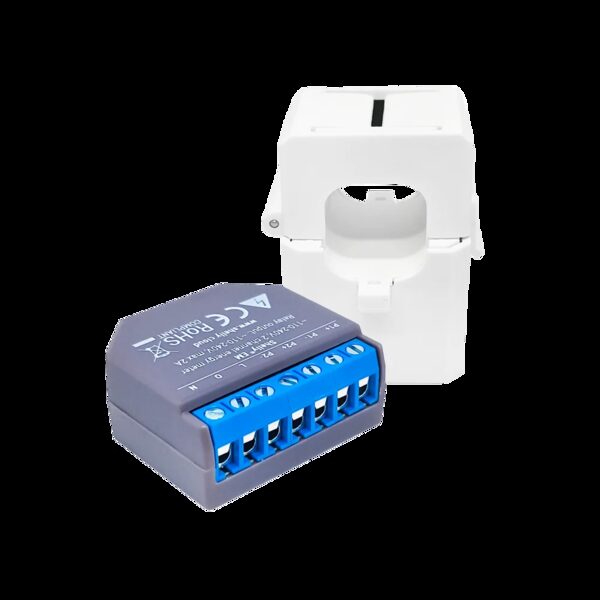
The Shelly EM is the measurement device in the range, and its published specification is specific. It is rated for a power supply of 110-240 V, 50/60Hz, has an operational temperature range of -20 °C to 40 °C, and includes an internal temperature sensor for overheating protection1. Its documented use cases are energy saving, contactor control, power monitoring, solar panels monitoring, heavy load control and preventative monitoring1.
For a heating system the useful applications are the electric ones. An immersion heater, a panel heater or a storage heater draws a measurable load, and the EM can report it. The device can also act on what it measures: it can automatically turn off the whole circuit if consumption or energy reaches the set limit1. That is overload protection as well as monitoring.
The conformity position is worth stating plainly. Shelly published a multilingual EU declaration of conformity, number 189, for the Shelly EM dated 23 July 2025. A declaration of conformity is the maker's statement that the product meets the applicable EU directives; it is a compliance document, not a performance guarantee, and it says nothing about how the device behaves in a particular heating circuit.
Where measurement matters for a scheme, the standards are higher than a consumer device meets. Heat pump metering guidance specifies Class A of the Measuring Instruments Directive, with resolution not finer than 1Wh, for all electrical supplies to a heat pump plus a DHW cylinder where supplied by the heat pump11. A Shelly EM is a household monitoring tool, not a scheme-compliant meter, and the two should not be confused. Using heating controls with time-of-use tariffs covers where measurement feeds into tariff decisions.
Cost and comparison: Shelly against smart thermostats and TRV kits
There is no published UK price for a Shelly heating installation in the figures available, so the comparison has to run on the smart thermostat side, where prices are documented. Most smart thermostats cost between £100 and £200, but some will have add-ons such as installation which push the total higher3. A smart thermostat for boiler heating controls is put at around £100 to £25012.
Installation is the variable that changes the picture. A full set of heating controls, meaning a programmer, a room thermostat and TRVs for all radiators, is put at around £600 to fully install13. Where a programmer and thermostat already exist, adding TRVs to all radiators costs around £3709. Hive recommends finding a local tradesperson to install the smart thermostat, as it can be a bit of a task14.
| Option | Documented cost | What it covers |
|---|---|---|
| Smart thermostat | £100 to £200, plus installation3 | Room temperature control and scheduling |
| Smart thermostat for boiler controls | around £100 to £25012 | As above, boiler-specific |
| Full heating control set | around £600 installed13 | Programmer, room thermostat, TRVs throughout |
| TRVs added to existing controls | around £3709 | Radiator-level control only |
The documented limitations of smart thermostats are worth weighing against a relay approach. They can be expensive and have an installation cost, and having one means you are only tracking your heating, so you cannot keep an eye on your electricity and gas usage15. A Shelly EM addresses that gap directly, because circuit-level monitoring is its stated purpose1.
Savings are not a reliable differentiator. A smart thermostat could save money, but savings aren't guaranteed, and they depend on the home, heating habits, existing controls, energy prices, and how the thermostat's features are used16. The same caution applies to any control change. How much do heating controls cost and do heating controls save money carry the wider figures.
Limits and risks: what Shelly cannot do
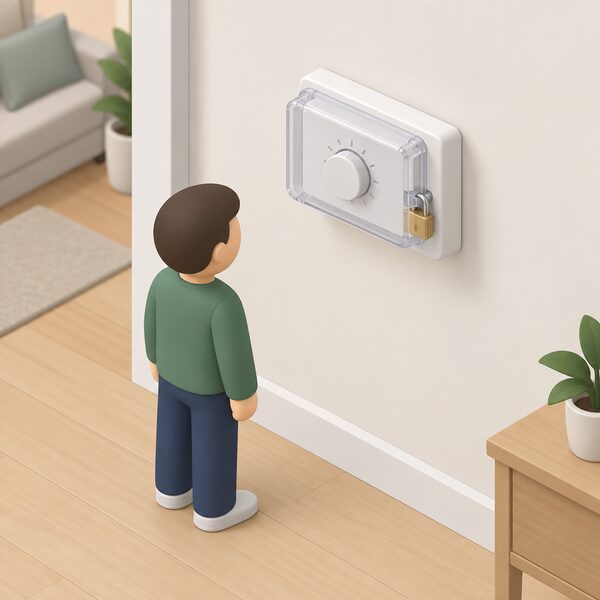
The limits fall into three groups: what the device cannot sense, what the regulations require, and what the household has to maintain.
On sensing, a relay has no thermometer. It cannot know a room is cold unless something tells it. That is a design constraint rather than a fault, but it means a Shelly-based system is never a drop-in thermostat replacement on its own.
On regulation, the requirements are specific and they are not optional. Controls must be installed that ensure a heat generator does not supply hot water services and space heating service simultaneously17. Controls to ensure continued low-temperature operation, limiting flow temperature at the heat generator, must be installed and commissioned in accordance with the design and cannot be overridden by the householder17. A householder-written automation that overrides a commissioned flow temperature limit is not a neutral change.
On standards, hybrid control sits in an unsettled place. There is currently no agreed control specifications or inclusion of hybrid control systems in standards18. That means a household combining a Shelly relay with a heat pump and a boiler is working outside a defined specification, and the design responsibility sits with whoever commissions it.
There is also a human factor. Heating controls are continually improving, yet research shows lots of people don't fully understand them, and many simply don't use them19. A hub-driven system with custom automations raises that bar rather than lowering it.
Finally, the dependence a Shelly setup creates is on the household's own infrastructure: a hub, a network, a power supply and the willingness to maintain automations. That is a different kind of dependence from a manufacturer's cloud, and for some households it is preferable. It is still dependence. Heating controls and energy independence sets out the trade-off, and smart heating control security and data covers the data side.
Sources19 cited
- Shelly EM 50A clamp product page, Shelly, 2026-09-20
- Relay help and boiler connection guidance, Bosch Smart Home, 2026-09-20
- What are smart thermostats?, Uswitch, 2026-02-05
- Thermostats and heating controls, Home Energy Scotland, 2026-09-20
- Best smart radiator valves, Which?, 2026-09
- Renewable heat right for your home, Energy Saving Trust, 2026-05-19
- Approved Document L, Volume 1, dwellings, HM Government, 2021
- Zigbee FAQ, Connectivity Standards Alliance, 2026
- Thermostats and heating controls, Energy Saving Trust, 2026-02-10
- Smart homes and lower carbon footprint, Energy Saving Trust, 2026-01-21
- Domestic RHI guide to metering, Ofgem, 2026
- Boiler prices: how much does a new boiler cost, Which?, 2025-09-17
- Tips to improve the EPC rating of your home, Energy Saving Trust, 2026-08-03
- tado vs Hive: which smart thermostat is best, Energy Helpline, 2026-09-20
- Ultimate energy saving tips guide, Smart Energy GB, 2026-04-24
- What is a smart thermostat?, Smart Energy GB, 2026-08-19
- Low temperature heating, NCM PCDB, 2026-09-17
- Heat pump and hybrid controls guidance, HHIC, 2026-09-17
- Boilers, Home Energy Scotland, 2026-09-20
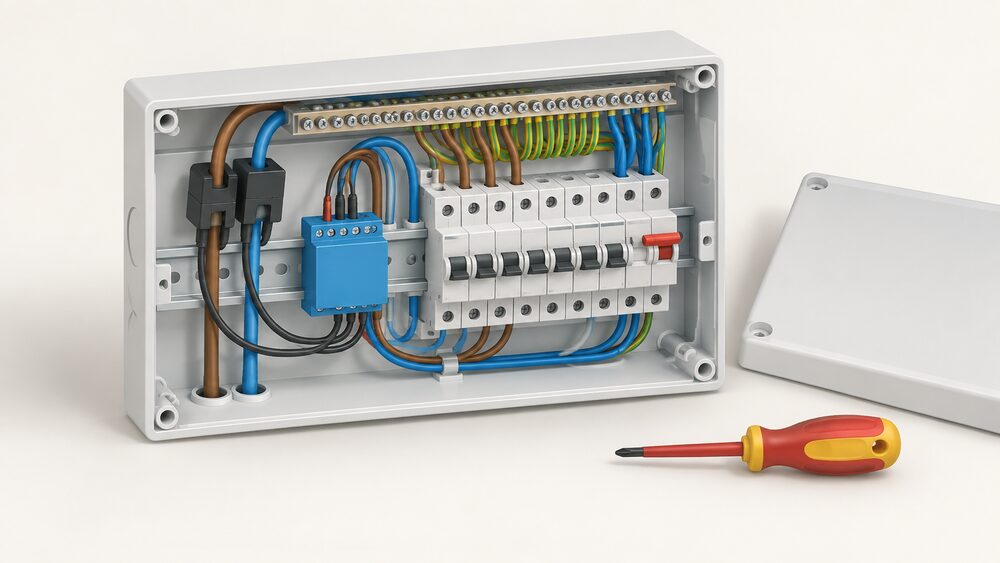 Shelly Smart Relays and Energy Monitoring DevicesShelly devices fit inside your fuse box to track how much electricity your home uses.
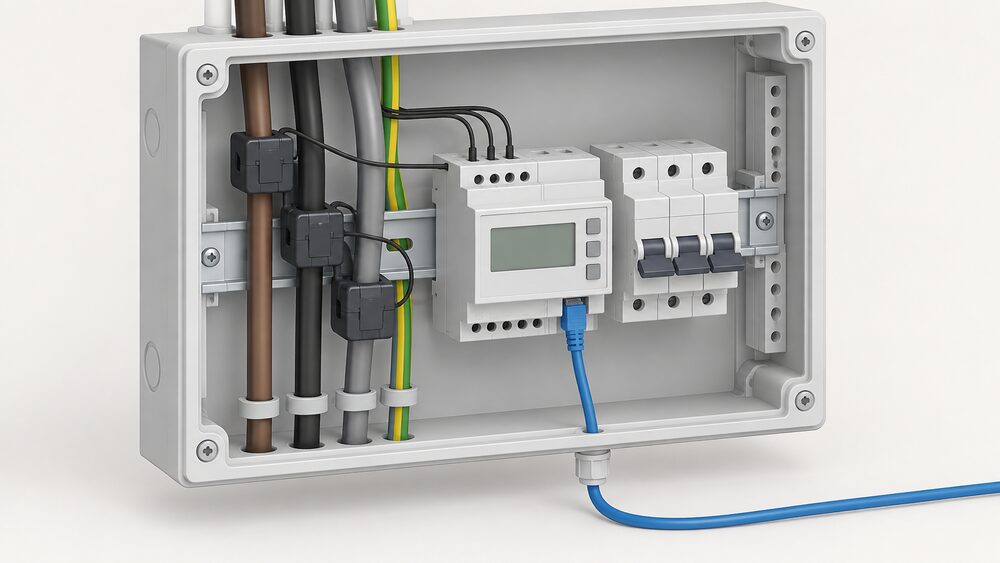 Shelly Pro 3EM Three-Phase Energy MeterWhat is your whole house using, and how much solar are you sending back to the grid?
 Shell EnergyShell Energy left the UK domestic market when Octopus Energy took over its 1.3 million household accounts on 1 December 2023; what the transfer means for former customers, tariffs and independence.