In this guide
Unilin Insulation is the Irish and UK rigid board maker that traded for years as Xtratherm, and it now sits inside the global Unilin group. It makes PIR and phenolic boards for walls, roofs and floors, and it sells something less visible alongside the boards: a technical service that runs from U-value calculation and condensation risk analysis through to accredited junction details and psi-value calculations at design stage1.
For a household, the practical question is what the boards do for energy independence. Rigid boards raise the thermal performance of a specific element, a floor, a roof, a wall lining or a wall wrap, which reduces the heat a home needs to buy. They do not change the fuel or the supplier. A home insulated with Unilin boards is still on the grid and still buying gas, electricity or oil, and the boards themselves are a manufactured product with a single supply chain. What changes is the size of the bill and the amount of heat that stays in the building.
The company does not offer grants. It states plainly that it does not directly offer grants, though its technical team can help a householder navigate the requirements and benefits of energy efficiency grants3. Grant funding comes from government schemes, and grant funded schemes may offer only a limited choice of materials4. The rest of this page sets out the range, the technical support, the certification, the sustainability position and where the limits sit.
Unilin Insulation: formerly Xtratherm, now part of the global Unilin group
The name change is the first thing to get straight, because it affects how a householder searches for a product and how an installer prices it. The business trades as Unilin Insulation and was formerly Xtratherm. Product names carried over from the Xtratherm period are still in use, including the XT and SR prefixes, so a merchant listing for XT/TL or a Safe-R board is the same operation under the older label1.
Unilin Insulation is part of the global group of Unilin companies, which combine their efforts under the group's ONEHOME strategy7. The company describes its commitment to renovation as part of that global ONEHOME strategy, and published a renovation brochure in November 2025 setting out insulation solutions for refurbishment work4. That matters for a UK household because the renovation side of the range is the part most likely to be relevant to an existing home rather than a new build.
The technical team covers customers in both Ireland and the UK, and its experience is described as built through engagement and participation with the Irish construction industry for over 30 years5. Unilin also states more than 40 years of industry experience in advising on insulation specifications, detailing and build-ups2. The two figures are not in conflict: one describes the team's engagement with a particular market, the other the company's wider industry experience. Both are the maker's own account of itself.
The company reserves the right to change product information without notice, which is a standard manufacturer position and a reason to check the current datasheet rather than an old one before specifying5.
The product range: boards for walls, roofs and floors
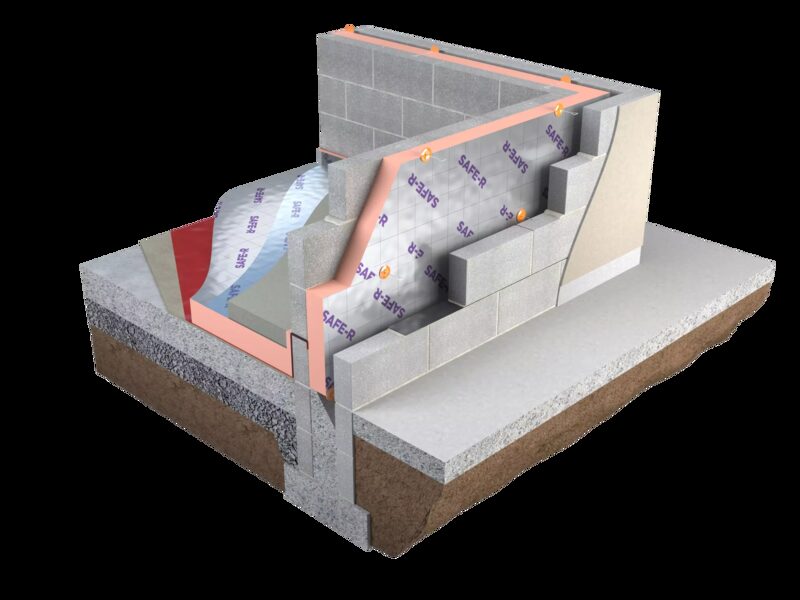
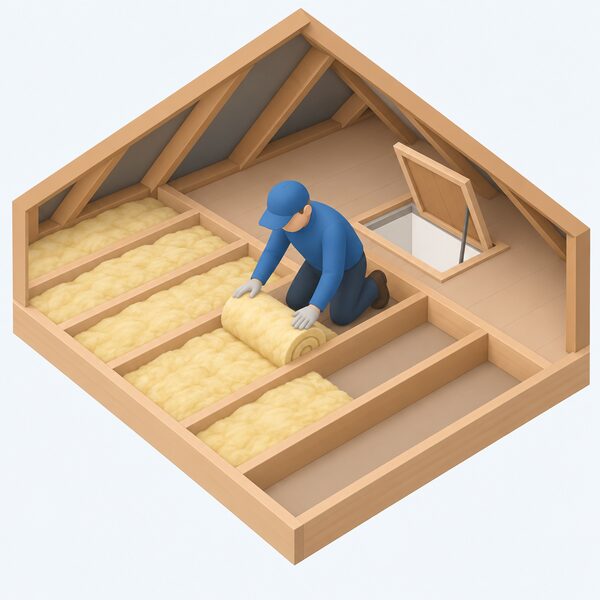
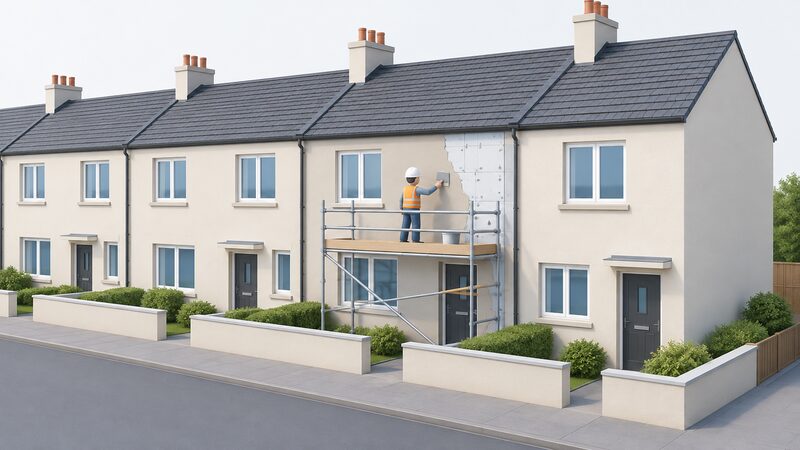
Unilin's range divides by where the board goes. For floors, the products are XO/UF and XT/PR_UF. For roofs, they are RAFTERLOC and FR/ALU. For internal wall insulation, the range includes thermal liners such as XT/TL and SR/TBFL-MF. For external wall insulation, it includes WARM-R SD E Grey EWB and Stonewool EWI1.
The chemistry differs across the range. Safe-R is Unilin's range of phenolic insulation, a material with a lower thermal conductivity than PIR, which means a thinner board for the same U-value5. That is the trade-off a householder with limited internal space is usually weighing: phenolic costs more per unit of performance but takes less room. PIR boards are the mainstream product for floors, roofs and wall linings where thickness is less constrained.
| Application | Products named by the maker | Notes |
|---|---|---|
| Floor insulation | XO/UF, XT/PR_UF1 | Rigid boards for floor build-ups |
| Roof insulation | RAFTERLOC, FR/ALU1 | Rafter-level and insulated plasterboard options |
| Internal wall insulation | XT/TL, SR/TBFL-MF1 | Thermal liners, dry lining |
| External wall insulation | WARM-R SD E Grey EWB, Stonewool EWI1 | Board and stone wool systems |
| Phenolic range | Safe-R5 | Lower conductivity, thinner build-up |
Thermal bridging: junction details and psi-value calculations
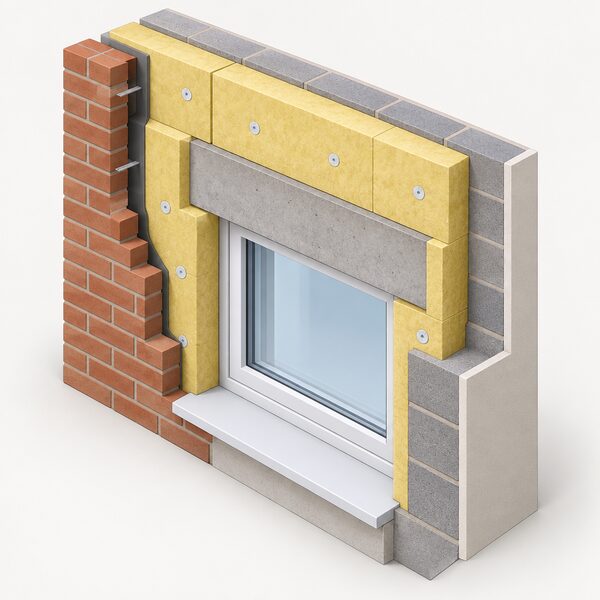
Thermal bridging is where a fabric specification most often fails to deliver what the model promised. Heat escapes at junctions, around lintels, at wall-floor and wall-roof intersections, and at window reveals, in ways that a simple U-value for the flat area of the wall does not capture. Unilin states that manufacturers such as itself support this at the design stage by providing integrated insulation systems, accredited junction details and psi-value calculations2.
The company's technical services list includes pre-design assessment of details and Y-value performance checks, alongside pre-tender specification checks3. A Y-value is the aggregate of all the junction heat losses in a dwelling, so a design that gets the junctions right can meet a target with less insulation in the flat areas, or meet a tighter target with the same thickness. That is the commercial argument for using a maker's accredited details rather than generic ones.
The regulatory backdrop is that the choice of insulation should be based on the best thermal performance that is practicable, to achieve a U-value as close as possible to the target where a standard is not functionally or technically feasible8. Approved Document L deals with limiting heat gains and losses, air permeability and pressure testing, insulation regulations and related matters9. In Wales, the 2014 Approved Document L1B sets cost-effective U-values for specific renovation triggers, including 0.18 W/m²K for renewal of a flat roof covering where existing insulation is less than 100 mm or in poor condition, and 0.30 W/m²K for renewal of cladding to dormer side walls, with condensation risk to be assessed in both cases10.
"the choice of insulation should be based on the best thermal performance that is practicable to achieve a U-value as clo"
Technical support: over 40 years of experience from design to construction
Unilin's technical support is available throughout both the design and construction stages of a project2. The published service list is unusually specific for a board manufacturer: a free consultation service with a Unilin technical expert, certified U-value calculations and condensation risk analysis, an off-plan BER/SAP calculation consultation service in conjunction with the householder's own SAP assessor, fabric performance specifications to achieve an A-rated building, pre-design assessment of details and Y-value performance, a pre-tender specification check, installation training, and an installation validation process with the install team3.
The free consultation service connects a householder or specifier with Unilin technical experts who provide one-to-one advice on insulation solutions3. The team can be reached on 0371 222 1055, with a general line on 0371 222 1033 and email at tech.ui@unilin.com5.
Two of those services are worth separating out. The SAP consultation is aimed at the assessor rather than the householder, because the Standard Assessment Procedure is what produces the EPC rating, and the fabric specification has to be expressed in terms the assessor can enter. The installation validation process is the maker checking that its own product has been fitted as designed, which is a different thing from a building control inspection.
Installation training matters because rigid boards are unforgiving of gaps. Official retrofit guidance for underfloor insulation expects installation techniques to be in line with the manufacturer's instructions and the prescribed installation methods for the product used11. The European Ecolabel for insulation products requires suitable training to be available for installers, so the expectation is not unique to one maker12.
Certified U-value calculations and condensation risk analysis
The two calculations Unilin certifies are the ones that decide whether an insulation specification is safe as well as effective. A U-value calculation shows how well insulated an element is. A condensation risk analysis assesses whether water vapour will condense inside the build-up, which is the failure mode that turns a well-insulated wall into a damp one3.
The company's technical services include certified U-value calculations and condensation risk analysis, fabric performance specifications for A-rated buildings, pre-design assessments and Y-value performance checks, and pre-tender specification checks3. The same pairing appears in independent guidance on spray foam, where a pre-installation survey is expected to include a U-value calculation, an assessment of the risk of condensation occurring, and identification of any problems and measures needed to prevent them13. The principle is general: insulation changes the temperature profile through a build-up, and the moisture behaviour has to be checked.
For internal work, Unilin states that its PIR-based systems must be combined with appropriate vapour control layers, airtightness detailing and junction design to avoid interstitial condensation and cold bridging2. That is a condition of use, not a suggestion. Internal wall insulation in particular moves the dew point within the wall, and the vapour control layer is what keeps moisture out of the cold side of the structure.
Where a standard cannot be met by insulation alone, the Welsh consultation position is that the choice should be based on the best thermal performance that is practicable8. In Northern Ireland, Part F consultation material sets a limiting U-value of 1.40 W/m2K as a window-area-weighted average for windows, roof windows, glazed rooflights, curtain walling and pedestrian doors15. Those are the numbers a specification has to work around, and they are why the junction and condensation work sits alongside the board sale.
Grants: what Unilin does and does not offer
Unilin Insulation does not directly offer grants. Its stated position is that while it does not offer grants itself, its technical team can help a householder navigate the requirements and benefits of energy efficiency grants3. That is a support role, not a funding one, and it is worth being clear about the difference before approaching a manufacturer expecting a contribution.
Grant funding in the UK comes from government schemes. Insulation can be expensive to install, but government grants are currently available that could significantly reduce installation costs16. Some households may be eligible for grant funding for floor insulation as part of the government's Warm Homes Plan17. The Warm Homes: Local Grant funds insulation, energy-efficient heating systems and renewable energy installations18. Government-backed grants are available to help pay for insulation in homes with cavity walls19. The ECO scheme funds insulation including loft, roofs and walls20.
The four nations differ. Energy Efficient Scotland's Area Based Scheme funds external wall insulation, park home insulation, internal wall insulation, cavity wall insulation, loft insulation, underfloor insulation and room-in-roof insulation21. The Warm Homes Programme funds insulation, low carbon heating and renewable technologies22. In Northern Ireland, guidance on condensation and mould advises considering insulating walls and loft if they have not been done, and notes that a grant may be available for this23. In Wales, ECO4 Flex operates through participating local authorities24.
A householder weighing independence should read this section as a limit. A grant reduces the cost of a measure but ties the work to scheme rules, an approved installer and often a restricted product list. Self-funded work keeps the choice of board and detail, and loses the subsidy.
Sustainability: EPDs, ONEHOME and science-based targets
Unilin publishes Environmental Product Declarations for phenolic, PIR, expanded polystyrene and bio-enhanced PIR insulation board products2. An EPD is the document a specifier asks for when a project has embodied carbon targets, because it sets out the modelled environmental impact of a product over its life cycle on a consistent basis.
The company describes its investment in research and development as delivering developments in product properties, performance and circularity, backed by improving EPDs7. It states that it is committed to science-based targets in line with the Paris Agreement, limiting global warming to 1.5°C above pre-industrial levels, with official validation and annual tracking7. Targets are considered science based if they are in line with what the latest climate science deems necessary to meet that goal7.
The wider policy context is that the construction sector is being pushed to unlock data collection, analysis and sharing across all stages of construction, with cost and barrier reduction identified as innovation needs for new builds, existing properties and HVAC between 2025 and 203025. EPDs are part of that data layer.
For a household, the honest reading is that a board's embodied carbon is small next to the operational carbon it saves over a building's life, but it is not zero, and the EPD is how that is quantified rather than asserted. The ONEHOME strategy is a group-level commitment, and the renovation brochure published in November 2025 is the practical expression of it for existing homes4.
Case study: A-rated social housing in Waterford
Unilin's own case study material describes work on ECO360 in Waterford, where the company helped achieve A-rated, energy-efficient social housing that was awarded a Pride of Place award in 20237. The project is in Ireland rather than the UK, and it is the maker's account of its own product, so it should be read as an illustration of what the system is designed to achieve rather than as independent verification.
The relevance to a UK household is the pattern rather than the address. A-rated social housing schemes typically combine a fabric-first approach, high-performance insulation at walls, roofs and floors, careful junction detailing, and controlled ventilation, because tightening a building without ventilation creates the moisture problems that the condensation analysis exists to prevent. Unilin's technical services list maps onto that sequence: fabric performance specifications for A-rated buildings, pre-design assessment of details and Y-value performance, and installation validation3.
Independent UK retrofit case studies show the same shape of work. The Ealing Social Housing Decarbonisation Fund project involved supplying and installing external wall insulation and replacement windows26. A Sheffield family retrofit used funding from Skipton Building Society to insulate a dining room and connect it to the central heating system27. Neither is a Unilin project, and neither is offered as evidence about Unilin boards, but both show that the fabric measure is usually one part of a package.
Independent research supports the fabric-first logic. Researchers from Leeds Sustainability Institute found fabric insulation of walls and roofs to be one of the most effective ways to retrofit an older, solid walled home to prevent overheating in summer and prevent heat loss in winter28. That is the double benefit a householder is buying: less heat lost in winter, less heat gained in summer.
Renovation, older buildings and where the boards fit
Unilin states that its PIR-based systems can be used in older buildings, but only where they are carefully specified and detailed as part of a whole-building retrofit strategy14. In traditional or solid-wall buildings, the systems are suitable for wall insulation, roof upgrades or floors where moisture risk can be controlled and vapour flow is properly managed2. The condition is doing the work, not the product.
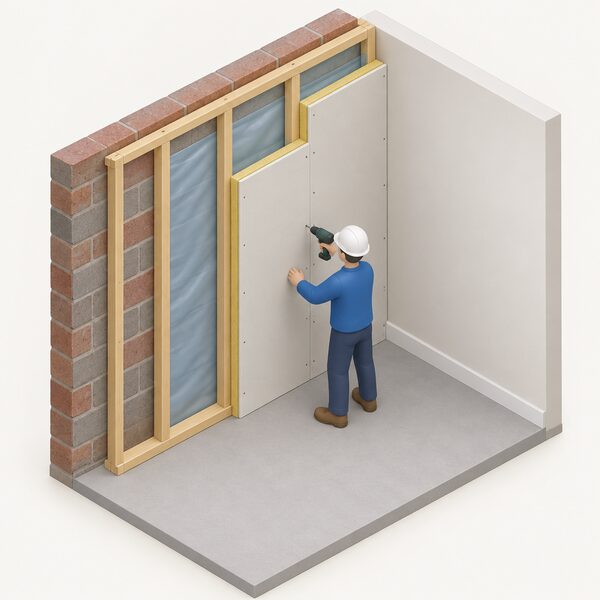
Internal wall insulation in these buildings typically consists of dry lining in the form of pre-insulated plasterboard or built-up systems using insulation such as mineral wool or foam sheets held in place using a studwork frame29. That is the category Unilin's thermal liners fall into. The risk with any of them is that the original wall becomes colder and wetter behind the lining, which is why the vapour control layer and the hygrothermal assessment matter.
Unilin states that its systems are supported by hygrothermal assessment where necessary14. A hygrothermal assessment models heat and moisture movement through the build-up over a year of weather, and it is the tool that answers whether a proposed internal lining will cause problems in a particular wall. For a solid wall home, that assessment is the difference between a specification that works and one that produces damp.
The wider retrofit context is that repairs reducing heat loss through the building fabric, or reducing damp or moisture penetration, were eligible measures under Scotland's Home Energy Efficiency Equity Loan pilot30. That framing, fabric repair and moisture control together, is the right way to read the Unilin condition on older buildings.
For a household, the independence question here is straightforward. Boards reduce the heat a home loses through a specific element, and the technical support reduces the risk that the work creates a moisture problem. Neither changes the fact that the home remains connected to a grid and a supplier, and that the boards come from one manufacturer's supply chain. What a well-detailed retrofit does is lower the amount of energy that has to be bought, which is the part of energy independence a household can control directly.
Sources30 cited
- What does Unilin offer: the different types of insulation products, Unilin Insulation, 2026
- Fabric performance FAQs, Unilin Insulation, 2026
- Renovation insulation products FAQ, Unilin Insulation, 2025-01-14
- Better Homes Renovate Insulate brochure, Unilin Insulation, 2025-11
- Safe-R phenolic insulation range, Unilin Insulation, 2026-06-04
- Safe-R product page, Unilin Insulation, 2026-06-17
- Does ECO360 help achieve Passivhaus or NZEB standards, Unilin Insulation, 2026-08-31
- Approved Document L Volume 1 consultation version, Welsh Government, 2025-08
- Approved Document L: Conservation of fuel and power, Planning Portal
- Building Regulations guidance Part L1B existing dwellings, Welsh Government, 2014-07
- ECO4 delivery guidance v3.2, Ofgem, 2025-12-08
- Ground source heat pumps and water source heat pumps, Scottish Government, 2010-03
- Spray foam insulation review, Which?, 2026-05-26
- How can I improve thermal performance in older buildings without causing moisture problems, Unilin Insulation, 2026-09-08
- Part F consultation document 2021, Northern Ireland Department of Finance, 2021-10
- Cheap and easy ways to insulate your home over a weekend, Which?, 2025-10-06
- Floor insulation review, Which?, 2026-05-26
- Home and business grants, schemes and advice, East Herts Council, 2026-09-17
- Free energy saving tips, Uswitch, 2025-10-14
- ECO4 Flex open, South Cambridgeshire District Council, 2026-09-17
- Home energy efficiency, Argyll and Bute Council, 2026-09-17
- Your home energy checklist, National Energy Action, 2026-09-10
- Dealing with condensation and mould, National Energy Action, 2026-09-07
- Transitioning to renewables in Wales, MCS Certified
- EINAs 2025 heat and buildings, Department for Energy Security and Net Zero, 2025
- External wall insulation and window replacements in Ealing, SWIGA, 2026-09-20
- From the coldest room I've ever been in to a warm and healthy home, National Energy Action, 2026-03-16
- 7 tips to keep your home cool during a heatwave, Elmhurst Energy, 2025-08-13
- About solid wall insulation systems, SWIGA, 2026-09-20
- Home Energy Efficiency Equity Loan pilot: homeowner feedback survey, Scottish Government, 2022-03-14