
In this guide
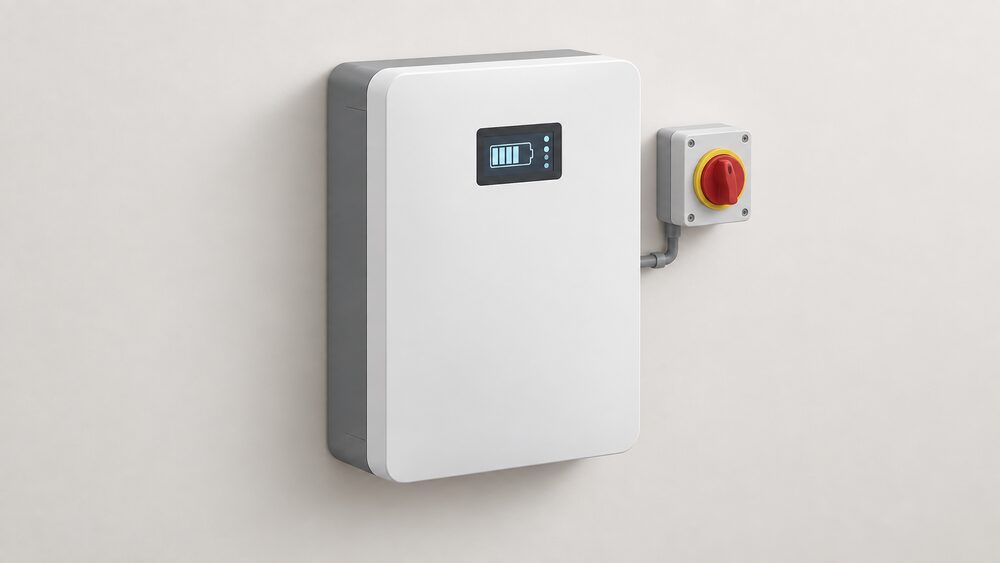
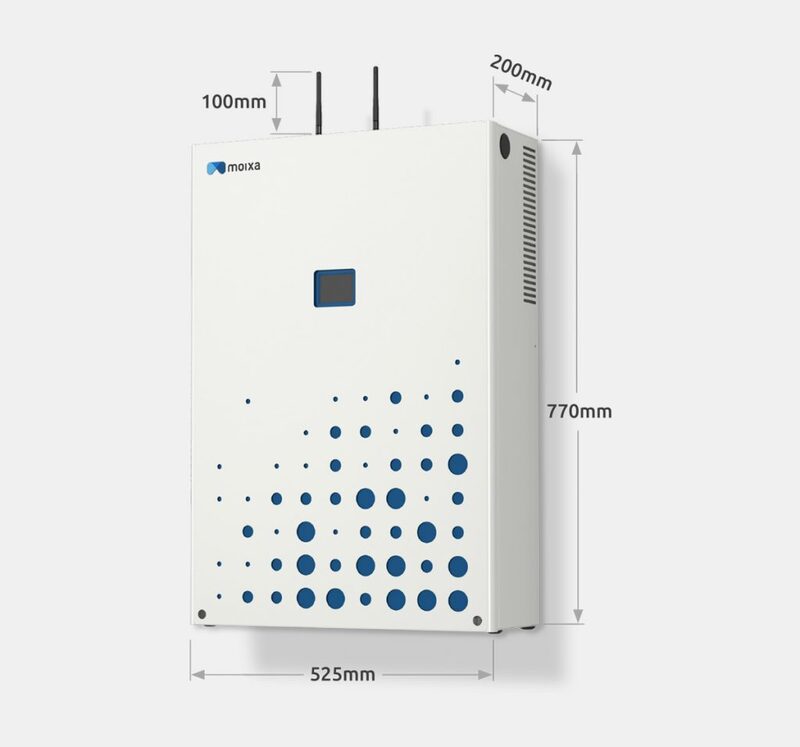
The Moixa Smart Battery is a 4.8kWh lithium iron phosphate home battery sold direct by Moixa, with a usable capacity of 4.08 kWh at 85% depth of discharge and a 10-year manufacturer warranty1. It is a small unit by current UK standards, designed to sit alongside rooftop solar and to earn part of its keep through GridShare, Moixa's aggregation platform, which the company has paid households £50 a year to take part in2.
The brand's history matters to anyone buying or owning one. Moixa Technology Ltd is a subsidiary of Moixa Energy Holdings, and the company was acquired by Lunar Energy in August 2022, which means the product line now sits inside a larger distributed energy software business rather than a standalone UK hardware maker3. The warranty terms in circulation date from 2019 and are written around the MSB-V4 4.8kWh unit.
This page sets out what the battery is, how it operates, what it depends on, and what the warranty actually requires. It is a specification and ownership reference, not a recommendation: the unit is no longer the capacity or the feature set most UK buyers are quoted, and its power-cut behaviour is a limitation rather than a feature.
Who makes the Moixa Smart Battery, and what Lunar Energy's ownership means for owners
Moixa Technology Ltd is a subsidiary company of Moixa Energy Holdings, and the manufacturer's warranty is issued in that corporate name3. The company's public record in home storage goes back further than the Smart Battery: the UK government awarded a contract of £1.3m to Moixa Technology Ltd for an energy storage demonstration, and the firm later ran domestic flexibility work including a Lewes virtual power plant covering 27 homes equipped with 4.8kWh Smart Batteries3.
In August 2022, Lunar Energy acquired Moixa, describing it as a global software company for distributed energy resources management. That is the single most important fact for an owner or a prospective buyer. The acquisition moved Moixa into a software and aggregation business, and the hardware line has not been refreshed in the way the wider UK market has moved on. The Smart Battery is listed as available direct from Moixa, so there is no distributor network behind it and no independent retail channel to fall back on for spares or price comparison2.
For a household, the practical consequence is a dependence on one company for support, for the app, for GridShare participation and for any warranty claim. That is a narrower base than a brand sold through wholesalers and installed by a wide installer network. It does not make the product unusable, but it does mean the manufacturer's continued operation is part of the system's working life, not a background detail.
Capacity and chemistry: the 4.8kWh LiFePO4 unit and its usable range
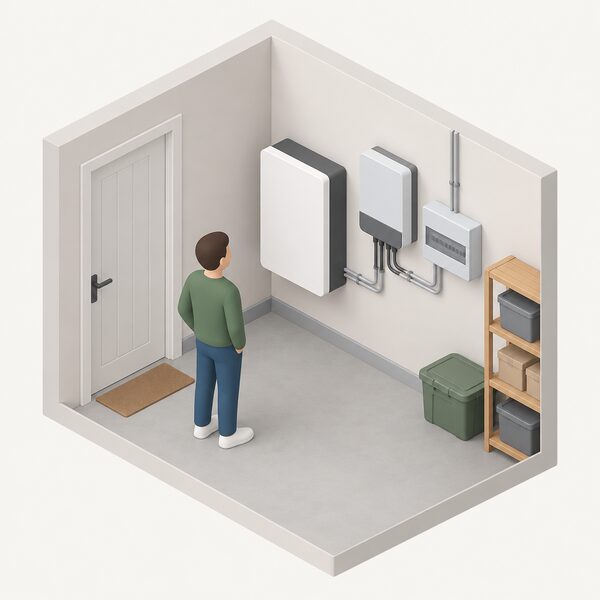
The headline figure is 4.8kWh, and the chemistry is lithium iron phosphate, listed by Moixa as LiFePO41. That chemistry is the same family used across most current UK home batteries, and it is generally chosen for thermal stability and cycle life rather than for energy density. A fuller comparison of chemistries is at home battery chemistries.
The number that matters for daily operation is not 4.8kWh but 4.08 kWh, which is what Moixa states is usable at 85% depth of discharge1. The gap between the two is the reserve the battery management system holds back, and it is normal rather than a fault. The general principle is set out at battery capacity and usable capacity.
At 4.08 kWh usable at 85% depth of discharge, the unit is small. It will cover an evening's base load in a low-consumption home and take the edge off peak-rate import, but it will not carry a heat pump through a winter night or absorb a full day's summer generation from a large array. Moixa's own product page also lists a 7.2kWh Optimised Battery System at 60 dBA, a larger and louder unit from the same stable1. Sizing is covered in more detail at what size home battery do you need.
| Specification | 4.8kWh Moixa Smart Battery | 7.2kWh Moixa Optimised Battery System |
|---|---|---|
| Chemistry | Lithium iron phosphate (LiFePO4)1 | Not stated |
| Usable capacity | 4.08 kWh at 85% depth of discharge1 | Not stated |
| Maximum noise level | 51 to 53 dBA1 | 60 dBA1 |
| Warranty | 10 years, extendable with GridShare membership1 | Not stated |
Operating modes: Balance, Scheduled and Smart charging
Moixa's batteries run in three modes, and the differences between them are about who decides when the battery charges and discharges. In Scheduled mode, the support team can set the battery to charge, discharge or stay idle between any set times over a seven day period6. That is the mode for a household with a fixed routine or a device that needs the battery out of the way at particular hours.
Smart mode is the automated option, and it comes with conditions. Moixa advises that for 14 days after installation the battery stays in Balance mode or Scheduled mode before Smart mode is used, so the software has a baseline to work from6. Where a price plunge event is known in advance, the battery will discharge ahead of time and charge up during the plunge; unplanned plunge events are not considered by the software, and Scheduled mode is recommended in that case6.
Smart mode also interacts with electric vehicle charging. Moixa advises that EV charging is kept as regular as possible so the software can predict upcoming charging and optimise the battery to support it6. Irregular charging undermines the prediction, which is a general feature of forecast-based battery control rather than a Moixa-specific weakness.
Where a household wants the battery idle at set hours for compatibility with another device such as an EV charger, Moixa states this can be arranged through the support team7. That is a support-mediated setting rather than a user-facing control, which is worth knowing before purchase: several of the operating decisions on this system run through Moixa rather than through the app.
Grid charging and time-of-use tariffs: storing cheap electricity
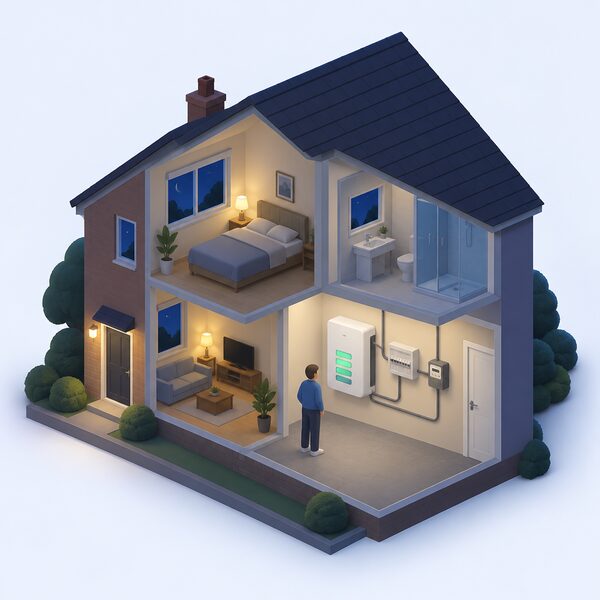
The commercial case for a battery of this size rests on price difference rather than on generation. Independent guidance is consistent: a battery can be charged with cheap electricity from a supplier, typically on certain tariffs at night or in the middle of the day, and discharged when prices are higher8. The Energy Saving Trust frames it as storing excess solar generation or charging when the tariff is cheap, then using the stored energy at night or when prices are high9.
The mechanism is well established across the sector. Dedicated smart storage battery tariffs typically have cheaper rates overnight so the battery can be charged and the power used during the day when it would be more expensive to buy10. The same logic appears in guidance on storing energy, which describes charging up when prices are cheaper and using that stored energy when prices go up11, and in advice on time-of-use tariffs, which notes that storing cheap electricity and using it later, even during peak times, can significantly increase savings12.
Moixa's own position is that if a household has a time-of-use tariff plan, the battery may already be set to charge when electricity is at its cheapest7. That is a statement about configuration rather than a guarantee, and it depends on the tariff being one the system recognises. The wider subject is covered at stacking a home battery with smart and time-of-use tariffs.
Two limits apply. First, a 4.08 kWh usable capacity caps the arbitrage: the spread is earned on a small volume each cycle. Second, the battery's participation in GridShare means some of its stored energy may be traded by Moixa rather than retained for the household, which is the trade-off behind the £50 annual payment reported for GridShare members2. Aggregation and flexibility services are explained at virtual power plants, flexibility services and home batteries.
Connectivity: keeping the battery online for the dashboard and app
The Moixa Smart Battery requires a live internet connection for performance data to be shown on the dashboard and mobile app4. That is not a cosmetic requirement: without the connection, the household loses visibility of what the battery is doing, and Moixa loses the data it needs to run GridShare optimisation.
Three connection methods are supported: a direct Ethernet cable between the battery and the router, a pair of powerline adapters, or WiFi4. The WiFi route is not self-service. The battery broadcasts a network named Moixa followed by its unique MAC address, and the password is provided by the support team4. On the Optimised Battery System, the wireless connection must be activated by the support team before it can be used, and any existing Ethernet or powerline adapter must be disconnected before the WiFi connection is fully utilised13.
Once connected, a local portal is reachable at http://172.24.24.1 for configuration4. Data consumption is modest: approximately 100 MB per month4. Moixa states that traffic can be reduced on request, but warns this could limit how much of your data is visible and affect support4.
This is the clearest dependence the product creates. Local operation continues without broadband, but monitoring, remote diagnosis and any GridShare participation do not. The general subject is covered at monitoring a home battery: apps, data and local access.
What happens during a power cut: why backup is not standard
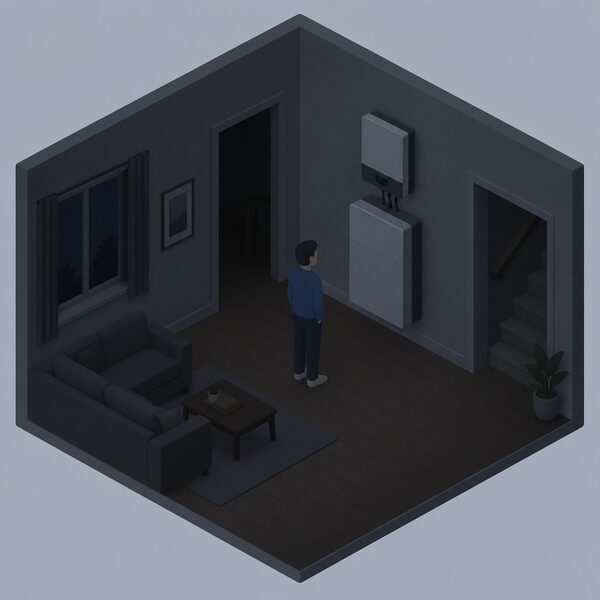
The Moixa Smart Battery is not set up to provide power during a power cut as standard. Moixa states that the inverter requires a constant power source and the battery will not discharge during a power cut5. The company adds that power cut operation is not currently an option, and that it is working on making the feature available as an addition to a standard installation5.
That places the unit in the majority rather than the minority. The Energy Saving Trust states that a battery storage system does not normally provide power in a power cut unless additional equipment and configuration is included16. The Centre for Sustainable Energy makes the same point more briefly: not all batteries can deliver electricity during a power cut17. Northern Powergrid notes that storage devices can provide backup supplies in some cases, but that this is not always possible and should be checked with the installer18.
Which? reported in 2019 that several owners told it their batteries do not work in a power cut, because the solar and battery also shut down19. That is the standard behaviour of grid-tied inverters, which must disconnect when the grid is absent to protect engineers working on the network.
The wider subject, including what equipment is needed, is covered at battery backup in a power cut: EPS, changeover and what keeps running and will a battery storage system work during a power cut.
Safety: handling, first aid and what to tell the fire service
Moixa's safety instructions are written for a lithium ion battery and are worth reading before anything else on this page. The unit should not be tampered with20. The contents of an open battery can cause severe irritation and chemical burns, and swallowing a battery can cause serious chemical burns of the mouth, oesophagus and gastrointestinal tract20.
First aid follows from that. On skin contact, remove contaminated clothing and wash the skin with soap and water, seeking medical attention if irritation persists20. If an open battery is ingested, do not induce vomiting or give food or drink; rinse the mouth and seek medical attention immediately20.
The fire service instruction is the one to remember. In the case of a house fire, or a fire where the battery is located, the householder must tell the firefighters that there is a Moixa Smart Battery containing a lithium ion battery, and share the relevant documents so they can tackle the fire safely20. North Wales Fire and Rescue Service gives the general rule for lithium ion batteries in the home: in the event of a fire, do not try to tackle it yourself, leave and call 99921.
"In the event of a fire, don't try and tackle it yourself - leave and call 999."
Regulation in this area is tightening. Amendment 4 (2026) to BS 7671:2018, published on 15 April 2026, adds a chapter on stationary secondary batteries that places strong emphasis on safety-critical matters such as appropriate battery location, ventilation and fire-risk mitigation22. Electrical Safety First's battery safety campaign calls for standards for conversion kits and charging systems and for consideration of a temporary ban on the sale of universal chargers23. More detail is at home battery fire safety and how safe are home battery storage systems.
Warranty eligibility and registration for MSB-V4 systems
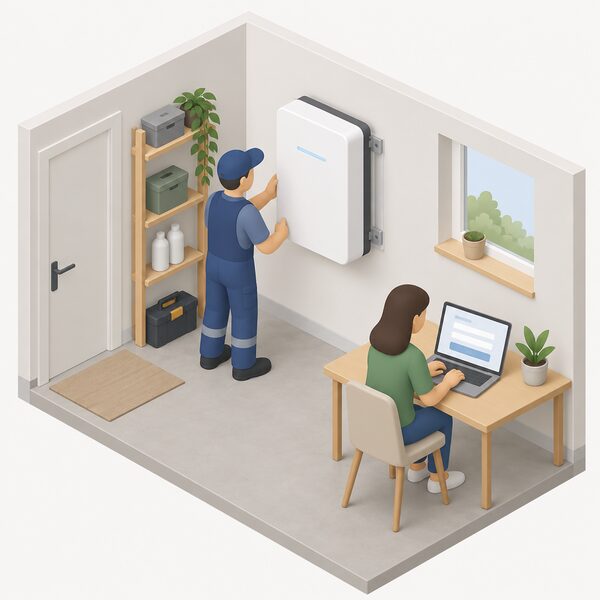
The warranty on the MSB-V4 4.8kWh Smart Battery runs for 10 years from the date of installation3. Moixa's product page states the same term and notes it is extendable with GridShare membership1. Which? lists the Moixa Smart Battery (AC) at 2kWh or 3kWh with a 10-year warranty, extendable for GridShare members, which is a different capacity figure from the 4.8kWh unit and appears to describe a different variant2.
Eligibility is conditional and the conditions are specific. The warranty applies to units installed after 1 April 2019, installed by a certified Moixa Accredited Installer and commissioned by Moixa, and registered via the internet by the user setting up an account at mygridshare.com3. All systems also come with a 2-year installation warranty as standard1.
The capacity thresholds are where the terms get interesting, and the two figures sit on different timescales. The warranty states that Moixa will only accept a claim if the battery capacity falls below 70% of its initially rated capacity within 7 years, and below 60% of its initially rated capacity within 10 years3. The warranty does not reconcile the two thresholds. The general subject is covered at home battery warranties: retained capacity, throughput and conditions.
Two further terms matter. An extension to the manufacturer's warranty applies for as long as a customer remains a contracted participant in Moixa's GridShare scheme, which ties warranty length to continued participation3. And the warranty may be transferred to a new owner by notifying Moixa by email, provided the product remains in its original installed position3. Moixa also states that this is a voluntary manufacturer's warranty and does not affect the statutory rights of users3.
Troubleshooting: restarts, blank screens and calibration
The restart procedure for the 4.8kWh system is to turn the round isolator switch to the OFF position and leave it for 30 seconds, then turn it back to ON; the battery should return to normal operation and display the Moixa logo on the LCD screen5. The Optimised Battery System uses the same sequence13. After a restart, the battery may take between 30 and 60 seconds to start storing power7.
If the battery shows no lights, the first check is the mains consumer board and any additional mini board, to confirm there are no tripped breakers15. When the unit is switched off, the LCD screen should go blank5. A blank screen with the isolator already on points elsewhere.
On data, Moixa states the system is calibrated so its data should be in line with meter readings for PV generation and electricity from the grid15. Where state of charge readings drift, Moixa says this can be easily fixed by remote tweaking in the calibration settings7. Persistent discrepancies are worth checking against the meter serial number, since meters are sometimes mixed up between flats in the same building, causing residents to be charged for the wrong flat's usage24. Billing disputes of this kind are documented by the Energy Ombudsman25.
Noise can be managed. Moixa states that the charge and discharge level can be set to run at a reduced rate at specific times of day, which also reduces the noise from the battery5. The 4.8kWh unit is listed at 51 to 53 dBA maximum, against 60 dBA for the 7.2kWh system1. Bypass mode is entered by pushing the BYPASS button on the front of the unit15.
If the charge drops below its reserve level, the system automatically corrects itself with a very short charge up from the grid5. The same applies if the battery has discharged below its lowest safety limit7. Independent guidance puts a typical reserve at around 20% of total storage capacity, at which point a system stops discharging9.
What the Moixa Smart Battery means for household independence
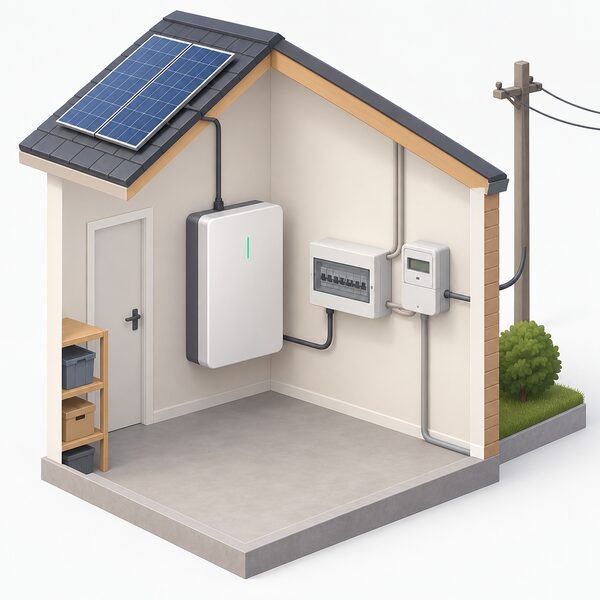
The unit delivers partial independence and leaves several dependencies in place. On the positive side, it stores self-generated solar electricity for evening use and can shift cheap off-peak import to peak hours, which reduces the volume of electricity bought at the most expensive times9. It is a genuine buffer against peak pricing.
The dependencies are more numerous than the benefits. The household remains connected to the grid and to a supplier, because the battery cannot operate islanded during a power cut5. It depends on a live broadband connection for monitoring and for GridShare participation4. It depends on Moixa, now part of Lunar Energy, for support, for configuration changes, for calibration fixes and for warranty administration3. And the longest warranty term depends on continued participation in a scheme run by that same company3.
For a household weighing this against current alternatives, the honest summary is that the Moixa Smart Battery is a small, well-specified lithium iron phosphate unit from a company that has changed hands and moved its focus to software. Its capacity is modest, its backup capability is absent as standard, and its operating flexibility runs through a support team rather than a user interface. The wider context is at home battery storage for UK homes and home batteries and household energy independence.
Sources27 cited
- Moixa Smart Battery product page, Moixa, 2022
- Solar panel battery storage, Which?, 2026
- Moixa Product Warranty, Moixa, 2019
- Connectivity, Moixa, 2024
- General, Moixa, 2022
- Additional FAQs, Moixa, 2022
- Performance, Moixa, 2022
- Battery storage, Home Energy Scotland, 2026
- Battery storage, Energy Saving Trust, 2026
- Time of use tariffs explained, Which?, 2026
- Storing energy, Energy Saving Trust, 2026
- Should I switch to a time of use tariff, Energy Saving Trust, 2026
- Connection types, Moixa, 2024
- Connection types, Moixa, 2024
- Troubleshooting, Moixa, 2022
- Solar power facts, Energy Saving Trust, 2026
- Battery storage, Centre for Sustainable Energy, 2026
- Storage, Northern Powergrid, 2026
- Solar panel battery popularity is booming, Which?, 2019
- Safety instructions, Moixa, 2022
- Lithium-ion batteries, North Wales Fire and Rescue Service, 2026
- Amendment 4 (2026) to BS 7671:2018 published, IET, 2026
- Battery safety campaign, Electrical Safety First, 2026
- Moving house gas and electricity guide, Uswitch, 2026
- Incorrect estimated billing, Energy Ombudsman, 2026
- Battery storage, Energy Saving Trust, 2026
- Tariffs for renewable technology, Energy Saving Trust, 2026
 Moixa and GridShareMoixa was acquired by Lunar Energy in August 2022 and GridShare Membership is no longer offered.