
In this guide
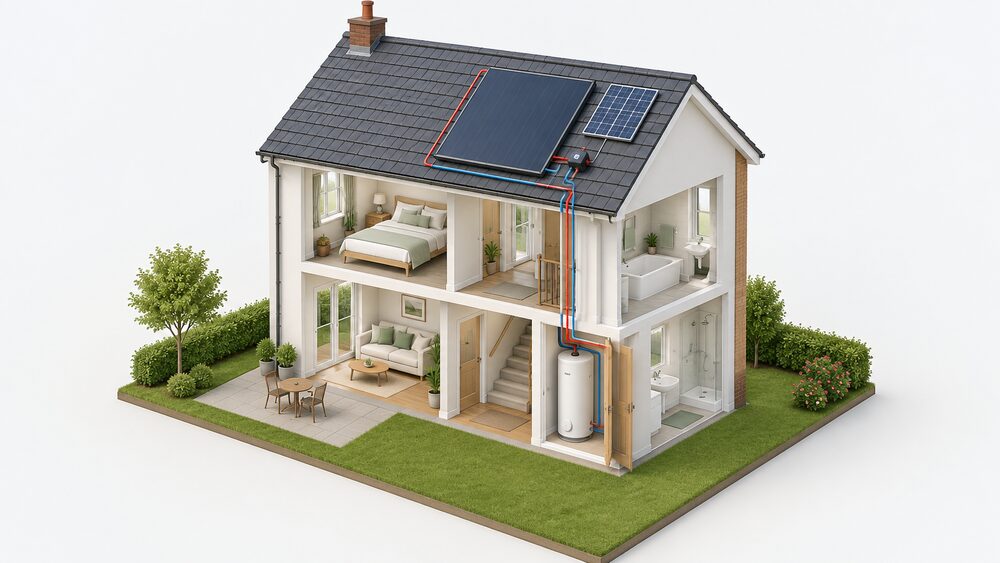
Solartwin is a solar water heating system built around flexible silicone rubber flat plate panels that use drinking quality water directly as the heat transfer fluid, with no glycol and no heat exchanger between panel and cylinder. The maker describes it as an "innovative, zero carbon, polymer-intensive, solar water heating system" and states that the panels "freeze without damage when containing water"1. That single design choice is what separates it from the mainstream solar thermal market, where the collector loop is normally filled with a water and glycol mix specifically to stop the liquid freezing2.
The performance case is the same as any well-designed solar thermal system. Independent guidance puts a well-designed solar heating system at up to 70% of a home's annual domestic hot water needs, with summer coverage reaching 100% in the best months and winter coverage falling to around 25%2. A family-size system may contribute 1500kWh of heat per year5. Solartwin's own published figures are older and narrower, and the company's technical documentation dates from 20071.
What a household gets is a system that removes the glycol loop, the heat exchanger and the mains electrical supply to the pump, and replaces them with a photovoltaic pump and a direct water circuit. What it does not remove is the cylinder, the plumbing, the roof, or the dependence on a conventional boiler or immersion for backup in winter.
What Solartwin is: direct solar water heating without glycol
Solar water heating, also called solar thermal, is the collection of heat from the sun into a fluid and its transfer to a hot water store6. The conventional arrangement uses a sealed collector loop filled with a heat conducting liquid, "usually a mixture of water and glycol to protect the liquid from freezing", which then passes through a heat exchanger to heat the cylinder contents2. The glycol is there for one reason: a water-filled panel on a UK roof in February will freeze and can burst.
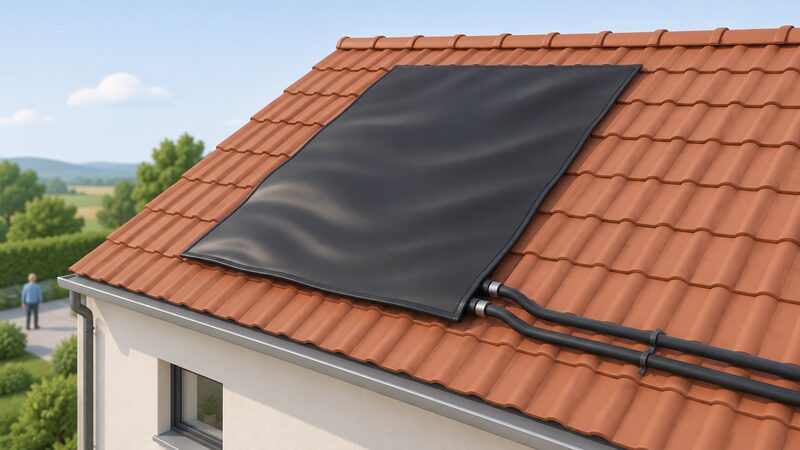
Solartwin's approach is to make the panel itself tolerant of that. The maker states that its panels "freeze without damage when containing water", and that the normal fluid is "drinking quality water, with well controlled hardness"1. The company also states that the system is "drinking water approved at high temperatures" under UK water regulations, and that both direct and indirect water heating options are possible1.
That removes two components from the system: the glycol charge and the heat exchanger. It also removes the periodic glycol replacement that a conventional solar thermal loop needs, and it avoids what the maker calls the "+/- 20% carbon clawback" associated with the conventional approach1. Heat is still stored in a separate cylinder, so the system is not a combi-style instantaneous heater1.
The trade is that the water in the panel is the water in the cylinder, or is in direct contact with the domestic circuit. That makes water quality a design input rather than an afterthought, which is why the maker's own documentation pairs the direct approach with hardness control.
How the freeze-tolerant design works
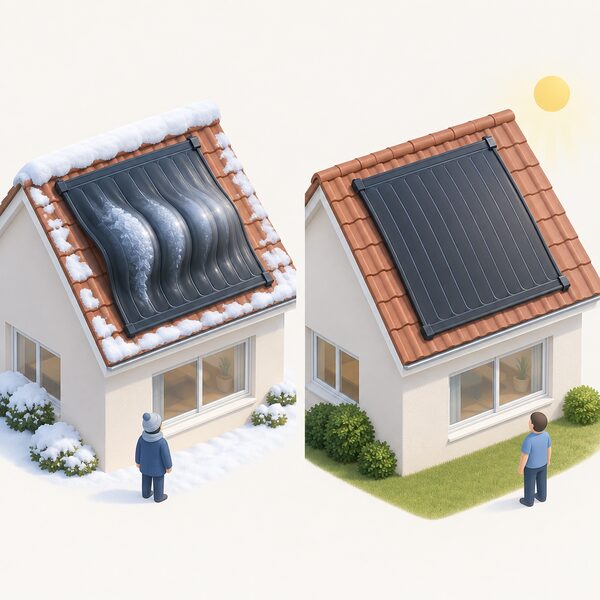
The mechanism is straightforward once the material is understood. A rigid metal absorber with small waterways will crack when the water inside expands on freezing. A flexible silicone rubber absorber can deform with the ice and return to shape when it thaws. The maker's claim is not that the panel avoids freezing, but that it survives it: "panels freeze without damage when containing water"1.
Because the panel is not sealed against a glycol loop, the system can be configured for direct or indirect water heating1. In a direct arrangement the potable water itself circulates through the collector. In an indirect arrangement a separate circuit is used. The maker lists both as options, which matters because the choice determines how much of the domestic water system is exposed to the collector.
The hardness point follows directly from that. The maker states that "robust hardness control may be needed" when water is heated directly, and that the normal fluid is drinking quality water with well controlled hardness1. Heating hard water drives scale out of solution, and scale deposits on the inside of a collector reduce its output and eventually block it. In a glycol-filled sealed loop this is largely a non-issue because the loop fluid is treated and rarely replaced. In a direct system it is a maintenance item.
Multiple panels are always run in parallel rather than in series, and each panel is individually pumped1. Parallel connection keeps the temperature rise across each panel lower, which reduces both scale formation and stagnation temperatures. It also means a single panel failure does not take the array out of service in the way a series string would.
"panels freeze without damage when containing water"
The solar-powered pump: 12 volt PV, no mains electrics
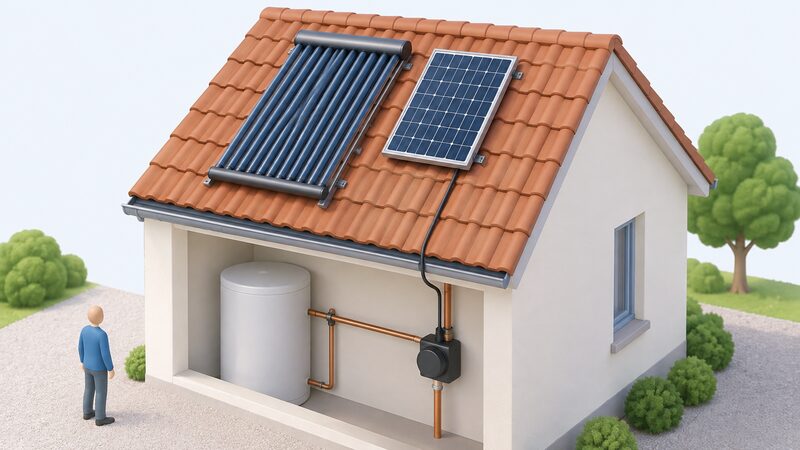
The circulation pump in a Solartwin system is driven by a photovoltaic module rather than by mains electricity. The maker states that the panels are "photovoltaically pumped" and that each is individually pumped1. The practical consequence is that the pump runs when the sun shines and stops when it does not, which is roughly the control logic a solar thermal system needs anyway, achieved without a mains supply to the roof or a controller that has to decide when to switch on.
This is a genuine independence gain at the margin. A conventional solar thermal installation needs a mains feed to the pump station, a controller, a temperature sensor pair and a power supply that keeps running in all weathers. A PV-driven pump needs none of that. The system cannot circulate at night, but it has no reason to.
The wider UK context for small photovoltaic generation is that it is now a mainstream domestic option. Independent guidance puts a plug-in solar system at around 700 kWh generated across the year, with installation from around £450 and no installation cost on some products8. That is a different product from a solar thermal pump, but it illustrates the same principle: a small PV module can drive a small load directly, without an inverter, a battery or a grid connection10.
The limit is that a PV-driven pump gives no control over flow rate independent of irradiance, and no ability to run the pump from the grid during a cloudy but warm spell when the collector is still above cylinder temperature. The maker's design accepts that trade in exchange for removing the electrical installation entirely.
Panel and system specifications
The published specification material is old, and that matters for how it should be read. The technical document carrying the panel and system facts is dated 10 January 20071. The company's installation method statement was updated to version 2010c on 1 September 2010, and a brochure dated 10 January 2012 sets out installed and self-install prices1. Nothing in the material reviewed here is more recent than 2012.
| Attribute | Solartwin specification | Source |
|---|---|---|
| Panel type | Flexible flat plate, silicone rubber based | 1 |
| Heat transfer fluid | Drinking quality water, hardness controlled | 1 |
| Freeze behaviour | Freezes without damage when containing water | 1 |
| Pump | Photovoltaic, each panel individually pumped | 1 |
| Panel connection | Multiple panels always in parallel | 1 |
| Water heating options | Direct or indirect | 1 |
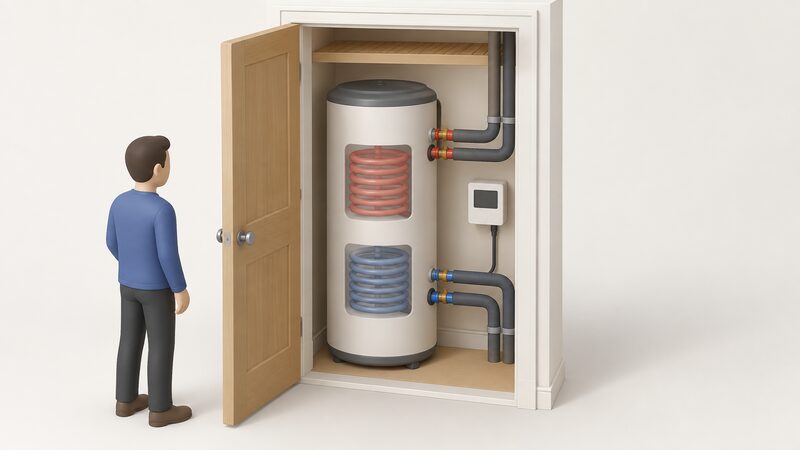
| Heat storage | Separate cylinder | 1 |
| Performance testing | EN 12975 performance report | 1 |
| Water approval | Drinking water approved at high temperatures, UK water regulations | 1 |
The EN 12975 reference is the European standard for solar thermal collectors and systems, and the maker states that the panel has a performance report to it1. That is the document a householder or an installer would want to see before comparing the panel against a glazed flat plate or evacuated tube collector, because it is the only basis on which collector output can be compared like for like.
The absence of a current datasheet is the main practical difficulty. A householder considering the system today cannot verify the current panel dimensions, aperture area, output per panel or cylinder compatibility from the material available, and should ask the supplier for a current EN 12975 test report before committing.
Performance: 1000 kWh a year and 30 to 70% of hot water
The headline performance figures for solar thermal in the UK come from independent guidance rather than from the maker. A well-designed solar heating system can yield an equivalent amount of energy to satisfy up to 70% of a home's annual domestic hot water needs, and in the summer months it may satisfy 100% of that need2. Which? puts the seasonal split at about 90% of hot water needs in summer and 25% in winter4. The Energy Saving Trust gives the same shape: around 90% of hot water requirements in summer, dropping to around 25% in winter11.
A family-size solar water heating system may contribute 1500kWh of heat per year5. That is the figure to hold against the 1000 kWh in the plan: the independent range for a family-size system is around 1500kWh, and the seasonal percentages are the more useful guide for a household trying to judge what a system will actually deliver month by month.
The gap between the summer and winter figures is the whole story of solar thermal in the UK. In June and July a correctly sized system can meet essentially all hot water demand. In December and January it meets roughly a quarter of it, and the cylinder needs backup from a boiler or an immersion heater. The annual average of 30 to 70% is not a steady output; it is a summer-weighted figure that depends on how much hot water the household uses and how well the cylinder is sized to store what the panels collect.
Three things drive where a household lands in that range: the collector area and orientation, the cylinder volume relative to daily demand, and how the backup heating is controlled. A system that lets the boiler reheat the cylinder in the morning will collect less useful solar heat than one that runs the boiler only when the cylinder drops below a usable temperature in the evening.
Costs: installed price, DIY kit and extras

There is no current published Solartwin price in the material reviewed here. The company's brochure dated 10 January 2012 publishes installed and self-install prices for the system, but those figures are more than a decade old and are not reproduced here because they no longer represent what a household would pay1. Prices for solar thermal are installer-quoted, and a householder should expect to obtain a survey and a written quotation rather than work from a list price.
For scale, the wider UK solar market gives some context. A typical solar system can cost around £6,100 to install, and domestic solar panel systems are generally around 4.5 kWp and cost around £7,60013. Those are photovoltaic figures, not solar thermal, and the two products are not interchangeable, but they indicate the order of magnitude of a roof-mounted renewable installation in the current market.
On VAT, the position is not uniform across the UK. Official guidance for Northern Ireland gives a worked example in which an installer charges £5,385 excluding VAT, made up of £3,500 for materials and £1,885 for labour, and notes that because materials are 65% of the total, standard 20% VAT applies to the materials while 5% VAT applies to the labour14. That example concerns solar panels and battery installation, and it illustrates the principle that the VAT treatment depends on the split between materials and labour rather than on the technology alone.
Where a household is considering a self-install route, the comparable UK kit market is worth understanding. Plug-in solar kits typically cost between £500 and £1,000, and kits are likely to include one or two panels, an inverter, mounting equipment, cable and a standard three-pin plug15. A Solartwin self-install kit is a different proposition because it involves plumbing and a cylinder rather than a plug, but the same principle applies: the kit price is only part of the cost, and the labour, cylinder and any electrical or plumbing work sit outside it.
Warranty, installation and what Solartwin asks of owners
The published Solartwin material does not contain a current warranty term. What it does contain is a full installation method statement, updated to version 2010c on 1 September 2010, and a users guide issued in November 2009 covering backup heating timing, insulation, inspection checks, water hardness control and panel cleaning1. Those documents describe what the system asks of an owner in practice.
The maintenance items are the ones the design implies. Water hardness control is the first, because the panel contains drinking quality water and the maker states that robust hardness control may be needed1. Panel cleaning is the second, and it is a general solar maintenance point rather than a Solartwin-specific one: independent guidance notes that some installers require a full service within a specific period to keep the warranty valid17. Inspection of the panel, pipework and cylinder connections is the third.
On installation duration, there is no Solartwin-specific figure. Independent guidance for solar panel systems generally puts a typical installation at one to two days, with larger or more complex jobs taking longer18. A solar thermal installation that involves a cylinder change, plumbing modifications and roof work sits at the longer end of that, and the method statement runs to a full procedure rather than a quick fit.
Registration and paperwork matter for any renewable installation. Independent guidance for plug-in solar systems states that a householder should register the system with the manufacturer to activate any warranty and to be contacted about any problem or safety recall20. The same logic applies to a solar thermal system: the serial number, the commissioning record and the installer's details are what a future warranty claim depends on.
Where Solartwin fits: suitability, water hardness and roof limits
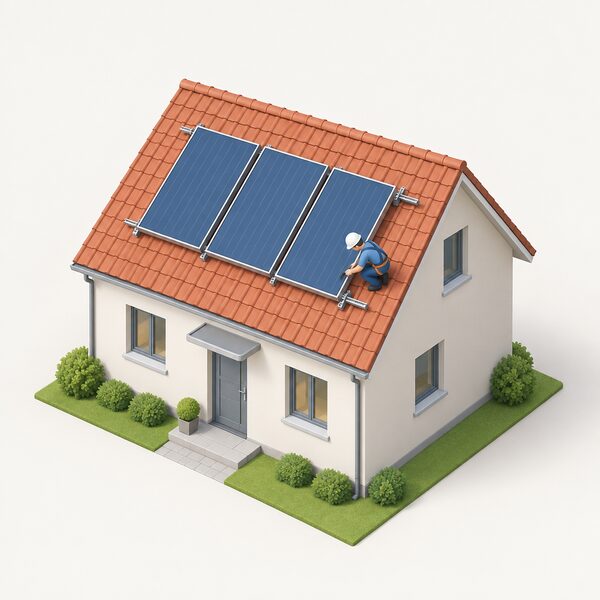
Roof orientation is the first constraint. Official guidance for solar thermal in Northern Ireland states that all solar panels should be mounted on south facing roofs, between south-east and south-west12. Independent guidance for solar generally puts the optimum at directly south, to maximise exposure and generate the most energy, with an unshaded south-facing roof described as ideal21. East and west facing roofs still present a good opportunity and offer good potential for energy generation, though output is lower21.
Roof strength and space are the second. Official guidance states that the roof where the solar collectors are to be installed should be strong enough to support the weight and prevent any safety issues arising6. There needs to be adequate roof space to install the desired array size while leaving the required setbacks from roof edges and ridges21. The number of panels that can be installed may be limited by roof shape, skylights, shading from nearby buildings or trees, local planning or conservation area requirements, and local grid capacity and export limits18. The size of the roof may dictate the type or number of panels that can be installed23.
Water hardness is the third and the most Solartwin-specific. Because the panel uses drinking quality water directly, the maker states that robust hardness control may be needed1. In a soft water area that is a minor maintenance point. In a hard water area it is a design constraint that affects how the system is configured and how often it is serviced.
Flat roofs are workable. Solar panels can be installed on both pitched and flat roofs, and on a flat roof the panels need to be tilted and spaced to avoid shading24. Solar panels can be installed on a flat or sloping roof25. The general principle is that the mounting arrangement changes, not the viability.
For a household weighing energy independence, the position is this. A Solartwin system reduces gas or electricity demand for hot water by a meaningful share in summer and a modest share in winter, and it removes the glycol loop, the heat exchanger and the mains supply to the pump. It does not remove the cylinder, the backup boiler or immersion, the roof, or the need for maintenance. The dependence that remains is on a conventional heat source for the winter months and on the household's own attention to water treatment and cleaning. For the wider picture of how solar thermal compares with photovoltaic generation, see solar thermal vs solar PV and solar water heating.
Sources25 cited
- Solartwin EN 12975 reliability detail, Solartwin, 10 January 2007
- Your home guide to solar water heating, OFTEC, 20 September 2026
- Solar water heating with solar thermal panels, Which?, 15 May 2026
- Could solar water heating work for you, Energy Saving Trust, 20 May 2026
- Solar water heating, Centre for Alternative Technology, 27 June 2025
- Generating your own energy: solar water, Welsh Government
- Renewable heating: what are the options for your home, Energy Saving Trust
- Solar panels, Energy Saving Trust, 27 August 2026
- Plug-in solar panels, Energy Saving Trust, 17 September 2026
- Plug-in solar panels now available, Energy Saving Trust, 27 August 2026
- Solar water heating, Energy Saving Trust, 20 May 2026
- Solar thermal panels, nidirect, 22 October 2024
- Plug-in solar explained, Low Carbon Hub, 9 July 2026
- VAT on energy saving materials, HM Revenue and Customs, 20 September 2026
- Plug-in solar panels, Which?, 15 September 2026
- Plug-in solar, Centre for Sustainable Energy, September 2026
- Solar panel cleaning and maintenance, Energy Saving Trust, 25 August 2026
- Solar panel installation, Energy Saving Trust, 7 September 2026
- Solar power facts, Energy Saving Trust, 13 August 2026
- Plug-in solar consumer guide, Electrical Safety First, August 2026
- What makes a good solar PV roof, Renewables First, 8 April 2026
- Solar panels, London Borough of Hammersmith and Fulham, 17 September 2026
- Renewables and electrics, NICEIC, 17 September 2026
- Solar energy, Solar Energy UK, 17 September 2026
- Switch your home energy supplier, Ofgem, 2026