
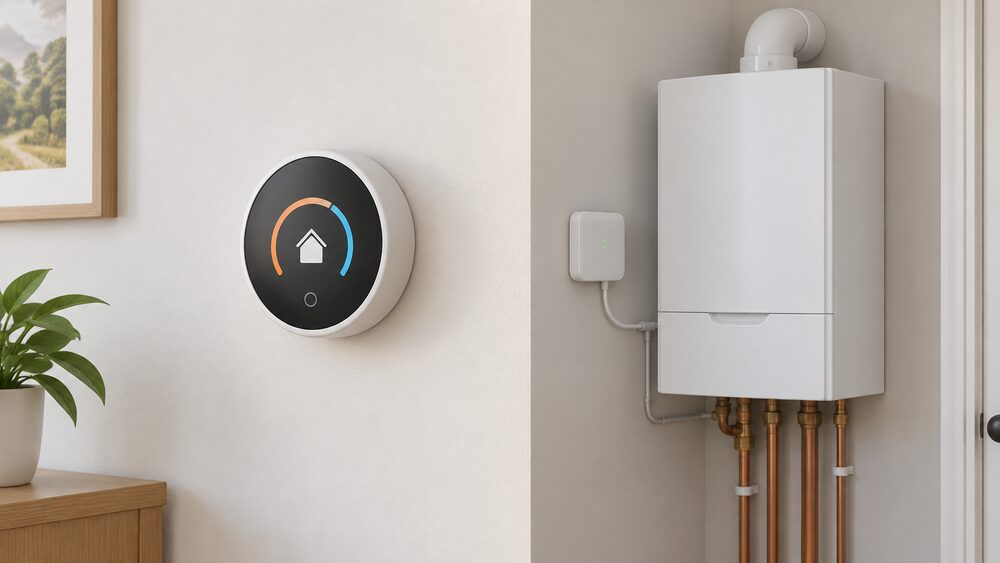
In this guide
Timeguard is a UK maker of programmable thermostats and time controls, the switching and timing side of a heating system rather than the boiler itself. Its products sit in the same market as the controls sold by boiler manufacturers and by specialist control brands: a room thermostat, a programmer or time switch, and increasingly a Wi-Fi model that adds app control on top of the local schedule.
The current line-up is built around wired and wireless programmable thermostats, with the Wi-Fi Room Thermostat as the Wi-Fi model most often quoted in the UK. Two UK prices are given for that unit, £109.85 and £91.54, both dated 17 September 2026, and which of the two applies is unresolved. Prices for this class of control are quoted rather than published as a fixed list, and the VAT position is not stated for either figure.
The discontinued NTTWIFI Wi-Fi time switch is the other model buyers search for, and it is no longer available. Anyone replacing one is choosing between a current Wi-Fi room thermostat and a wired programmable control. What follows sets out what Timeguard makes, how the range divides, what the Wi-Fi models actually do, and what a control of this kind does and does not do for a household's energy independence.
What Timeguard makes: thermostats and time controls
Timeguard's output belongs to a category the trade treats as one thing: time and temperature control. The distinction matters because the two halves do different jobs. A time control decides when the heating runs; a thermostat decides how warm the house gets and when the boiler stops firing. A programmable room thermostat combines both in one device, which is the form most households now buy.
That combination is standard across the market, not unique to any one maker. Vaillant describes its sensoCOMFORT and sensoHOME thermostats as providing both time and temperature control in one device6, and Drayton's MiStat P is described in the same terms, controlling time and temperature1. Ideal Heating sells thermostats, timers and accessories for the full range of its boilers and heat pumps2, and offers time and temperature controls including the Ideal Halo RF4. The pattern is consistent: a control brand supplies the switching and sensing, and the boiler brand supplies its own compatible version.
For a household, the practical question is not what the category is called but what the control replaces. A like-for-like swap is the simplest case, and makers of comparable controls keep older formats in production for exactly that reason. Nu-Heat stocks a selection of dial thermostats and time clocks used in its systems so that they can be replaced like-for-like3. Where the existing control is a simple dial thermostat and a separate time clock, a programmable room thermostat replaces both, and the wiring has to be checked before that is assumed.
Timeguard's own range divides along the same lines as the rest of the market: wired programmable thermostats, wireless models with a receiver at the boiler, and Wi-Fi models that add app control. The next section sets out how those three groups differ in practice.
The range at a glance: wired, wireless and smart models
The market offers programmable thermostats in several physical forms. Netatmo's own guidance lists wired programmable thermostats, wireless programmable thermostats, remote controlled programmable thermostats, fixed programmable thermostats and mobile programmable thermostats6. That list is a useful map for any brand, because the differences are about where the control sits and how it talks to the boiler, not about what it does.
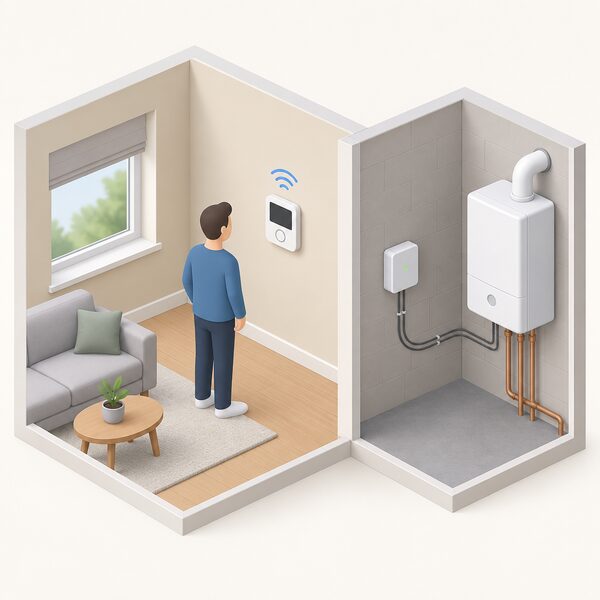
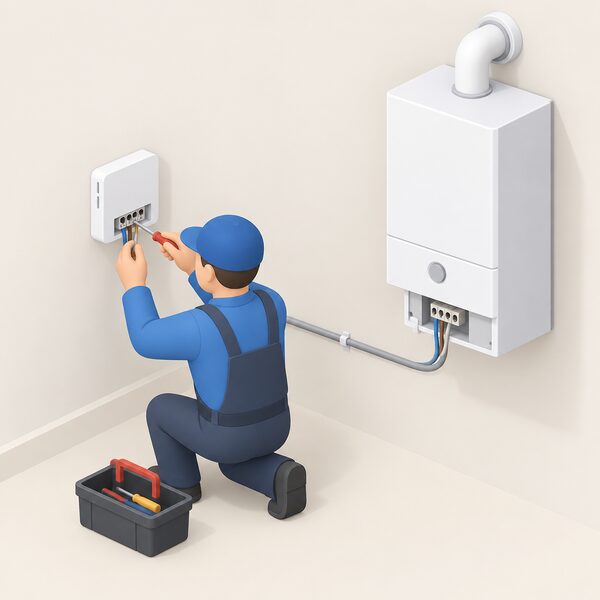
Wired models are installed on a wall and connected to the boiler or wiring centre by cable. Wireless models split into two parts: a thermostat that can be sited anywhere within radio range, and a receiver wired to the boiler. The thermostat sends a signal to the receiver, which tells the boiler when to turn the heating on or off, with no direct wired connection between thermostat and boiler4. That is what makes a wireless thermostat more flexible to site than a wired one, and it is also why the receiver still has to be installed by someone competent to work on the boiler's wiring.
Smart models add connectivity on top. A smart thermostat connects to Wi-Fi, which allows it to form part of a more connected home heating system4, and it is worth being precise that a wireless thermostat is not always smart: smart thermostats usually add app control, internet connectivity, automation or other connected features4. Depending on the model, a smart thermostat may offer app control, voice control, hot water settings, location-based heating, reminders or alerts, open window detection, routine learning and heating-use tracking4.
| Control type | Where it sits | How it reaches the boiler | App needed |
|---|---|---|---|
| Wired programmable | Fixed to a wall | Direct cable | No |
| Wireless programmable | Anywhere in radio range | Receiver wired to the boiler4 | No |
| Wi-Fi smart | Anywhere in radio range | Receiver wired to the boiler4 | Yes, for remote features |
Some smart, wireless models can also be used to control hot water as well as heat7, which matters in homes with a cylinder rather than a combi. For a fuller account of how these categories divide, see room thermostats and heating programmers, timers and time switches.
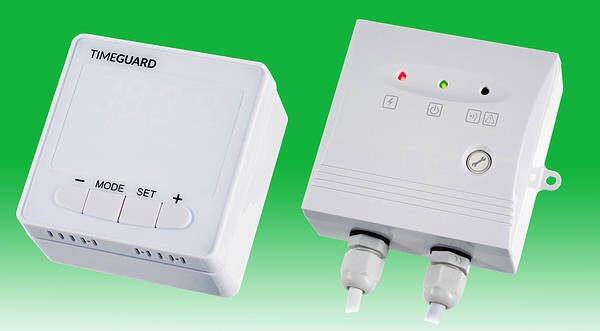
TRTWIFI Room Thermostat: specification and price
The TRTWIFI Room Thermostat is the Timeguard model most often quoted in UK listings, and it is the one a household is most likely to be comparing against other Wi-Fi controls. Two distributor listings give different prices for it, £109.85 and £91.54, dated 17 September 20261.
That places it in the middle of the Wi-Fi thermostat market rather than at the bottom of it. For comparison, Which? lists a Habi Wireless Smart Thermostat at £62 from Screwfix and a Google Nest Thermostat E at £1998. Herschel's mains-powered Wi-Fi thermostat is listed at £89.00, its plug-in Wi-Fi thermostat at £79.00, its iQ T2 Wireless Thermostat Pack at £69.00 and its SmartLED mains thermostat at £102.009. Those are maker and retailer figures for different products with different capabilities, so they set a context rather than a like-for-like comparison.
What the TRTWIFI buys is a Wi-Fi room thermostat with a receiver, in the same functional class as the rest of the Wi-Fi controls above. The specification that matters for a household is not the badge but three things: whether the receiver can be wired to the existing boiler, whether the schedule can be set locally as well as in the app, and whether the model is current. On the last point, the NTTWIFI is not, and that is covered below.
Smart controls and the app: what Wi-Fi models do
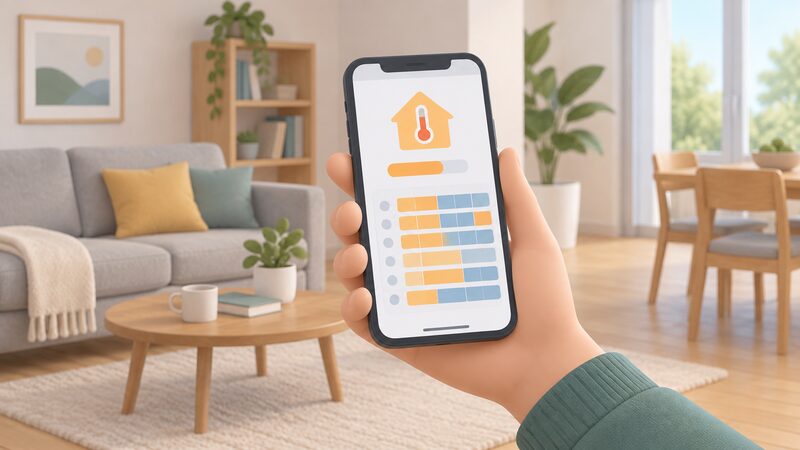
A Wi-Fi thermostat does two separate things, and it is worth keeping them apart. The first is local control: the schedule and the setpoint live in the device, and the boiler is switched by the receiver regardless of whether anything is connected to the internet. The second is remote control: the thermostat connects to Wi-Fi so that the heating and hot water can be controlled through a smartphone, tablet or desktop11.
The remote half is what most buyers are paying for, and it is also where the dependence sits. Smart room thermostats are operated using Wi-Fi and a smartphone app7, and the app is the interface for anything done away from the wall unit. Herschel's Wi-Fi thermostats, for example, use Smartlife app control9, and its Smart2.0Pro is described as a mains or USB powered thermostat with Wi-Fi and app control, while the Smart2.0 is a battery-operated, non-Wi-Fi wireless thermostat12. The distinction between a wireless thermostat and a Wi-Fi one is exactly this: radio to the receiver in both cases, internet to the app in only one.
For a household, the practical consequences are straightforward. Remote scheduling, energy monitoring and any app-based features depend on a working broadband connection, the manufacturer's servers and the manufacturer's app continuing to be supported. Local scheduling at the unit does not. Where a control is bought mainly for the app, the support position of the maker matters as much as the hardware, and that is a question worth asking before purchase. The wider picture is set out in smart thermostats and in smart heating controls: security, data and product support.
Discontinued models: the NTTWIFI and what to choose instead
The Timeguard NTTWIFI Wi-Fi time switch has been discontinued, and the product page states that it is no longer available2. That is the position a buyer needs to know before searching for one: units may still circulate through trade counters and online sellers, but there is no current production, and support and spares for a discontinued control cannot be assumed.
Discontinuation is normal in this market and not a reflection on the product. Warmup lists its TSTAT Flap as a discontinued thermostat13, and resol lists a thermostat controller as no longer available14. What matters for a household is what happens next. A discontinued control that fails is replaced rather than repaired, and the replacement has to be compatible with the wiring already in the house.
Two routes follow. The first is a current Wi-Fi room thermostat, which brings app control and a receiver at the boiler. The second is a wired programmable thermostat, which keeps the schedule local and avoids the app dependence entirely. Both are legitimate; the choice turns on whether remote control is wanted and whether the existing wiring suits a receiver.
There is a wider lesson in the NTTWIFI's status that applies to any connected control. A Wi-Fi thermostat is a piece of hardware plus a service, and the service can end before the hardware does. Google's withdrawal of support for older Nest thermostats is the clearest recent example, though Which? reports that other Nest models sold in the UK, including the Nest Learning Thermostat 3rd gen from 2015 and the Nest Thermostat E from 2018, are unaffected and will continue to receive security updates15. The point is not that any particular maker is unreliable, but that the app half of a smart control has a support life of its own. That is covered in more detail in Google Nest thermostats in the UK.
Where Timeguard sits among UK thermostat brands
The UK thermostat market divides into three groups, and Timeguard sits in the middle one. The first group is the boiler manufacturers, who sell controls designed for their own appliances: Ideal Heating offers thermostats, timers and accessories for its boilers and heat pumps2, and Vaillant's sensoCOMFORT and sensoHOME provide time and temperature control in one device6. The second group is the independent control brands, which sell controls that work across a range of boilers. The third is the specialist heating categories, such as underfloor heating and infrared, where the control is sold as part of a system.
The independent group is where most of the price competition sits. Which? lists a Habi Wireless Smart Thermostat at £62 and a Google Nest Thermostat E at £1998, and Herschel's Wi-Fi and wireless thermostats run from £69.00 to £102.00 across its range9. Those figures span a wide band for products that all do broadly the same job, and the differences are in build, app, support and the number of features rather than in the basic switching function.
Compatibility is the practical dividing line. A control sold by a boiler maker is guaranteed to suit that maker's appliances: Vaillant's timeSWITCH 150 is described as compatible with all Vaillant combi boilers16, and the ecoTEC sustain combi range is listed as compatible with the wide range of Vaillant room thermostats, wired and wireless17. An independent control has to be checked against the boiler instead, which is why the receiver and its wiring are the part of the installation that decides whether a given model will work.
For a household, that means the brand question is secondary to two others: whether the control's receiver can be wired to the existing boiler, and whether the schedule can be set and kept locally. A control that satisfies both is doing the job regardless of whose name is on the front. Comparisons across the main brands are collected under heating controls, and the wired versus wireless question is set out in wired vs wireless room thermostats.
What a Timeguard control means for household energy independence
A heating control is the part of a heating system a household actually operates, and its contribution to independence is real but bounded. Room thermostats and heating controls allow a household to set and maintain the temperature in the home, keep it warm for the times of day people are there, and switch it off to save electricity when they are not18. A smart thermostat controls heating and helps manage how the central heating is set and adjusted4. That is the benefit: the household decides when heat is produced, rather than leaving it to a fixed pattern or a manual switch.
The dependence that remains is worth stating as plainly. A control does not change the fuel. A gas boiler still needs gas from the grid and a supplier, and a control that switches it does not alter that. A Wi-Fi model adds a second dependence on top: broadband, the maker's servers and the maker's app, for as long as the maker supports them. Local scheduling at the unit survives a broadband outage; remote scheduling does not.
There is one point in the household's favour. A thermostat helps control how much energy is used, but it will not be a barrier to switching the actual energy deal19, so the control does not lock a household to a supplier. Controls also support measures that go further: time and temperature zone control allows the heating times of at least two zones to be programmed independently, as well as having independent temperature control20, and heating appliances with their own thermostatic controls allow a conservatory's temperature to be controlled separately from the rest of the house21. Standalone electric heaters tend to be more energy efficient if they have thermostatic controls, with a separate plug-in thermostat available as an upgrade22.
The honest summary is that a Timeguard control, like any other, gives a household command of when and how warm the house is, and that command is worth having. It does not give independence from the gas grid, from a supplier, or, on a Wi-Fi model, from the manufacturer's app. The wider argument is set out in heating controls and energy independence.
Sources22 cited
- MiStat P discontinued, Drayton Controls, 2025-08-26
- Ideal Heating controls, Ideal Heating, 2026-09-17
- Omnie Home Thermostat wireless, Omnie, 2026-09-17
- Boiler Plus installer support, Ideal Heating, 2026-09-17
- Omnie Home Thermostat 230V, Omnie, 2026-09-17
- Controls and frost protection, Vaillant, 2026
- IT700 Smart Thermostat, Salus Controls, 2026-09-20
- ECO4 Measures Table v4.0, Ofgem, 2025-07-29
- What is a smart thermostat, Smart Energy GB, 2026-03-16
- Heating controller guide, Netatmo, 2026-09-20
- Wireless thermostat guide, Netatmo, 2026-09-20
- How to buy the best smart thermostat, Which?, 2026-09-17
- Do I already have a smart meter, Smart Energy GB, 2026-09-20
- T-PL plugin thermostat, Herschel Infrared, 2026-08-26
- Room thermostat guide, Netatmo, 2026-09-20
- Mirror infrared panel heater MD Plus series, SunDirect Heater, 2026-09-20
- iQ T2 wireless thermostat pack, Herschel Infrared, 2026-08-26
- TSTAT Flap, Warmup, 2026-09-20
- Select XLS LED front lit infrared panel heater, Herschel Infrared, 2026-08-26
- Google withdrawing support for older Nest thermostats, Which?, 2025-05-13
- Make winter feel summer, Home Energy Scotland, 2026-09-20
- Energy efficient heaters, Uswitch, 2026-07-01
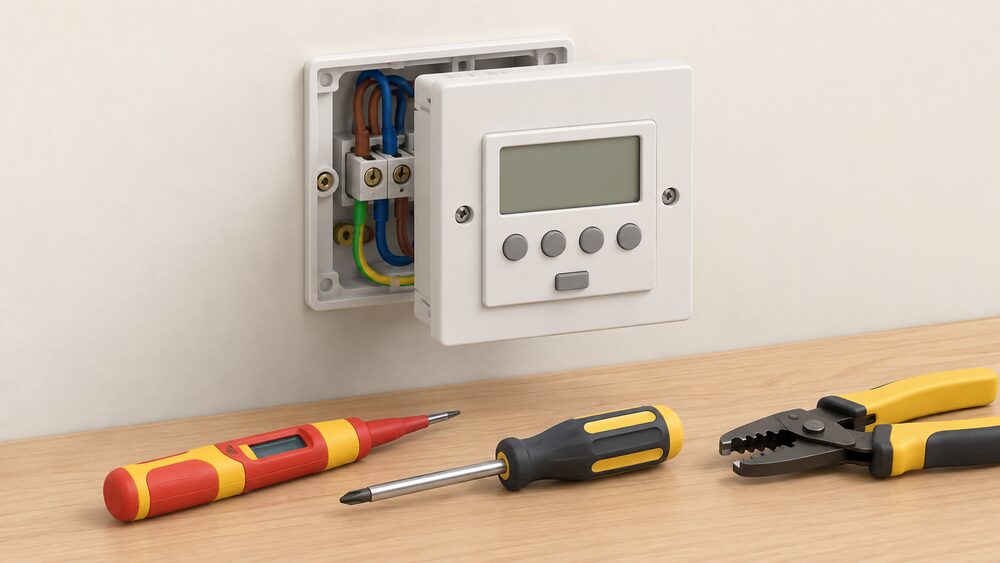 Timeguard Smart Timers and Connected ControlsTimeguard smart controls are WiFi connection units, timers and light controls for UK homes, fitted by a qualified electrician and dependent on an app for remote access.