
In this guide
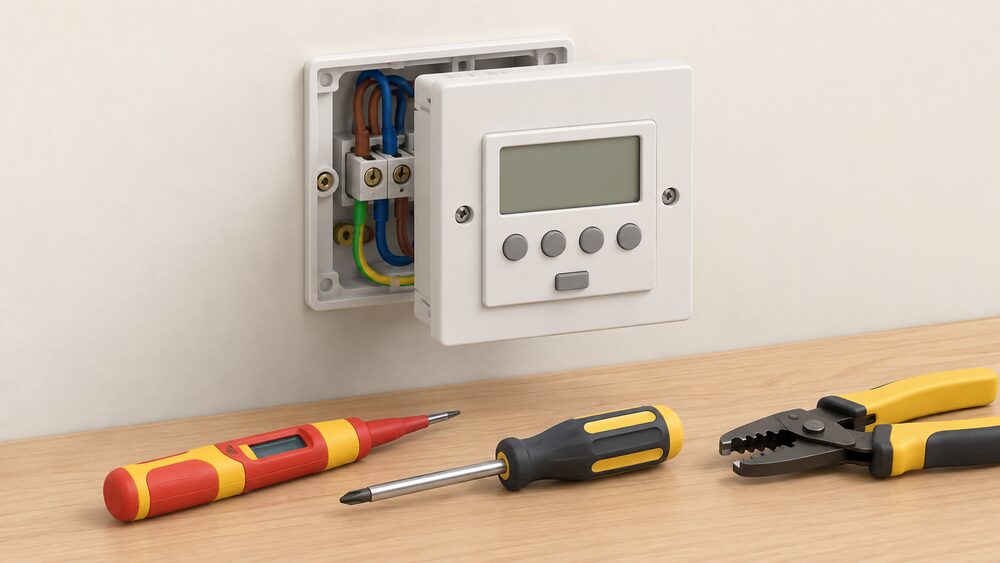
Timeguard is a UK maker of wiring accessories whose consumer-facing range covers WiFi connection units, time switches and light controls: the kind of device that switches a circuit to a schedule and, on the connected models, lets a household change that schedule from a phone. The controls sit on the fixed wiring of a home rather than on the meter, so they work alongside a smart meter rather than replacing any part of it.
The reason timing controls matter to a household's energy position is the tariff structure they can exploit. Smart meters enable time-of-use tariffs, where electricity used at different times is charged at different amounts1, and having one lets a household take advantage of advanced time-of-use tariffs2. Smart meters also enable innovative tariffs including time-of-use products3, which are the new generation of tariffs enabled by smart meters4. A timer that shifts a load into a cheaper window is the simplest way to act on that.
What Timeguard controls do not do is generate anything. They switch and schedule existing loads, so the home remains dependent on the grid, on a supplier and, for the connected models, on a WiFi network and the maker's app. This page sets out the range, the smart features, compatibility, installation limits, warranty position and what the controls mean for independence.
What Timeguard smart controls are and the range at a glance
Timeguard's consumer range divides into three jobs: switching a circuit on a clock, sensing temperature and calling for heat, and controlling lighting. The connected models add a WiFi connection unit that puts the schedule on a phone. That is the same architecture the wider controls market uses. A wireless boiler control connects to your devices via WiFi, so the boiler's temperature and timings can be controlled from a phone10.
The distinction that matters when reading any Timeguard listing is between a timer and a thermostat. Timers and thermostats can be combined in a single device to control what temperature a boiler heats to at different times10, and the market has moved steadily towards that combination. Ideal Heating, for example, provides thermostats, timers and accessories for the full range of its boilers and heat pumps11, which is the pattern most makers now follow.
For a household, the practical question is which circuit the device sits on. A timer on an immersion heater, a storage heater or an outdoor lighting circuit is doing load shifting. A timer on a boiler's heating circuit is doing comfort scheduling. The two have different paybacks and different wiring requirements, and the second usually needs a thermostat in the chain as well.
The product families: timers, thermostats and light controls
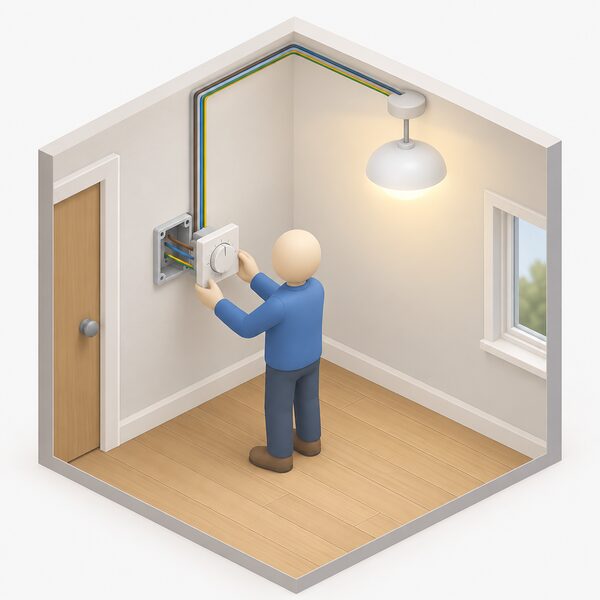
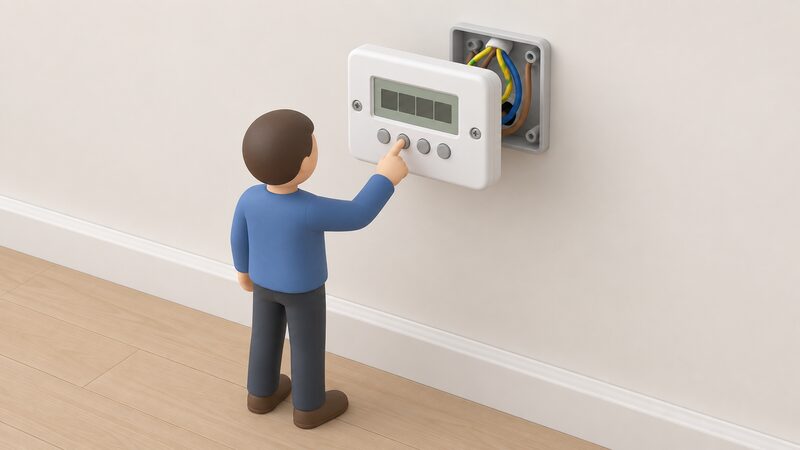
Timers are the core of the range: units that hold a weekly or daily programme and switch a circuit accordingly. They are used on heating, hot water, ventilation and outdoor lighting, and the wired versions replace an existing wall switch or sit in a consumer unit enclosure.
Thermostats and heating controls form the second family. The wider market shows what these now include. Modern storage heaters offer thermostats, remote wi-fi controls, programmable timers, fans to help disseminate the heat and open window detectors12. Smart thermostats can be programmed or remotely controlled to manage a home's temperature13, and most allow multiple routines so the home sits at the desired temperature at the right times13. Depending on the model, a smart thermostat may offer app control, voice control, hot water settings, location-based heating, reminders or alerts, open window detection, routine learning and heating-use tracking14.
Light controls are the third family. Smart LED bulbs can be set to timers and dimmed, brightened or have their colour changed15, and the same scheduling logic applies to a wired light control: the circuit runs to a programme rather than to a switch. Official guidance for self-build homes recommends installing smart systems that control lighting, heating and cooling based on occupancy and time of day16, which is precisely the function this family performs.
| Family | Typical job | What it switches |
|---|---|---|
| Time switches and timers | Schedule a circuit | Immersion, storage heater, lighting, heating circuit |
| Thermostats and heating controls | Hold a temperature to a programme | Boiler or heat pump call for heat |
| Light controls | Schedule and dim lighting | Lighting circuits and lamps |
Smart features: app control, programming and overrides
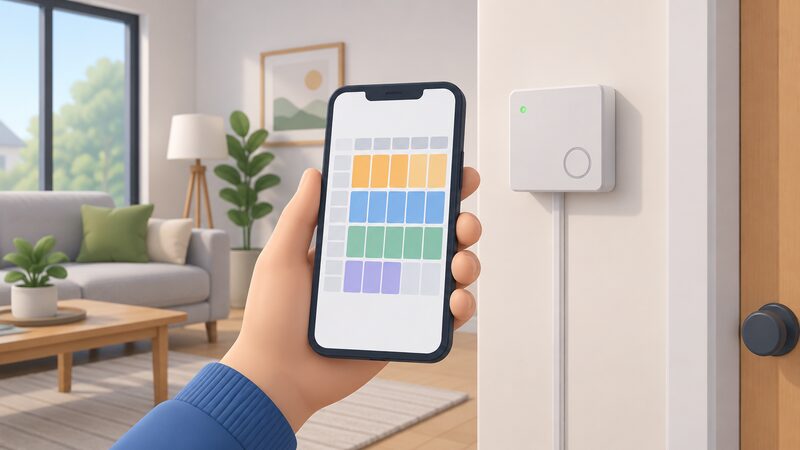
The connected models add three things to a plain timer: a phone interface, a programme that can be edited without touching the unit, and some form of override. Smart heating controls let a household access temperature settings using a mobile app2, and most smart heating controls link to a phone, with heating controllable via smartphone, tablet or laptop, or by telling a smart speaker what is wanted6.
Voice control is not universal. It applies to compatible assistants such as Alexa, Google Assistant or Siri, depending on the product7. Where a Timeguard unit supports one of these, the voice route runs through the same cloud account as the app, so it adds a dependency rather than removing one.
The programming side is where the energy benefit sits. Some smart controls learn household routines or allow more detailed room-by-room temperature management17, and zone controls can enable independent programming of temperature and heating times in at least two different areas or zones of a premises18. A single timer on one circuit cannot do that; it can only move that circuit's running hours.
Compatibility with UK heating systems and wiring
Compatibility splits into two questions: whether the control can switch the appliance, and whether it can talk to it intelligently. On the first, a timer is a switch. It interrupts or makes a circuit, and it does not care what is on the other end as long as the load is within its rating. That is why timers appear on immersion heaters, storage heaters and lighting as readily as on heating.
On the second, the boiler makers have their own ecosystems. The Vaillant ecoTEC sustain combi range is compatible with the wide range of Vaillant room thermostats and wired and wireless controls19, and the ecoFIT sustain range is compatible with Vaillant's intelligent range of controls20. Baxi's AmbiZen Smart Control is compatible with its air source heat pumps, boilers and cylinders21. Honeywell Home smart heating controls are designed to work with both boiler and heat pump systems17. A third-party timer sits outside those ecosystems: it can switch the circuit, but it will not give the boiler the modulating signals a manufacturer's own control provides.
For a combi boiler specifically, the heating circuit is normally controlled by the boiler's own thermostat and programmer connections rather than by a separate time switch on the supply. Whether a Timeguard unit can be used, and how, depends on the boiler's switching arrangement and is a question for an electrician or heating engineer looking at the actual installation.
Installation: who can fit what, and where the limits are
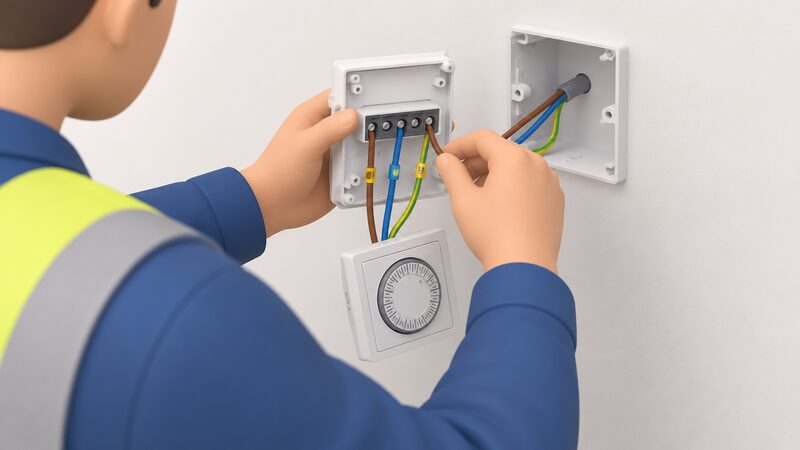
Timeguard controls are fixed-wiring products. They sit inside a wall box or an enclosure on a circuit that is part of the installation, which puts them in the territory of a qualified electrician rather than a plug-in accessory. The comparison is instructive: a smart plug needs no tools, while a wall-mounted timer requires the circuit to be isolated, the conductors identified and the unit tested after fitting.
The wider market shows how installation is being simplified where makers want it to be. Baxi's AmbiZen Smart Control offers wireless, cable-free installation with plug-and-play setup that installers can fit in minutes21. That is a heating control designed to avoid new cabling. A wired timer has no such shortcut.
Where a control is fitted as part of a funded energy efficiency measure, the certification rules apply. Installers can only hold one PAS 2030 certification for each type of measure22, which is a tightening of the rules governing who may install what under such schemes. For a household, the practical points are these:
- Fixed-wiring work on a timer or light control is electrician work, not a DIY swap.
- Any work on the meter, the supply or the consumer unit's incoming side is not householder territory.
- Electrical substations and similar network equipment should only be entered by trained staff23, and the network operator's emergency line is staffed 24 hours a day23.
- Where a device is being fitted alongside a smart meter installation, the meter installer will show a photo ID card before starting24, and smart meters are fitted by trained installers who have passed formal qualifications set out in the Smart Metering Installation Code of Practice1.
Reliability, warranty and support
Warranty terms for controls vary widely across the market, and the range is worth knowing when comparing any unit. At the long end, one smart thermostat carries an unreplaceable battery with a twelve-year manufacturer's warranty25, and a solar array with its system components can be covered over at least a 25-year period25. Those are the extremes. A wiring accessory such as a timer is normally covered for a shorter period, and the terms are set out in the documentation supplied with the unit.
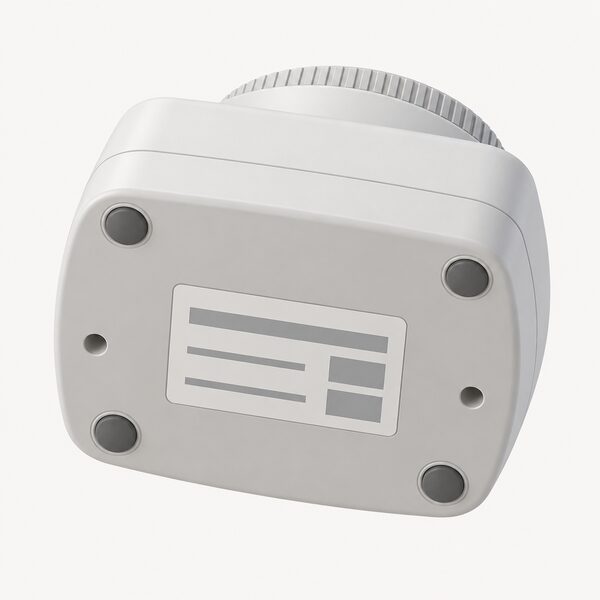
Two practical points follow. First, the model and serial number are needed for any warranty claim or support call. On comparable UK electrical products the identifying code sits on the product rating label, often on the underside of the casing26. Second, the warranty covers the device, not the installation: a fault traced to the wiring rather than the unit is a different matter.
Support for faults runs through the maker's technical line for the product itself. For anything involving the fixed wiring, the supply or signs of overheating at the unit, the network operator is the correct contact, and that line is staffed 24 hours a day23. Energy suppliers also maintain support arrangements for customers in difficulty with bills27, which is a separate route from a product fault.
What Timeguard controls mean for household energy independence
The honest position is that a timer is a load-shifting device, not a generating one. It changes when a home uses power, not whether it buys that power from a supplier. The grid connection, the supplier relationship and the meter all remain.
What it does deliver is control over timing, and timing is where money and carbon are increasingly decided. Smart meters provide real-time information about a household's energy use, helping customers avoid wasting energy and getting estimated readings and bills28, and the data they produce puts a household in control of its energy usage, so energy-saving steps can be taken to reduce CO2 emissions29. Smart meters also allow suppliers to offer incentives to households that can reduce energy use during peak hours, helping to balance supply and demand and reduce pressure on the grid30. A timer that moves a load out of the peak is one way to respond to that.
The dependence that remains is worth stating plainly. A connected Timeguard control depends on the home's WiFi, on the maker's app and servers for remote functions, and on a continuing supply of electricity to the circuit it controls. Local scheduling survives a broadband outage; remote scheduling does not. For a household weighing independence, the controls are a useful layer on top of a smart meter, and the wider picture is set out in Smart Meters and Home Energy Management, with the tariff side covered in Smart Meters and Time-of-Use Tariffs and the cloud question in App Subscriptions and Cloud Dependence.
Sources30 cited
- What is a smart meter?, Smart Energy GB, 2026-08-10
- Guide to smart meters, Energy Saving Trust, 2026-07-15
- Smart meters, MCS Certified, 2026-07-24
- Should I switch to a time of use tariff?, Energy Saving Trust, 2026-01-23
- Gas meters and electricity meters: what you need to know, Which?, 2026-01-16
- Smart heating controls: what they do and why they matter, BEAMA, 2025-04-07
- What are smart plugs and do energy saving plugs work?, Smart Energy GB, 2026-08-19
- Smart thermostats: how to buy the best, Which?, 2026-09-17
- Timeguard NTTWIFI WiFi time switch, Tradesparky, 2026-09-17
- Heating controls, Ideal Heating, 2026-09-17
- New smart control from Baxi simplifies wireless installation for installers, CIPHE, 2026-05-12
- Dimplex Quantum night storage heaters, Centre for Sustainable Energy, 2026-06
- How a smart thermostat can save you money this winter, ivie, 2025-11-18
- What is a smart thermostat?, Smart Energy GB, 2026-08-19
- Energy saving lightbulbs, Uswitch, 2025-01-14
- Self-build homes: sustainability, Planning Portal, 2026
- Smart heating zoning and training take centre stage at InstallerSHOW 2026, CIPHE, 2026-06-09
- ECO4 new measures and products guidance, Ofgem, 2026-03-26
- Vaillant ecoTEC sustain combi boilers, Quiet Mark, 2026-09-17
- Vaillant ecoFIT sustain combi boilers, Quiet Mark, 2026-09-17
- Boiler controls, Worcester Bosch, 2026-09-17
- Reforming consumer protection for home upgrade schemes, GOV.UK, 2026-06-17
- What is an electrical substation?, UK Power Networks, 2026-09-17
- Getting a smart meter installed, Smart Energy GB, 2026-03-16
- ECO4 innovation approved innovation measures, Ofgem, 2026-02
- Safeguard+ electric shower product recall, Electrical Safety First, 2026-09-17
- Support with energy bills, Energy UK, 2026
- Ultimate energy saving tips guide, Smart Energy GB, 2025-09-03
- Smart meters and decarbonisation, Smart DCC, 2026
- How does tidal energy work and how could it impact your energy use?, Smart Energy GB, 2026-08-19
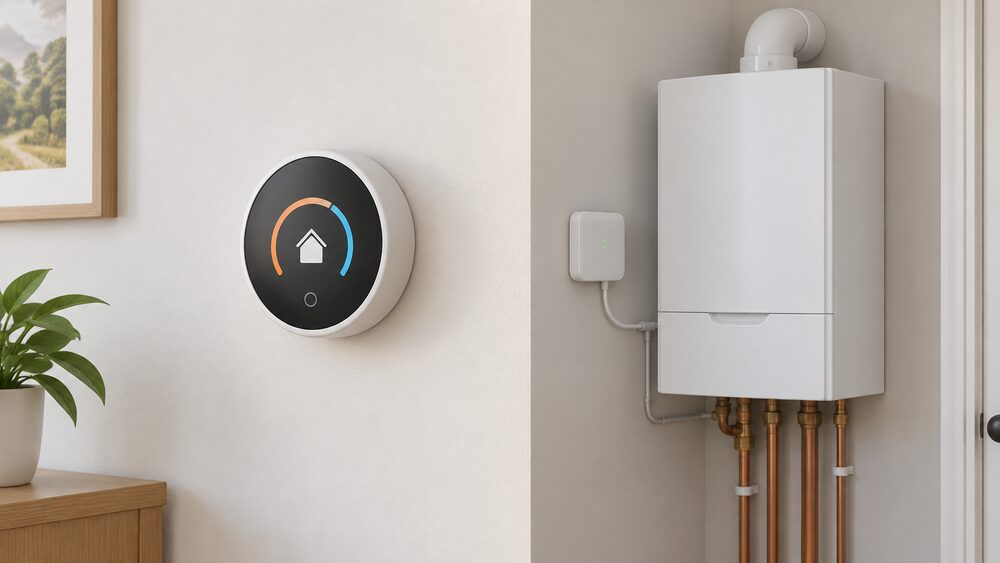 Timeguard Thermostats and Time ControlsTimeguard makes thermostats and time controls that switch your heating on and off, rather than boilers themselves.