

In this guide
SSE Airtricity is Northern Ireland's second largest electricity supplier and one of five domestic electricity companies in the province, alongside Budget Energy, Power NI, Click Energy and Share Energy1. It also sells gas in Greater Belfast and the Gas to the West area, where its tariffs are regulated and must be approved by the Utility Regulator before they change3. For a household, that dual position matters: electricity is a competitive market, gas is a controlled one.
The headline numbers for autumn 2026 are a 6.2% electricity tariff increase announced on 3 July 2026 and effective from 1 August, adding around £76 a year, and a 19.2% gas increase announced on 28 August 2026 and effective from 1 October, affecting around 204,000 domestic gas customers1. On the Home Energy Tariff, the unit rate is 10.230p for the first 2,000 kWh and 7.010p after that, with an annual cost of £906 using 12,000 units6.
Fixed-term discounts are the main lever a household can pull. The 1 Year Home Electricity deals range from a 2% discount with a £60 welcome credit to a 15% discount, and the best-priced of them comes in at £1,109 a year using 3,200 units against £1,305 on the standard 24hr rate3. Every one of those discounts is a reduction against SSE Airtricity's own standard rate, not a comparison with any other supplier.
SSE Airtricity: who they are and where they operate
SSE Airtricity is a Northern Ireland supplier, not a Great Britain one. The Consumer Council lists five domestic electricity companies in the province, and SSE Airtricity is one of them2. Its gas business is narrower still: it supplies Greater Belfast and the Gas to the West area, and the Utility Regulator must approve its gas tariff changes before they take effect3. That regulatory gate is the single biggest structural difference between the two fuels for this supplier.
The company also runs official energy efficiency delivery. SSE Airtricity Energy Services NI Ltd is the scheme manager for Energy Plus Provincewide and for the Housing Association Efficient Electric scheme, both funded through the Northern Ireland Sustainable Energy Programme7. That work sits alongside the supply business rather than inside it, but it means the same corporate name appears on grant-funded insulation and heating measures as on bills.
Ownership sits within the SSE group, which also operates the SSE brand in Great Britain. The two are separate supply operations: SSE Airtricity's domestic customers are in Northern Ireland, and the group's Great Britain domestic supply business has been run under the OVO group since 20209. For a householder, the practical consequence is that switching advice, price cap coverage and consumer protections differ depending on which side of the Irish Sea the meter sits.
Scale is real but not dominant. SSE Airtricity is described as Northern Ireland's second largest electricity supplier1, and its gas arm serves around 204,000 domestic customers1. In a 2021 Which? customer satisfaction survey it placed third for gas in Northern Ireland and joint fifth for electricity, so market size and customer sentiment do not track each other10.
The tariff range: Home Energy Tariff and fixed-term discount options
SSE Airtricity's electricity range splits into a standard variable product and a set of one-year fixed-term discounts. The Home Energy Tariff is the default: a two-tier unit rate with no fixed term, available on Direct Debit or pay on receipt of bill6. The fixed deals apply a percentage discount to the standard unit rate for twelve months, and the size of that discount is the whole product.
The published discounts run from 2% to 15% on 24hr meters, with several carrying a £60 welcome credit3. On Economy 7 meters the discounts run from 2% to 13%, with day and night rates quoted separately4. Keypad versions carry their own discounts, up to 10.5% with a £30 welcome credit, and are restricted to new customers3.
| Tariff | Discount | Unit rate | Annual cost (3,200 units) |
|---|---|---|---|
| Standard Rate 24hr | none | 40.790p | £1,3053 |
| 1 Year Home Electricity | 15% | 34.670p | £1,1093 |
| 1 Year Home Electricity | 13% | 35.490p | £1,1363 |
| 1 Year Home Electricity | 10% plus £60 credit | 36.720p | £1,1753 |
| 1 Year Home Electricity | 9% | 37.120p | not stated3 |
| 1 Year Home Electricity | 8% plus £60 credit | 37.530p | £1,2013 |
| 1 Year Home Electricity | 2% plus £60 credit | 39.970p | not stated3 |
Two conditions sit on the fixed deals. The 15% tariff is available only to new customers, and the 13% tariff carries a £40 early exit fee3. The 13% deal started on 1 August 2026, and the 15% deal carries the same start date3. The £60 welcome credit on the 2% tariff must be redeemed within one year3.
For a household, the fixed-term structure is the main decision. A discount against a supplier's own standard rate is not the same as a cheap tariff in absolute terms: the standard 24hr rate is 40.790p, so even the largest discount leaves a unit rate above 34p3. Comparing against other Northern Ireland suppliers is covered in energy tariffs in Northern Ireland, and the general mechanics of fixed terms are set out in fixed-rate energy tariffs.
Electricity unit rates and what a typical bill costs
The Home Energy Tariff uses a two-tier structure rather than a flat rate. The first 2,000 kWh in a quarter is charged at 10.230p per unit and everything after that at 7.010p, on both Direct Debit and pay on receipt of bill6. That is unusual by Great Britain standards, where a single unit rate plus a standing charge is the norm, and it means the effective rate falls as consumption rises.
The published annual cost on that tariff is £906 using 12,000 units6. The fixed-term comparison figures use a different consumption basis, 3,200 units, which is why the numbers are not directly comparable: the standard 24hr rate comes out at £1,305 on 3,200 units, and the 15% discount deal at £1,109 on the same basis3. A household reading both sets of figures needs to check which consumption assumption sits behind each.
Economy 7 rates are quoted separately. The 13% fixed deal lists a day rate of 36.180p and a night rate of 18.470p, while the 10% deal with a £60 credit lists 37.430p by day and 19.280p at night4. The 2% deal lists 40.760p by day and 20.100p at night4. The spread between day and night rates is roughly double, which is what makes overnight loads worth shifting. The mechanics of that are covered in Economy 7 tariffs.
Pay As You Go is priced differently again. The PAYG unit rate is listed at 7.443p per unit for the first 2,000 kWh and after it, which is a flat rate rather than the two-tier structure on credit tariffs6. Prepayment customers therefore pay a different shape of tariff, not simply a higher version of the same one. Prepayment rules generally are covered in prepayment and pay as you go tariffs.
Price changes: the 6.2% electricity rise and the 19.2% gas rise
Two increases landed in the second half of 2026. The electricity rise of 6.2% was announced on 3 July 2026 and took effect from 1 August, adding around £76 a year to a typical bill1. The gas rise of 19.2% was announced on 28 August 2026 and takes effect from 1 October, affecting around 204,000 domestic gas customers across Greater Belfast and the west1.
The two figures are not comparable in scale or in cause. Electricity supply in Northern Ireland is competitive, so a supplier's increase reflects its own wholesale and hedging position rather than a regulator-set cap. Gas in Greater Belfast is regulated, so the 19.2% figure has been through the Utility Regulator's approval process before it can be applied3. A household on both fuels therefore faces two different mechanisms producing two different numbers in the same quarter.
For context on how these compare with the wider market, the Great Britain price cap rose by 28% for gas and 6% for electricity in July 2026, driven by the conflict in the Middle East11. That is a different market with a different cap, and Northern Ireland domestic electricity is not covered by the Ofgem cap at all, which is covered in does the Ofgem energy price cap apply in Northern Ireland. The comparison is useful only as a sense of direction.
Regulated gas tariffs in Greater Belfast: why the Utility Regulator must approve changes
Gas supply in Greater Belfast is a regulated activity, and SSE Airtricity is one of the suppliers operating within it. The Utility Regulator must approve tariff changes before they take effect, which is why the 19.2% increase announced on 28 August 2026 carries an effective date of 1 October rather than applying immediately1. The same structure applies in the Gas to the West area, where a tariff change is also scheduled for 1 October 20265.
The practical effect for a household is a slower, more predictable price cycle than a competitive market produces. Regulated gas tariffs are reviewed on a quarterly basis, usually changing every three months to reflect the price of the energy being supplied12. That gives a household a clearer view of when the next change might land, though not of its size.
Comparison tables follow the effective date rather than the announcement date, so a table published in late August will still show the pre-October rate until the change actually applies4. That is a deliberate convention and it matters when reading a price comparison in the weeks between an announcement and its start date.
The regulator's price controls also carry non-price requirements. Business plan strategies under those controls must consider how climate change could impact networks and outline adaptation actions to manage risks to services13. That sits behind the tariff rather than in it, but it shapes what the networks are required to plan for over the longer term.
For a household, the dependence here is structural rather than commercial. A regulated gas tariff means the price is set through a process the household cannot influence by switching, and the only competitive lever is which supplier delivers it. The wider Northern Ireland picture is covered in energy tariffs in Northern Ireland.
Switching discounts and rewards for new customers

Most of SSE Airtricity's acquisition activity sits in the fixed-term discounts rather than in separate reward schemes. The welcome credits are the clearest example: £60 on several 24hr and Economy 7 deals, and £30 on the keypad tariffs3. The 2% deal's £60 credit must be redeemed within one year3.
The discounts themselves are structured as reductions against SSE Airtricity's own standard unit rate, which means the headline percentage is not a saving against any other supplier. A 15% discount off a 40.790p standard rate produces 34.670p, and that is the figure to compare3. The same logic applies to the Economy 7 deals, where the discount applies to both day and night rates4.
Reward schemes more broadly are available only to selected customers from selected suppliers, and time-of-use schemes offer cheaper energy or other rewards for using energy at different times14. That is a different category from a switching discount: it rewards behaviour rather than acquisition. Households wanting that kind of tariff are covered in time-of-use electricity tariffs and free electricity hours and reward tariffs.
Historically, SSE ran an Air Miles tariff offering 25 Air Miles for every three months a customer stayed, for those switching to both gas and electricity15. That is a 2001 structure and is included only as an example of how far the acquisition model has moved towards straight unit-rate discounts. The general evidence on switching savings is that customers on default tariffs could potentially save over £300 by moving to a cheaper deal16, though that figure comes from a Great Britain market review and should not be read across to Northern Ireland without qualification.
Keypad, credit bill and Direct Debit: how payment method changes what you pay
SSE Airtricity offers three payment routes: Direct Debit with an e-bill or a postal bill, pay on receipt of bill, and a prepayment meter under the Pay As You Go label6. The Home Energy Tariff is available on Direct Debit and on pay on receipt of bill at the same unit rates, 10.230p for the first 2,000 kWh and 7.010p after6. That is a notable feature: on this tariff, the payment method does not change the unit rate.
The Pay As You Go version is priced separately at 7.443p per unit for the first 2,000 kWh and after it6. Keypad tariffs carry their own discounts, up to 10.5% with a £30 welcome credit, and are restricted to new customers3. The keypad deals are therefore a distinct product family rather than a payment option on the credit tariff.
The wider pattern in the market is that payment method does affect price. Under the Great Britain default tariff cap, customers paying by standard credit, cash or cheque pay an additional £106 compared with those on Direct Debit17. That is a Great Britain cap figure and Northern Ireland domestic electricity is not covered by the cap, but it illustrates the general direction: credit payment typically costs more than Direct Debit.
For a household, the choice between keypad and credit is partly about budgeting and partly about tariff structure. A prepayment meter removes the risk of building arrears but limits the tariff options available, and the keypad discounts are smaller than the largest credit discounts. The general rules on prepayment are covered in prepayment and pay as you go tariffs, and the meter constraints that determine which tariffs are available at all are set out in which tariffs your meter allows.
What SSE Airtricity means for a household's energy independence
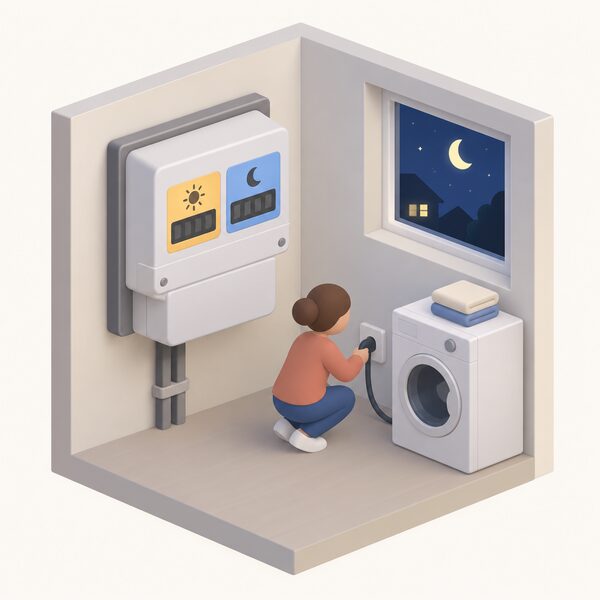
The honest position is that SSE Airtricity tariffs offer very little independence and a great deal of dependence, and that is true of any grid supplier. A household on these tariffs depends on the Northern Ireland electricity network, on SSE Airtricity as the billing and supply counterparty, and on the gas network and a regulated tariff if it heats with gas. None of that changes by choosing a different discount level.
The one genuine lever is consumption timing. Economy 7 rates on the fixed deals run from 18.470p to 20.100p at night against 36.180p to 40.760p by day, so shifting load into the night window changes what a household pays without changing supplier4. That is a real, if modest, form of control. It is the same principle behind shifting electricity use to cheap rates and time-of-use electricity tariffs.
Beyond that, the dependence is structural. The gas tariff is regulated, so the price is set through a process the household cannot influence. The electricity market has five suppliers, so switching is possible, but all five sell grid electricity at prices driven by the same wholesale market. The only routes that genuinely reduce dependence are generating or storing electricity at home, which are covered in solar and battery import tariffs and exporting electricity from a home battery.
For a household weighing options, the practical questions are which payment method fits, whether a fixed discount is worth the exit fee, and whether an Economy 7 meter would suit the load pattern. The wider framework for those decisions is in UK energy tariffs and tariffs and household energy independence.
Sources17 cited
- Electricity, oil and gas help for consumers, Consumer Council, 2026
- Switching electricity or gas supplier, Consumer Council, 2026
- Electricity price comparison table, Consumer Council, 2026
- Economy 7 price comparison, Consumer Council, 2026
- Greater Belfast gas tariffs, Consumer Council, 2026
- Gas to the West tariffs, Consumer Council, 2026
- NISEP list of schemes 2024-25, Utility Regulator, 2024
- NISEP annual report 2024-25, Utility Regulator, 2026
- Ofgem's call for evidence on white label providers, Citizens Advice, 2015
- Best and worst energy companies for 2021 revealed, Which?, 2021
- Citizens Advice responds to DESNZ consultation on community batteries, Citizens Advice, 2026
- Understanding energy bills 2026, 100Green, 2026
- Well adapted energy system, Climate Change Committee, 2026
- Smart meter cost facts, Smart Energy GB, 2026
- Review of domestic gas and electricity competition and supply price regulation, Ofgem, 2001
- CMA publishes final energy market reforms, GOV.UK, 2016
- Default tariff cap letter, 1 April 2024, Ofgem, 2024
 SSE AirtricitySSE Airtricity is Northern Ireland's second largest electricity supplier and a regulated gas supplier in Greater Belfast and the West, with fixed-term discounts, keypad options and gas tariffs approved by the Utility Regulator.