
In this answer
Short answer
The short answer is at least 48 hours before you move. The published guidance for households is to give the existing supplier at least 48 hours' notice of the move, and ideally more1. One supplier's plan transfer requires a call at least 48 hours before the move for the tariff to follow you to the new address3.
Notice is not the same as the account closing. The account closes on the date you stop being responsible for the property, and the final bill is worked out from the closing meter reading. Giving notice early simply means the supplier has the move date on record and can prepare the final bill.
Two things run in parallel on a move. The old account has to be closed with a meter reading, and the new property has to be registered in your name. The supplier that served the previous owners becomes your supplier automatically when you move in, so supply continues without a gap4.
How much notice, and why 48 hours is the floor
The 48 hour figure appears across the consumer guidance. Citizens Advice sets it as the minimum, and the same wording appears in the Energy Saving Trust checklist1. Confused.com puts it as at least two days' notice of the move2. Which? frames it as at least 48 hours in advance, ideally more, and notes that some suppliers let the process start earlier7. One supplier's plan transfer terms require a call at least 48 hours before the move for the tariff to move with you3.
The reason for a floor rather than a deadline is administrative. The supplier needs the move date, the closing reading and a forwarding address to close the account and raise the final bill. Notice given well in advance is accepted; the 48 hours is the point below which the process becomes rushed.
Where the property is on a heat network rather than mains gas or electricity, the contract terms are different. Under the draft heat network consumer protection guidance, if the domestic consumer notifies the authorised person at least two working days before the date they stop owning or occupying, the contract ends on that date; otherwise it ends at the end of the second working day after notification, or the date another person begins to own or occupy and takes a supply8. That is the same two day shape as the 48 hour rule, expressed in working days.
Notice periods for price changes are a separate matter and much longer. A supplier must give 30 days' notice if a tariff change will make you worse off7. That rule protects the household while the account is live; it does not extend the notice needed to close an account on a move.
How to notify your supplier and what details to give
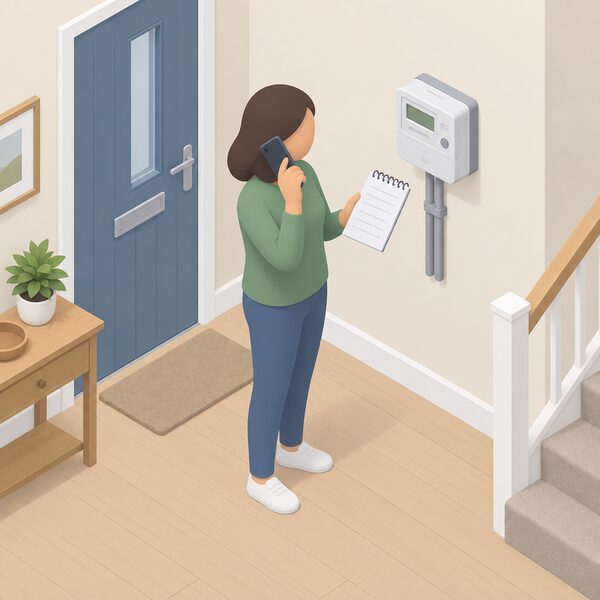
Notification is normally a phone call or a message through the online account. The details a supplier needs are the account number, the move date, the closing meter reading and a forwarding address for the final bill. Where a complaint is already running, the account number and any case reference number should be quoted when contacting the supplier9.
If the matter escalates, the Energy Ombudsman expects the household to notify the supplier and work with it to resolve the issue before contacting the ombudsman10. Useful details for a case include the supplier's name, the account holder's name, the account number and the date the complaint was first raised with the supplier11. For a complaint in progress, the supplier should be told what the complaint is about, when the problem happened, what outcome is wanted, and the first date of contact, along with letters, emails and phone calls about it9.
Households on a support scheme have a parallel duty to report changes. The Nest home energy support scheme customer charter requires customers to tell the scheme when something changes12, and a house move is exactly that kind of change.
What happens on moving day: readings and responsibility
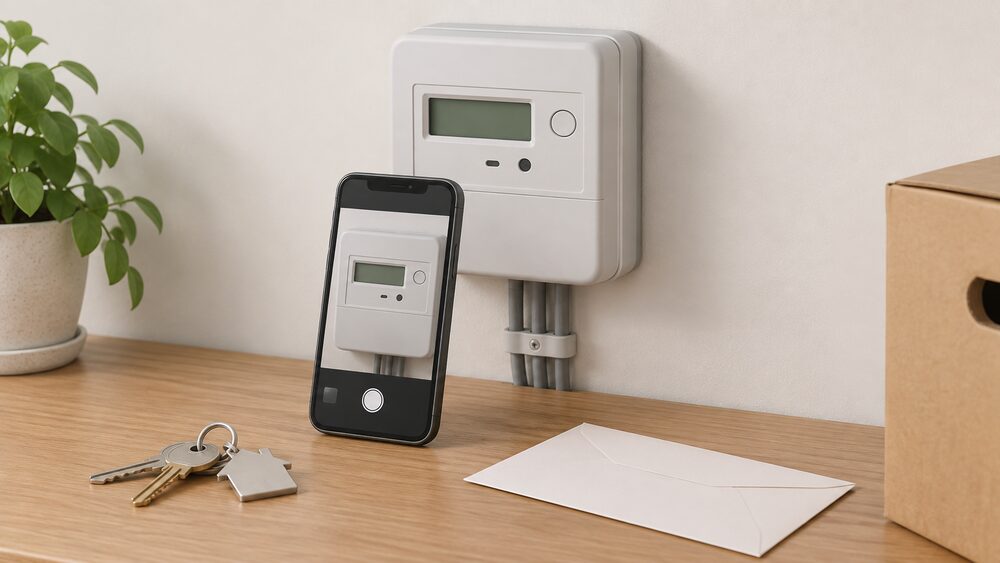
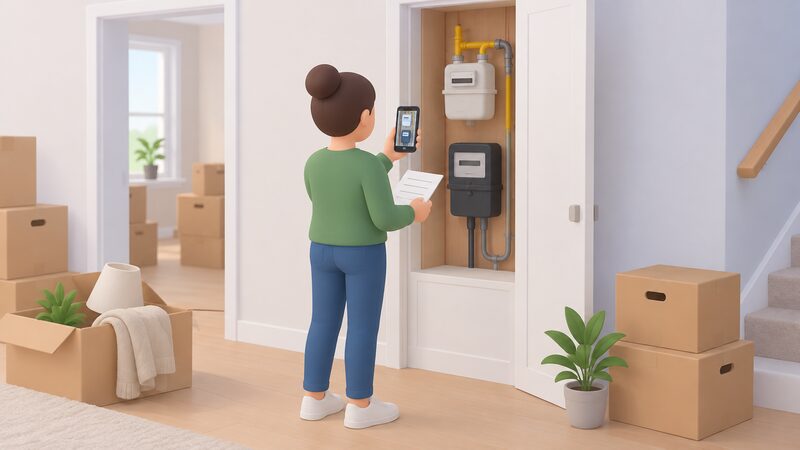
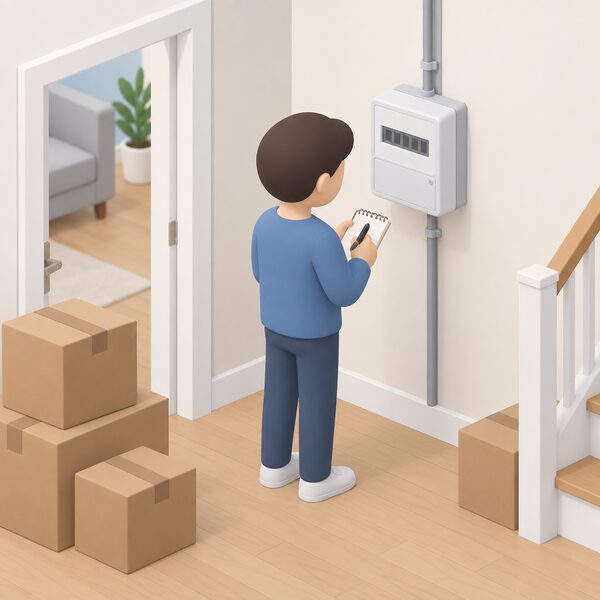
Take a meter reading on the day you move out and send it to the supplier so you are not overcharged13. Photograph the meter as evidence. The same principle applies on a switch: part of the switchover process includes taking a meter reading on the day of the switch14.
On the incoming side, the supplier serving the previous owners becomes your supplier automatically when you move in4. The practical steps are to find out who the supplier is, contact it to say you have moved in, and submit meter readings with photographs as evidence6. The same three steps apply to a newly built home and to a rented house: identify the supplier, notify it that you have moved in, and submit the first gas and electricity reading6.
Smart meters change the reading routine. In smart mode the meter sends automatic readings to the supplier1, and readings should be sent automatically by the smart meter to the energy supplier15. That does not remove the value of a dated reading on moving day, because the closing bill turns on the reading at the point responsibility changes.
Where the electricity meter itself has to be moved, the supplier owns the meter and is the only company that can move it, so the customer must arrange for the supplier to visit to move and connect it16. On a new connection, the electricity supplier must attend the same day to re-fit the electricity meter, after which power is ready to go17.
Final bills, closing the account and refunds of credit
The final bill should arrive within six weeks of the account closing5. Where a switch is involved and money is owed, any amount owed is added to the final bill sent by the old supplier, which should arrive within six weeks12. There are 28 days to pay a final bill5.
Credit works the other way. The supplier must refund credit within 10 working days of sending the final bill5, and the same 10 working day figure applies after the final bill on a switch18. Ofgem states that when you switch to a new supplier, your old supplier will refund any credit in your final bill, and compensation can follow if it does not19. The same refund duty applies to credit left on a closed account21.
Refunds are not always automatic in practice. Accounts closed when moving home or switching suppliers during the past five years may still be due a refund22, which is why a household that moved and never chased the balance should check.
Where a household is in debt rather than in credit, the supplier should review current payments and debt repayments23. That review sits alongside the final bill process rather than replacing it.
| Item | Timeframe | Source |
|---|---|---|
| Final bill issued | Within 6 weeks | 5 |
| Time to pay a final bill | 28 days | 5 |
| Credit refunded | Within 10 working days of the final bill | 5 |
If you are switching supplier at the same time as moving
Switching and moving can be done together, and the timing rule is straightforward: wait until the day you become responsible for the property1. For a purchase, that is after exchanging contracts6. If you pay a supplier directly for the electricity or gas you use at home, you can choose a different supplier or tariff at any time24.
Switching is easiest on a variable rate tariff, or where a current fixed rate contract is ending shortly25. A fixed deal may be portable: the supplier may allow the tariff to move to the new home, though rates can change by region5. Where the household stays with the same supplier, the switch to a different tariff can be done through the online account or via customer services26.
To start a switch, a supplier needs the name of the current supplier, the name of the current tariff, the amount of energy used in kilowatt hours, how the bill is currently paid and how it would be paid with a new supplier, and the postcode27.
Tenants can switch where they pay the supplier directly, including with a prepayment meter28, and a renter can switch where the lease says the bills are their responsibility29. Where a Green Deal loan is attached to the property, the electricity supplier can be changed as long as the new supplier is taking part in the Green Deal scheme30.
If a supplier goes out of business, nothing needs to be done: the household is moved automatically to a new supplier and the supply is not interrupted24. That protection matters on a move, because it means a switch in progress does not leave the new property without a supplier.
Where the responsibility sits between occupiers
Responsibility follows occupation, not ownership of the meter. The outgoing occupier is billed to the closing reading; the incoming occupier is billed from it. Because the previous owners' supplier becomes the new occupier's supplier automatically4, there is no gap in supply and no need to apply for a connection.
An energy supplier is responsible for providing energy to homes and businesses31, and the network operator's role is separate: the supplier owns the electricity meter and is the only company that can move it16.
In rented homes there is an additional duty on the landlord. A copy of the electrical installation report must be supplied to a new tenant before they occupy the premises32. That is a safety record, not an energy account, but it is part of what a new occupier should expect to receive at the point responsibility changes.
"When you move in, whoever supplied energy to the previous owners will automatically become your supplier."
What it means for household energy independence
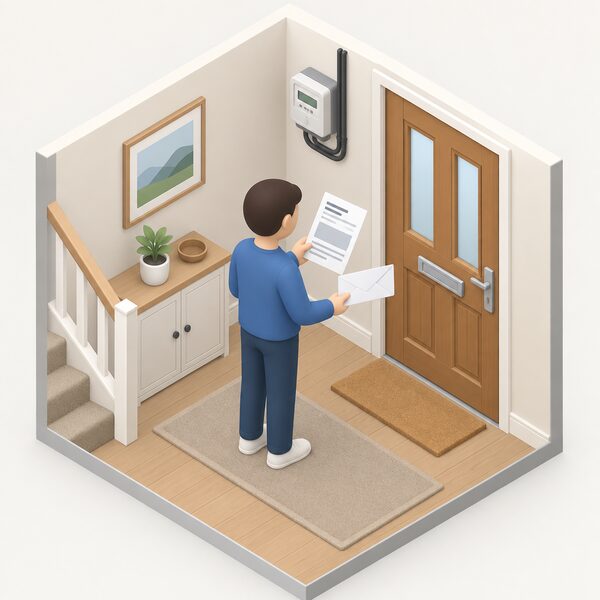
Notice to a supplier is a procedural step, and it does not change where the energy comes from. The household remains connected to the grid, buys through a licensed supplier, and depends on that supplier's billing, meter and account systems. Giving 48 hours' notice, taking a dated reading and chasing the credit refund are the parts of a move a household controls.
The dependence that remains is structural. Supply continues automatically from the previous occupier's supplier4, so the incoming household starts on a supplier it did not choose, on whatever tariff that supplier applies, until it switches. Switching is available from the day responsibility begins1, and the supplier can be changed at any time where the household pays it directly24. Until that happens, the account runs on the inherited terms.
For a household moving into a property with a smart meter, the reading routine is largely automatic1, which reduces the risk of an estimated closing bill but does not remove the need to record the reading on the day. For a household on a heat network, the contract terms follow the two working day rule in the draft guidance8, and the supplier relationship is with the heat network operator rather than a gas or electricity supplier.
Sources32 cited
- Moving house energy checklist, Energy Saving Trust
- Energy: your questions answered, Confused.com
- Moving house gas and electricity guide, Uswitch
- Moving home: dealing with your energy supply, Citizens Advice
- How to switch supplier when moving house, Confused.com
- A step by step guide to setting up gas and electricity in a new home, Energy Helpline
- How to switch energy supplier, Which?
- Heat networks consumer protections draft guidance, Ofgem
- Complaints process easy read, Smart Energy GB
- How we can help: energy suppliers, Energy Ombudsman
- Creating a case with the Energy Ombudsman, Energy Ombudsman
- Nest home energy support scheme customer charter, Welsh Government
- Who supplies my electricity and gas?, Uswitch
- What happens to credit if I switch?, Uswitch
- Smart meters: your rights and expectations, GOV.UK
- What's involved in moving your electricity supply, UK Power Networks
- What happens after I apply to move my supply, UK Power Networks
- Energy refunds, Uswitch
- How your electricity or gas bill is calculated, Ofgem
- Understand your electricity and gas bills, Ofgem
- How your electricity or gas bill is calculated, Ofgem
- Government help with gas and electric bills, StepChange
- Get help with your energy bills, Ofgem
- Switch your home energy supplier, Ofgem
- How to read your energy bill, Confused.com
- How to check your energy tariff and switch if you find a better deal, British Gas Energy Trust
- Switching your energy supplier, Energy Saving Trust
- Switching energy supplier if you're a tenant, Citizens Advice
- Gas and electricity guides, Confused.com
- Green Deal energy saving measures, GOV.UK
- Complain about your energy supplier, Ofgem
- Electrical safety standards in the private and social rented sectors: guidance, GOV.UK
 Moving Home Energy AccountsMoving home means you get a new energy supplier whether you choose one or not, so who supplies your new place and what happens to your old account?
 Switching SupplierHow long does switching energy supplier actually take, and what happens if you owe money?
 Smart Meter InstallationCan your supplier make you have a smart meter, and how long should you wait for an appointment?
 Telling the Network OperatorWho tells the network operator you are having a home EV charger fitted, and when?
 What Happens on Installation DayHow long will installation day take, and will you need to be in?
 Back Billing RulesCan a supplier really charge you for energy you used years ago?