
In this guide
Electrorad is a Leeds-based supplier of electric radiators and panel heaters that has worked in the UK electric heating market since 2000, and states it was the first company in the UK to import German electric radiators with fireclay cores1. Its range covers designer panel heaters, the Smartpanel, the Digi-Line Zigbee range, the Thermastore HHR storage heater, electric towel rails, contract panel heaters, the Aeroflow, the Vanguard and the Accorto1. The company sells through online retailers and nationwide wholesalers rather than fitting installations itself2.
For a household, the appeal is straightforward: an electric radiator needs no pipework, no flue and no fuel delivery, just a 13 amp supply to each unit3. What it does not do is remove dependence on the grid and an electricity supplier, and the running cost is set by the price of that electricity rather than by the radiator. Electrorad's own efficiency claim is that its radiators convert all of the electrical energy into heat, making them 100% energy efficient4.
The range is broad enough that the choice matters more than the brand. The Aeroflow carries a 30-year guarantee on all parts except the thermostat, which is covered for 2 years5. The ECO-RAD is Lot 20 compliant and sold only through selected wholesalers7. Controls across the ranges include WiFi app control, 7 day and 24 hour timing, adaptive start and open window detection8.
Electrorad: the company behind the range
Electrorad has supplied electric heating in the UK since 2000, and describes itself as the first company in the UK to import German electric radiators with fireclay cores1. That origin matters to how the range is positioned: the fireclay core is the heat store inside the Aeroflow and similar models, and the German connection is used as a quality marker across the product pages11.
The customer base is trade-weighted. Electrorad states that it works with a wide range of customers, from electrical wholesalers to housing associations, providing tailored solutions1. It is a member of the IBA, Fegime and AIEW buying groups, which is how much of its stock reaches electrical wholesalers and, through them, installers2. For a householder, that means the route to purchase is usually a wholesaler or an online retailer rather than a direct sale, though the company takes orders through its own contact team and can point to a nearest retailer12.
The company holds large stocks of all products at its Leeds warehouse, with quick response times and next-day delivery if required, and runs a showroom at its head office in Leeds1. Some resellers also display products13. The Vanguard is described as British-made, so not everything in the range is imported14.
On the independence question, the structure is a distributor model rather than a manufacturer's direct relationship. A household buying an Electrorad radiator is buying from a UK supplier that holds stock and handles warranty work in the UK, which shortens the repair loop, but the product itself is one component in a system that still runs on mains electricity from a supplier. The company's own framing is that electric heating avoids fuel storage and deliveries rather than avoiding the grid9.
The Electrorad range at a glance

The range splits into radiators, panel heaters, storage heating and towel rails. Electrorad lists designer panel heaters, Smartpanel, Digi-Line (Zigbee), the Thermastore HHR storage heater, electric towel rails, contract panel heaters, Aeroflow, Vanguard and Accorto1. All of the electric radiators feature programmable thermostats, and the same feature is found across the electric radiators and towel rails15.
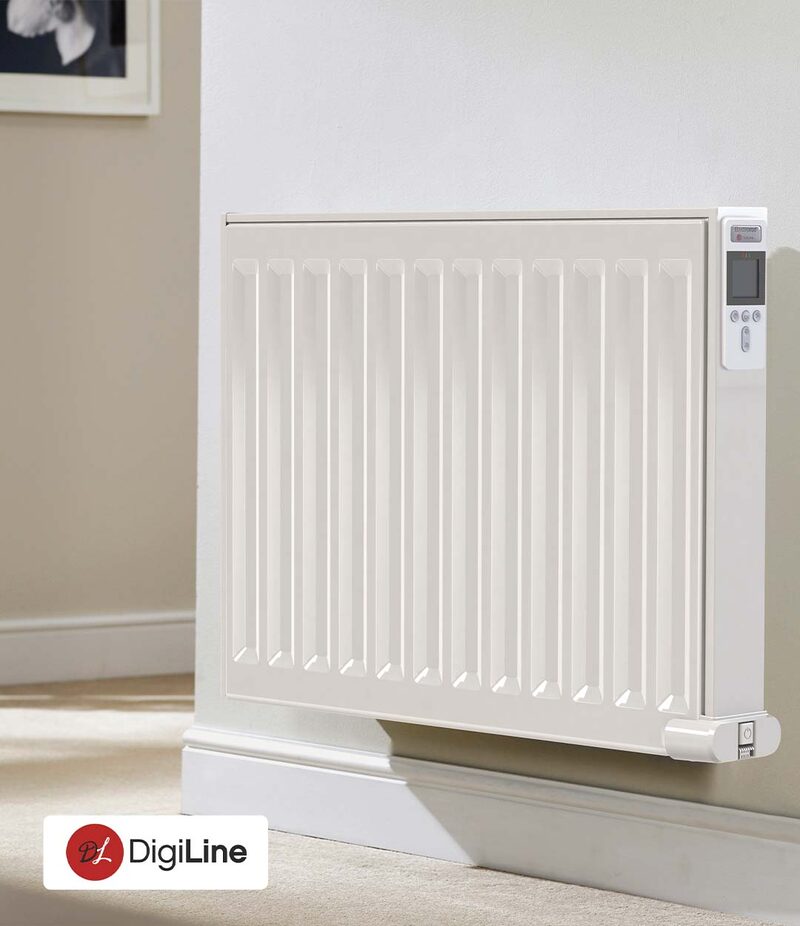
The Digi-Line range is the one designed to look familiar: Electrorad notes that its Digi-Line electric radiators even look like traditional gas radiators, which matters where a household is replacing a wet system and wants the room to look unchanged4. The range also includes low-level and compact models that take up minimal wall and floor space4. The Vanguard is a radiant heating design rather than a convection-led one, and carries an eco temperature setting15.
For context, the wider UK electric radiator market includes Myson, which offers panel, plan, column and decorative models, and Stelrad, whose Electric Series launched as the brand's first electric range with around a dozen models and a rounded vertical tube column design in three sizes16. Stelrad has manufactured radiators since 1936 and describes itself as the UK's number one radiator brand, producing more than 2.5 million radiators a year19. Electrorad's position in that field is as a specialist importer and supplier rather than a volume manufacturer.
| Product line | Type | Notable feature |
|---|---|---|
| Aeroflow | Electric radiator | 30-year guarantee, thermostat excluded5 |
| Digi-Line (Zigbee) | Electric radiator | Looks like a traditional gas radiator, voice control4 |
| Vanguard | Electric radiator | Radiant heating, British-made15 |
| ECO-RAD | Electric radiator | Lot 20 compliant, wholesalers only7 |
| Designer Panel Heater | Panel heater | Lot 20 compliant, plus or minus 0.2 degrees C thermostat13 |
| Thermastore HHR | Storage heater | Listed in the range1 |
Controls: thermostats, timing and app control
Electrorad's control package is consistent across the ranges. The company lists distance control by WiFi based app, 7 day and 24 hour timing control, adaptive start control that learns when to turn on to achieve optimum comfort, open window detection, and very accurate room thermostat control8. An app can be added for full control of the property whether at home or away9.
Thermostat accuracy is the figure the company repeats most often. Electrorad states that its ranges have electronic thermostats with an accuracy of plus or minus 0.2 degrees C9. The Digi-line Zigbee is listed with temperature accuracy within the same figure, using double proportional band control (PI and PWM)12. The Designer Panel Heater holds temperatures within plus or minus 0.2 degrees C with a high-accuracy digital thermostat13. The ECO-RAD is listed with temperature control within a range of plus or minus 0.2 degrees C7.
Voice control is partly prospective. Electrorad states that its radiator controls will soon be compatible with Amazon Alexa, allowing a radiator to be turned on or off and temperatures changed by voice8. The Digi-line Zigbee page describes Alexa and Google Home compatibility including voice control where such a smart home system is installed12, and the Vanguard+ is described as integrating seamlessly with smart home systems, controllable by voice or through an app15.
The dependence this creates is worth naming. Local control at the radiator continues without a broadband connection, but app scheduling, remote adjustment and any voice control run through a home network, a third-party smart home platform and the manufacturer's app. That is a supplier relationship layered on top of the electricity supply.
Efficiency: 100% of electricity used becomes heat

Electrorad's efficiency claim is that its radiators convert all of the electrical energy into heat, making them 100% energy efficient4. The same figure appears across its guidance: electric radiators convert electricity into heat directly at 100% efficiency9, all models produce the same amount of heat for the same amount of electricity used, making them all 100% energy efficient10, and all electric radiators and heaters have an efficiency of 100% according to Joule's law14.
That claim is not a maker's exaggeration. The Welsh Government's Approved Document L consultation version states that electric resistance heating is assumed to be 100% efficient20, and the UK Approved Document L Volume 1 for dwellings carries the same assumption21. BEAMA, the trade body for the electrotechnical industry, states that all electric resistance heating products are 100% efficient at point-of-use22. An energy supplier's guidance describes electric radiators as effectively 100% efficient at point of use23.
What the figure does not mean is low running cost. Every electric radiator converts all the electricity it draws into heat, so no model can beat another on conversion efficiency, and the difference between products lies in how that heat is delivered and controlled rather than in the percentage. Electrorad makes this point itself, stating that all German electric radiators on the market will give exactly the same running costs11. The running cost is set by the unit price of electricity and by how long the radiator is on, which is why timing control and accurate thermostats matter more than the efficiency badge.
"Electric resistance heating is assumed to be 100% efficient"
For a household, the honest position is that an electric radiator is a perfectly efficient way to turn electricity into heat and an expensive way to heat a home if the electricity is bought at standard rates. The independence it offers is from gas, pipework and fuel delivery, not from the grid or from a tariff. Running cost comparisons by fuel are set out in electric heating running costs, and the tariff structures that can change the arithmetic are covered in Economy 7 and time-of-use tariffs.
Installation: no plumbing, plug-in or wired
Electrorad describes its radiators as fuss-free to install, with no disruption to any other heating and no additional plumbing and wiring required4. The general guidance is that electric radiators do not require extensive plumbing, making them suitable for both new builds and refurbs, and that they simply plug or spur in and are ready to use9. No pipework is needed, just a 13 amp electric supply to each radiator3.
The practical consequences follow from that. Electric radiators do not require a chimney, fuel storage tanks or extensive pipework, which makes them suitable for a wide range of spaces24. They are generally easier and less costly to install compared to many other heating systems because they do not need pipework10. The Energy Saving Trust notes that direct electric heating such as panel heaters can be simple and cheap to install since it does not need pipes, radiators or underfloor systems25.
Maintenance is minimal. Electrorad states that unlike systems relying on gas or oil, electric heating systems do not require regular maintenance or the storage of fuel9, and that there is minimal maintenance required and no annual servicing needed23. Independent guidance makes the same point about bleeding: electric radiators do not circulate hot water through the home and do not trap air, so they do not need to be bled26.
The independence gain here is real and specific: no gas connection, no flue, no annual service visit, no fuel delivery, and no pipework to freeze or leak. The dependence that remains is the electricity supply itself, plus the wiring capacity of the house. Where a property has no gas connection at all, the wider options are set out in heating a home off the gas grid.
ECO-RAD: Lot 20 compliance and specifications
Lot 20 is the Ecodesign requirement for local space heaters, and Electrorad states that all of its products would be compliant with it by September 20178. The ECO-RAD electric radiator is listed as Lot 20 compliant7, and the Designer Panel Heater is described as fully Lot 20 compliant, meeting Ecodesign Lot 20 energy standards13.
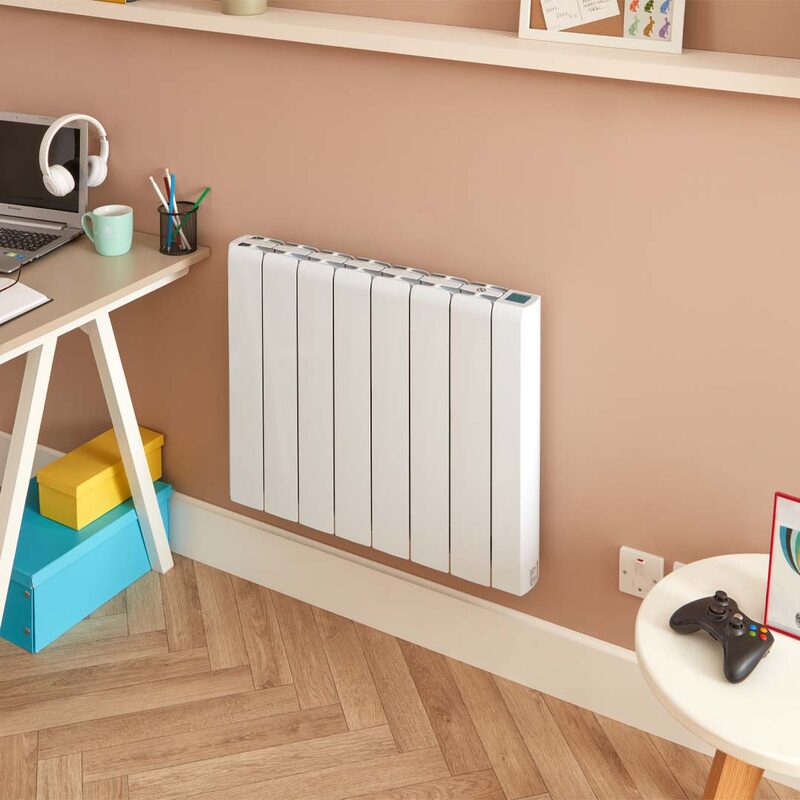
The ECO-RAD's specification is built around heat retention and control. It uses a dynamic fluid with high thermal inertia, which is the heat store that keeps emitting after the element switches off, and it comes complete with a UK plug and power cord7. It has adaptive start control and temperature control within plus or minus 0.2 degrees C7. Availability is the constraint: the ECO-RAD is only available through selected wholesalers7.
Lot 20 compliance is a product standard rather than a performance promise. It requires features such as accurate thermostat control and options like open window detection and adaptive start, which is why those features appear across the Electrorad ranges8. A compliant radiator is not automatically cheap to run; it is one that meets a defined set of control and efficiency requirements.
For a household comparing electric radiators, Lot 20 compliance is a baseline to check rather than a differentiator, since it applies across the market. The differentiators are the heat store, the control accuracy and the warranty terms. Standards and certification for heating appliances generally are covered in heating appliance standards and certification.
Where to buy and delivery across the UK

Electrorad sells through a network of online retailers and nationwide wholesalers across the UK2. The company states that its radiators are available from online suppliers with free next day delivery4, and that it holds large stocks of all products at its Leeds warehouse with quick response times and next-day delivery if required1. A householder can also contact the team to order, find out more, or be pointed to a nearest retailer12.
The buying groups matter to availability. Electrorad is a member of the IBA, Fegime and AIEW buying groups2, which is how its products reach electrical wholesalers and, through them, the trade. The company works with customers from electrical wholesalers to housing associations1. For a householder, that means the fastest route is often an online retailer or a local electrical wholesaler rather than a direct order, though direct contact is possible.
Electrorad also publishes two free tools: a heating calculator to help understand a home's heating requirements and select the right product, and a free heating survey form1. These are sizing and selection aids. They are not an installation service, and Electrorad does not fit radiators itself.
On delivery timing, the stated position is next-day where stock allows, with the ECO-RAD the exception because it is wholesaler-only1. Prices are not published by Electrorad for the range as a whole, so costs are quoted by the retailer or wholesaler at the point of purchase. Sizing a room correctly before ordering is the step that determines whether the radiator chosen will actually heat the space, and the principles are covered in radiators and heat emitters and heating system design and balancing.
Warranty and what owning an Electrorad radiator means
The warranty terms vary by product, and the headline numbers need reading carefully. Electrorad states that some manufacturers quote 10, 20 and 30-year guarantees but only cover the radiator body, and positions its own Aeroflow guarantee as covering all the integral workings, including the elements, fireclay panels, thermal switches and electrical wiring as well as the metal casing5. The Aeroflow range carries a 30-year guarantee covering all parts except the thermostat, namely the heating elements, the internal wiring, the fire clay, the thermal switches and the radiator case6. The thermostat is guaranteed for 2 years6, and the thermostat and electronics are covered for 2 years5.
That split is the key term. A 30-year guarantee on an electric radiator is a guarantee on the passive and heating parts, not on the control electronics, which is the component most likely to fail first. Electrorad states that all the radiators are repaired or replaced in the UK5, which keeps the warranty loop domestic.
"The guarantee is 30 years and covers all parts except the thermostat i.e The heating elements, the internal wiring, the fire clay, the thermal switches and the radiator case"
Elsewhere in the range, Electrorad's electric water heaters carry a 25-year guarantee with a dedicated secondary return27, and the company states that some models offer up to 30-year warranties28. For comparison, the neos electric radiator, sold by a different UK supplier, is described as carrying a 25-year guarantee and as a UK and International patented product made in Britain in Leeds29.
Safety features are part of the ownership picture. Electrorad states that because electric radiators do not produce flames or combustion gases there are no concerns regarding carbon monoxide leaks, and that its products include overheating protection and child locks9. That removes one class of risk entirely, though it does not remove the electrical risk: a product recall notice from Electrical Safety First shows that not every electric heater on the UK market meets the Electrical Equipment (Safety) Regulations 201630.
For a household, owning an Electrorad radiator means a heating appliance with no combustion, no annual service and a long parts guarantee, supplied through a UK distributor that handles repairs domestically. The dependence that remains is the electricity supply, the tariff it is bought on, and for app and voice features, a broadband connection and a smart home platform. Where the aim is to reduce reliance on gas specifically, the alternatives are set out in electric radiators and panel heaters and home heating and energy independence.
Sources30 cited
- Wall mounted electric radiators, Electrorad, 2025
- Where to buy, Electrorad, 2025
- The move to electric heating to reduce emissions, Electrorad, 2026
- Conservatory electric radiators, Electrorad, 2026
- Electric radiator guarantees, Electrorad, 2026
- Aeroflow radiators, Electrorad, 2026
- Trust Electric Heating Ltd, Which? Trusted Traders, 2026
- New electric heating regulations, Electrorad, 2026
- Why choose an electric heating system, Electrorad, 2026
- Are electric radiators expensive to run, Electrorad, 2026
- German electric heating systems, Electrorad, 2026
- Digi-line electric radiators Zigbee, Electrorad, 2025
- Designer panel heaters, Electrorad, 2025
- Create a greener home, Electrorad, 2026
- Decoding heating jargon, Electrorad, 2026
- Henrad compact vertical radiators launched, CIPHE, 2024
- Myson low temperature heating, CIPHE, 2024
- Heat loss calculator and radiator sizing software, CIPHE, 2026
- Sorand water heater 2000W recall, Electrical Safety First, 2026
- Approved Document L Volume 1 Dwellings, UK Government, 2026
- Electric heating, Energy Saving Trust, 2026
- Approved Document L Volume 1 consultation version, Welsh Government, 2025
- Electric radiators, EDF Energy, 2026
- Benefits of electric space and water heating, BEAMA, 2026
- How to bleed a radiator, Smart Energy GB, 2026
- Renewable heat right for your home, Energy Saving Trust, 2026
- Electric water heaters, Electrorad, 2025
- ECO-RAD, Haverland, 2025
- The future of home heating, Myson, 2025
- Electric flow boilers, Heatrae Sadia, 2026