
In this guide
Stelrad is the UK's number one radiator brand, and the company says it manufactures and distributes more than 2.5 million radiators every year1. Its catalogue runs to more than 50 radiator ranges, from the trade-standard Compact through to the Electric Series launched in 2023 and the Danish-designed Hudevad range added in 20251. For a household, that breadth matters less than three practical things: whether the radiator is made here, what it costs, and what it does to the home's dependence on the gas grid.
The manufacturing answer is straightforward. Stelrad states on its product pages that its products are proudly made in the UK, and that wording appears across the Compact, Compact with Style, Planar, Elite and Classic Towel Rail ranges4. The company is an Industrial Associate of CIPHE, the Chartered Institute of Plumbing and Heating Engineering1.
The independence answer is more mixed. A Stelrad panel radiator is a passive emitter: it holds no fuel, generates no heat of its own and depends entirely on what the rest of the system sends it. Fitted to a gas boiler it keeps the household on the gas grid and on a supplier. Fitted to a heat pump it becomes part of an electrified system, and the low-temperature variants exist for exactly that reason. The Electric Series changes the fuel but not the dependence on a supplier and a grid connection.
Stelrad at a glance: the UK's biggest radiator maker
Stelrad describes itself as having grown to become the UK's number one radiator brand, manufacturing and distributing more than 2.5 million radiators every year1. The group is wider than the Stelrad badge: Henrad Radiators is part of the Stelrad Radiator Group, and the Henrad Compact Vertical range was launched in response to demand from installers and independent merchants11. Stelrad is also an Industrial Associate of CIPHE, a trade membership that places it inside the UK plumbing and heating industry's professional body rather than outside it1.
The product spread is unusually wide for a single manufacturer. Stelrad continues to expand its offerings with more than 50 radiator ranges, covering the volume trade market through to designer and specialist products1. That includes the UK's leading brand of Low Surface Temperature radiators, the type specified where surface temperature has to stay below a set limit, such as schools, care settings and some domestic rooms1.
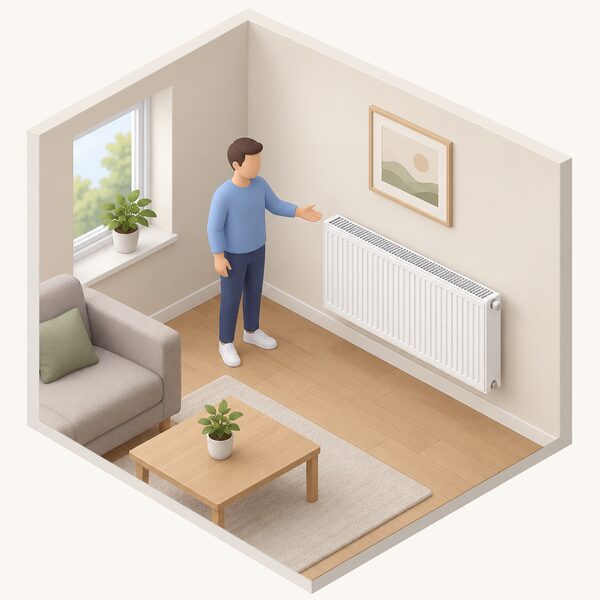
For a household, the significance of scale is availability and parts continuity rather than prestige. A brand producing millions of units a year has a distribution network that reaches independent merchants, and a radiator that can be replaced like for like years later. The trade-off is that Stelrad is a component supplier, not a heating system: it makes the emitter, not the heat source, the controls or the fuel supply. Everything that determines running cost and carbon sits upstream of the radiator.
The range: more than 50 radiator ranges, from Compact to electric
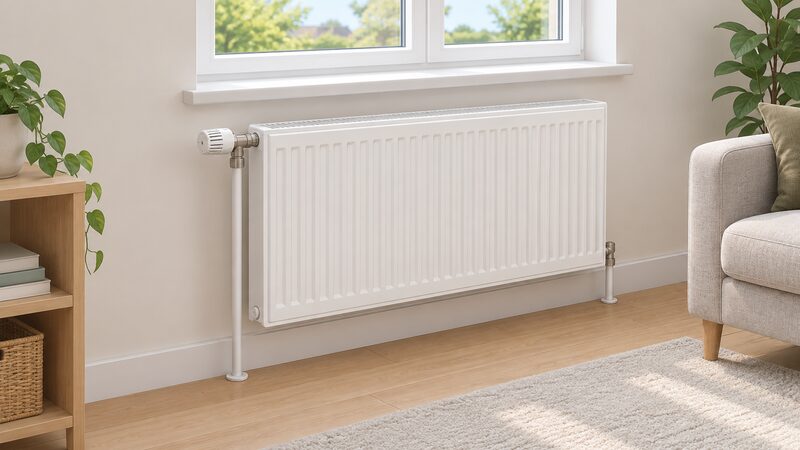
The Compact is the workhorse. It is listed in P1, K1, P+ and K2 types for horizontal models, and the Compact with Style vertical models come in K1, P+ and K24. The Planar sits above it as a slimmer, flatter panel, described as having a slim, understated design and the ultimate minimalism design, and it is listed in K1 and K2 types, positioned as perfect for new build developments6. The Elite is the high-output option, described as the perfect solution when maximum heat output is needed from a steel panel radiator, and it is available nationwide7. The Classic Towel Rail covers bathrooms8.
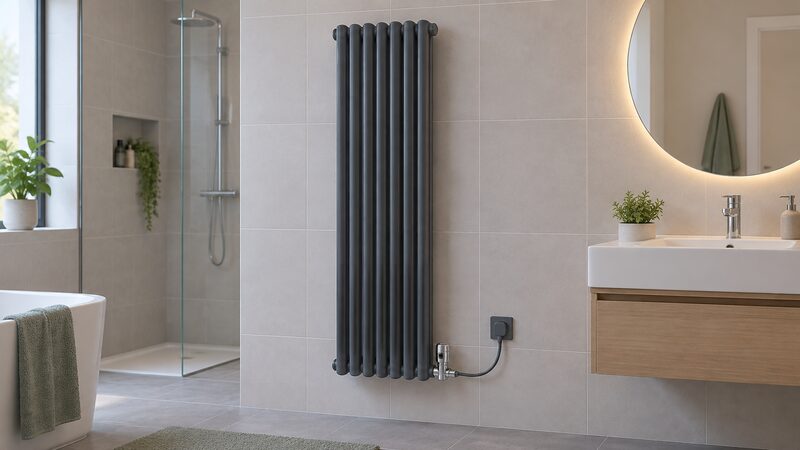
The Electric Series arrived in September 2023, available from merchants from 1st September2. It includes the Stelrad Electric Column, a rounded vertical tube column radiator available in three sizes in both white or anthracite grey2. Hudevad, a Danish brand established in 1938, was launched on the Stelrad website in February 2025, with the P5 horizontal available in K1, K2 and K3 options and K2 vertical models, in 62 different models3.
| Range | Types | Positioning | Warranty |
|---|---|---|---|
| Compact | P1, K1, P+, K24 | Volume trade range | 5 years4 |
| Compact with Style | K1, P+, K25 | Vertical and styled | 5 years5 |
| Planar | K1, K26 | Slim, new build | 5 years6 |
| Elite | Not stated | Maximum output | 10 years7 |
| Classic Towel Rail | Not stated | Bathroom | 5 years8 |
| Hudevad P5 | K1, K2, K33 | Danish designer | Not stated |
What Stelrad radiators cost
There is no manufacturer list price for Stelrad radiators. The published figures come from distributors, and they are quoted per radiator including VAT, before any installation labour. City Plumbing lists a Stelrad Compact K1 600 x 1800mm at £208.79 including VAT, a Compact K3 500 x 1800mm at £464.99, a Compact K3 600 x 1800mm at £513.14, a Softline Compact K2 450 x 1800mm at £272.90 and a Softline Compact K2 700 x 1800mm at £390.3610. The Softline Plan K1 600 x 1200mm is listed at £259.4010.
The designer end costs considerably more. The Concord Plane range is listed at £418.39 for a single panel 1800mm model, £962.71 for a double panel of the same size, £1,491.77 for a double panel 740mm x 1800mm and £520.12 for a K1 1800mm model10. Those are distributor prices for the radiator alone, and they show how much of the cost sits in the finish and the format rather than the heat output.
Three things move the price: the panel and convector type, since a K3 carries more steel than a K1; the finish, with the Concord Plane range at the top of the published list; and the size, with 1800mm lengths dominating the published examples. Installation is separate and installer-quoted, and it varies with whether the radiator is a like-for-like swap or part of a wider system change. For the wider cost picture, new boiler cost sets out what a full system replacement involves.
Sizes, outputs and colours: choosing the right radiator

Stelrad's Elite range is listed with lengths from 400mm to 3000mm and heights of 300mm to 700mm, which gives a sense of the envelope the trade ranges cover7. The type code does the rest of the work: P1 is a single panel with no convector fins, K1 a single panel with one set of fins, P+ a double panel without fins, K2 a double panel with two sets of fins, and K3 a triple panel with three sets. More panels and fins mean more output from the same wall space, at a higher price and a deeper profile.
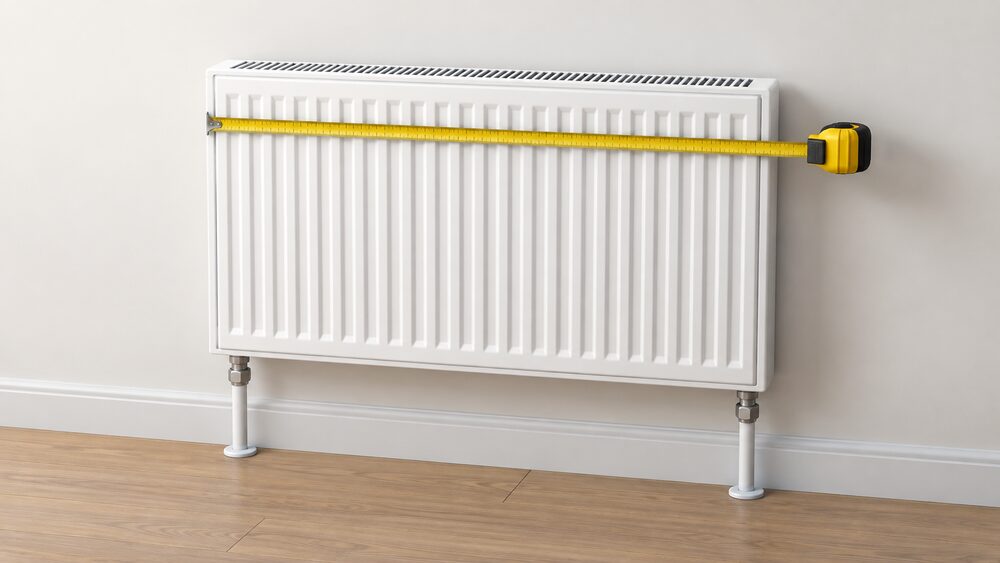
Measuring for a replacement is a household task that goes wrong easily. The width is taken from the far left to the far right of the radiator itself, and a second person is recommended if the span cannot be reached in one go12. Most radiator manufacturers publish the exact measurements of their radiators on their website, which helps when choosing a replacement12. The critical figures are the pipe centres and the wall to face depth, not just the nominal height and width, because a radiator that is deeper will not sit under the same sill.
Colour is a stock question as much as a design one. Stelrad offers a number of coloured radiators from stock within the usual 72 hour delivery time1. Cast iron alternatives, for comparison, are often white or grey in colour and take up quite a bit of space, which may not suit smaller homes13. For a household weighing a like-for-like swap against a change of emitter type, radiators and heat emitters covers the wider field.
Electric and low-temperature options: the Stelrad Electric Series and Hudevad
The Electric Series is Stelrad's answer to homes without a wet system, or rooms a wet system does not reach. It launched in September 2023 and is available from merchants2. The Electric Column is a rounded vertical tube column radiator in three sizes, in white or anthracite grey2. This is direct electric heating: it converts electricity to heat at the point of use, with no boiler, no pipework and no flue.
The wider electric market shows what that means in practice. Electric heating types include electric radiators and electric panel heaters14. Direct electric radiators can be a suitable option where there is a requirement for rapid response or intermittent heating, and are particularly sustainable with self-generated energy such as from photovoltaic panels15. That last point is the independence argument for electric emitters: paired with solar and a battery, a direct electric radiator can run on self-generated power, where a wet radiator cannot run on anything but the heat source feeding it.
Low-temperature operation is the other half of the picture. Radiators for low temperature heating systems typically require to be around 2.5 times larger than a conventional radiator, according to official guidance16. Fan-assisted models can provide around 3 times as much heat output than a standard radiator of the same size, which allows a low flow temperature17. That is the trade-off a heat pump conversion runs into: the emitter has to grow, or become fan-assisted, to deliver the same room temperature at a lower flow temperature. Hudevad's P5 range, with 62 models in K1, K2 and K3 options, is the designer end of that specification3.
Sizing a radiator: the heat loss calculator
Stelrad publishes a heat loss calculator and radiator sizing software package, described as the leading package used by installers and specifiers across the UK heating sector, and available to installers and specifiers across the UK heating sector9. The updated versions are ready to access from the website at stelradprofessional.com9. The January 2026 update added improved styling for better match with colours, layout and typography, improved compatibility with modern browsers, and a feature whereby the user can choose between hot water or electrical heating and display products accordingly9.
That last feature is the one that matters for a household planning a heat pump or a switch to electric emitters. Sizing a radiator is not a matter of matching the old one. The room's heat loss drives the requirement, and the emitter's rated output has to be read at the flow temperature the system will actually run. For fan-assisted radiators, the method is to divide the room's heat loss by the rated output of the emitters at a warm water to air temperature difference of 50 degrees Celsius18. For electric radiators, the starting point is the room's BTU requirement, since radiators come with individual BTU ratings19.
Controls change the outcome as much as sizing does. Thermostatic radiator valves adjust the temperature in different rooms, so unused spaces are not heated more than necessary20. Lowering the setting on thermostatic radiator valves is associated with a 5.5% saving on household bills in one set of independent statistics21. Reflector panels behind radiators are a separate, low-cost measure: purpose-made panels should be bought from a DIY store, and they are lightweight enough to install yourself, though a tenant should check with the landlord first22. The wider controls picture is at heating controls and thermostats.
Delivery: 72 hours as standard, 48 hours Express

Stelrad's distribution is built around short lead times. Radiators are delivered anywhere in the UK at short notice, the majority within 72 hours of order, or within 48 hours for Express orders1. Coloured radiators from stock follow the same 72 hour pattern1. That is a trade-facing promise rather than a consumer one: the order runs through a merchant or an installer, and the clock starts when the merchant places it.
The practical consequence for a household is that a radiator swap is rarely the bottleneck in a heating project. Where a boiler replacement or a heat pump installation is waiting on parts, the emitter can usually be sourced quickly. The exception is anything outside the stocked selection, where the lead time is quoted rather than published, and bespoke or made-to-order finishes fall into that category.
For comparison, delivery promises elsewhere in the heating market are longer. A new electricity connection for a small development is quoted at 15 working days as a guaranteed standard to receive a quote, which shows how much slower infrastructure work is than component supply25. Radiators sit at the fast end of the supply chain because they are manufactured in volume and held in merchant stock.
Buying through merchants and what ownership means for independence
The published route to a Stelrad radiator is through merchants and stockists. Hudevad P5 horizontal radiators are listed as available from stelrad.com3. Stelrad is an Industrial Associate of CIPHE, which places it within the trade body structure rather than selling direct to the public1. For most households the purchase runs through a plumber or heating engineer who buys from a merchant, or through a merchant directly if the householder is arranging the work.
That structure has an independence dimension worth stating plainly. A radiator is a component with no fuel, no controls and no connectivity of its own. Owning one confers no energy independence: the heat still comes from a boiler burning gas, an oil tank, a heat pump drawing electricity, or a direct electric element drawing from the grid. What the household controls is the emitter, the flow temperature and the controls, and those determine how much of the heat source's output reaches the room rather than the flue or the outside air.
The dependence that remains is therefore upstream. A wet radiator system keeps the home on a gas or oil supply, or on electricity for a heat pump. An electric radiator keeps the home on the grid and on a supplier, though it can be paired with self-generated power15. The manufacturer relationship is limited to warranty and replacement parts, and the warranty terms are consistent across the ranges: 5 years parts and labour when registered within 30 days of installation and serviced annually, with the Elite listed at 10 years4. Registration runs through the product pages and the supplying merchant, and the annual service condition is the one that voids cover if it is missed.
For households weighing a change of emitter type against a change of heat source, heating and energy independence sets out where the boundaries sit, and electric radiators and panel heaters covers the direct electric alternative in more detail.
Sources25 cited
- Stelrad profile, CIPHE, 16 March 2023
- Stelrad Electric radiators, CIPHE, 13 September 2023
- Stelrad launches Hudevad models, CIPHE, 13 February 2025
- Stelrad Compact, Ideal Heating, 17 September 2026
- Stelrad Compact with Style range, Ideal Heating, 17 September 2026
- Stelrad Planar, Ideal Heating, 17 September 2026
- Stelrad Elite, Ideal Heating, 17 September 2026
- Classic Towel Rail, Ideal Heating, 17 September 2026
- Heat loss calculator and radiator sizing software, CIPHE, 21 January 2026
- 1800mm radiator ranges, City Plumbing, 17 September 2026
- Henrad Compact Vertical radiators launched, CIPHE, 1 March 2024
- How to measure a radiator, Vaillant, 2026
- Cast iron radiator guide, Netatmo, 20 September 2026
- Renewable heat: right for your home, Energy Saving Trust, 19 May 2026
- Myson low temperature heating, CIPHE, 25 January 2024
- Edinburgh LHEES, City of Edinburgh Council, December 2023
- My property and heat pumps, Renewables First, 23 March 2026
- Radiator, Mitsubishi Electric, 17 September 2026
- Electric radiators, EDF Energy, 2026
- Maintaining the ideal home temperature, Smart Energy GB, 17 August 2026
- Boiler statistics, Uswitch, 4 January 2024
- Radiator reflector panels, Energy Saving Trust, 31 October 2025
- Radiator panels, Smart Energy GB, 22 April 2026
- Magnetic radiator heat saver, UK Green Building Council, June 2024
- Indicative costs for new connections, Electricity North West, 19 September 2026