
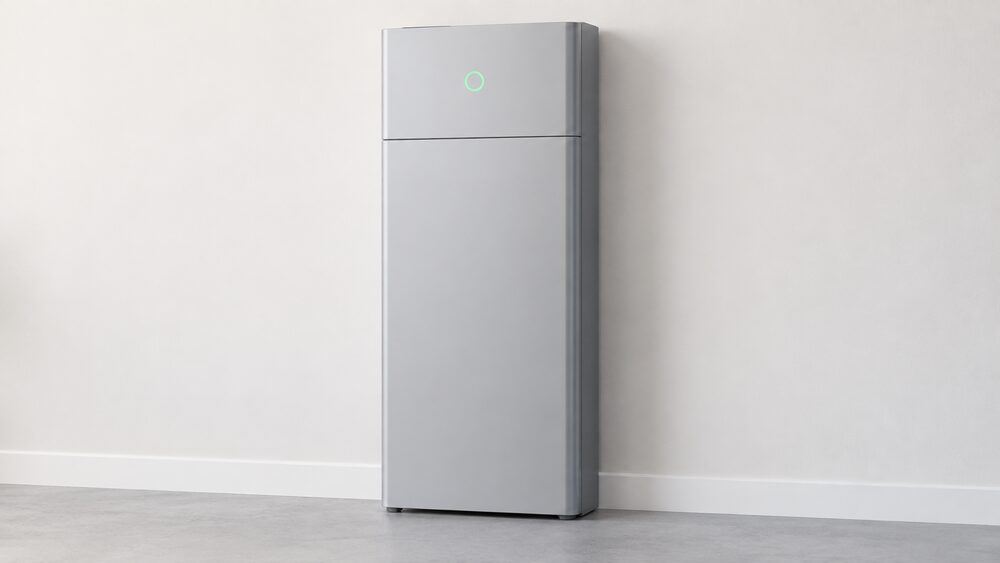
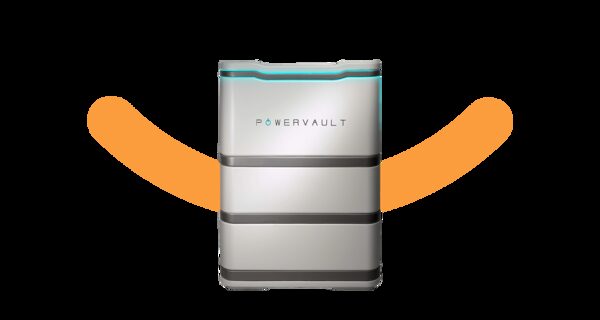
The Powervault P5 is a lithium-ion home battery assembled in a UK factory, sold in 5, 10, 15 and 20kWh units that the maker lists as 4, 8, 12 and 16kWh of usable AC capacity1. It is IP65-rated for indoor or outdoor installation, comes with a hybrid inverter for AC or DC coupling, and carries a stated 10-year warranty as standard1.
The company position matters more than any specification. Companies House recorded the appointment of an administrator for POWERVAULT LTD on 27 November 2025, and a separate entity, POWERVAULT PLUS LTD, was incorporated on 17 November 20254. A household weighing a P5 is therefore weighing a battery whose maker is in administration, and the warranty should be read as a claim against that estate rather than as a promise a buyer can bank on.
What follows sets out the specifications, the warranty terms in detail, the price position, the company's status, and what the system does and does not do for a household's energy independence.
What the P5 offers a UK household
The P5 is a modular lithium-ion battery that stores unused solar energy and discharges it back to the home when needed2. It comes as an AC or DC-connected system with a hybrid inverter, offered in 3.6kW and 6kW options, and the maker states it can be oversized to accommodate 5.4kW or 9kW of solar PV panels respectively1. It can work alongside a pre-existing solar inverter or wind turbine, and retrofitting one is stated to have no impact on Feed-in-Tariff generation payments2.
It can also charge from the grid to store cheap off-peak electricity for use at peak hours, which is what makes it useful to a household without solar as well as one with it2. The maker states the P5 seamlessly integrates with most solar panel systems, and that it can be used in three phase systems for even larger energy capacity1.
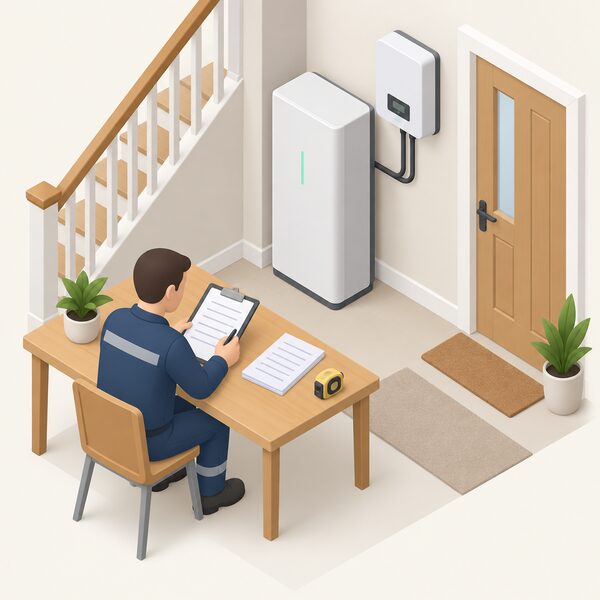
Installation is by a Powervault approved installer partner, and the maker states the unit requires professional installation by certified technicians to ensure proper setup, integration and safety1. It is available in grey or white2.
The independence this buys is partial and worth stating plainly. A P5 shifts when grid electricity is drawn, and how much of it is drawn at all where solar is present. It does not remove the grid connection, the electricity supplier, or the standing charges that come with both. The UK manufacturing base shortens the parts and service chain, but the company's administration is the more immediate fact for anyone considering one.
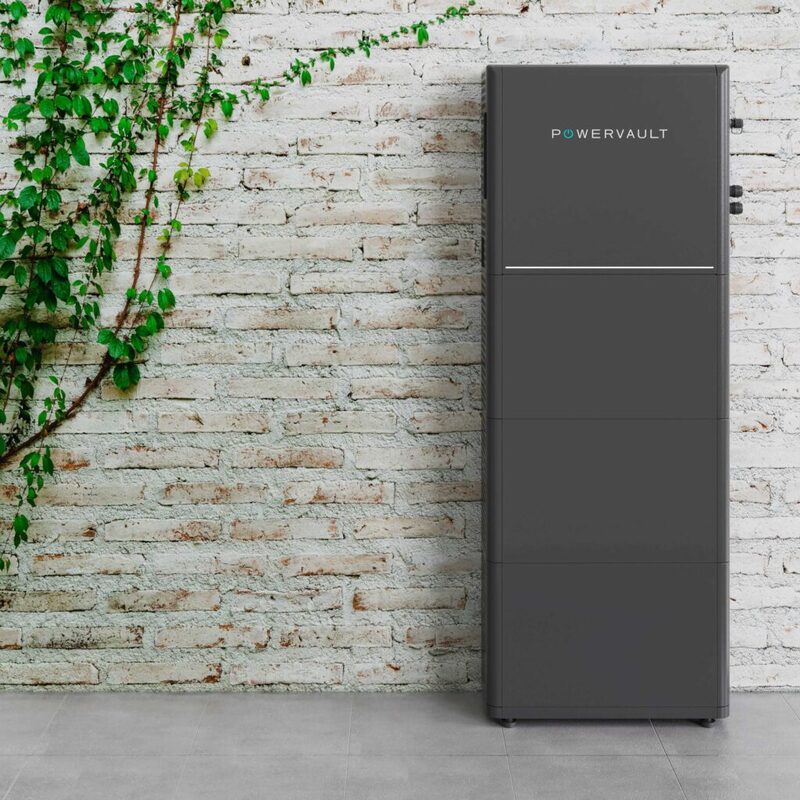
Specifications: 5 to 20kWh, IP65, 90 to 235kg
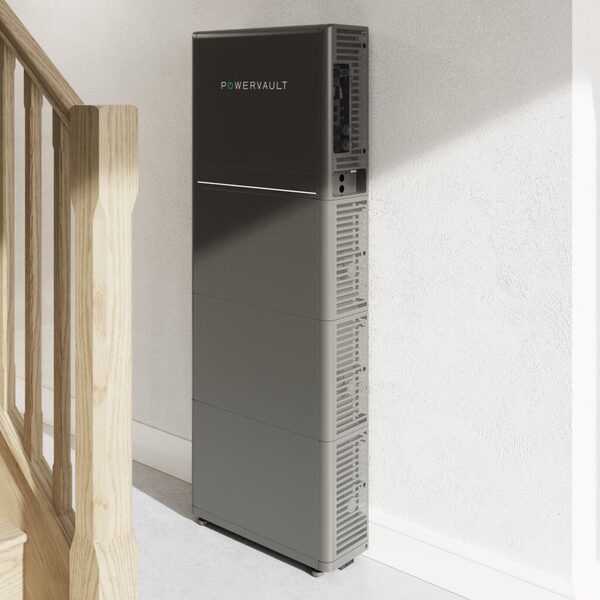
The P5 is sold in four nominal sizes, and the maker gives both a DC nominal figure and an AC usable figure for each. The gap between them is the capacity a household can actually cycle.
| Model | DC nominal | AC usable | Dimensions (w x h x d) | Weight |
|---|---|---|---|---|
| 5kWh | 5.12kWh | 4kWh | 640 x 955 x 210mm | 90kg |
| 10kWh | 10.24kWh | 8kWh | 640 x 1,330 x 210mm | 140kg |
| 15kWh | 15.36kWh | 12kWh | 640 x 1,755 x 210mm | 190kg |
| 20kWh | 20.48kWh | 16kWh | 640 x 2,180 x 210mm | 235kg |
The figures above are the maker's, accurate to plus or minus 5% and provided at 25 degrees C1. That temperature condition is not a footnote. The maker states charging power is reduced below 5 degrees C, and that charging and discharging power are de-rated at high temperature2. A battery sited in an unheated garage or on a north-facing external wall will spend part of the year operating below its rated figures, which is why ventilation and operating conditions matter as much as the headline capacity.
Other specification points: the P5 uses lithium-ion battery cells, carries in-built fire suppression as an additional safety feature, and is IP65-rated for indoor and outdoor installation1. Each unit is described as fully upgradeable up to 20kWh, and the range can be used in three phase systems1. The maker lists unlimited cycle life over 10 years2.
The capacity ladder is the practical point. A household choosing the 5kWh unit is buying 4kWh of usable storage, and the difference between nominal and usable figures is explained in battery capacity and usable capacity.
Warranty: 10 years, with the battery pack conditions that matter
The P5 comes with a 10-year warranty as standard, and the maker states this is included in the retail price1. The warranty applies only to Powervault P5 products, and only to products sold from 16 July 2024 to customers within the United Kingdom3.
Powervault warrants that the Base Product will be free from defects in materials and workmanship for the warranty period, and the remedy is at the company's sole discretion: either repair the defective Base Product or provide a replacement in exchange for it3. All replaced parts, modules and products remain the property of Powervault3.
Two exclusions carry real weight. First, any nominal DC kWh performance parameters are expressly excluded and disclaimed from the warranty, and all capacity calculations are in AC usable kWh measured under test conditions3. Second, no warranty is provided for any Internet Components, and providing an internet connection to the Powervault is the customer's responsibility3.
The battery pack has its own conditions. It is not considered defective if its performance in usable AC kWh under test conditions is the same as or greater than the End State of Health recorded on the Data Sheet, or if the Production Date of the Battery Pack on the customer sales invoice is more than 10 years old3. Where a pack does need replacing, the warranty sets a pro-rata discount off the price of a new pack by years since production date: 100% under one year, then 90%, 80%, 70%, 60%, 50%, 40%, 30%, 20% and 10% in successive years, falling to 0% after 10 years3.
Other terms: if the product is faulty or does not work on first delivery, up to 30 days, a refund or part refund may be claimed, and if the product cannot be repaired or replaced within the warranty period a refund or part refund may be available3. Powervault commits to provide upgrade options for 24 months following purchase for products stated as upgradable at point of purchase3. The wider landscape of retained capacity and throughput conditions is covered in home battery warranties.
Price: installer-quoted, with no published P5 figure
There is no published price for the Powervault P5 in the available figures. Prices are installer-quoted, and the VAT position is not stated.
The nearest published Powervault pricing is for the earlier Powervault 3, listed by Which? at £3,229 for the 4kWh unit and £4,999 for the 8kWh unit, both excluding VAT and installation6. That is a different product from the P5 and should not be read across as a P5 price, but it is the only published Powervault figure available and it indicates the order of magnitude the brand has occupied.
For context on what a home battery costs generally, and how quotes are built, see how much a home battery costs. The P5's modular design means the quote depends heavily on which of the four sizes is specified, whether the installation is indoor or outdoor, and whether the household is adding a battery to existing solar or starting from scratch. The 20kWh unit weighs 235kg and stands 2,180mm tall, so siting and mounting work will differ from a 90kg 5kWh unit1.
Company status: administrator appointed in November 2025
This is the section that should shape any decision about a P5.
Companies House recorded the appointment of an administrator for POWERVAULT LTD on 27 November 20254. A separate company, POWERVAULT PLUS LTD, was incorporated on 17 November 20255. The two events sit ten days apart.
The practical consequences for a household are these. A warranty is only as good as the entity standing behind it, and an administrator's role is to realise assets for creditors, not to honour consumer guarantees indefinitely. Spare parts, service visits and software support all depend on a trading operation continuing. The P5's monitoring and control run through a web portal that enables remote monitoring of energy production, consumption and battery status, adjustment of settings and schedules, and enabling of SMARTSTOR1. That portal depends on a company continuing to run it.
"Powervault will (at its sole discretion) either offer to: (i) repair the defective Base Product, or (ii) provide a replacement in exchange for the defective Base Product"
The maker states it has been assembling energy storage batteries in its UK factory for over 10 years, and the P5 is described as designed and manufactured in a UK factory1. That history is real, and the UK assembly base is a genuine differentiator among home batteries. It does not change the current corporate position. Anyone weighing a P5 against another brand should establish, before committing, who is responsible for service and warranty claims now, and get that in writing.
What the P5 means for energy independence
A home battery's contribution to independence is measured as self-sufficiency: the percentage of electricity consumed in the property over a year that is met by behind-the-meter solar or electrical energy storage, or the fraction met by self-consumed electricity7. The P5 addresses that figure directly by storing surplus solar generation and discharging it back to the home when needed, and by charging from the grid at off-peak times for use at peak hours2.
What it does not do is take a household off the grid. The P5 remains connected, still draws from a supplier, and still depends on the grid for the periods when stored energy runs out. The independence it offers is temporal, shifting when electricity is drawn rather than whether it is bought. Reducing dependency on imported gas is a separate question, addressed by electrification of heat rather than by storage alone8.
The dependencies the P5 adds are worth naming. Remote monitoring and scheduling run through a web portal and SMARTSTOR software, so they depend on a home internet connection, the maker's servers and a continuing company1. The warranty explicitly excludes internet components and places the responsibility for providing a connection on the customer3. Installation depends on a Powervault approved installer partner2. And the longest-term dependency of all is on the manufacturer remaining in a position to honour a 10-year term, which the administration filing puts in question4.
For a household in Scotland, where homegrown energy is framed as a route to greater energy independence, the storage case is the same as elsewhere in the UK, though the policy context differs8. The general principles of what storage can and cannot deliver are set out in home batteries and household energy independence, and the wider market in home battery storage.
Sources8 cited
- Powervault P5 product page, Powervault, 2026
- Powervault P5 brochure, Powervault, June 2025
- Powervault P5 warranty, Powervault, July 2024
- POWERVAULT LTD filing history, Companies House, November 2025
- POWERVAULT PLUS LTD, Companies House, November 2025
- Solar panel battery storage, Which?, May 2026
- MCS 032 self-consumption calculation, MCS Certified, 2025
- Solar Energy Scotland manifesto, Solar Energy UK, 2026
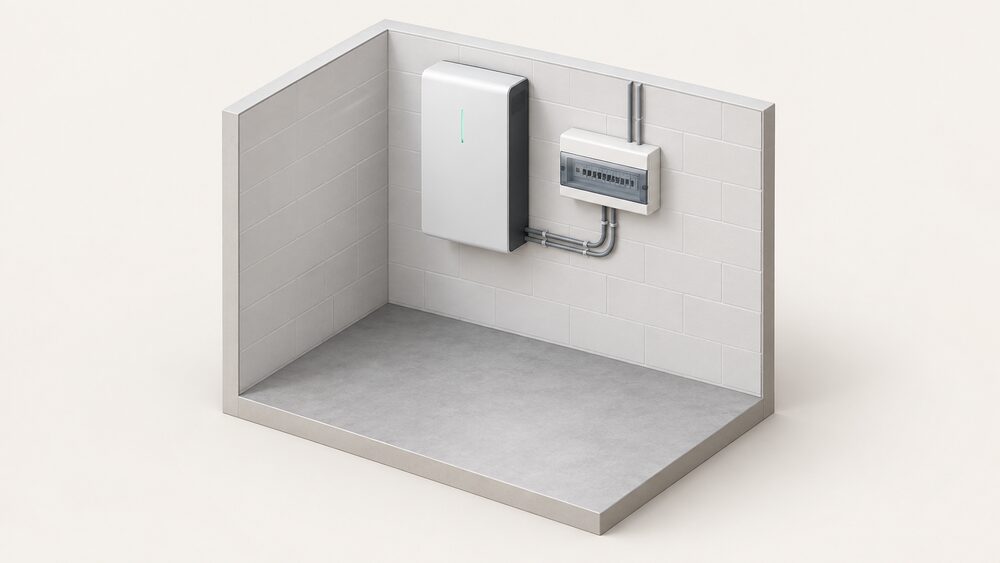 Powervault home battery storagePowervault made home batteries in two sizes, and many households want to know what they cost and whether the ten year warranty still means anything now the company has gone into administration.