In this guide
Ampair was one of the longest-running names in British small wind, building micro turbines for boats, remote sites and, for a period, homes. The company behind it, Ampoweruk, ceased trading on 2nd November 20211. That single fact governs everything else on this page: there is no factory to honour a warranty, no parts desk, no technical support line and no new stock. An Ampair turbine still turning today is kept going by its owner, by the second-hand market and by independent engineers.
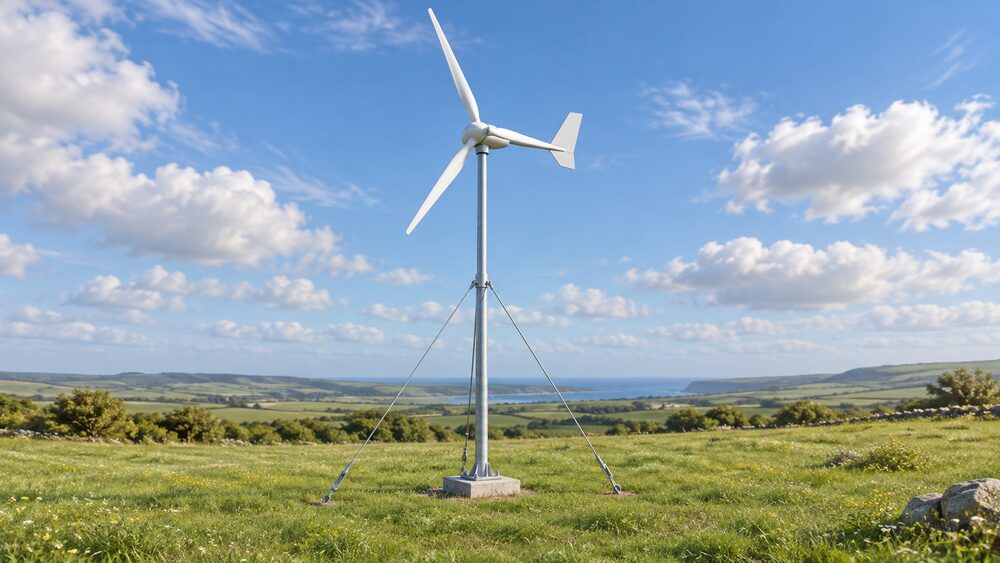
The machine most people search for is the Ampair 600, a 600 W turbine sold in two forms. The building-mounted version uses 1.7 m blades and starts generating at about 3.5 m/s. The pole-mounted version uses 5.6 m blades and starts at about 2.7 m/s. Both reach their rated 600 W only in strong wind, around 11.5 to 12.5 m/s, which is well above the 5 m/s average that independent guidance treats as the threshold for considering a small turbine at all2.
For a household, the practical position is narrow but not hopeless. A 600 W machine is a battery charger and a supplement, not a substitute for a grid connection or a full off-grid power system. What has changed since 2021 is the support structure around it, not the physics. Owners are now on their own for spares, and buyers are buying a second-hand machine with no manufacturer behind it.
Ampair entered administration: what that means for owners and buyers
The failure of a small wind manufacturer is not like the failure of an energy supplier. When a domestic energy supplier goes out of business, the process is managed: the household does not need to do anything, is moved automatically to a new supplier, and the supply is not interrupted4. There is no equivalent mechanism for a turbine maker. No regulator steps in to keep spares flowing, and no successor is appointed to honour guarantees.
What that leaves is a machine with a finite pool of parts. Consumables and standard components are not a problem: bearings, fastenings, cable, fuses and many electrical items are generic and can be matched by an engineer. The difficult items are the ones unique to the design, principally blades, the hub and any proprietary controller or regulator board. Once the second-hand pool of those is exhausted, a damaged turbine becomes a repair project rather than a parts order.
Owners should also be clear that any warranty given at the time of sale is now effectively unenforceable against the maker. A workmanship warranty from the installing company may still stand if that business is trading, and a handover pack issued at completion, including product details and the workmanship warranty, is the document that matters in that case5. For anything bought second-hand, there is no warranty at all unless a private seller offers one.
The wider market context is that small wind in the UK is a thin sector. The Feed-in Tariff, which once supported it, is closed to new applicants, and the accredited generators who remain are simply the owners of installations already in the scheme6. Anyone weighing an Ampair against a currently supported technology should read microgeneration for the wider picture, and Proven Energy wind turbines and Evance wind turbines for two other UK makers that failed.
What the Ampair 600 was: a 600 W turbine for marine and off-grid use
The Ampair 600 belongs to the small end of a very wide category. Individual wind turbines vary in size and power output from a few hundred watts to two or three megawatts, where one megawatt equals 1,000 kilowatts5. At 600 W, the Ampair sits at the bottom of that range, in the class of machine intended to charge a battery bank rather than to run a house.
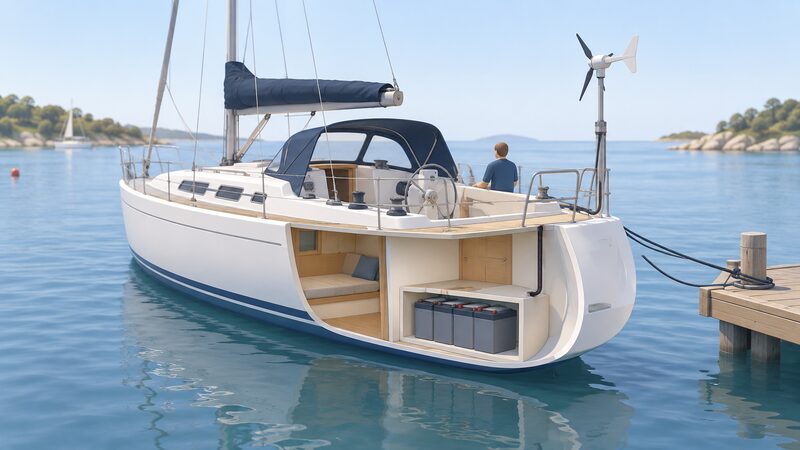
That class has a clear role. Off-grid and marine installations use small turbines to top up batteries, and the value of a 600 W machine is that it produces something in weather when solar produces little, particularly through winter and overnight. It is a complement to a solar array and a battery, not a replacement for either. The off-grid wind power page covers how a turbine, controller, dump load and battery bank fit together.
It is worth being precise about what the 600 W figure means. It is a rated output at a specified wind speed, not an average. A turbine rated at 600 W does not deliver 600 W for most of the year; it delivers a small fraction of that in ordinary weather and approaches the rating only in a strong, steady blow. The rated figure is a label for the machine's class, and the annual yield is a function of the site.
For scale, the UK's onshore wind ambition is 30 GW7, and offshore deployment ambition runs to 50 GW8. A single 600 W machine is a rounding error against those numbers, and it is not meant to be anything else. Its purpose is local: a few hundred watts where there is no grid, or a modest offset where there is.
Two versions of the 600: building-mounted or pole-mounted
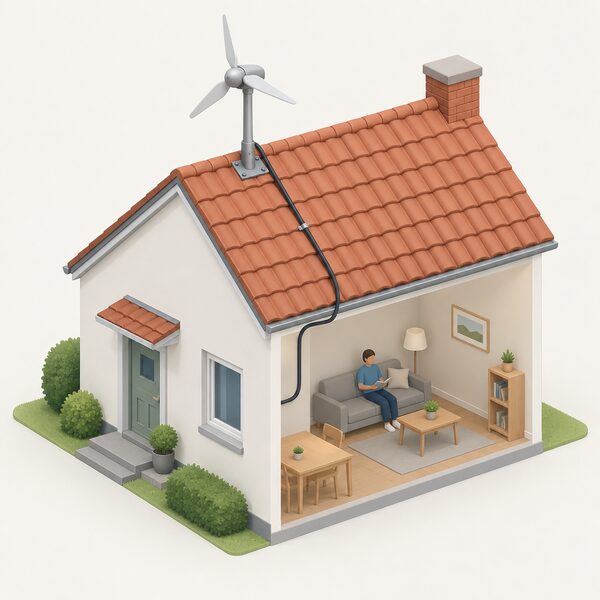
Domestic wind turbines in the UK come in two main types: the freestanding or pole-mounted turbine, and the roof-mounted turbine6. Ampair offered the 600 in both forms, and the choice between them is the single biggest determinant of how much the machine will actually produce.
Building-mounted turbines can be installed on the roof of a home, or on rooftops and building sides3. They cost less to install than pole-mounted machines, but tend to be less efficient9. The reason is the wind itself: studies show building-mounted turbines to be far less effective owing to lower wind speeds in built-up areas6. A roof is a convenient place to put a turbine and usually a poor place to find steady air.
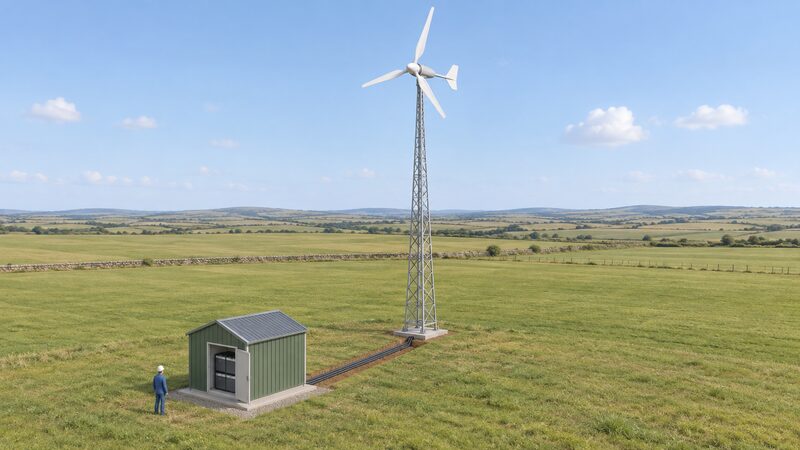
Pole-mounted turbines stand on their own mast, usually placed in a clear, open area where there is plenty of wind5. Free-standing turbines work best in a large open place that is exposed to the wind3. The trade-off is cost and permission: a mast needs ground, a foundation and often a planning application, but it puts the rotor in the resource.
| Version | Blade diameter | Cut-in wind speed | Typical mounting |
|---|---|---|---|
| Building-mounted 600 | 1.7 m | about 3.5 m/s | Roof or building side |
| Pole-mounted 600 | 5.6 m | about 2.7 m/s | Free-standing mast, open ground |
The comparison generalises beyond Ampair. Pole-mounted vs roof-mounted wind turbines sets out the same trade-off across the market, and roof and building-mounted wind turbines deals with the mounting and structural questions in detail.
Building-mounted 600: 1.7 m blades, cut-in at 3.5 m/s
The building-mounted 600 is the compact version: 1.7 m blades and a cut-in speed of about 3.5 m/s. Cut-in is the wind speed at which the rotor starts turning fast enough to generate, and 3.5 m/s is a light breeze. The machine will begin producing in conditions that are common in most of the UK, which sounds encouraging until the second figure is considered: the wind at roof level is slower and far more turbulent than the wind measured at a mast in open ground.
That turbulence matters more than the average speed. A roof-mounted rotor sits in the disturbed air created by the building itself, and the same studies that find building-mounted turbines less effective attribute it to lower wind speeds in built-up areas6. The turbine may spin often and generate little, because gusty, direction-changing air does not drive a rotor efficiently.
Planning is the other constraint, and it is stricter than many owners expect. Permitted development rights do not apply to wind turbines mounted on a dwellinghouse or a building within its curtilage10. In practice that means a building-mounted turbine normally needs a planning application, and the official guidance is to always check with the Local Planning Authority about planning issues before a system is installed11. Where permitted development does apply, the limits are tight: no part of the turbine including blades may protrude more than three metres above the highest part of the roof excluding the chimney, no part may be within five metres of any boundary, and the swept area must be no more than 3.8 square metres8. The same three metre and 15 metre height limits appear in the legislation for Class H12.
Pole-mounted 600: 5.6 m blades, cut-in at 2.7 m/s

The pole-mounted 600 is the same 600 W machine with a much larger rotor: 5.6 m blades and a cut-in speed of about 2.7 m/s. The longer blades sweep a bigger area, capture more energy from the same air and start turning in a lighter breeze. This is the version that makes sense on a rural site, a smallholding or a coastal property with open exposure.
The siting rule is straightforward. Pole-mounted turbines need a clear, open area with plenty of wind5, and free-standing machines work best in a large open place exposed to the wind3. A mast in the lee of trees, buildings or a hill will underperform regardless of the machine bolted to it. The wind speed and siting page covers how to judge a site, and how to find the wind speed at my postcode explains the tools available for an initial estimate.
Planning for a free-standing turbine is more permissive than for a building-mounted one, but the limits are specific. The highest part of a stand-alone turbine must not exceed 11.1 metres10, and any part of the turbine including blades must be at least the overall height of the turbine plus 10 per cent of its height from any point along the property boundary9. In Scotland, Class 6G permits a free-standing turbine within the curtilage of a dwelling, with a blade tip height limit of 15 m and the lowest part of the blade at least 5 m from ground level13. A Scottish Government consultation proposed a maximum turbine height of 15 m measured to the tip of the wing blades, and a rule that no part of the turbine including blade tips would be less than 5 m from the ground15.
| Rule | England and Wales | Scotland |
|---|---|---|
| Maximum height | 11.1 m to highest part10 | 15 m blade tip height13 |
| Blade clearance | Not stated in the same terms | At least 5 m from ground level13 |
| Boundary rule | Overall height plus 10 per cent from any boundary point9 | Not stated in the same terms |
Rated power at 11.5 to 12.5 m/s: what the figures mean in practice
The 600 W rating is reached at roughly 11.5 to 12.5 m/s. That is a strong wind, equivalent to a stiff breeze at the top of the range that most inland sites see only occasionally. The gap between the cut-in speed of 2.7 or 3.5 m/s and the rated speed of 11.5 to 12.5 m/s is where the machine spends almost all of its life, producing somewhere between nothing and a fraction of its label.
This is why independent guidance is so insistent on the site. The Energy Saving Trust recommends considering a wind turbine only where the local annual average wind speed is five metres per second or more5, and the same threshold of at least 5 m/s appears in consumer guidance6. Independent guidance puts the optimum wind speed for a turbine at around five metres per second9. Below that average, a small turbine's output falls away sharply, and the economics rarely work.
For context on what a larger machine can do, a well-sited 6 kW pole-mounted turbine can provide enough power to supply two average homes16, and pole-mounted turbines typically produce 3 to 15 kWh of electricity5. A 600 W machine is roughly a tenth of that class, and its realistic contribution is battery charging and a modest offset rather than household supply.
The honest summary is that the rated figure tells a buyer what class of machine they are looking at, and the site tells them what it will produce. Two identical Ampair 600s, one on a sheltered roof and one on an exposed mast, will have annual outputs that differ by a large multiple. The wind turbine output and sizing page works through the relationship between swept area, wind speed and yield.
What owning an Ampair means for energy independence now the company has failed
A small wind turbine does something specific for a household's independence: it generates electricity on site, from a resource nobody sells, and it does so at times when solar does not. The benefits of a domestic turbine are free electricity, the option of electricity storage, and a reduced or eliminated home carbon footprint6. For an off-grid property, that is the difference between running a generator and not.
What it does not do is remove dependence. A grid-connected turbine still relies on the grid for the times it is not producing, and on a supplier for the electricity it imports. Any unused or excess electricity can be exported to the grid and sold to a local electricity supply company5, but that is a sale, not a severance. The micro wind, hydro and CHP and energy independence page sets out where the boundary between self-sufficiency and grid reliance actually falls.
The Ampair failure adds a second layer of dependence, this time on a company that no longer exists. There is no maker to call, no warranty to enforce and no new bespoke spares. Owners depend on the second-hand market, on independent engineers and on their own maintenance. Maintenance checks are necessary every few years and generally cost around £100 to £200 per year depending on the turbine size3, and that cost now buys an independent engineer's time rather than a manufacturer's service.
On funding, the position is bare. There is no financial support available for homeowners who wish to generate their own electricity through domestic renewable technologies2, and there are currently no specific schemes that can help fund a wind turbine installation3. Wind turbines were removed from the list of qualifying energy-saving materials for reduced VAT, a change the UK was required to make in 201917, and in Northern Ireland wind turbines do not qualify for the reduced rate, attracting 20 per cent VAT19. The Feed-in Tariff is closed, and its accredited generators are simply the owners of installations already in it6. Ofgem's scheme year 13 report records 1,273 MW of wind installed capacity across the scheme20, and the separate Smart Export Guarantee annual report for 2022-23 records seven wind installations registered under that scheme21, a figure that shows how little new small wind has been connected.
For a household weighing an Ampair today, the calculation is about condition and site, not brand. A used machine with sound blades, a working controller and an exposed mast can still earn its keep in an off-grid or marine setting. The same machine on a sheltered roof, with no spares behind it, is a maintenance liability. The installing and maintaining a domestic wind turbine page covers what a service visit involves, and small wind turbine standards and certification explains the certification position for machines bought new.
Sources21 cited
- Yu Energy Retail Limited dispute decision, Energy Ombudsman, 2026
- Support to generate your own electricity, nidirect, 2025
- Wind turbines, Energy Saving Trust, 2026
- Switch your home energy supplier, Ofgem, 2026
- Small wind turbines, MCS Certified, 2026
- Wind, nidirect, 2026
- Wind turbines, Uswitch, 2026
- Wind turbines, Home Energy Scotland, 2026
- Planning permission: building-mounted wind turbines, Planning Portal, 2026
- Planning permission: stand-alone wind turbines, Planning Portal, 2026
- Class H: installation or alteration of wind turbine on domestic premises, legislation.gov.uk, 2026
- Planning permission for wind turbines, Welsh Government, 2026
- Circular 1/2024: householder permitted development rights, Scottish Government, 2024
- Circular 1/2024: householder permitted development rights (PDF), Scottish Government, 2024
- Review of permitted development rights: phase 3 consultation analysis, Scottish Government, 2024
- Wind turbines, Planning Portal, 2026
- Feed-in Tariffs, Ofgem, 2026
- Feed-in Tariffs annual report, scheme year 13, Ofgem, 2023
- Smart Export Guarantee annual report 2022-23, Ofgem, 2023
- Energy-saving products and VAT, GOV.UK, 2026
- Explanatory memorandum: VAT on energy-saving materials, legislation.gov.uk, 2022