In this guide
KACO new energy is a German inverter manufacturer whose residential offer sits in two families: the blueplanet NX3 string inverters and the blueplanet hybrid NH3 units that combine solar PV and battery storage in one enclosure. The company describes its inverters as equipment "for solar PV plants, battery storage and more energy efficiency", and lists a dedicated application range for residential PV and battery storage1.
For a UK household, the practical shape of the range is this. The blueplanet 3.0 NX3 to 20.0 NX3 M2 covers residential and commercial solar PV plants as a three-phase string inverter, in power classes of 3.0, 5.0, 8.0, 10.0, 15.0 and 20.03. The blueplanet hybrid 6.0 NH3 to 12.0 NH3 covers residential and small commercial battery storage and solar PV systems3. Both are monitored through blueplanet smartcloud, the portal KACO developed with Siemens, which replaced the older blueplanet Web Public interface from 1 January 20264.
The brand's strongest published technical claim is not a headline efficiency figure but a study. KACO commissioned Fraunhofer Institute for Solar Energy Systems ISE to compare multi-MPPT against single-MPPT operation, published the report on 9 November 2021 and presented the results with Fraunhofer in a pv magazine webinar on 28 February 20225.
What KACO new energy makes: PV inverters and battery storage
KACO new energy's product scope runs from domestic string inverters to utility-scale equipment. The company's own framing is that its inverters serve "solar PV plants, battery storage and more energy efficiency", and that they are "equipped with many useful features", with accessories offered to meet individual system technology requirements1.
The portfolio document dated 1 June 2025 sets out the tiers. At the residential end sit the blueplanet 3.0 NX1 to 5.0 NX1 single-phase string inverters and the blueplanet 3.0 NX3 to 10.0 NX3 three-phase string inverters, both described as residential5. The blueplanet hybrid 6.0 NH3 to 12.0 NH3 covers hybrid inverters for residential and small commercial battery storage and solar PV systems5. Above that, the blueplanet 100 NX3 and 125 NX3 support up to 200% DC oversizing, and the blueplanet gridsave TL3-S range provides bidirectional battery inverters for commercial and industrial energy storage5.
That spread matters for a householder because it indicates where the company's engineering attention sits. The residential products are a genuine part of the catalogue, not a badge exercise, but the commercial and utility products carry the more distinctive technical claims, including the silicon carbide inverters used in a 1 MW solar roof in Dammam, Saudi Arabia, reported in November 2019 as the country's first installation using 1500 V components5.
KACO also builds for grid operators' requirements rather than only for households. Its inverters can be configured for zero feed-in, and can be set to feed in only a certain amount of solar energy, which is the configuration used where a network operator restricts export6. In February 2025, ELES, Slovenia's transmission system operator, added several KACO new energy inverters to its approved list, and in September 2024 the company described a flexible frequency support system in Sweden5. Those are grid-services applications, but they show the same control functions that domestic export limitation relies on. For how export limitation works on a home system, see export limitation and G100.
Residential scope: PV and battery storage in one application range
KACO groups its domestic products under a single application heading: inverters for residential PV and battery storage. The company describes that range as carrying "extensive standard features for communication and maintenance"2.
The hybrid family is the part that matters for a home wanting storage. The blueplanet hybrid 6.0 NH3 to 12.0 NH3 is listed as hybrid inverters for residential and small commercial battery storage and solar PV systems, and blueplanet smartcloud supports those units directly3. The string family, blueplanet 3.0 NX3 to 20.0 NX3 M2, is a three-phase string inverter for residential and commercial solar PV plants, with power classes at 3.0, 5.0, 8.0, 10.0, 15.0 and 20.03. A household choosing the string route adds storage as a separate AC-coupled battery system rather than through the inverter.
| Family | Type | Application | Power classes |
|---|---|---|---|
| blueplanet 3.0 NX1 to 5.0 NX1 | Single-phase string | Residential5 | Not stated |
| blueplanet 3.0 NX3 to 20.0 NX3 M2 | Three-phase string | Residential and commercial PV3 | 3.0 / 5.0 / 8.0 / 10.0 / 15.0 / 20.03 |
| blueplanet hybrid 6.0 NH3 to 12.0 NH3 | Hybrid | Residential and small commercial battery storage and PV3 | 6.0 to 12.03 |
| blueplanet 100 NX3 / 125 NX3 | String, utility | Commercial and utility5 | Up to 200% DC oversizing5 |
| blueplanet gridsave TL3-S | Bidirectional battery | Commercial and industrial storage5 | Not stated |
The wider context is that battery storage is normally paired with generation or a tariff rather than standing alone. Independent guidance states that "home battery storage is usually used in combination with solar panels or a smart time of use tariff, or both"7. KACO's hybrid range assumes the first of those pairings. Households weighing whether to add storage at all, and what it does to self-consumption, will find the trade-offs set out in adding battery storage to solar.
MPPT performance: what the Fraunhofer ISE study found
The most substantial independent technical work attached to the KACO name is a maximum power point tracking study. KACO new energy published the report on 9 November 2021, stating that the study was conducted by Fraunhofer Institute for Solar Energy Systems ISE on behalf of KACO new energy GmbH. On 28 February 2022 the company presented the study results together with Fraunhofer ISE in a pv magazine webinar5.
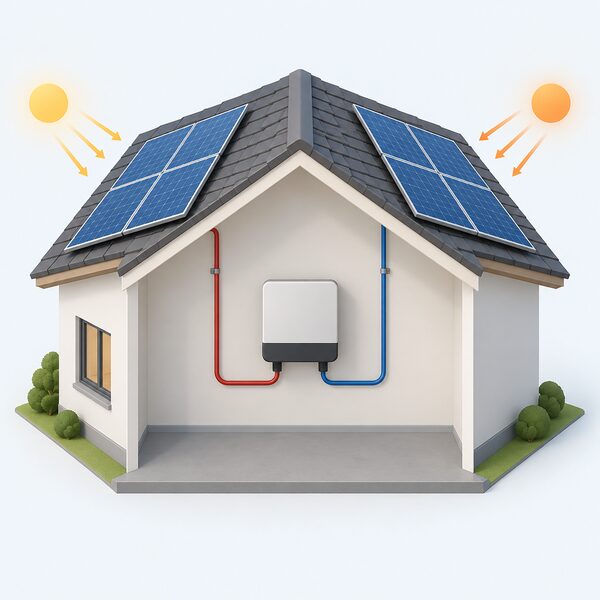
The subject is multi-MPPT against single-MPPT operation. A maximum power point tracker continuously adjusts the operating voltage of a PV array so that it delivers its peak power under the conditions at that moment. Where an array is split across trackers, each section can be optimised separately, which matters when parts of a roof face different directions or sit under different shading. Where a single tracker serves the whole array, one compromise voltage is applied to all of it.
The study's significance for a household is that it addresses the case for multiple trackers with measured data rather than assertion. The material reviewed here does not reproduce the study's numerical findings, so the yield difference between the two configurations cannot be stated here. What can be said is that the work was commissioned by the manufacturer and carried out by a research institute, which is a stronger basis than a maker's own marketing claim, and that KACO chose to publish it and to present it publicly with the institute.
For a home, the practical question is how many trackers a roof needs. A single-plane, unshaded roof rarely needs more than one. A roof with an east and a west pitch, or with a chimney casting a shadow across part of the array, is where separate trackers earn their place. The general principles are covered in string inverters for home solar and roof orientation, pitch and shading.
Monitoring and data: the blueplanet Web phase-out
KACO's monitoring arrangements changed at the start of 2026, and any household running an older KACO system needs to know about it. The company states that "starting January 1, 2026, the blueplanet Web Public user interface will be phased out", and its product page for the platform carries the notice "WE ARE PHASING OUT"2.
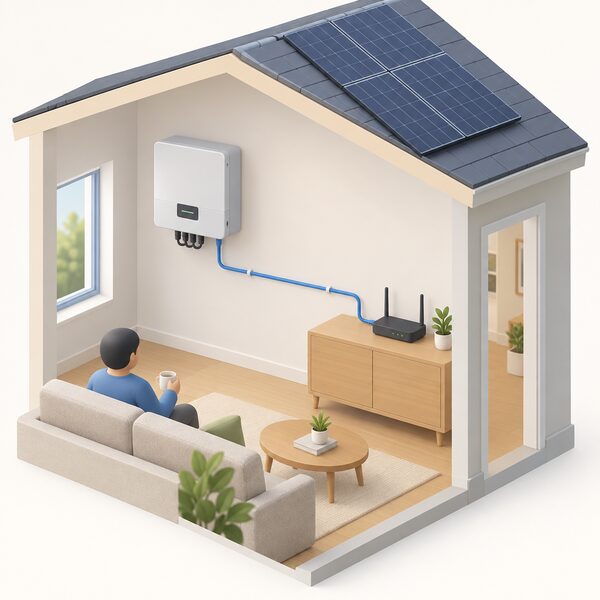
The replacement is blueplanet smartcloud. KACO describes it as a portal the company "developed its own, new monitoring portal together with Siemens", and separately as developed "together with Siemens"3. Data migration from the old portal was scheduled to begin on 15 November 2025, with users told to "begin migrating your data from the old portal starting November 15, 2025"4.
Three things about the transition are worth noting. First, existing hardware is not stranded: KACO states that "it is also possible to let inverters that are already in operation be monitored by the blueplanet smartcloud"3. Second, the NX3 solar PV inverters require the Connect-GEN2 communication unit to connect to the new portal, so an older installation may need that unit fitted3. Third, the portal supports both installer and system owner access levels, so a householder can hold their own login rather than relying on the installer3.
KACO also offers a home energy management system under the blueplanet edition, which the company says provides "seamless integration of blueplanet string and hybrid inverters", PV surplus management and the ability to use various types of interfaces8. Registration for the blueplanet web pro service is not an online sign-up: the form is downloaded, completed offline and returned as a PDF by email to service(at)kaco-newenergy.de4. For the general principles of reading inverter data, see monitoring a solar PV system.
Cybersecurity and certification: ISO 27001 and the 360 NX3
KACO's cybersecurity work sits mostly above the domestic range, but the certification behind it applies to the company. In February 2026 KACO new energy reported that it had achieved DIN EN ISO 27001 certification, the international standard for information security management5.
The product associated with that push is the blueplanet 360 NX3. In January 2026 the company reported that the unit addresses cybersecurity in the utility-scale segment, and on 12 January 2026 that it "sets new standards for cybersecurity in the utility-scale segment and strengthens the resilience of the European energy supply"5. On 19 February 2026 KACO announced direct delivery of the blueplanet 360 NX3 to the Regensburg Ost energy site, supporting implementation of that project5.
The 360 NX3 is not a residential inverter. Its power class and its application place it in the utility segment, well above the blueplanet NX3 and NH3 families a household would install. The relevance to a domestic buyer is indirect but real: an inverter is a networked device with a communications path, and the security posture of the manufacturer's whole product line is a reasonable indicator of how the residential units are maintained. The same February 2026 announcement covered planning work between blueplanet gridsave and Lumera Energy on decentralised and flexible energy systems5.
"KACO new energy has developed its own, new monitoring portal together with Siemens."
A householder should read the certification as a company-level fact rather than a guarantee about a specific domestic model. The material reviewed here does not state which residential inverters fall inside the ISO 27001 scope, nor does it give a security specification for the NH3 or NX3 families. What it does establish is that the manufacturer treats information security as a certifiable management system rather than a marketing line, and that the newest utility product was launched on that basis.
Where KACO inverters are listed and available
KACO new energy is a German manufacturer, and the material reviewed here does not include a UK distributor list, a UK price list or a UK stockist directory. Prices for KACO residential inverters are therefore installer-quoted, and no range can be given here.
What the material does show is where the products have been accepted onto third-party approved lists. In February 2025, ELES, Slovenia's transmission system operator, officially added several of KACO new energy's newest inverters to its approved list5. That is a European grid-operator approval rather than a UK one, and it is worth reading as evidence of type approval in a regulated market rather than as availability in Britain.
For a UK installation, the connection route runs through the network operator. UK Power Networks states that "your installer should contact us on your behalf" for low carbon technology upgrades, so the application for a connection or an upgrade is made by the installer rather than the householder9. The general framework for domestic connections is set out in connecting solar to the grid: G98 and G99.
Two further points bear on availability. KACO's residential range is described in the portfolio document as covering single-phase and three-phase string inverters plus the hybrid NH3 series, which is a narrower domestic catalogue than the largest inverter brands carry5. And the company's service contact is a German head office address and number, service@kaco-newenergy.de and +49 7132 896-1000, rather than a UK support line5. A household considering the brand should establish with the installer what the support route looks like in practice before committing.
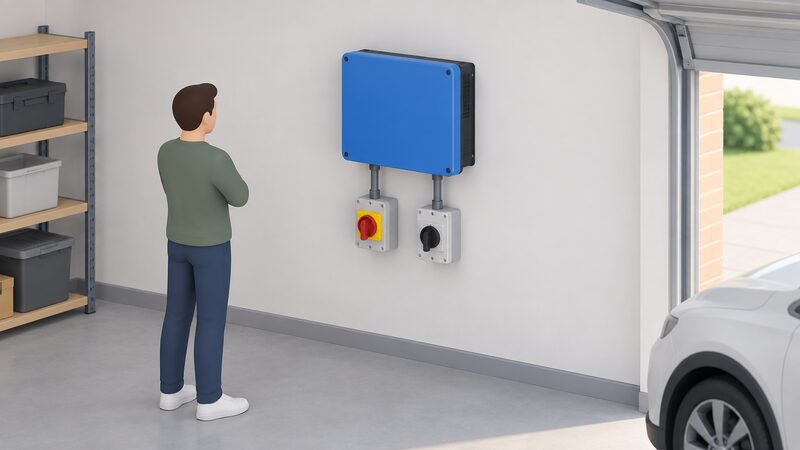
What a KACO inverter means for household energy independence
An inverter is the component that turns a roof array into usable electricity. Independent guidance describes the function plainly: the direct current from the panels "passes through a solar inverter to create an alternating current (AC), which is the type of current used to power homes"10. Everything a household gains from solar runs through that conversion, and everything it remains dependent on runs through it too.
KACO's contribution to independence is the control it offers over where the power goes. The company states that its inverters "can be configured for zero feed-in", and that in that configuration "you can thus make sure that 100% of the solar energy produced is used locally and not fed into the public grid"6. It also states that the inverters "can be set to feed in only a certain amount of solar energy", which is the setting used where a network operator caps export6. Those two functions are the difference between a system that serves the house first and one that serves the meter.
The dependence that remains is straightforward. A grid-connected KACO inverter still needs the grid to operate in its normal mode, and the household still buys whatever the array and battery cannot cover. Monitoring adds a second layer: blueplanet smartcloud is a manufacturer's portal, developed with Siemens, and remote visibility depends on the household's broadband connection and on KACO continuing to run the service3. The phase-out of blueplanet Web Public is a live demonstration of what that dependence means, since users had to migrate their data to keep their records4.
The wider case for homegrown generation is made by the industry itself. Solar Energy UK states that "more homegrown energy means greater energy independence"11. That is a general claim about generation rather than about any one inverter brand, and it holds regardless of whose equipment is on the wall. Households wanting the fuller picture of what independence does and does not mean for a home with solar should read solar panels and household energy independence.
Sources11 cited
- Solutions, KACO new energy, 2026
- Inverters for residential PV and battery storage, KACO new energy, 2026
- blueplanet smartcloud, KACO new energy, 2026
- Monitoring, KACO new energy, 2026
- Portfolio KACO 2025, KACO new energy, 1 June 2025
- Zero feed-in and dynamic power regulation, KACO new energy, 2026
- Battery storage, Energy Saving Trust, 19 August 2026
- Leaflet HEMS, blueplanet edition, KACO new energy, 2026
- Adding more power: what's involved, UK Power Networks, 2026
- How do solar panels work?, Smart Energy GB, 16 March 2026
- Solar Energy Scotland manifesto, Solar Energy UK, 2026