
In this guide
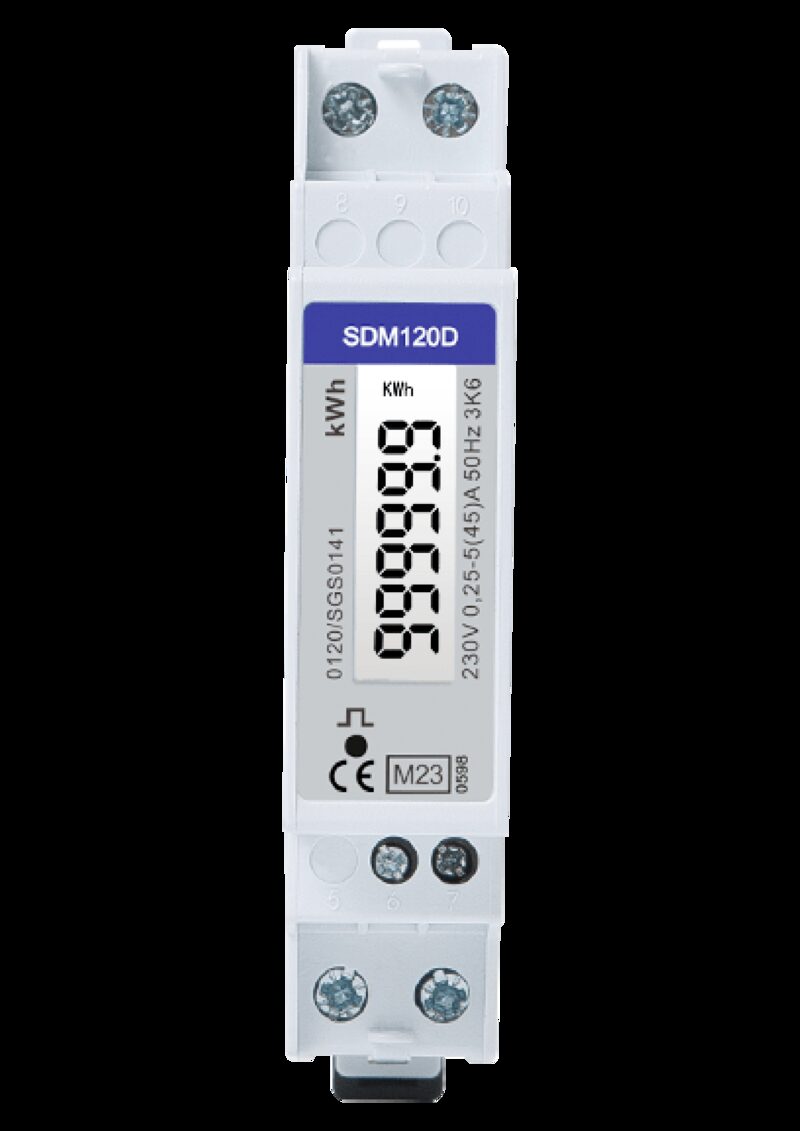
An Eastron SDM meter is a DIN-rail-mounted electricity meter that measures alternating current power flows at the point where a property connects to the grid. The maker describes it as providing revenue-grade measurement of AC power flows at the grid connection point, with accurate import and export readings and RS485 Modbus RTU communications1. In a UK home it is the metering layer behind a solar, battery or export limitation setup: it tells the control system how much power is coming in, how much is going out, and how much the inverter is allowed to push to the network.
It is not a replacement for the supplier's meter. The meter on the wall that the energy company reads and bills from remains the billing instrument, and the Eastron sits downstream of it, inside the household's own installation. What it adds is fast, local, bidirectional measurement that a control system can act on, rather than a monthly or half-hourly figure arriving through a supplier.
The practical consequence is that an Eastron meter is an electrician's job, not a plug-in device. It is wired in series with the supply, so the conductors carrying the load pass through it, and that work requires the circuit to be isolated first. The sections below set out what the meter records, how it is fitted, where it is used, and what it does and does not do for a household's energy independence.
What an Eastron SDM meter does in a home monitoring setup
The meter's job is to sit at the boundary between the property and the network and report what crosses it. The maker lists three control functions built on that measurement: zero-export, peak-shaving and time-of-use algorithms1. Zero-export is the one most UK households meet first, because it is what allows a solar or battery inverter to be run without exporting to the grid at all, or without exporting beyond a set ceiling. Peak-shaving uses the same live reading to hold down the amount drawn from the grid during expensive periods, and time-of-use algorithms shift when the system charges or discharges.
That is a different function from the supplier's smart meter. A smart meter automatically sends electricity and gas meter readings to the supplier, and typically displays data on an in-home display unit, offering transparency about energy use3. The data path runs outward, to the supplier, and the household sees a summary. An Eastron meter's data path runs inward, to a controller, and the controller can act on it in seconds. The two are complementary: the supplier's meter settles the bill, the DIN-rail meter drives the equipment.
For a household, the difference matters most when something needs to respond faster than a half-hourly settlement period. Export limitation, in particular, is a control loop rather than a record. The meter reads the flow, the inverter adjusts its output, and the loop repeats. Without a meter at the connection point, that loop has nothing to close on.
Import and export readings: what the meter records
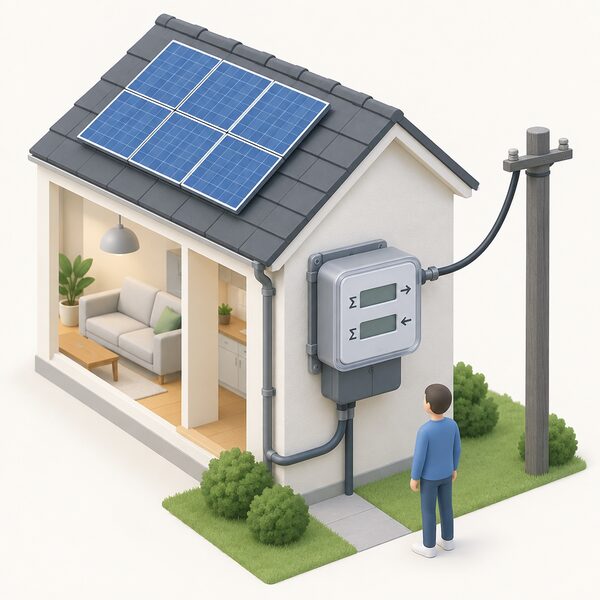
Bidirectional measurement is the defining feature. The maker states the meters give accurate import and export readings1, which means the same device registers power flowing into the property and power flowing back out to the network. For a home with solar, that is the difference between a system that can only see consumption and one that can see generation and export as well.
The distinction between import and export is well established in UK metering practice, even if the display conventions vary. On an import/export meter with a sigma display, the default display shows a small sigma near the bottom of the screen, which is the total import, and another read then displays with a small sigma on the same screen, which is the total export, reached after cycling through time, date and rates 1, 2, 3 and 45. NIE Networks describes the same convention in its own guidance6. On an Economy 7 import/export meter the convention differs: the display shows a small 5 followed by five numbers, and those five numbers are the export reading6. All meters are read from left to right5.
Export measurement also carries regulatory weight where payments depend on it. Feed-in Tariff payments are based on generation and export meter readings7, and an export meter is always located at the point where the installation connects into the distribution or transmission network, and must measure export separate from any other energy source unless pro-rating is available8. An export meter must be capable of taking measurements at half-hourly intervals in relation to the exported electricity volumes for which payment is sought9. Metered export is defined as export payments made based on export meter readings, as opposed to deemed export10.
"An export meter is always located at the point where the installation connects into the distribution or transmission network"
Where a shared meter is involved, the rules tighten. If pro-rating is available and the shared meter is an export meter, then the electricity exported can be accurately measured, but deemed export payments are not available in that case8. Even where deemed export applies, a valid generation meter reading must still be provided to receive deemed export payments8. Supplier audits of generation and export meter readings should be proportionate to the level of abnormal readings, and can range from desk-based investigation to onsite visits11.
DIN-rail installation: wiring in series with the supply
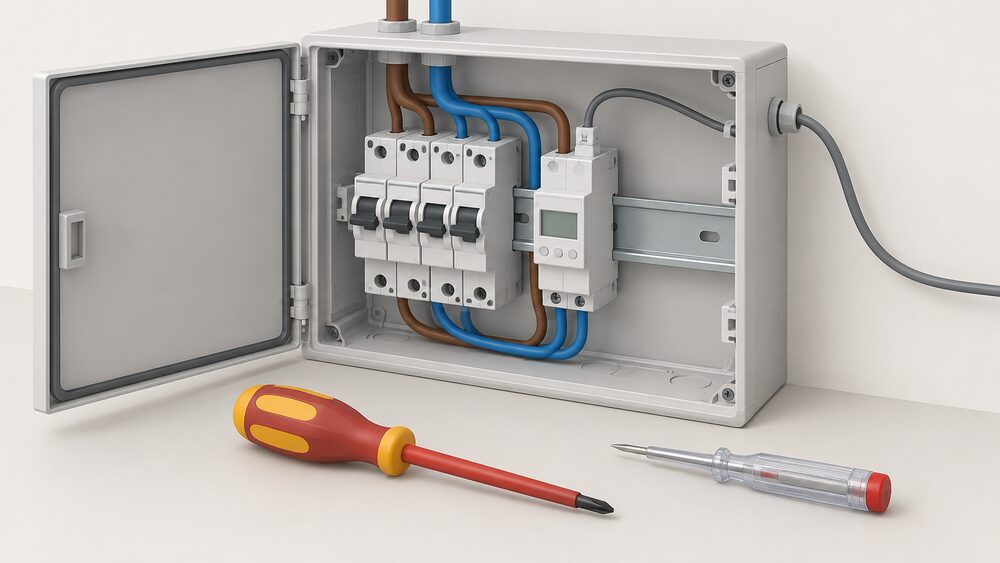
A DIN-rail meter clips onto the standard rail used inside consumer units and control panels, the same strip that holds miniature circuit breakers. The maker lists the mounting as DIN-rail-mounted and the communications as RS485 Modbus RTU1. That combination explains why the device appears so often in home energy setups: it fits into an existing enclosure, and it speaks a protocol that inverters, batteries and home energy management systems already understand.
Series wiring is the part that determines what the meter can do. Because the load conductors pass through the meter rather than being clamped around them, the meter measures the actual current in the circuit rather than inferring it from a magnetic field. That is what supports the revenue-grade description1. It also means the meter is part of the circuit, not an observer of it, and the installation has to be planned as such: correct conductor sizing, correct isolation, and a Modbus cable run back to whatever is reading it.
For a household, the practical points are these. The meter needs a spare way or a dedicated enclosure, it needs a communications cable as well as the power conductors, and it needs to be positioned where the electrician can reach it for testing. Where a system is being added to an existing installation, the meter is usually fitted at the same time as the inverter or battery, so the enclosure and cable routes are planned once.
Isolating the supply: why installation is not a DIY job
Fitting a meter in series with the supply means opening conductors that are live under normal operation. The circuit has to be isolated before that happens. For scale, a supplier smart meter installation requires the electricity supply to be turned off for up to an hour to allow the installation to go ahead12. A DIN-rail meter inside an existing installation is isolated at the appropriate protective device, but the principle is the same: the conductors are dead before they are opened.
The trade rules reinforce this. Independent guidance on domestic distributed generation states that only accredited companies are allowed to install small-scale embedded generation, and that to make sure installations are safe and comply with all of the regulations, that restriction exists for a reason2. On new connections, an electrician cannot install the new connection but can do internal works from the meter to the consumer unit13. Metering and connection work sits with accredited parties; internal wiring sits with the household's electrician.
There is a second reason the work is not a like-for-like swap. A distributed generation installation switches itself off until after the mains supply has been restored, to protect itself2. That behaviour is a safety feature, but it means the system's response to a supply interruption has to be understood before the meter and the inverter are commissioned together. Getting the meter's direction of measurement wrong, or its Modbus addressing wrong, produces a system that either under-reports or controls on the wrong signal.
Homes and commercial setups: where the meters are used
The same meter specification serves both domestic and small commercial settings. The maker's description, revenue-grade measurement of AC power flows at the grid connection point1, is a specification written for installations where the measurement has to stand up, not just inform. Official guidance on smart metering takes a similar line on premises generally: the technical enablers of successful smart meter deployment included in the guidance are generally relevant when considering the building design of all premises and not specific to a particular type14.
The scale of the two markets differs. Smart meters have been installed in 65% of homes and 61% of businesses, with 90% of these meters operating in smart mode15, and almost 40 million households and small businesses across Britain already use smart meters16. Electricity meters with a profile class of 1 or 2 are classified as domestic meters17, which is the boundary that separates a household supply from a commercial one for metering purposes.
For a household, the relevant point is that the meter does not care whether the building is a house or a shop. What changes is the surrounding installation: three-phase supplies, larger current ratings, and control systems with more inputs. A home with a single-phase supply and a rooftop solar array uses the same measurement principle as a small business running a three-phase connection, and the meter's role at the connection point is identical in both.
What an SDM meter means for household energy independence
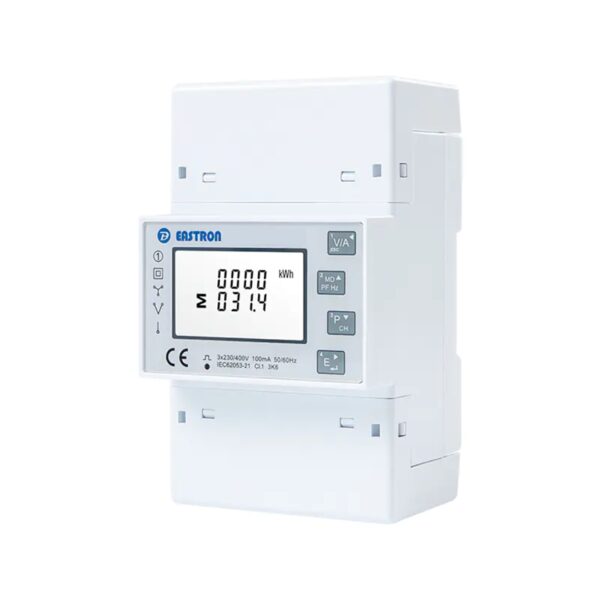
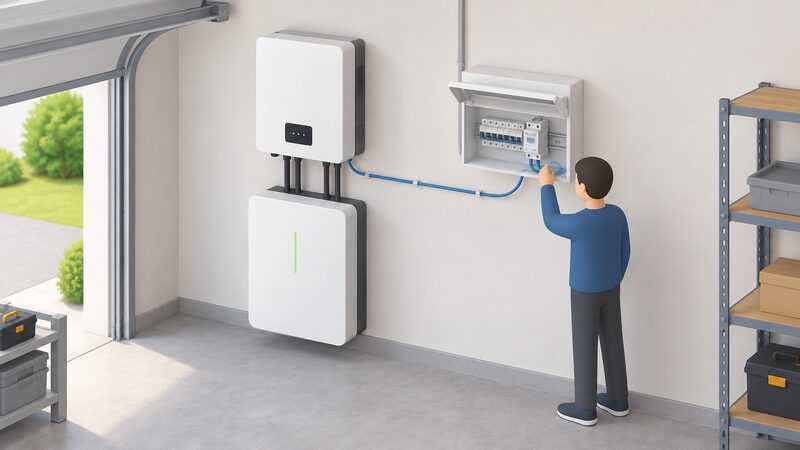
The honest position is that an Eastron meter increases a household's control over its own energy without reducing its dependence on the grid. It measures the connection point, and the connection point is exactly where dependence lives. A home with this meter still draws from the network when its own generation falls short, still relies on a supplier for the import it takes, and still relies on the network to accept whatever it exports.
What the meter changes is the quality of the household's own information and the speed at which its equipment can respond. Smart meter data puts households in control of their energy usage, meaning they can take energy-saving steps to reduce their CO2 emissions18, and smart meters integrate with smart home systems, enabling automated adjustments in response to usage patterns4. A DIN-rail meter takes that a step further by feeding a control loop rather than a display. Zero-export, peak-shaving and time-of-use algorithms all depend on a live measurement at the boundary1.
There are dependencies to name plainly. The meter itself is a manufacturer's product, so its support and replacement sit with that company and its distributors. Its communications run over a wired RS485 Modbus link1, which means a cable and a controller, not a cloud service, though whatever reads the Modbus data may itself depend on an app or a platform. And the measurement is only as useful as the system acting on it: a meter with no controller attached is a record, not a control.
For a household weighing independence, the meter is best understood as an enabling component rather than a source of autonomy. It makes self-consumption, export limitation and time-of-use shifting possible, and it does so locally, on a wired protocol, without needing the supplier's permission or a broadband connection. It does not change where the electrons come from when the sun is down. More on how monitoring fits into the wider picture is at smart meters and energy independence, and the technical background on local data is at local data access and Modbus.
Where an SDM meter fits alongside the supplier's meter
The two meters are not in competition, and treating them as alternatives leads to the wrong expectations. The supplier's smart meter is the billing instrument, installed by the energy supplier at no extra cost19, and any household that pays for energy, whether owning or renting, should be able to book a smart meter installation where it is expected to work in the property21. It sends readings automatically and comes with an in-home display3.
The DIN-rail meter is a private measurement device inside the household's own installation. It is not offered by suppliers, it is not free, and it is not part of the national smart metering network. What it offers instead is a fast, local, bidirectional signal that a control system can use. A household with solar and a battery may end up with both: the supplier's meter for billing and settlement, and a DIN-rail meter for export limitation and self-consumption control.
That division also explains the accuracy question. Smart meter accuracy is a matter for the national system and its standards22, while a DIN-rail meter's accuracy is a matter for its own specification and the maker's claims1. The two are measured against different requirements because they do different jobs.
Sources22 cited
- Eastron Meters, Sunsynk, 2026-09-17
- What is domestic distributed generation, UK Power Networks, 2026-09-17
- Get help with your smart meter, Ofgem, 2026
- How do smart meters reduce my bills, Smart DCC, 2025
- How to read your electric meter: import/export meters, NIE Networks, 2026-09-19
- Meter reading guide: import/export meters, NIE Networks, 2026-09-20
- Feed-in Tariffs guidance for renewable installations V16, Ofgem, 2021-12-13
- Guidance for FIT Generators V18, Ofgem, 2026-04-01
- Draft licence conditions, GOV.UK, 2026-09-17
- Key terms explained: Feed-in Tariffs, Ofgem, 2026-09-17
- FIT Guidance for Licensed Electricity Suppliers V17.1, Ofgem, 2024-09-06
- Smart meters and WiFi: does a smart meter need WiFi, Smart Energy GB, 2026-03-16
- New supplies: connect 1 to 4 new properties FAQs, SSEN, 2026-09-17
- Future Homes and Buildings Standards consultation response, GOV.UK, 2026-03
- State of the energy market report: retail, Ofgem, 2025-04-15
- Tough new rules force suppliers to fix faulty smart meters, GOV.UK, 2026-03-10
- Domestic electricity consumption indicator, ONS, 2025-12-18
- Smart meters and decarbonisation, Smart DCC, 2026
- How to get a smart meter, Smart DCC, 2026
- Do you have to have a smart meter by law, Smart DCC, 2026
- Smart meters: your rights and expectations, GOV.UK, 2025-08-08
- How accurate are smart meters, Smart DCC, 2026