
In this guide
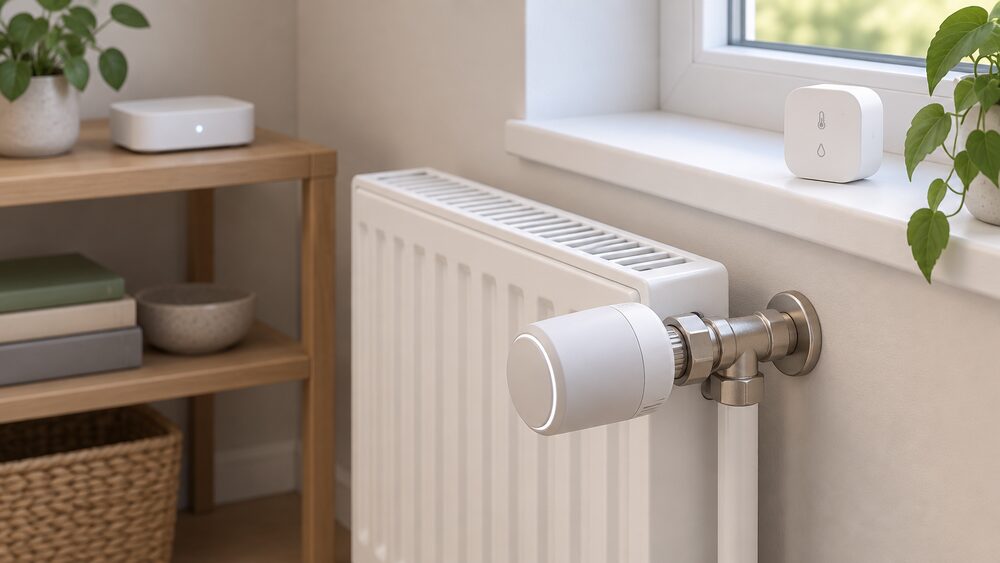
SONOFF's heating range is built around one central product, the Thermo Series TRV Gen2 (TRV-ZBT), a Zigbee thermostatic radiator valve head that replaces the manual head on an existing radiator valve. Around it sit the sensors, switches and gateways that make a heating system controllable: the SNZB-02D and SNZB-02LD temperature sensors, the BASIC-ZB1GSP DIN rail switch, the MINI-ZBD dry contact switch, the S60 series Zigbee smart plug, the NSPanel wall switch and the Orb Matter socket1.
The single most important fact for a UK buyer is that the TRV Gen2 needs a Zigbee gateway. SONOFF states it directly on the product page: "A Zigbee gateway is needed"1. The valve fits existing M30 x 1.5mm radiator valves, and the adapters in the package are described as compatible with most heating systems and manufacturers1. It is a DIY retrofit rather than a boiler control: it changes how individual radiators are regulated, not how the boiler fires.
That distinction sets the limits. A SONOFF TRV gives a household room-by-room control that a manual valve cannot, and it does so without a subscription or a manufacturer's cloud account being strictly necessary for the schedule to run9. It does not replace a room thermostat, does not modulate a boiler, and does not remove the home from the gas grid or from a gas supplier. What it changes is how much of the heat already being paid for is used where it is wanted.
What SONOFF makes for heating: thermostats, TRVs and switches
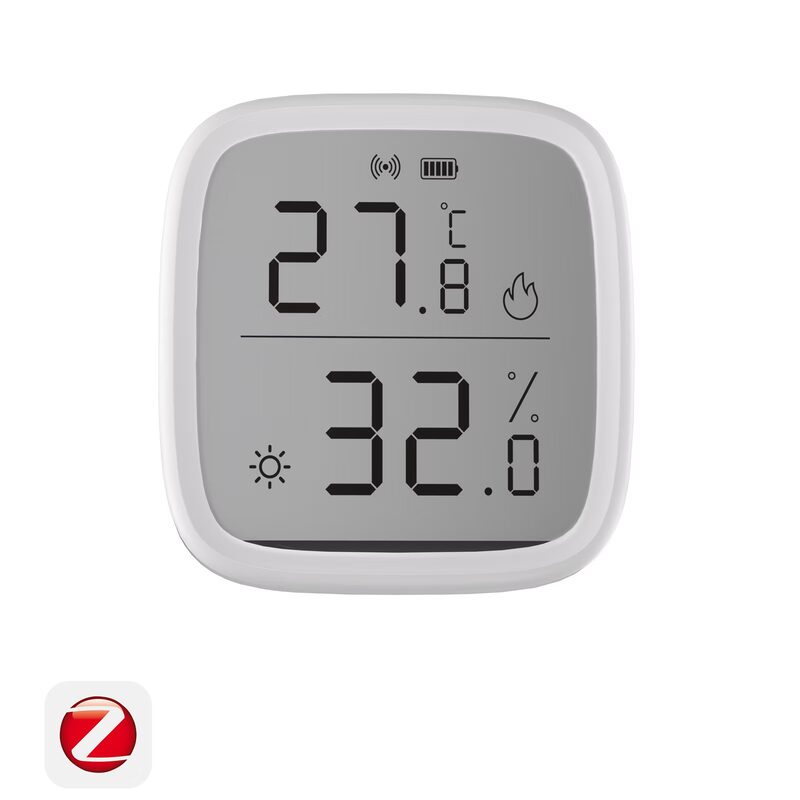
SONOFF's heating offer is a set of components rather than a single appliance. The TRV Gen2 is the radiator-level device. The SNZB-02D is a Zigbee 3.0 LCD temperature and humidity sensor, and the SNZB-02LD is an IP65 version with a probe, both intended to report room conditions back to a hub2. The BASIC-ZB1GSP is a DIN rail Zigbee switch for indoor use, the kind of part that suits a plant room or a wiring cupboard5. The MINI-ZBD is a dry contact switch, which is the component used where a device needs to close a potential-free contact rather than switch a live load6.
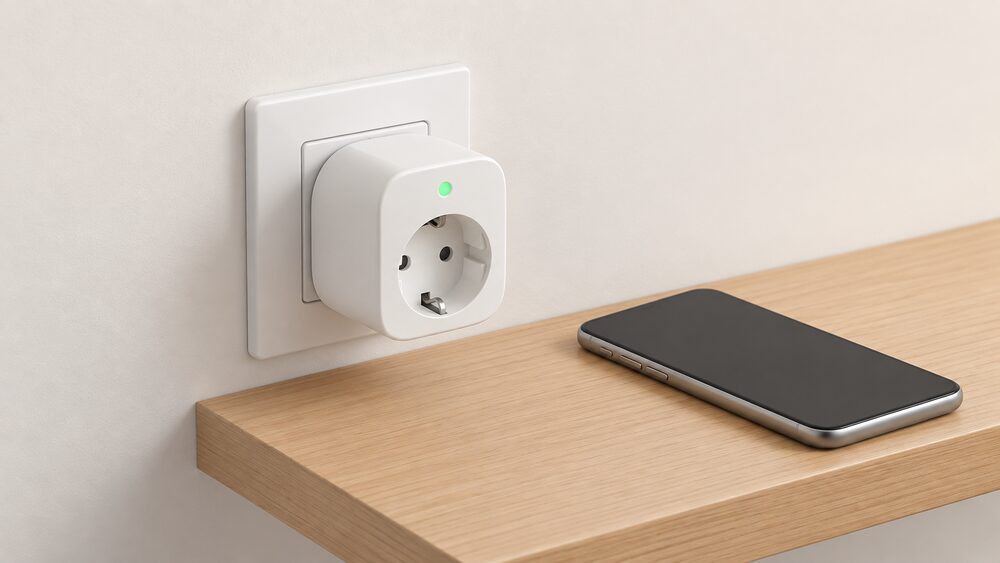
The S60 series Zigbee smart plug and the Orb Matter socket extend control to mains-powered appliances, and the Orb works with Apple Home, Google Home, Alexa, SmartThings and Home Assistant through Matter8. The NSPanel is a wall-mounted scene switch with a thermostat function built in, and it is the one device in the range that behaves like a room thermostat rather than a valve or a relay7.
Two things are worth noting about the shape of the range. First, the thermostat side is thin: the Thermostat Core Zigbee Smart Thermostat (TP-WGZBA) is listed as pre-order only on the official store, so a UK household cannot presently buy it as a stocked product11. Second, the range is Zigbee-first. Almost every heating-relevant device communicates over Zigbee 3.0 and expects a gateway, which is what makes the hub choice the central decision rather than an accessory1.
The Thermo Series TRV Gen2: modes and what it controls
The TRV Gen2 is sold under SONOFF's Thermo Series label and runs a PID algorithm that modulates valve openings rather than switching fully open and closed1. That matters in practice: a valve that opens in small increments holds a room closer to its target and avoids the overshoot that a simple on/off head produces. SONOFF's own guidance describes the same PID approach as delivering more stable room temperature13.
Scheduling is generous for a valve at this level. The Gen2 stores up to three independent temperature plans, each supporting 7-day weekly scheduling with up to 12 time periods per day1. In other words, a household can run a weekday and weekend pattern, or a separate plan for a home office, without reprogramming the valve each week.
The three operating modes are Auto, Manual and Off, the last also called Frost Protection Mode14. Auto runs to the pre-set schedule and, in SONOFF's words, "the schedule you set can be executed on a weekly basis, eliminating the trouble of repeated settings"14. Manual holds a temperature set by hand. Off closes the valve to the frost setting, which is the position used to protect pipework in an unheated room14.
Protection features are built in: automatic anti-calcification maintenance, frost protection, low battery alerts and a child lock1. The Gen2 also works with a remote temperature sensor, and SONOFF lists its own Zigbee temperature and humidity sensor as the external probe1. That matters because the valve's own sensor sits near the radiator pipe and, as SONOFF acknowledges, "tends to read higher than the actual room temperature when heating is running"10. An external sensor placed away from the radiator corrects that bias.
| Feature | TRV Gen2 detail |
|---|---|
| Control | PID algorithm modulating valve openings1 |
| Plans | Up to 3 independent plans, 7-day weekly, up to 12 periods per day1 |
| Modes | Auto, Manual, Off (Frost Protection)14 |
| External sensor | Works with a remote temperature sensor1 |
| Window detection | Connects with door/window sensors to reduce or stop heating1 |
| Protection | Anti-calcification, frost protection, low battery alerts, child lock1 |
Zigbee or Wi-Fi: how SONOFF heating devices connect
The heating devices are Zigbee, not Wi-Fi. The TRV Gen2, the SNZB-02D and SNZB-02LD sensors, the S60 series plug and the BASIC-ZB1GSP switch all use Zigbee 3.01. Zigbee operates in unlicensed bands worldwide at 2.4GHz, 915MHz in the Americas and 868MHz in Europe, with raw data throughput of 250Kbs at 2.4GHz across 16 channels15. It uses an IEEE 802.15.4 defined CSMA-CA protocol that reduces the probability of interfering with other users, and over-the-air AES-128-CCM encryption15.
The practical consequence of Zigbee over Wi-Fi is range and power. A Zigbee network supports hundreds of nodes, and the standard was developed to be backwards and forward compatible15. Mains-powered Zigbee devices act as repeaters, which is why a plug or a switch between the hub and a distant TRV improves reliability. SONOFF's own recommendation for its Zigbee sensors is no more than 50 metres through walls between device and gateway2. That is a maker's figure for a clear path; in a British house with masonry walls and foil-backed plasterboard, the usable distance is shorter.
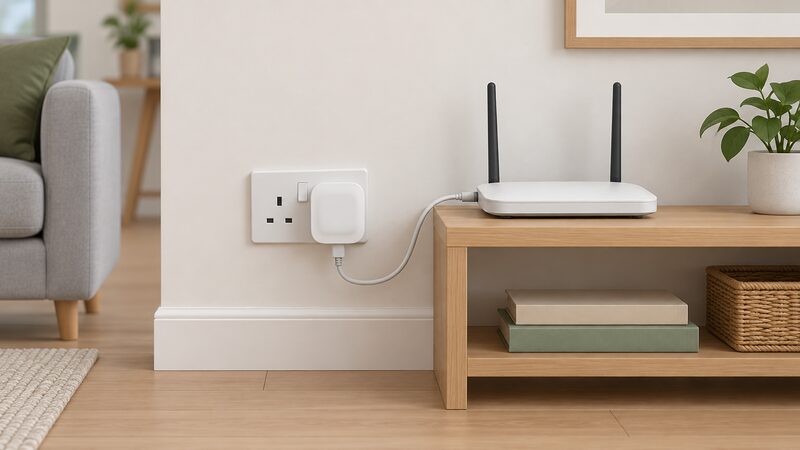
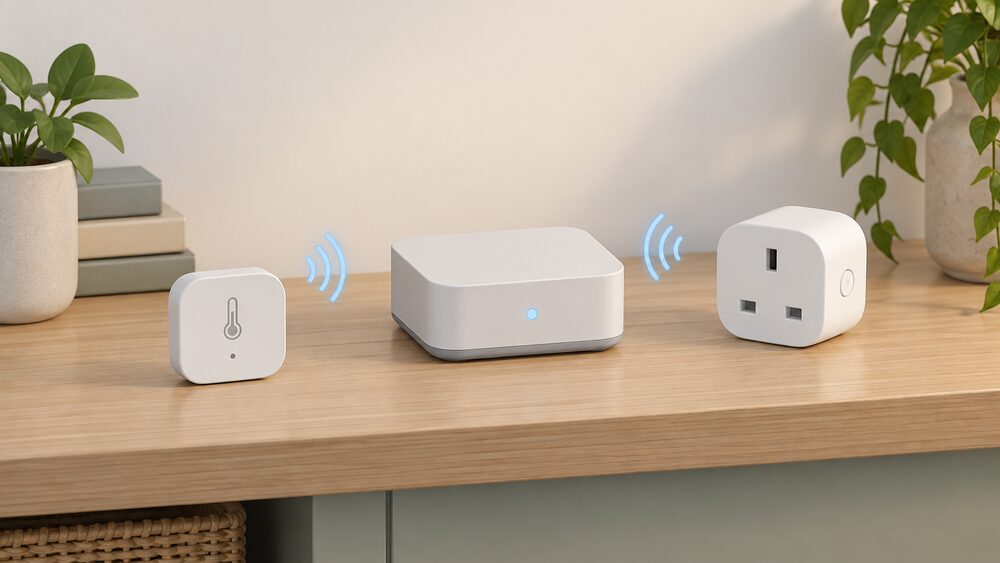
The hub options SONOFF lists for its Zigbee 3.0 sensors are the iHost, NSPanel Pro, ZBBridge-P, ZBBridge-U, ZBDongle-E, ZBDongle-P, and the Amazon Echo 4th Gen, Echo Show 2nd Gen and Echo Plus 2nd Gen2. The ZBDongle-E and ZBDongle-P are USB sticks rather than standalone hubs, which points to the Home Assistant route: SONOFF lists the TRV as integrated into Home Assistant via Zigbee2mqtt14. For a household already running Home Assistant, that is a local integration with no manufacturer cloud in the path.
Matter and local control: what it means for cloud independence
This is where SONOFF's heating range is strongest for a household concerned about dependence, and also where the limits sit. Zigbee itself is a local protocol: as the Connectivity Standards Alliance describes it, local connectivity "still works if the internet is down and doesn't require connection with/communication to the cloud"15. A Zigbee TRV talking to a Zigbee hub on the same LAN does not need a broadband connection to function.
SONOFF's own statements bear this out at device level. The TRV keeps running its schedule even if it loses the gateway: "Localized scheduling: Even if the device loses connection to the gateway, it will continue to follow the set schedule"9. The Orb socket "can be used with local control" and works without internet access, not depending on the server8. The NSPanel is the exception: without internet, features requiring cloud services such as the thermostat and screen widgets will not work, though basic relay control, touch switches and power-on behaviour still operate over the local network7.
Matter is the bridge to the big ecosystems. Matter is described as a universal, open-source and secure connectivity standard for smart home devices, using Wi-Fi, Ethernet and Thread rather than relying on lots of separate control hubs, and allowing products from different brands such as Apple, Google, Amazon and Samsung to communicate17. Zigbee and Matter are different technologies with a similar underlying data model, expected to co-exist, with bridging specified in Matter15.
SONOFF uses that bridging route. The TRV Gen2 works with Apple Home via a Matter Bridge, naming the Bridge-M, ZBBridge-U, iHost and CUBE OS with a SONOFF Zigbee Dongle1. The same pattern appears across the range: the SNZB-02D, SNZB-02LD, S60 plug and BASIC-ZB1GSP all reach Apple Home through a Matter Bridge using the ZBBridge-U or eWeLink CUBE2. Apple Home support therefore depends on running a bridge, not on the TRV alone.
Linking TRVs with sensors and smart scenes
A single TRV is a better manual valve. A set of them, linked to sensors and scenes, is a zoning system. SONOFF's guidance is that custom smart scenes can be created by linking the TRV with other SONOFF devices, naming smart door sensors and temperature sensors as the triggers14. The Gen2 specifically connects with door and window sensors to reduce or stop heating when windows are open1, and it also senses a sudden temperature drop and turns the valve off automatically to prevent energy waste14.
The external sensor route is the one that changes accuracy rather than convenience. Because the valve's built-in sensor sits near the pipe and reads high while the heating runs10, a separate room sensor gives the valve a truer target. SONOFF lists its Zigbee temperature and humidity sensor as the external probe for the Gen21. Group control is also supported: SONOFF describes managing all connected valves simultaneously and turning off all radiators with one click9.
Independent guidance supports the principle behind this. The Energy Saving Trust notes that programmable TRVs with timing control let each radiator come on at different times and heat each room separately18. Ivie's advice is to use TRVs on individual radiators to adjust the temperature in different rooms based on usage, turning down TRVs in unused rooms19. Home Energy Scotland recommends adjusting TRVs to the frost setting so radiators use the minimum energy needed to protect the home20. Those three positions describe exactly what a scheduled, sensor-linked SONOFF TRV does.
Where SONOFF heating devices fit a UK home
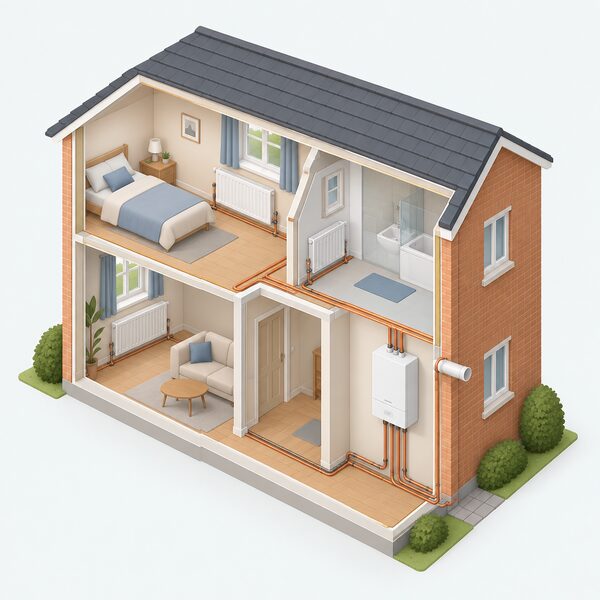
The fit is clearest in homes with a conventional gas or oil boiler and radiators, where the boiler is already controlled by a separate room thermostat or programmer and the household wants room-by-room control without replacing the boiler. A SONOFF TRV sits on top of that existing system. It does not need to be wired into the boiler, does not touch the boiler interlock, and does not require a registered installer.
The regulatory position on TRVs is worth knowing. In Wales, building regulations state that any new radiator installed will require a thermostatic radiator valve to be installed, and that a TRV gives better control over individual room temperatures21. That is a Welsh requirement; the position differs across the four nations, and a household in England, Scotland or Northern Ireland should not assume the same wording applies.
Siting matters for any thermostat, and the same logic applies to a room sensor paired with a SONOFF TRV. Independent guidance is that the best place for a smart thermostat is where the temperature is relatively consistent22. A maker's installation list for a comparable thermostat warns against drafts or dead spots behind doors and in corners, hot or cold air from ducts, sunlight or radiant heat from appliances, concealed pipes or chimneys, and unheated areas such as an outside wall23. A SONOFF external sensor placed in any of those positions will mislead the valve.
The dependence that remains is worth stating plainly. The home stays on the gas grid and on a gas supplier. The boiler still needs mains electricity for ignition, pumping and controls. The TRVs need batteries, a Zigbee hub and, for app control, a home network. The eWeLink app is the configuration route for most features, and Apple Home needs a Matter bridge. None of that is unusual for a smart heating device, but it is not independence from the grid, and it is not a substitute for a boiler control that modulates the boiler.
Buying in the UK: sales, pricing cycles and availability
SONOFF sells direct through its own store, and the UK storefront carries the heating range. Prices are not published in the material available here, so a UK buyer should treat them as quoted at the point of sale rather than fixed. What is documented is the discount pattern. The TRV Gen2 page carries a quantity offer: buy 2 and save 5% with code Save5, buy 4 and save 10% with code Save101. The Zigbee thermostatic radiator valve is listed with a 10% saving on the US and French storefronts11.
The seasonal cycle is regular. A Christmas sale ran from 19 December to 31 December 2025 with up to 35% off selected products and quantity-based extra discounts24. A Valentine's promotion, buy 2 get 12% off with code VADA12, ran from 2 to 15 February 202624. SONOFF also published a Summer Ready 2026 campaign page dated 25 June 2026 covering energy monitoring, water and heating control, sensors and gateway products24. A household buying several TRVs at once is therefore buying into a discount structure that rewards quantity and timing.
Availability is the other variable. The Thermostat Core Zigbee Smart Thermostat (TP-WGZBA) is listed as pre-order only11, so the thermostat side of the range is not yet a stocked UK purchase. The TRV Gen2, the sensors, the switches and the gateways are the parts that can be bought now. For wider context on how these devices compare with mainstream smart thermostats, smart thermostats and smart TRVs cover the alternatives, and Zigbee, Matter, KNX and Wi-Fi explains the protocol choices in more depth.
Sources24 cited
- SONOFF TRV Gen2 Zigbee Thermostatic Radiator Valve, SONOFF, 2026-09-20
- SONOFF SNZB-02LD IP65 Zigbee LCD Smart Thermometer (Probe Version), SONOFF, 2026-09-20
- SONOFF SNZB-02D Zigbee LCD Smart Temperature Humidity Sensor, SONOFF, 2026-09-20
- SONOFF iPlug Zigbee Smart Plug S60 Series, SONOFF, 2026-09-20
- SONOFF BASIC DIN Rail Zigbee Smart Switch BASIC-ZB1GSP, SONOFF, 2026-09-20
- SONOFF MINI Dry Zigbee Dry Contact Smart Switch MINI-ZBD, SONOFF, 2026-09-20
- SONOFF NSPanel Smart Scene Wall Switch, SONOFF, 2026-09-20
- SONOFF Orb Socket Matter Over WiFi Smart EU Wall Socket, SONOFF, 2026-09-20
- Automate Your Home Heating with SONOFF Thermostatic Radiator Valve, SONOFF, 2025-06-04
- Zigbee TRVs for Home Assistant: Smarter Heating Guide, SONOFF, 2026-06-07
- SONOFF Home Appliances, SONOFF, 2026-09-20
- SONOFF Home Appliances, SONOFF, 2026-09-20
- TRVZB Upgrade: Smart Temperature Control for More Stable Room Temperature, SONOFF, 2026-01-28
- Automate Your Home Heating with SONOFF Thermostatic Radiator Valve, SONOFF, 2025-06-04
- Zigbee FAQ, Connectivity Standards Alliance, 2026
- SONOFF NSPanel Smart Scene Wall Switch, SONOFF, 2026-09-20
- Making Home Energy Management Work for Consumers, Energy Systems Catapult, 2026-02-12
- Thermostats and Heating Controls, Energy Saving Trust, 2026-02-10
- The Best Way to Run Your Central Heating to Save Money, Ivie, 2026-09-20
- Protect Pipes in Winter, Home Energy Scotland, 2025-12
- Building Regulations: Extensions and Energy Efficiency, Welsh Government, 2026-09-17
- What Are Smart Thermostats?, Uswitch, 2026-02-05
- Mycond TRF-B2 Fan Coil Thermostat, Mycond, 2026-09-17
- SONOFF 2025 Christmas Sale, SONOFF, 2025-12-31
 SONOFF iHost Smart Home HubIf the internet goes down, will your smart home keep working?
 SONOFF Smart Home DevicesSONOFF plugs and sockets show what each appliance in your home actually uses, and when.