
In this guide
Potterton is one of the oldest names in British domestic heating, and it is still trading. The brand now sits inside Baxi Heating UK Ltd, whose portfolio also carries Baxi, Main Heating, Heatrae Sadia, Megaflo, Remeha, Andrews Water Heaters, Potterton Commercial and Packaged Plant Solutions across the UK and Ireland1. Potterton continues to offer its own ranges of combi, regular and system boilers rather than being folded into another badge2.
The current picture is mixed rather than uniformly strong. In a 2025 owner survey Potterton scored three stars, with 79% of owners reporting they were happy with their boiler, three percentage points below the average satisfaction rate2. The Potterton Titanium Heat, a heat-only model, carries a 7-year parts and labour warranty3. Prices are installer-quoted, with no published list price for a supplied and fitted Potterton.
For a household thinking about energy independence, the position is straightforward and worth stating plainly. A Potterton gas boiler keeps the home on the mains gas grid and on a gas supplier, with an electrical dependence for ignition, controls and pumping. It does not reduce dependence on the grid or on imported gas. What it does offer is a familiar, widely serviced appliance with parts available through a national merchant network4.
A heritage brand now owned by Baxi
Potterton was bought by Baxi in recent years, and it still offers its own ranges of combi, regular and system boilers2. That ownership matters more than brand nostalgia. Baxi Heating UK Ltd operates a multi-brand structure covering Baxi, Potterton, Main Heating, Heatrae Sadia, Megaflo, Remeha, Andrews Water Heaters, Potterton Commercial and Packaged Plant Solutions, across the UK and Ireland1. Baxi boilers are described as manufactured in the UK and stocked with merchants nationwide4, and independent guidance notes that both Baxi heating boilers and Glow Worm boilers are British-made8.
For a Potterton owner, the practical consequences are about parts and service rather than prestige. Sharing a parent with several other volume brands means shared supply chains, shared merchant distribution and a service network that already handles the group's products. It also means the brand's engineering direction is set by the parent company rather than by Potterton alone.
The heritage is real, though. Potterton models appear on third-party compatibility lists going back through the Heatmax Combi 24 HE, 28 HE and 33 HE and the Profile 40e, alongside current eurocondense EC 120, EC 160 and EC 200 units9. That spread of model names across decades is why the brand is still found in millions of UK homes even where it is no longer the first name a buyer thinks of. The wider ownership picture across the UK boiler market is set out in Potterton, Baxi and the brands behind UK boilers.
The current range: combi, system and regular
Potterton's own ranges cover combi, regular and system boilers2, which means the brand spans the three main domestic formats rather than specialising. The three types differ in how they supply hot water and where the components sit, and the differences drive both cost and installation work. Combi boilers heat water on demand with no cylinder, system boilers use a stored cylinder fed by a pressurised circuit, and regular or heat-only boilers feed a tank, usually in a loft, with a separate feed and expansion arrangement.
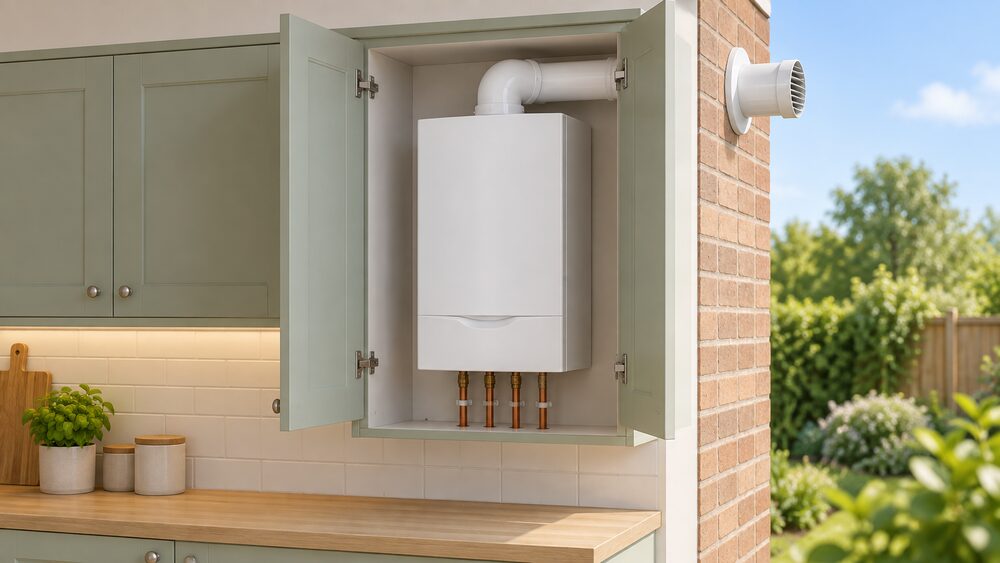
The Potterton Titanium Heat is a heat-only model, and it is the one current Potterton product with a published specification in the record. It measures 270mm in depth3, which is a compact figure for a heat-only unit and relevant where a boiler has to sit in a kitchen cupboard or a tight utility space. Heat-only boilers are also the cheapest type of boiler to buy8, which is part of why the format persists in older housing stock and in homes where a cylinder and tank are already in place.
| Format | Hot water | Typical fit | Cost position |
|---|---|---|---|
| Combi | On demand, no cylinder | Smaller homes, limited space | Mid to high |
| System | Stored cylinder, pressurised | Family homes, multiple bathrooms | Mid |
| Regular / heat-only | Tank-fed, separate cylinder | Older homes with existing tanks | Cheapest to buy8 |

Price: what the figures actually show

There is no published Potterton list price for a boiler, and none for a supplied and fitted installation. Prices are installer-quoted after a survey. The figures that do exist are market context rather than Potterton-specific. One independent guide puts a new boiler at around £1,5006, and a separate guide quotes system boiler installation at £1,580 to £5,00010.
Oil figures sit higher and are broken down more finely. A heat-only oil boiler is quoted at £1,200 to £2,450 for the unit, with an average total cost of £3,075 including installation; a system oil boiler at £1,450 to £2,375, averaging £3,163 in total; and an oil combi at £2,025 to £2,825, averaging £3,67511. Those ranges include the boiler and the installation work separately, which is why the totals exceed the unit prices.
Three things move a quote: the output and format chosen, whether the system type is changing, and flue or siting work. A like-for-like replacement is less work than a conversion from regular to combi, which removes a cylinder and tank and adds new pipework. VAT treatment is not stated in any of the figures above, so they should be read as quoted rather than as confirmed VAT-inclusive prices. Broader cost context sits in New Boiler Cost in the UK.
Warranty: 2 to 7 years, with registration conditions
The Potterton Titanium Heat carries a 7-year parts and labour warranty3. That is the clearest published Potterton term in the record, and it applies to a heat-only model rather than to the combi range. Across the market, manufacturers offer warranties of 7 to 12 years to balance risk and cost5, so a 7-year term sits at the lower end of the current market band rather than above it.
Other brands illustrate how wide the spread has become. Intergas combi products come with a standard 7 to 10 year warranty5. ATAG offers up to 18 years, with 10 years as standard12. Vaillant's ecoTEC plus combi carries a standard 2-year warranty, upgradeable to 7 years when registered by a Vaillant Advance installer, with an option to purchase an extension to 10 years13. Worcester Bosch boilers typically come with seven or ten-year warranties14.
Registration is the condition that catches people out. Where a boiler is installed by someone who is not registered for the relevant competent person scheme, the installer cannot self-certify that the work is compliant, and the firm or the householder must give notice to the local authority of the intention to carry out the boiler work in advance and pay a notification fee15. Warranty terms usually depend on registration within a set window as well, and a missed deadline can leave only the standard term in place. The full set of conditions is covered in Boiler Warranties and Guarantee Registration.
Efficiency: mixed, from B-rated to A-rated
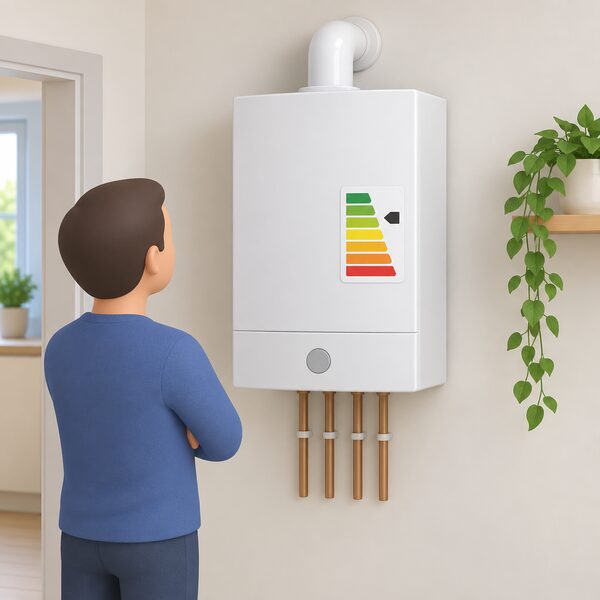
The ErP scale is the reference point. A-rated boilers are 90% or more efficient, while G-rated boilers are less than 70% efficient16. In between, a C-rated boiler is 82 to 86% efficient, and an F-rated boiler is 70 to 74% efficient16. Independent guidance for households is to consider energy efficient models, which may be A-rated17.
Potterton's published record spans that range rather than sitting at the top of it. The brand's ranges cover combi, regular and system boilers2, and the efficiency rating depends on the individual model rather than the badge. For comparison, all Worcester Bosch boilers are A-rated, meaning over 90% efficient14, and Worcester Bosch states its boilers are guaranteed to be 94% efficient16. Those are maker claims for a different brand, given here only to show where the market ceiling sits.
What determines real-world efficiency in a fitted system is whether the boiler condenses, which depends on flow temperature and radiator sizing rather than on the rating label. The settings that govern this are explained in Boiler Flow Temperature, and the rating system itself in Boiler Efficiency, ErP Ratings and SEDBUK.
Reliability and owner satisfaction: 79% and three stars
The owner evidence for Potterton is modest. In a 2025 survey the brand scored three stars, and 79% of owners reported being happy with their boiler, three percentage points below the average satisfaction rate2. That is a below-average result, not a poor one, and it is survey-based: it measures how owners rate appliances they already have, not the odds for a new installation.
For context on how such scores are read, 87% of energy supply customers rate their supplier three stars or higher18, so three stars is a common middle band rather than an outlier. Trust in the sector more broadly is limited: 27% of all people say they trust a heating system or boiler manufacturer19. Independent installer ratings exist too, though they measure the installer rather than the boiler brand; one heating firm is recommended by 100% of its customers with 5.0 ratings for customer service and quality20.
What shapes individual performance more than the badge is installation quality, system cleanliness and annual servicing. A modern combi boiler is expected to last 10 to 15 years5, and combi boilers typically fall within the same 10 to 15 year range as system and regular boilers21. With annual servicing and a clean water system, a modern combi is put at 15 to 18 years5. The servicing regime that supports those figures is set out in Boiler Servicing and Maintenance.
A mainstay of UK social housing
Potterton's presence in social housing is a function of the wider stock rather than of any single contract. In Scotland, 80% of dwellings currently have boilers and most of these are combi type, producing hot water on demand22. Scottish social housing shows a similar pattern: mains gas and electricity are the primary fuel types present in 95% of social housing23, and a separate figure puts mains gas and electricity as primary fuels in 94% of social housing, with a further 6%, or 37,000 households, using some form of communal heating24.
Communal heating is a distinct category and worth separating out. In England in 2023 there were 646,000 dwellings, 3% of the total, using communal heating as their primary heating system25. Those homes are not on individual gas boilers at all, so a brand-level choice does not arise for them.
Where social landlords do specify individual boilers, the drivers are cost, parts availability and serviceability rather than efficiency leadership. Condensing gas boilers are by far the most common boiler type in UK homes8, and the regulatory baseline for new installations in England includes the Boiler Plus requirement, which obliges existing households to install an additional energy saving measure from a choice list at the point of installing a new or replacement combi gas boiler in an existing dwelling26. That requirement is explained in Boiler Plus: The Control Requirements Explained. New-build social schemes increasingly go further: one Passivhaus social housing development in Dalbeattie was built by main contractor Ashleigh (Scotland) Ltd27, a reminder that the fabric-first route bypasses boiler choice entirely.
Where Potterton sits among budget boiler brands
Potterton competes in the value end of the market, and the format mix reflects that. Heat-only boilers are the cheapest type of boiler to buy8, and the Potterton Titanium Heat is a heat-only model with a 7-year parts and labour warranty3 and a 270mm depth3. That combination, a low-cost format with a longer-than-baseline guarantee, is the brand's clearest commercial position.
The comparison set is crowded. Vaillant's ecoTEC pro range is listed on Quiet Mark28, and ATAG's iC Economiser Plus carries up to 18 years of warranty with 10 years as standard12. Those are different propositions at different price points, and neither is a Potterton. What Potterton offers is a name with decades of UK presence, parts through a national merchant network4, and a service base that already knows the group's products.
For a household weighing independence, the honest summary is that a Potterton gas boiler does not change the fuel position at all. It keeps the home on mains gas, on a gas supplier and on the electricity grid for ignition, controls and pumping. The dependence that remains is the grid, the supplier and imported gas. Households wanting to change that position are looking at a different question, covered in Home Heating and Energy Independence and Heating a Home Off the Gas Grid. Hydrogen-ready claims should be read carefully: hydrogen boilers are not currently available in the UK19, and the claim is covered in Hydrogen-Ready Boilers: What the Claim Means.
Sources28 cited
- Written evidence on the UK heating market, UK Parliament, 2026
- Potterton boilers review, Which?, 2025
- Potterton Titanium Heat, Baxi, 2026-09-17
- Professional products, Baxi, 2026-09-17
- How long do combi boilers last, Intergas Heating, 2026-04-23
- How long does a boiler last, Uswitch, 2024-11-13
- Boiler retirement: using trigger points to support homeowners, Which?, 2026-07-10
- Different boiler types, Uswitch, 2026-09-18
- Boiler compatibility check, Genius Hub, 2026-02-05
- New boiler, Uswitch, 2025-03-21
- Boiler statistics, Uswitch, 2024-01-04
- ATAG iC Economiser Plus boilers, Quiet Mark, 2026-09-17
- Vaillant ecoTEC plus combi boilers, Quiet Mark, 2026-09-17
- Worcester Bosch boilers guide, Uswitch, 2024-11-13
- Boilers and heating: building regulations, Planning Portal, 2026
- Boiler efficiency guide, E.ON Next, 2026-09-17
- Top energy savings tips, National Energy Action, 2026-07-13
- Understanding consumers' energy tariff choices, Ofgem, 2025-07
- DESNZ public attitudes tracker: heat and energy use in the home, winter 2025, DESNZ, 2025
- BPI Boiler Plumbing Installations, Which? Trusted Traders, 2026-09-17
- How long do boilers last in the UK, Navien, 2026-05-19
- The suitability of clean heating options for challenging dwelling types, ClimateXChange, 2024-09-20
- Scottish House Condition Survey 2023: key findings, Scottish Government, 2023
- Scottish House Condition Survey 2024: key findings, Scottish Government, 2024
- English Housing Survey 2023 to 2024: low carbon technologies fact sheet, MHCLG, 2023
- Carbon Budget Delivery Plan, DESNZ, 2023-03-30
- Passivhaus social homes benefit, CIPHE, 2024-07-08
- Vaillant ecoTEC pro, Quiet Mark, 2026-09-17