
In this guide
Isover is a glass mineral wool insulation brand sold in the UK through builders' merchants and insulation retailers, covering loft rolls, cavity wall batts and floor and timber frame products. It is a Saint-Gobain brand, and glass mineral wool is one of the three main materials used in cavity wall insulation in the UK, alongside EPS bead and PU foam1.
The material's case rests on three properties rather than on a headline number. Mineral wool is non-combustible and rated A1 or A2 under the Euroclass fire system, and it offers excellent sound absorption, which is why it is used in timber frame walls as much for acoustics as for heat2. It is also the cheapest of the mainstream options: cork insulation has been listed at up to ten times the price of equivalent mineral wool products, and cellulose at up to twice the price of mineral wool or rigid foam3.
What it does not do is remove a household's dependence on the grid or on a supplier. Insulation reduces the heat a building loses, so less fuel is bought, but the home still draws gas or electricity from outside. The independence it buys is measured in lower demand, not in self-supply.
What Isover glass mineral wool is
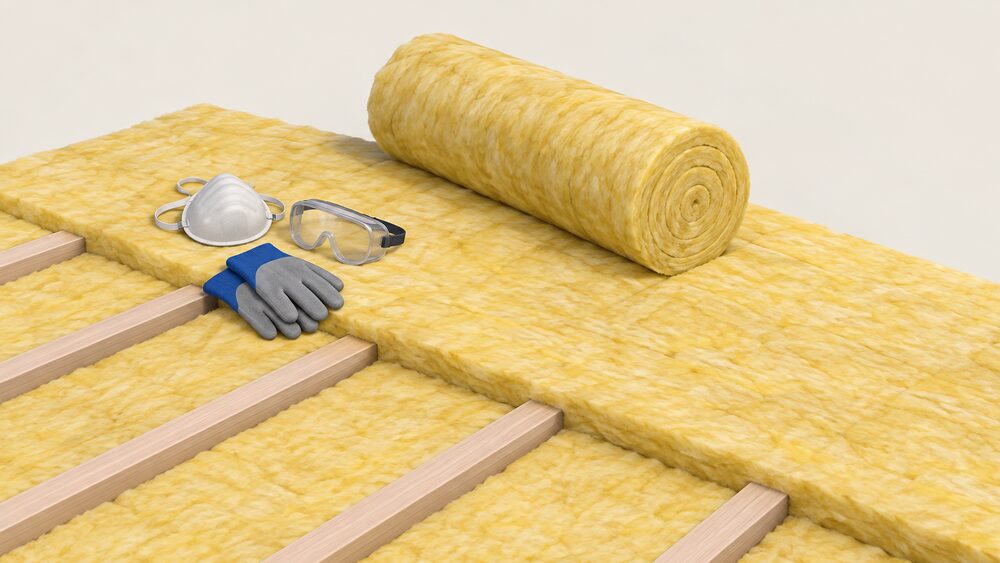
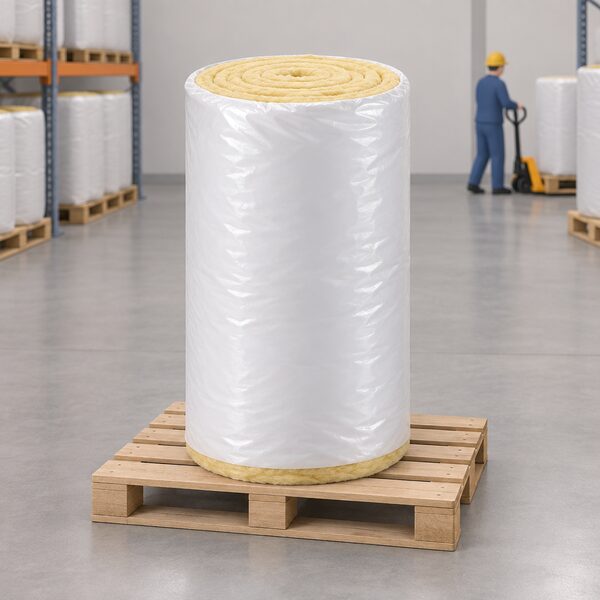
Glass mineral wool is spun from molten glass, largely sand and recycled glass, into a fibrous mat held together with a binder. It is supplied compressed in rolls and batts, and it works by trapping air in the fibre structure so that heat has to cross many small pockets rather than a solid path. The same structure absorbs sound and, because the fibres are mineral, does not burn.
In the UK market it sits in a small group of materials. Ofgem's guidance on insulation measures names the main cavity wall materials as mineral wool, glass or rock, EPS bead and PU foam1. That is the practical distinction a householder meets: mineral wool is the fibrous option, bead and foam are the injected options, and the choice is usually set by the wall type and the installer's method rather than by preference.
The brand position matters less than the material. Isover is one of several glass mineral wool names in the UK, and the products are bought by specification, thickness and thermal conductivity rather than by brand loyalty. What a householder is choosing between is a roll that fits between joists, a batt sized for a cavity, or a board for a place where wool will not stay put.
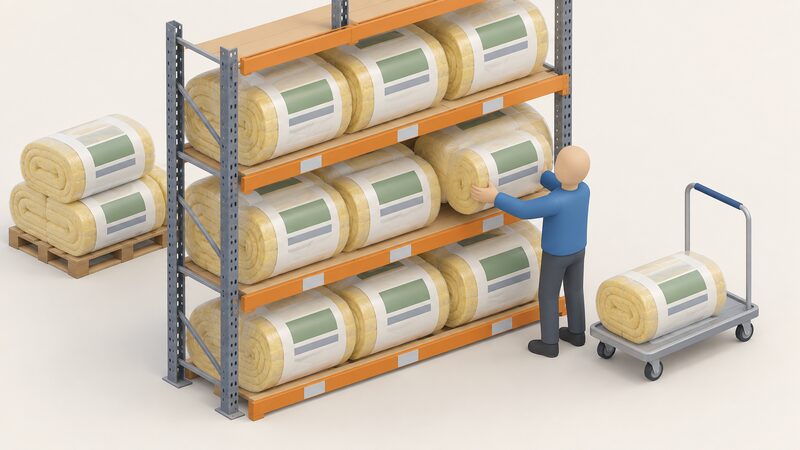
The Isover range for lofts, walls and floors
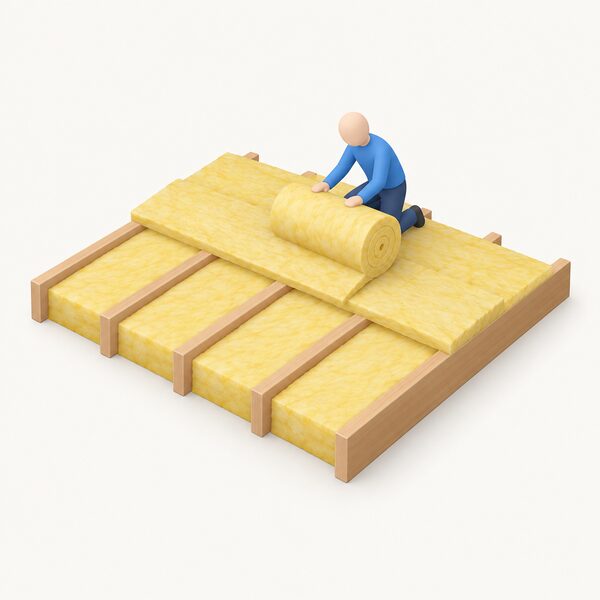
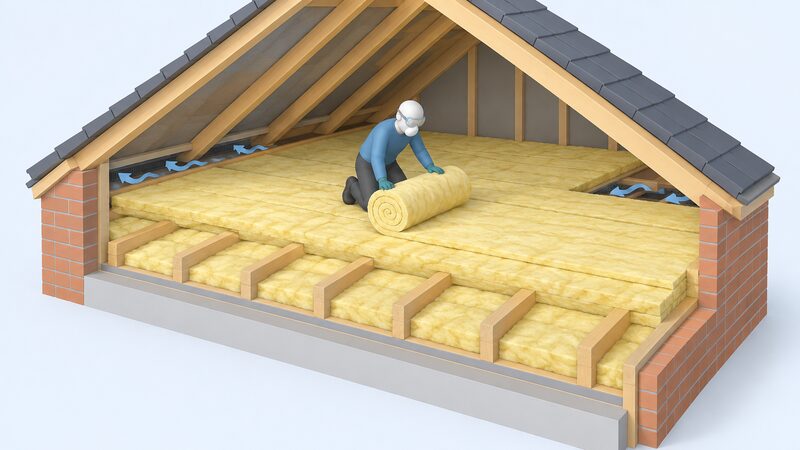
The range follows the places insulation goes. For lofts, the product is a roll laid between and over ceiling joists. Ofgem's delivery guidance describes loft insulation as installed between, and or on top of, joists, which is the two-layer approach the material is designed for8. For walls, the product is a batt or slab cut to cavity width, or a friction-fit batt for timber frame. For floors, it is a roll or slab laid between suspended timber joists.
The regulatory frame is broad. Energy-saving materials qualifying for the reduced rate of VAT include insulation for walls, floors, ceilings, roofs or lofts, and for water tanks, pipes and other plumbing fittings9. HMRC's own list repeats the same categories: walls, floors, ceilings, roofs or lofts, water tanks, pipes and other plumbing fittings10. Self-build guidance puts the same advice plainly: insulate walls, roof and floors to reduce heat loss11.
Where the material goes also determines what else has to be done. Insulating a loft area requires an application for approval under the Building Regulations, which can be included as part of an application for the overall project12. Northern Ireland guidance adds a ventilation condition: building regulations need adequate ventilation when installing loft insulation, and the local building control office should be consulted4. For the wider picture of which material suits which location, the insulation materials comparison sets out the alternatives side by side.
Thermal performance and typical U-values
There is no single U-value for Isover insulation, because the U-value belongs to the finished building element, not to the roll. What the regulations set is a target for the assembly, and the insulation is one input into it.
For existing dwellings, Approved Document L sets a threshold and an improved figure for walls. Internal or external wall insulation on an existing element has a threshold U-value of 0.70 W/(m2·K) and an improved figure of 0.30 W/(m2·K)15. Cavity insulation on an existing element carries the same 0.70 W/(m2·K) threshold15. Underfloor insulation, whether solid or suspended, should achieve a U-value of at least 0.25 W/m2K1, and internal wall insulation a target of 0.3 W/m2K1.
| Element | Threshold U-value | Improved or target U-value |
|---|---|---|
| Wall, internal or external insulation | 0.70 W/(m2·K)15 | 0.30 W/(m2·K)15 |
| Wall, cavity insulation | 0.70 W/(m2·K)15 | Not stated |
| Internal wall insulation | Not stated | 0.3 W/m2K1 |
| Solid underfloor insulation | Not stated | at least 0.25 W/m2K1 |
| Suspended underfloor insulation | Not stated | at least 0.25 W/m2K1 |
The gap between the threshold and the improved figure is the point. A wall at 0.70 W/(m2·K) is barely improved; a wall at 0.30 W/(m2·K) is a different building. Reaching the lower figure with mineral wool usually means more depth, since wool has a higher thermal conductivity than PIR board, and depth is what a loft has in abundance and a cavity does not. Where the standard is not functionally or technically feasible, official guidance states that the choice of insulation should be based on the best thermal performance that is practicable17. The mechanics of the numbers are set out in U-values and R-values explained.
Acoustic and fire properties
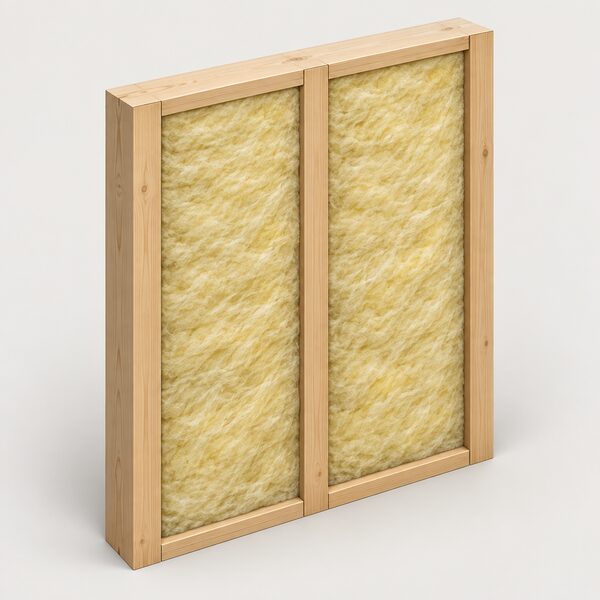
These are the two properties where mineral wool outperforms most alternatives, and they are the reason it appears in timber frame walls and party structures as well as in lofts.
On fire, mineral wool insulation in timber frame walls is described as non-combustible and A1/A2 Euroclass fire rated2. That is a material classification, not a statement about the finished wall, but it means the insulation itself does not add fuel to a fire or contribute to spread within the cavity. For a household, the practical consequence is that the insulation does not create a hidden combustible layer inside a wall or roof void.
On sound, the same guidance describes mineral wool as offering excellent sound absorption and enhancing the acoustic performance of walls2. This is why it is specified in separating walls and floors between dwellings, and why a loft conversion or a room-in-roof benefits from wool rather than board in the acoustic sense. For comparison, cork insulation is listed as able to absorb up to 70% of sound3, which gives a sense of the range these materials work in.
"Fire properties - non-combustible and A1/A2 Euroclass fire rated"
Neither property depends on thickness in the way thermal performance does, though density and installation quality both matter. A batt compressed into a gap that is too narrow loses some acoustic benefit, and a roll left with gaps around the edges lets sound and heat past it. The fire rating is a property of the material as supplied. More on this is at insulation safety: fire, cladding and handling.
Installation: fitting, protective clothing and ventilation
Fitting glass mineral wool is a physical job with three requirements: the right thickness, no gaps, and personal protection.
On protection, independent guidance on installing blanket insulation states that a face mask, goggles and gloves are needed as a minimum5. Long sleeves and trousers reduce skin contact, and the irritation from glass fibres is mechanical rather than chemical. Cutting outside or in a ventilated space, and washing exposed skin in cool water rather than warm, both reduce the effect.
On fitting, the standard approach for a loft is two layers at right angles. Independent guidance gives the example of laying a 100mm thick roll between the joists and then a 170mm or 200mm roll across the top, at right angles to the joists5. The cross-layer covers the joist timbers themselves, which would otherwise act as a thermal bridge through the insulation. The thickness of any given installation varies with the material chosen18.
On ventilation, the rules are explicit. Building regulations need adequate ventilation when installing loft insulation, and the local building control office should be consulted4. Insulation reduces heat loss but also reduces the drying capacity of a roof space if eaves ventilation is blocked, so the ventilation path at the eaves has to be kept clear. Where a conversion is involved and complete insulation of pipes, ducts and vessels is not possible, official guidance states that insulation should be fitted as for new systems as far as is reasonably practicable19.
Cost and how much you need
There is no published manufacturer price for Isover products in the figures available, and prices are quoted by merchants and installers. What exists is context. Wool insulation has been listed at around £18 to £25 per square metre3. External solid wall insulation on a typical three-bedroom semi-detached house can range from £950 for loft insulation to over £12,000 for external solid wall insulation, according to official statistics20.
VAT is the one figure that is settled. Insulation on walls, floors, ceilings and lofts qualifies for a lower rate of VAT7, and the qualifying categories include walls, floors, ceilings, roofs or lofts, water tanks, pipes and other plumbing fittings10. The reduced rate applies to the installation as well as the material where the conditions are met. HMRC's worked example is that an installer charging £1,000 excluding VAT, of which £400 is materials and £600 labour, can charge the reduced 5% rate on the total installation cost because the materials are 40% of the total21.
How much material a house needs is a function of area and target depth, not of brand. A loft at 270mm using a 100mm base layer and a 170mm cross layer needs two products in different thicknesses. A cavity needs batts cut to the cavity width. A suspended floor needs rolls cut to fit between joists with no gaps at the edges. For the cost picture across measures, see insulation and glazing costs in the UK.
Isover and Saint-Gobain: the company behind the product
Isover is a Saint-Gobain brand. Saint-Gobain is a large multinational building materials group, and its insulation businesses sit alongside other manufacturers in a UK market where glass mineral wool, stone wool, PIR board and natural fibres all compete for the same spaces.
The company structure matters to a householder in one practical way: it determines who stands behind a product guarantee and how long the product line is likely to remain available. A brand owned by a large group is a different proposition from a small manufacturer, and it is a different proposition again from a company that has failed. For the wider market, the insulation materials comparison covers the main manufacturers and their product families, and insulation product standards, certification and guarantees explains what a product guarantee actually covers.
There is also a public-interest dimension to how insulation is installed, separate from who makes it. The Great British Insulation Scheme identified poor quality workmanship by companies installing solid wall insulation as an issue22, and the government has since announced greater protections to restore families' trust in home upgrades23. Ofgem publishes contact details for obligated suppliers under the Great British Insulation Scheme and runs stakeholder forums and working groups on the scheme24. None of this is specific to Isover, but it is the context in which any insulation purchase sits.
How Isover compares with other glass wool insulation
Glass mineral wool competes on price and on fire and acoustic performance, and it loses on thermal conductivity per millimetre to rigid boards.
The price comparison is the clearest. Cork insulation has been listed at up to ten times the price of equivalent mineral wool products, and it is not widely produced in the UK, which is part of why it costs more3. Cellulose insulation is listed at up to twice the cost of mineral wool or rigid foam3. On thermal conductivity, cork at 0.037 to 0.043 W/m.K is described as on a par with both rock and glass wool insulation3, which puts the three fibrous and natural options in a similar band and leaves rigid foam boards ahead on performance per unit thickness.
| Material | Relative cost | Thermal conductivity |
|---|---|---|
| Glass or rock mineral wool | Baseline | Comparable to cork3 |
| Cork | up to ten times mineral wool3 | 0.037 to 0.043 W/m.K3 |
| Cellulose | up to twice mineral wool or rigid foam3 | Not stated |
The practical choice between glass wool and stone wool is usually made on availability and specification rather than on performance, since both are mineral wools with similar fire and acoustic behaviour. The choice between wool and rigid board is made on space: where depth is limited, as in a cavity or under a floor, a board achieves a given U-value in less thickness. Where depth is available, as in a loft, wool is the cheaper route to the same target. Comparisons with specific alternatives are at spray foam vs mineral wool loft insulation and multifoil vs mineral wool for loft insulation.
Where mineral wool falls short
Three limits are worth stating plainly.
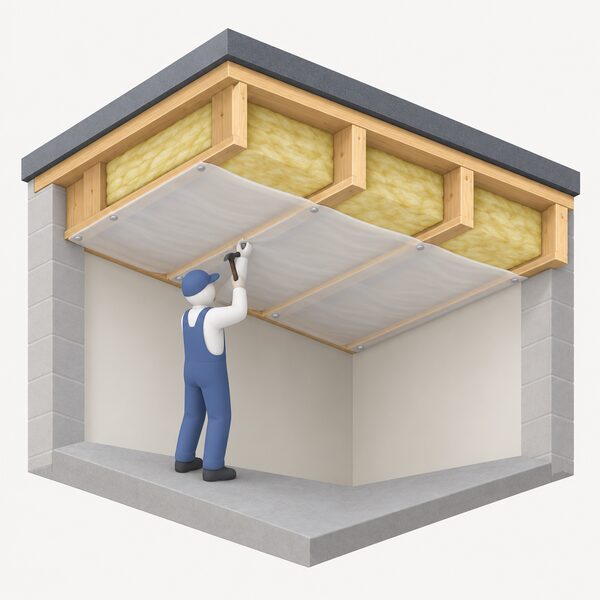
First, it is not a moisture barrier and it does not replace one. In a cold deck flat roof, official guidance states that a vapour membrane should be added to the underside of the insulation and tacked to the joists before applying the plasterboard26. In a ventilated cold loft, no such membrane is added over the insulation, and the material relies on ventilation to stay dry. Getting this wrong in either direction creates problems.
Second, internal wall insulation, whatever the material, creates cold walls. Official guidance states that internal wall insulation inevitably creates cold walls which are inherently more susceptible to moisture risk27. That is a property of insulating a wall from the inside, not of mineral wool, but it is the situation a householder ends up managing.
Third, the material only performs if it stays in place and dry. Mineral wool that is compressed, gap-edged, wet or disturbed loses performance, and the expected service life of at least 40 years for mineral wool and properly installed cavity insulation is conditional on proper installation6. A stone wool manufacturer states its own product can last at least 50 years with no need for maintenance and no degradation in quality or performance28, but that is a maker's claim for its own product, and the independent figure is the 40-year one.
For a household, the independence this buys is real but bounded. Less heat lost means less fuel bought, and a well-insulated loft or cavity reduces exposure to price movements. It does not remove the gas connection, the electricity supply or the supplier. What it changes is how much of both the home needs. The wider argument is set out in insulation, glazing and energy independence.
Sources28 cited
- ECO4 New Measures and Products Guidance v3.0, Ofgem, 2026
- Timber Frame Wall Insulation, MIMA, 2026
- Cellulose vs Hemp vs Cork Insulation, Uswitch, 2025
- Loft Insulation and Ventilation Guidance, nidirect, 2026
- Installing Blanket Insulation, Which?, 2026
- House Insulation: The Ultimate Guide, Federation of Master Builders, 2026
- Tax on Shopping: Energy-Saving Products, HM Government, 2026
- ECO4 Delivery Guidance Version 4.0, Ofgem, 2026
- Energy-Saving Materials: Reduced Rate of VAT, legislation.gov.uk, 2024
- VAT Energy Saving Materials and Grant Funded Heating Supplies: VENSAV3040, HM Revenue and Customs, 2026
- Self-Build Homes: Sustainability, Planning Portal, 2026
- Building Regulations: Extensions, Energy Efficiency, Planning Portal, 2026
- Building Regulations: Extensions, Energy Efficiency, Welsh Government, 2026
- Building Regulations: Additional Storeys, Energy Efficiency, Planning Portal, 2026
- Approved Document L Volume 1: Dwellings, HM Government, 2026
- Approved Document L Volume 1: Dwellings, 2021 Edition Incorporating 2023 Amendments, HM Government, 2023
- Approved Document L Volume 1 Consultation Version, Welsh Government, 2025
- Building Regulations: Conversion Projects, Planning Portal, 2026
- Building Standards Technical Handbook 2022: Insulation of Pipes, Ducts and Vessels, Scottish Government, 2022
- EINAS 2025: Heat and Buildings, HM Government, 2025
- VAT: Energy Saving Materials for Consumers, HM Revenue and Customs, 2026
- Written Statement: Housing Cabinet Secretary Responds to UK Government Action on GBIS and ECO4, Welsh Government, 2025
- Greater Protections to Restore Families' Trust in Home Upgrades, HM Government, 2026
- ECO Public Reports and Data, Ofgem, 2026
- Great British Insulation Scheme: Contacts, Guidance and Resources, Ofgem, 2026
- Building Regulations: New Roofs, Thermal Resistance and Insulation, Planning Portal, 2026
- Guide to Conversion of Traditional Buildings, Scottish Government, 2026
- Why Stone Wool, ROCKWOOL, 2026