In this guide
Sharp is a long-established electronics manufacturer that has been making solar modules for decades, and its panels are a common sight on UK roofs fitted during the years when the brand was actively sold into the European residential market. The practical question for a UK householder is rarely "should I buy Sharp?" and much more often "I have Sharp panels on this house, what do I actually own?" The answer sits in the model number on the backsheet, the guarantee terms document issued with that module, and the MCS certificate that covers it.
The modules most likely to be encountered are the NUJC330 and the NBJG435B-455B range, the latter covered by an MCS certificate dated 2 December 20241. Sharp's published guarantee terms for the EU and global markets have been reissued repeatedly, with validity dates running from 25 May 2020 through to 1 December 2024, so the version that governs a given panel depends on when it was made2.
What follows sets out who Sharp is as a solar maker, the UK range and its documentation, the warranty structure and how it has changed, the support route when something fails, and what owning Sharp panels means for a household's energy independence.
Sharp no longer sells solar panels in Europe: what that means for UK owners
The single most important thing to understand about Sharp solar panels in the UK is the sales route. In the UK, solar panels are sold via installers rather than direct to consumers, which is why consumer testing programmes do not name individual best buys in the way they do for white goods7. Sharp's position is a sharper version of that general picture: the brand remains a solar manufacturer with published product pages, datasheets and guarantee terms, but it is not a name a UK householder will typically be offered as a new installation in the way they might be offered other module brands.
For an owner, that changes very little in the short term and a good deal in the long term. The module itself does not stop working because the brand's European sales activity changed. What changes is the supply of identical replacement modules, the ease of a like-for-like warranty swap, and the likelihood that a local installer has recent familiarity with the model.
The practical consequences are worth stating plainly. First, the documentation you hold becomes the warranty. Sharp publishes guarantee terms for the EU and global markets with explicit validity dates, and the version dated to your module is the one that applies2. Second, the MCS certificate matters more than the brand name for any scheme eligibility, because scheme rules attach to the product and the installer rather than to current sales activity1. Third, if a panel fails, the replacement may not be an identical Sharp module, and independent guidance notes that a replacement panel may look different6.
Who Sharp is: a long-standing solar manufacturer
Sharp's solar history is longer than most of the brands now competing for UK roof space. The company's module pages describe monocrystalline solar panels built around silicon cells, and its NU-R245(J5) module is described as high-performance photovoltaic modules made of monocrystalline silicon solar cells3. The NUJD450 is a 144 half-cell monocrystalline panel designed for large free-field and commercial rooftop photovoltaic systems, and it carries an EUPD Germany PV Award from 20212.
That commercial and free-field orientation is a useful clue to where Sharp's module business has concentrated. The NUJD450's stated application is large free-field and commercial rooftop systems rather than the domestic retrofit market, and its guarantee territory is described as modules installed within the EU and additional listed countries2. A brand that designs for utility-scale and commercial arrays behaves differently from one that chases domestic installer accounts: fewer consumer-facing support channels, longer product cycles, and documentation aimed at specifiers.
For a householder, the relevant point is that Sharp is not a fly-by-night badge. It is an established manufacturer with a documented product history, published datasheets and formal guarantee terms. That matters for the performance warranty in particular, because a 25-year output promise is only as good as the company standing behind it, and Sharp has been standing behind solar modules for a long time.
The UK range: NUJC330 and NBJG435B-455B modules
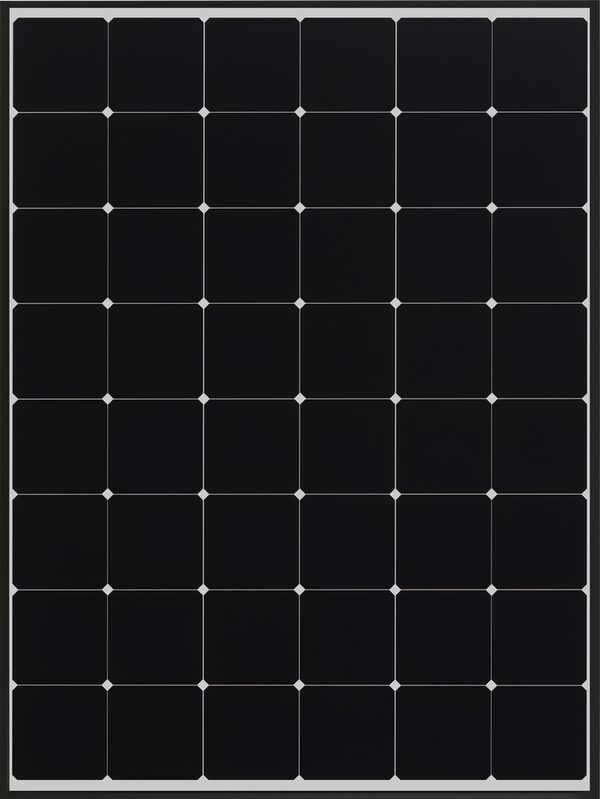
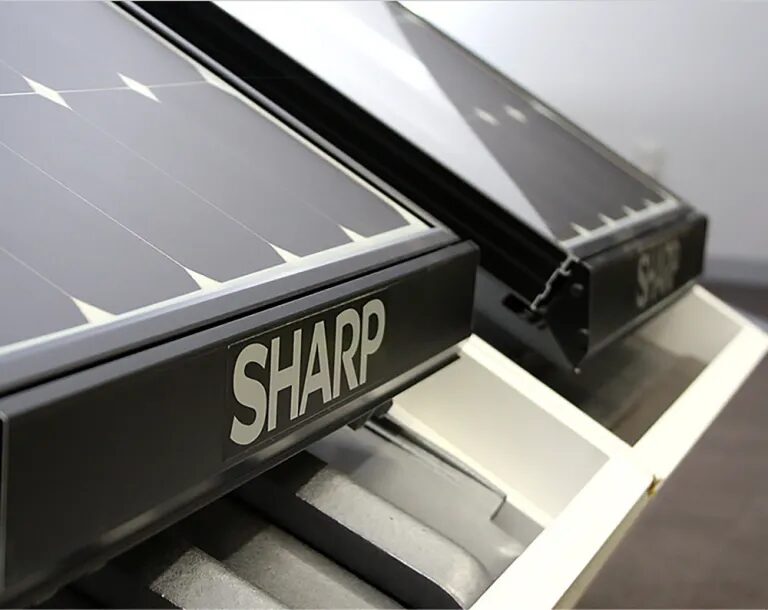
The two model families a UK owner is most likely to meet are the NUJC330 and the NBJG435B-455B range. The NBJG435B-455B range is the one with a current MCS certificate, numbered 241129 MR 50656074 0001 and dated 2 December 20241. That certificate is the document that ties the modules to the standards a scheme or a network operator will ask about.
Sharp's published guarantee terms for these modules have been reissued on a rolling basis. Guarantee terms for the EU and global markets were published with validity from 1 November 2023, 1 September 2024, 1 November 2024 and 1 December 2024, and the NUJC415 and NUJC435 carry terms taking effect from 1 November 20232. The NUJC330 datasheets were published in two versions dated 20 August 2020, one for EU countries and one for MEA countries2.
| Model family | Cell technology | Documentation | MCS certificate |
|---|---|---|---|
| NUJC330 | Monocrystalline | EU and MEA datasheets, 20 August 20202 | Not stated |
| NBJG435B-455B | Monocrystalline | Guarantee terms from 1 September 2024 and 1 December 20242 | 241129 MR 50656074 0001, 2 December 20241 |
| NUJC415 / NUJC435 | Monocrystalline | Guarantee terms from 1 November 20232 | Not stated |
| NUJD450 | Monocrystalline, 144 half-cell | EU and additional listed countries2 | Not stated |
| NU-R245(J5) | Monocrystalline silicon, 156.5 mm² cells3 | Maker product page3 | Not stated |
The NU-R245(J5) is an older module built from monocrystalline silicon solar cells measuring 156.5 mm², which places it in an earlier generation of cell format than the half-cell designs now standard3. An owner reading a model number off a backsheet can use the table above to work out roughly which generation of Sharp module they have, and therefore which set of guarantee terms is likely to apply.
Specifications and documentation: datasheets and the installation manual
Sharp's documentation set for a module typically comprises a datasheet, an installation manual and a guarantee terms document. The installation manual VSIM426-010 was published on 11 February 2019, and the guarantee terms for EU countries (SESE-NDNU-16-EN-5.5) were published on 25 May 20202. Those dates are the anchor points for older installations: a panel fitted in that period is governed by the documents issued around then, not by anything published since.
The documentation a householder should hold is not only the maker's paperwork. A properly commissioned installation hands over record drawings, test and completion certificates, maintenance instructions, manufacturers' product literature, a full description of works and commissioning certificates1. That handover pack is what a future buyer, an insurer or a warranty claim will ask for, and it is the reason the paperwork matters more than the badge on the roof.
For anyone wanting to read a Sharp datasheet properly, the terms on it follow the conventions explained in reading a solar panel datasheet, and the standards a module is tested to are set out in solar panel standards and testing. The installation side, including the 400mm edge setback rule that applies to panels installed under scheme specifications, is covered in solar panel installation.
Warranty: 10-year product and 25-year linear performance cover
Sharp's warranty structure follows the industry norm, and the industry norm is worth stating precisely because owners often conflate the two promises. Solar panels usually come with a 25-year performance warranty and a five to 10-year product warranty4. Most solar panels come with a 25-year performance guarantee5. The product warranty covers defects in the panel; the performance warranty covers the module's output declining over time.
Sharp's own guarantee terms are published as separate documents for the EU and global markets, each with a validity date. The terms valid from 1 November 2023, 1 September 2024, 1 November 2024 and 1 December 2024 are the most recent in the sequence, and the terms for the NUJC415 and NUJC435 take effect from 1 November 20232. The guarantee territory for the NUJD450 is described as modules installed within the EU and additional listed countries2.
The distinction between the two warranties matters at claim time. A panel that is producing less than expected is a performance claim, and independent guidance notes that some manufacturers require independent testing to prove the panel is not performing before accepting one6. A panel with a physical defect, a cracked cell or a failed junction box is a product claim. The two routes have different evidence requirements and different clocks.
"Solar panels usually come with a 25-year performance warranty and a five to 10-year product warranty."
For a fuller treatment of how degradation curves and warranty thresholds work across the industry, see solar panel warranties and degradation.
Guarantee terms: which version applies and how they have changed
Sharp has reissued its EU and global guarantee terms repeatedly, and the sequence of validity dates is the single most useful thing an owner can note. The published versions run from 25 May 2020, through 1 November 2023, 1 September 2024 and 1 November 2024, to 1 December 20242. Each version applies to the modules it was issued for, so the terms governing a panel are fixed at the point of manufacture rather than floating to the newest document.
That rolling revision is not unusual, and it reflects changes in the wider regulatory picture as well as in Sharp's own commercial terms. Energy labelling rules for space and water heaters have themselves been updated, with changes to labels and some definitions9. Module guarantee documents tend to move in step with that kind of regulatory housekeeping.
The practical consequence for an owner is that two Sharp panels on the same roof, fitted a year apart, may sit under different guarantee terms. Where the documents differ, both figures stand and the terms dated to the specific module govern. The way to establish which applies is to match the model number and the installation date to the guarantee terms document issued for that model, and to keep that document with the handover pack.

Support and service: technical questions and replacement modules
When a Sharp panel develops a fault, the route to resolution runs through the installer first and the manufacturer second. Official guidance is that it is advisable to contact an installer who can provide the necessary advice10. That is not a brush-off: the installer holds the commissioning record, the string design and the handover documentation, and those are what a manufacturer will ask for.
A full professional service inspects for small cracks or inverter issues, and it is worth checking the warranty policy, because some installers require a full service within a specific period to keep the warranty valid11. That condition is easy to miss and expensive to discover late. Cleaning and inspection costs depend on the number of panels, their location and whether specialist access equipment is needed11.
If a claim proceeds, the caveats are worth knowing in advance. The cost of labour for replacing the panel and any scaffolding may not be covered, the replacement panel may look different, and some manufacturers require independent testing to prove the panel is not performing6. Those three points account for most of the gap between what an owner expects a warranty to cover and what it actually covers.
For the wider picture on fault diagnosis and inspection intervals, see solar panel maintenance and cleaning and solar panel problems.
What owning Sharp panels means for household energy independence
A Sharp array does the same job as any other module: it converts sunlight into electricity that can be used in the building, or exported to the grid in return for a payment under the Smart Export Guarantee12. Photovoltaic panels could power a home, reduce bills and may earn money, and the household benefits include saving on bills, receiving payment for exported electricity, reducing carbon emissions and improving the property's EPC rating14.
The economics of self-consumption are the part that matters most for independence. Rates for selling electricity to the grid are much lower than tariffs for using electricity from the grid, so using solar electricity yourself is much more cost-effective than exporting it16. One independent estimate puts the effective locked-in cost of self-consumed solar power at 0p per kWh for the next 25 years5. That is the independence a Sharp array delivers: a portion of a household's electricity at a fixed, near-zero marginal cost, for as long as the modules produce.
What it does not deliver is independence from the grid. A grid-connected Sharp array has no storage unless a battery has been added, so surplus generation flows out and evening demand flows in. The household remains on a supplier, on a connection agreement, and on the network. The panels are made to last 25+ years and need very little maintenance, which is the durability side of the ledger, but durability is not autonomy6.
The brand's own position adds one more layer. Because Sharp is no longer an active domestic sales presence in Europe, the long-term support route depends on the guarantee terms document and on the installer relationship rather than on a continuing consumer channel. For a household weighing independence, that is the honest summary: a Sharp array gives you a fixed-cost slice of your own generation, and leaves you connected to everything else. The wider picture is set out in solar panels and household energy independence.
Sources16 cited
- Warm Homes Social Housing Fund wave 3 scheme guidance addendum, Department for Energy Security and Net Zero, 2026-06
- Sharp 450 Wp Mono NUJD450, Sharp, 2026-09-17
- Sharp NU-R245(J5), Sharp, 2026-09-17
- Buying a house with solar panels, Energy Saving Trust, 2026-08-13
- Solar panels, Uswitch, 2026-09-16
- Solar panel problems and how to solve them, Which?, 2026-03-26
- How we test solar panels, Which?, 2026-08-12
- Solar panels, London Borough of Hammersmith and Fulham, 2026-09-17
- Permitted development rights impact assessments, Scottish Government, 2026-09-17
- Are solar panels worth it, Which?, 2026-05-15
- Solar panel cleaning and maintenance, Energy Saving Trust, 2026-08-25
- Solar photovoltaic panels, London Borough of Bromley, 2026-09-17
- Solar PV panels, AgilityEco, 2026-09-20
- Solar panels and permitted development, London Borough of Richmond upon Thames, 2026-07-06
- Building regulations: solar panels, Welsh Government, 2026-09-17
- Solar panels, Oxfordshire County Council, 2026-09-17