
In this comparison
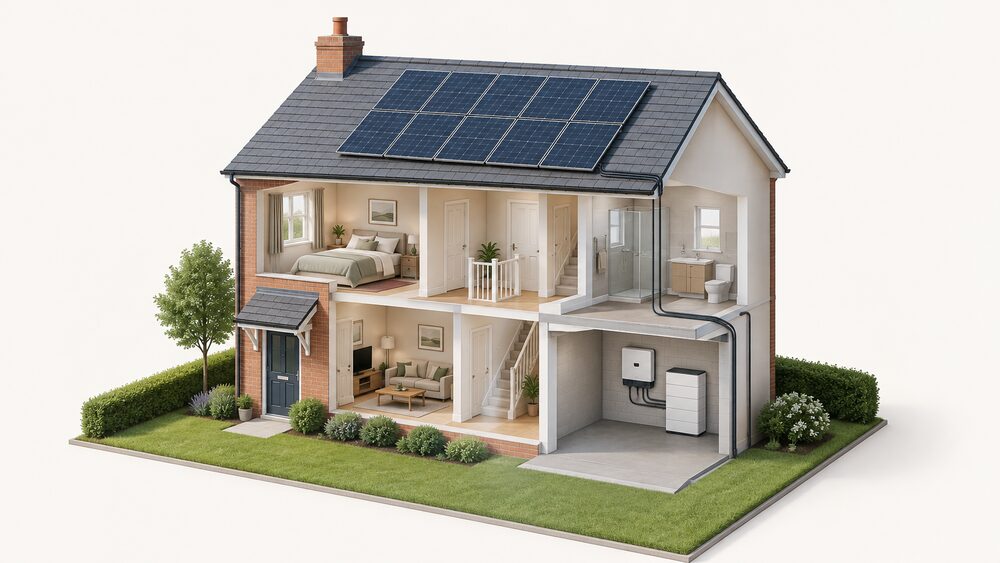
GoodWe and SolaX both sell hybrid inverters into the UK market at the value end of the price range, and both are pitched at households that want solar, a battery and some control over when power is used. The two brands are not identical in what they offer. GoodWe's UK presence runs through a distributor listing that includes the ESA Series all-in-one hybrid inverter from 5kW to 30kW, the Lynx D battery module at 5 kWh usable stacking to 40 kWh, and the Lynx F G2 high voltage battery at 6.4 to 28.8 kWh1. SolaX's own UK material presents a residential storage range from 2.5 kWh to 92.16 kWh, hybrid inverters with G98 and G99 certification, and an EV charger that works with its inverters6.
The comparison turns on more than efficiency figures. GoodWe's own site lists a news item dated 1 September 2026 stating the company was included in the BloombergNEF Tier 1 Power Inverter List for the sixth consecutive quarter, and a UK installer has documented GoodWe installations going back to 201910. SolaX states a presence in more than 110 markets with over 700 global partners, and its UK X3-HYBRID G4 materials list G98 and G99 certification12.
GoodWe at a glance: a Shanghai-listed inverter maker
GoodWe's product pages carry commodity codes rather than share information: 8504408400 on the DNS G3 string inverter, the GW10K-EHA-G20 and the GW5000-ES-20-AFCI hybrid, and 8504909090 on the Lynx D wall bracket17. Those are customs classifications for import, not a stock exchange ticker, and no listing detail for the company is published. What is clear is a maker that has been shipping into the UK for years and now sells a fairly wide residential catalogue here.
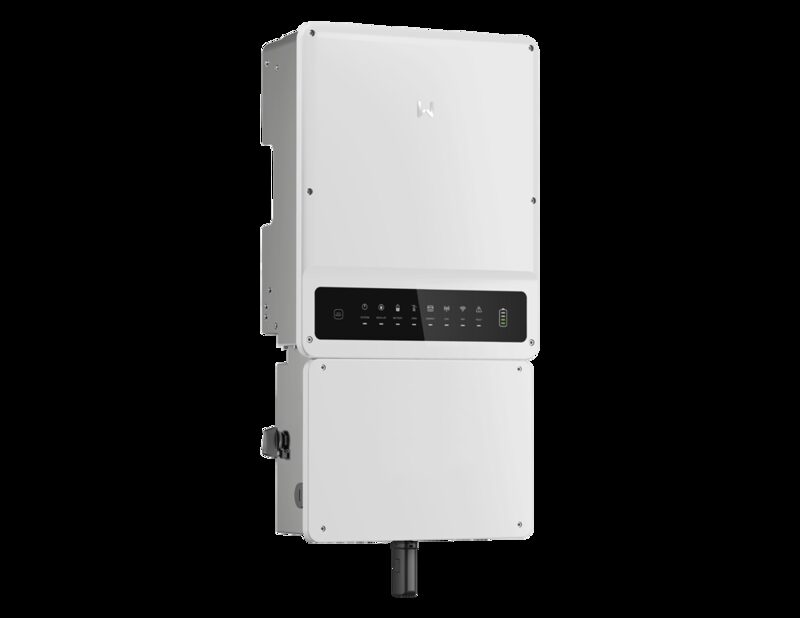
The range splits into three parts. There are string inverters such as the DNS G3, a single-phase 3kW unit17. There are hybrid inverters, including the GW5000-ES-20-AFCI at 5kW and the ESA Series all-in-one units20. And there is storage, in the Lynx D low voltage module and the Lynx F G2 high voltage series4. Around those sit accessories: a smart energy meter with a modular design and easy installation, and a wall bracket for the Lynx D21.
For a household, the practical question is not the corporate structure but whether the exact model is certified for UK connection and whether an installer will service it. GoodWe's own material describes the brand as a reliable and affordable choice for home solar panels, which is a positioning claim rather than a specification14. The evidence that matters is the certification record and the installation history, both of which are covered below.
Scale and track record: two million inverters delivered
No global installed capacity figure or cumulative unit count is published for GoodWe, so any claim of that kind cannot be made here. What is documented is a set of dated events that show the direction of travel. On 1 September 2026 GoodWe's homepage listed a news item stating the company was included in the BloombergNEF Tier 1 Power Inverter List for the sixth consecutive quarter10. On 7 September 2026 it listed the expansion of the EO G2 off-grid solution to the Philippines, and on 15 September 2026 an expansion of its Sub-Saharan Africa presence with a Nairobi office and an EO G2 launch10.
The UK record is older than those announcements. Wagner Renewables, a UK installer, completed a 6kW solar and storage installation in Putney in March 2019 using a GoodWe EM hybrid inverter with 7.2 kWh of Pylontech battery storage11. In May 2019 it installed a 4.27kW system in Eastleigh with a GoodWe hybrid inverter and the same battery capacity, and in February 2021 an 8.64kW system in Chichester with GoodWe inverters and 9.6 kWh of storage11. In March 2026 the same firm published an introduction to the GoodWe ESA Series and SEMS+ app11.
That is a seven-year UK track record across several product generations, which matters more to a household than a headline capacity number. It means spares, firmware and installer familiarity exist for the older hybrid range as well as the current ESA Series. It does not mean every model is still supported, and it says nothing about how long a given unit will last.
Efficiency: 8/10 residential rating
GoodWe's residential efficiency score is given as 8 out of 10 on a product page dated 20 November 202314. That is a single figure from the maker's own material and it is not broken down by model, so it should be read as a general positioning statement rather than a specification for a particular inverter. No conversion efficiency percentage for a GoodWe residential model is published.
SolaX publishes efficiency figures model by model, and they cluster in the high nineties. The X3-MIC G2 is stated at 98%, the X1-Boost G4 at up to 98.0%, the J1-ESS at 98%, and the X3-IES-P at 98% peak efficiency7. The X1-FIT G4 is given as up to 97%, and the X1 IES datasheet records a maximum efficiency of 97.6%22. Those are maker figures for the maker's own products, and they are the kind of number that appears on a datasheet rather than in an independent test.
The gap between an 8/10 score and a set of 97 to 98% figures is not a like-for-like comparison, because the two brands are measuring different things. A percentage conversion efficiency tells a household how much of the direct current from the panels becomes alternating current for the house. A score out of ten tells them nothing specific at all. Where a household is weighing the two, the datasheet figure for the exact model is the one that can be checked, and it should be read alongside the certification and warranty terms rather than on its own.

Positioning: a balanced value option
Both brands sit in the mid-market rather than the premium tier, and both makers describe their own products in those terms. GoodWe's material calls the brand a reliable and affordable choice for home solar panels14. SolaX's own guidance on premium versus mid-range inverters places its smaller-format options, such as the X1-MINI G4 family, in lighter single-phase applications6.
What separates them in practice is the shape of the range. SolaX publishes a residential product line from 2.5 kWh to 92.16 kWh, which spans a single small battery through to a substantial multi-unit installation15. It also offers 200% PV oversizing on the X1-Boost G4 and up to 200% on the X1-FIT G4, meaning the inverter can accept a panel array twice its rated output7. That suits a household that wants to add panels later without changing the inverter.
GoodWe's ESA Series is built around a different idea: an all-in-one unit that combines inverter and storage, available from 5 to 30 kW with expandable storage from 5 to 108 kWh1. The single-phase ESA 3 to 10K scales from 5 to 48 kWh per system with up to 6 modules per stack, and up to 6 inverters can be combined for a total storage capacity of up to 288 kWh1. GoodWe describes the series as featuring AI-driven energy management, dynamic tariff optimisation and smart control1.
For a typical three or four bedroom house, both brands offer a workable hybrid inverter with a battery in the 5 to 12 kWh region. The difference shows up at the edges: SolaX has more granular small-format options and a wider published battery range, while GoodWe's ESA Series is designed to be specified as a single integrated unit with a clear expansion path.
The product range for the home: HCA charger, ESA Series, SEMS+ and EO G2

GoodWe's residential catalogue in the UK covers inverters, batteries, monitoring and an EV charger. The ESA Series is the centrepiece: an all-in-one hybrid inverter with storage, sold in single-phase and three-phase versions from 5kW to 30kW1. The Lynx D LXD5.0-10 battery module provides 5 kWh usable and stacks from 5 kWh to 40 kWh across 8 modules, and works with GoodWe inverters for remote monitoring, diagnosis and firmware updates4. The Lynx F G2 series is a high voltage battery from 6.4 to 28.8 kWh with plug and play wiring, installed grounded5.
On the charging side, GoodWe launched the HCA Series residential smart EV charger on 9 December 2022, an AC wallbox with smart charging functions offered in single-phase and three-phase variants25. The smart energy meter has a modular design and easy installation21. The ESA Series supports one-click configuration and upgrade1.
SolaX's home range is broader in the number of product lines. It includes the X1-VAST at 5kW, 6kW, 8kW and 10kW with wireless meter compatibility, the X1-FIT G4 with CT compatibility and up to 150% EPS output for 10 seconds, and the X1 IES with a 10-year warranty22. The Smart EV Charger G2 comes in 4.6kW, 7.2kW, 11kW and 22kW versions with a Type 2 connector, dynamic load balancing, and WiFi, 4G or Ethernet connectivity9. The Energy Meter range has a 50ms refresh rate and voltage compatibility from 220V to 415V28.
| GoodWe | SolaX | |
|---|---|---|
| Hybrid inverter range | ESA Series, 5 to 30 kW1 | X1-VAST 5 to 10 kW; X1-FIT G422 |
| Battery range | Lynx D 5 to 40 kWh; Lynx F G2 6.4 to 28.8 kWh4 | Residential line 2.5 to 92.16 kWh15 |
| EV charger | HCA Series, single and three phase25 | Smart EV Charger G2, 4.6 to 22 kW9 |
| Monitoring | SEMS+ app11 | SolaXCloud29 |
| Meter refresh | Not stated | 50ms28 |
Certification and type testing: the GW-XS-30 certificate
Certification is the part of an inverter purchase a household cannot see but depends on. It is what allows the unit to be connected to the grid under the relevant engineering recommendation, and it is what a distribution network operator will ask for. GoodWe's GW-XS-30 certificate covers six models, was first issued on 15 February 2024, and is stated to be valid until 15 February 202930. That is a five-year term, and it applies to those six models only.
Type testing is a separate step. Testing for the RA.STORE-3F 10K was recorded as beginning on 2 June 2022 at a GoodWe Technologies test laboratory in Suzhou, China31. That record shows the process being carried out at the maker's own facility, which is normal for type testing, and it is dated evidence rather than a claim.
SolaX publishes a certification count: more than 1,100 product certifications globally, a figure repeated across several of its pages12. Its UK X3-HYBRID G4 materials list G98 and G99 certification6. The X1 IES datasheet lists IEC62109-1, IEC62109-2, VDE0126-1-1A1:2012, VDE-AR-N4105, G98, G99, AS4777, EN50549 and CEI0-2123. The J1-ESS is certified by JIS and JET, which are Japanese standards33.
A count of certifications is not the same as certification for the model being installed. The check that matters is whether the exact model number appears on a current certificate for the UK grid connection standard, and whether that certificate is still in date. A certificate that has lapsed, or that covers a different model, is not evidence for the unit on the wall.
Availability in the UK and installer experience
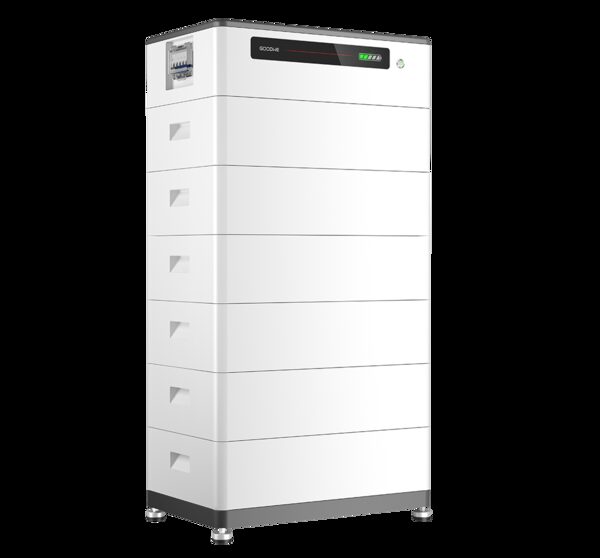
GoodWe equipment is listed by a UK distributor across the residential range: the ESA Series in 5kW, 8kW, 10kW and 12kW versions, the GW5000-ES-20-AFCI hybrid, the Lynx D battery module and the Lynx D wall bracket1. The wall bracket carries next day delivery subject to conditions19. Prices are installer-quoted and no published retail figures are given for either brand.
SolaX's UK availability is documented differently. Which? records that the SolaX battery system is available via UK installers, with a 10-year warranty on its 3.3 kWh and 6.5 kWh units34. The SolaX Thermal R290 Series heat pump is listed as available for the UK market, with a note that products may only be available in specific regions35. Some SolaX products are not for the UK at all: the J1 Hybrid is described as Japan exclusive, and the A1 Hybrid G2 is tailored specifically for the US residential market7.
Installer experience with GoodWe in the UK is documented by Wagner Renewables across installations from 2019 to 2021, including the Putney, Eastleigh, East Preston, Middleton-on-Sea, Worthing, Emsworth and Chichester jobs11. Several used GoodWe hybrid inverters with Pylontech storage, and one used a GoodWe AC coupled battery inverter alongside a SolarEdge system11. That is a record of a UK installer specifying GoodWe repeatedly over several years, which is the kind of evidence a household can weigh when an installer proposes the brand.
SolaX has a UK installer network too, and its partnership with Axle Energy, launched in the UK and France on 26 February 2026, allows eligible SolaX battery owners to connect their battery to a virtual power plant, managed automatically in the background36. That is a route to earning from a battery without changing hardware, and it depends on the maker's cloud platform remaining available.
GoodWe vs SolaX: what the comparison turns on
The two brands overlap heavily on the basics and diverge on the details. Both offer hybrid inverters with battery storage, both have UK certification on at least some models, and both sit in the value half of the market. The choice usually comes down to four things: the size and shape of the range, the warranty terms, the monitoring platform, and what happens in a power cut.
On range, SolaX publishes a residential line from 2.5 kWh to 92.16 kWh and offers 200% PV oversizing on two models, which suits a household planning to expand7. GoodWe's ESA Series runs from 5 to 30 kW with storage from 5 to 108 kWh, and the single-phase ESA 3 to 10K scales from 5 to 48 kWh per system with up to 6 modules per stack1. GoodWe's Lynx D stacks from 5 kWh to 40 kWh across 8 modules4.
On warranty, SolaX publishes terms model by model: 5 years on the X1-Boost G4, 12 years on the A1 Hybrid G2, and 5 years extendable to 10 on the X3-Hybrid G47. Its battery performance warranty runs for 120 months after the commissioning date, and the X1 IES carries a 10-year warranty23. Which? records a 10-year warranty on the SolaX battery system34. No GoodWe warranty terms are published, so no comparison can be made on that point.
On monitoring, GoodWe's SEMS+ app is introduced alongside the ESA Series and the maker describes the series as featuring AI-driven energy management, dynamic tariff optimisation and smart control11. SolaXCloud supports IEEE 2030.5 and OpenADR and carries what the maker calls robust security compliance, and SolaX devices work with a range of HEMS partners29. Both are cloud platforms, so both depend on the maker's servers and a working internet connection.
On resilience, SolaX's X1-FIT G4 offers up to 150% EPS output for 10 seconds, which is the emergency power supply function that keeps selected circuits running during an outage23. No equivalent figure is published for a GoodWe residential model. That is a real difference for a household that wants the lights to stay on in a power cut, and it is the kind of specification worth confirming for the exact model under consideration.
For energy independence, both brands reduce reliance on imported electricity by shifting solar generation into the evening and by charging a battery on a cheap tariff. Neither removes dependence on the grid, a supplier or the maker's cloud service. A hybrid inverter with a battery and an EPS function can keep a few circuits alive during an outage, but the household remains connected to the network for the rest of the year, and the app that manages it all sits on someone else's servers.
Sources36 cited
- GoodWe 10kW all-in-one ESA 1PH hybrid inverter, Alternergy, 2026
- GoodWe 5kW all-in-one ESA 1PH hybrid inverter, Alternergy, 2026
- GoodWe 12kW all-in-one ESA 3PH hybrid inverter, Alternergy, 2026
- GoodWe Lynx D 5.0 kWh HV LFP battery module, Alternergy, 2026
- GoodWe Lynx F G2 Series, GoodWe, 2026
- Premium vs mid-range inverters for UK homeowners, SolaX, 2026
- Best solar inverters, SolaX, 2026
- SolaX X1-VAST, SolaX, 2026
- SolaX Smart EV Charger G2, SolaX, 2026
- GoodWe homepage, GoodWe, 2026
- The future of the smart home: GoodWe ESA Series, Wagner Renewables, 2026
- Whole home energy management solutions, SolaX, 2026
- How to choose an inverter: price, performance, warranty, SolaX, 2026
- Best solar inverters in the UK, LuxPowerTek, 2023
- Best solar batteries, SolaX, 2026
- SolaX warranty terms and conditions, UK and Ireland, SolaX, 2024
- GoodWe 3kW DNS G3 1PH string inverter, Alternergy, 2026
- GoodWe 8kW all-in-one ESA 1PH hybrid inverter, Alternergy, 2026
- GoodWe Lynx D wall bracket, Alternergy, 2026
- GoodWe 5kW ES G2 1PH hybrid inverter, Alternergy, 2026
- GoodWe smart energy meter, GoodWe, 2026
- SolaX X1-FIT G4, SolaX, 2026
- SolaX X1 IES datasheet, SolaX, 2026
- GoodWe 10kW all-in-one ESA 1PH hybrid inverter, textured finish, Alternergy, 2026
- GoodWe launches solar-powered smart EV charger for residential use, GoodWe, 2022
- What size inverter do I need?, SolaX, 2026
- Different types of EV chargers, SolaX, 2026
- SolaX energy meter, SolaX, 2026
- SolaX smart energy management solutions, SolaX, 2026
- GW-XS-G3 certificate RD647, RD1699, RD413, GoodWe, 2024
- Type test report ATONG 04989, Energy Networks Association, 2022
- A guide to solar battery systems, SolaX, 2024
- SolaX J1-ESS, SolaX, 2026
- Solar panel battery storage, Which?, 2026
- SolaX Thermal R290 Series STU1-C10R290, Quiet Mark, 2026
- SolaX partners with Axle Energy to integrate SolaXCloud with VPP, SolaX, 2026
 The Full Brands GuideWhich boiler, heat pump or solar brand can you trust, and who actually owns it?
 Panel TypesWhich solar panels are best for a UK home, and how much do they cost?
 Energy Independence and MakersWhich brands let you keep control of your heating, solar or car charging, and which tie you to their app and their cloud?
 Solar Panel Manufacturers UKWhich solar panel brands are actually worth buying in the UK, and who really makes them?
 Warranties and DegradationHow long do solar panels actually last, and what do the warranties really cover?
 Second-Life EV BatteriesUsed electric car batteries can store solar power at home, but can you actually buy one in the UK?