In this guide
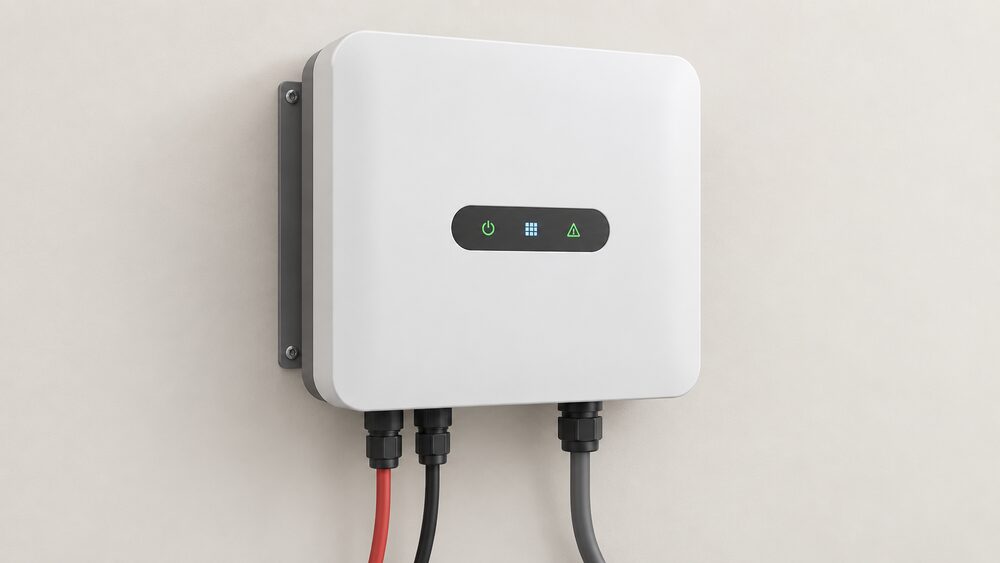
A Huawei inverter is the box that turns the direct current from a roof array into the alternating current a home uses, and in the UK the residential end of that range is the SUN2000 family. Huawei's own smart PV management material describes the wider system as integrating solar power, energy storage, and smart home control into one seamless app experience1. That sentence is the whole proposition and the whole caveat: the hardware converts power on its own, but the visibility and the control sit in a manufacturer's platform.
The residential picture is narrower than the brand suggests. Huawei's published UK compliance work covers listed residential single phase inverters, smart PV optimizers, smart power sensors, communication products, residential energy storage products, backup boxes, energy management equipment and Smart Guard products, with a second statement covering residential three phase inverters, residential energy storage systems and Smart Guard products2. Those two statements, issued on 22 April 2024 and 27 August 2024, are the clearest official marker of what Huawei actually sells into British homes.
For a household, the practical questions are the ones this page works through: which models appear on UK roofs, what they are rated at, how they pair with the Smart ESS battery, what the 210-compatible units mean for larger modules, what the compliance paperwork requires, and what remains outside the household's control once the system is running.
The SUN2000 residential range: which models UK homes use
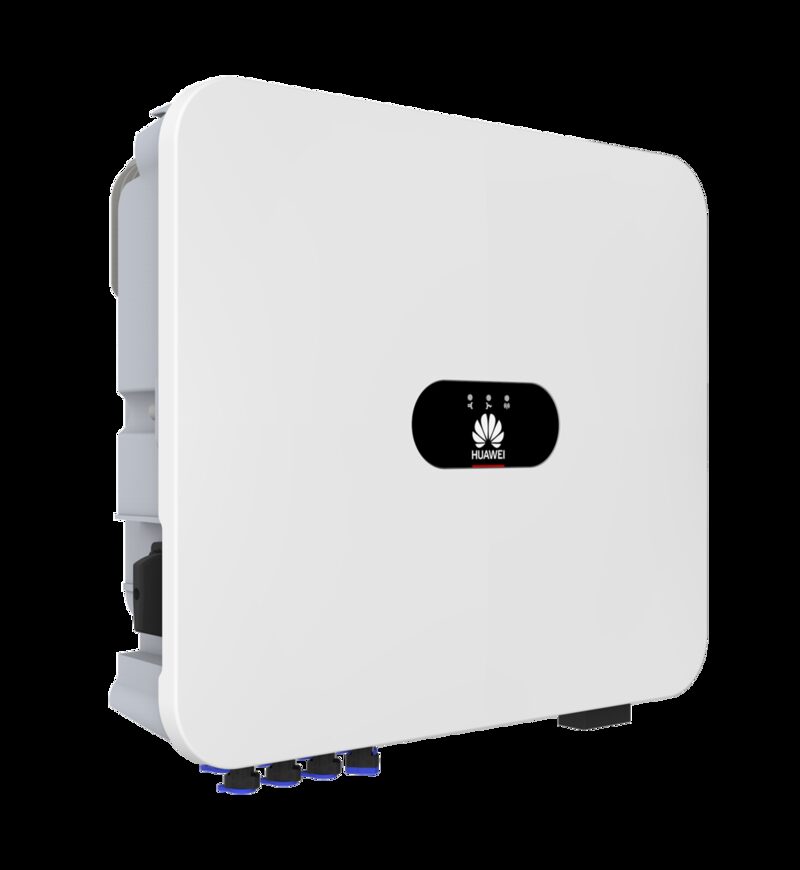
Residential model names usually carry the rating, so the range is readable from the label. The SUN-3/4/5/6/8/10/12K-SG05LP3-EU-SM2 is a hybrid inverter, and its name lists the sizes offered in that family, from 3K up to 12K2. Alongside it sits the SUN-5/6/8/10/12K-SG01HP3-EU-DM2, a three phase hybrid inverter covering 5-12kW with 2 MPPT and high voltage battery support2. Between them, those two families span the sizes a typical house and a larger three phase property would draw on.
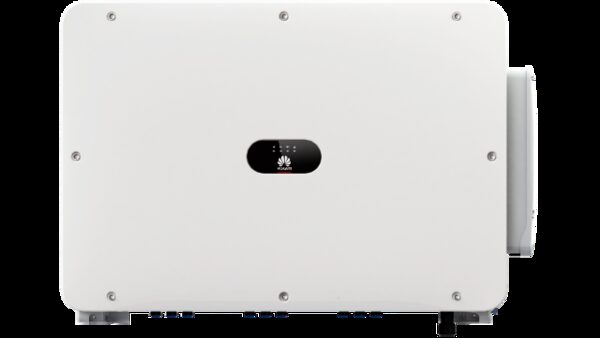
Above that sits the three phase residential and small commercial territory. The SUN2000-8-20KTL-M0 and M2 models carry an EU declaration of conformity with a CE marking date of 2 July 20202, and the SUN2000-L1 models hold Bureau Veritas certificate U20-0821 issued on 21 October 20205. These are the units that appear on larger domestic arrays and on light commercial roofs rather than on a typical semi-detached.
The naming convention is worth reading carefully, because it is the only reliable guide to what a quote is offering. The letters after the rating denote the series, and the series determines the manual, the certification and the battery pairing. A 6KTL-M0 and a 6KTL-L1 are not the same product with a different badge; they are different generations with different documentation.
For scale, the wider UK inverter market that Huawei competes in runs from single phase systems of 3.6kW to 8kW for residential use, through three phase systems of 8kW to 12kW for larger homes and light commercial premises, up to high-voltage commercial inverters from 20kW to 50kW3. Huawei's residential offer sits in the first two bands, with the commercial end covered by separate products.
Power ratings and key specifications
The ratings that matter to a UK householder are the continuous AC output and the number of MPPT trackers, because those determine how much array the unit can take and how well it handles a roof with two orientations. Huawei's residential units span the L1, M0 and M2 series, with the three phase models covering the upper part of the domestic band2.
The wider market context is useful for judging whether a quoted rating is generous or modest. Three phase hybrid inverters from other makers are sold in the 5kW to 25kW band with two MPPT trackers and high-voltage battery support6, and commercial and industrial-grade three phase inverters run from 20kW to 50kW3. A domestic Huawei installation in the 5 to 10kW range therefore sits in the middle of what the market offers, not at either extreme.
Cooling and enclosure matter more than they sound. The SUN2000-100KTL-M2 uses Smart Air Cooling2, a design choice that keeps the unit's rating stable in high ambient temperatures but introduces a fan as a service item over the life of the system. Residential units in the SUN2000 line are typically passively cooled, which removes that item but constrains where the inverter can be sited.
| Specification area | What to check on the datasheet |
|---|---|
| AC output rating | Matches the array size and the connection application |
| MPPT count | Two trackers suit a roof with two orientations6 |
| Battery support | High-voltage battery support stated on hybrid models6 |
| Display and interface | LED indicators plus the FusionSolar app2 |
| Cooling | Smart Air Cooling on the larger commercial units2 |
| Certification | Type test certificate matching the rating on the schematic7 |
Efficiency and performance in practice
Published efficiency figures for Huawei's residential units sit in the high nineties for the conversion stage, which is normal for transformerless string inverters and is not where real-world losses come from. The losses that a household actually experiences come from shading, from array mismatch, from cable runs and from the inverter's own standby behaviour overnight.
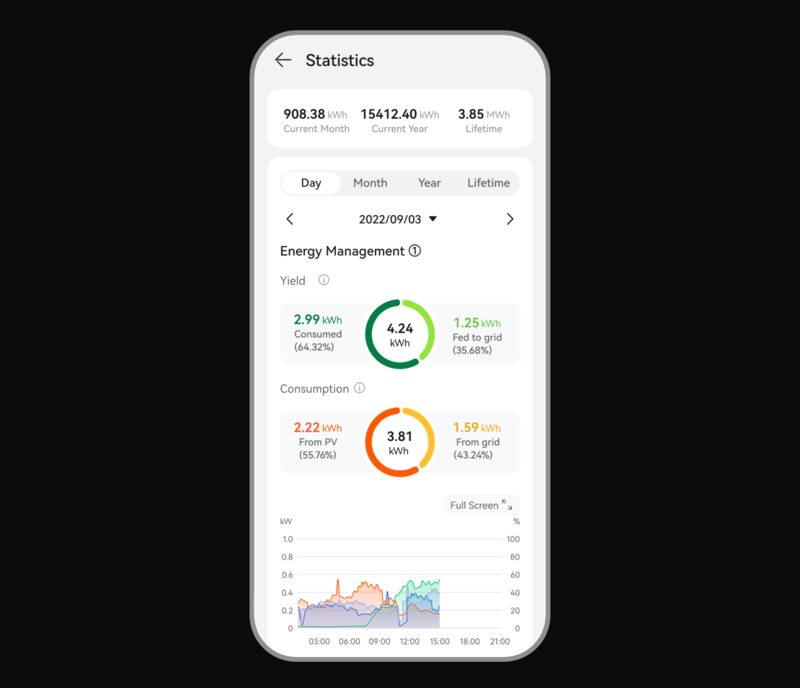
Monitoring is where performance becomes visible. Huawei's platform tracks system performance in real time and is described by makers in this market as enabling users to optimise their energy consumption8. That is a genuine benefit: without monitoring, a string that has dropped out or a partially shaded array goes unnoticed for months, and the loss is invisible on a quarterly bill.
One performance issue is not the inverter's fault at all. Grid voltage mismatch is listed among the causes of solar inverter faults4, and it is a supply-side condition rather than a hardware failure. Where the local network runs at the top of its voltage band, an inverter will trip to protect itself, and the fix sits with the network operator rather than with the household. That is a dependence worth understanding before assuming a fault code means a failed unit.
Battery storage: the Smart ESS and how it pairs with the inverters
Huawei's residential storage product is the Smart ESS Battery, stated in the SUN2000-2-6KTL-L1 datasheet as a 5kWh to 30kWh range available in 2020 Q32. That range is the headline: a single module for a modest evening load, or a stack for a household that wants to shift most of its generation.
The pairing logic is the same as any hybrid system. A hybrid inverter disconnects from the utility when the grid goes down and continues powering the home using solar panels and battery storage9, which is the capability that separates a hybrid from a plain string inverter. Makers in this market describe the hybrid category as suited to homeowners wanting to lower bills and have backup power during outages9. Whether a specific Huawei model provides that backup depends on the model and on whether a backup box is fitted, which is why Huawei's PSTI statements list backup boxes as a separate product category2.
Battery flexibility is the other half of the question. Some makers in this market advertise compatibility with a wide range of battery brands for ultimate flexibility10, and others build an intelligent energy management system with 24-hour online monitoring and self-adaptive adjustment of the battery10. Huawei's approach is closer to a closed ecosystem: the Smart ESS pairs with the SUN2000 range, and the management layer is Huawei's own.
Compatibility with larger panels: the 210-compatible models
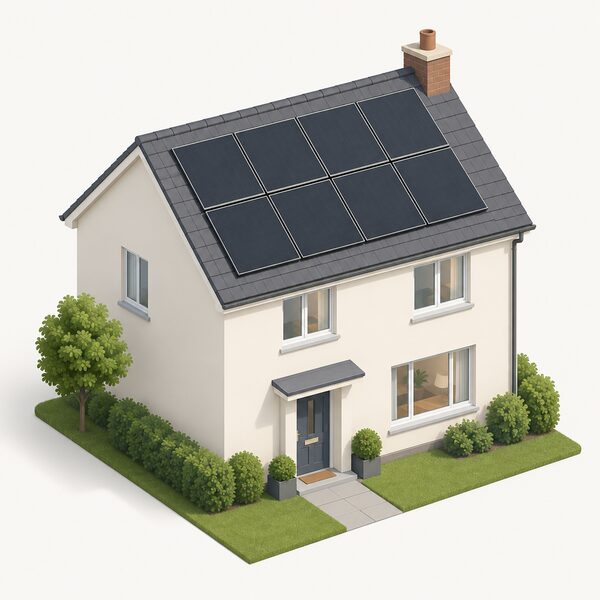
The 210 refers to wafer size in millimetres, and modules built on 210mm wafers are physically larger and higher current than the mainstream. Huawei announced production dates for two compatible inverter models on 29 January 2021: the SUN2000-196KTL-H3 would be mass-produced for the Chinese market at the end of March 2021, and the SUN2000-215KTL-H3 for other global markets at the end of May 20213.
Those are commercial-scale units, not residential ones, and that is the point a householder needs. The 210-compatible announcement concerns utility and large commercial inverters, where the higher current per string is an advantage because it reduces the number of strings and the amount of DC cabling. A domestic roof with eight to sixteen panels does not need that class of hardware.
Where the principle does reach a home is in string current limits. A larger, higher-current module can exceed what a small inverter's MPPT input will accept, and the consequence is clipping or, worse, an over-current condition the inverter manages by limiting output. The check is straightforward: the module's maximum power current against the inverter's per-MPPT input rating, read from the current datasheet rather than a product overview.
"Check the term against the current datasheet and installation manual, not only a product overview."
UK compliance: PSTI statements and certification
Two Huawei UK PSTI statements of compliance cover residential PV equipment. The first, issued 22 April 2024, covers listed residential single phase inverters, smart PV optimizers, smart power sensors, communication products, residential energy storage products, backup boxes, energy management equipment and Smart Guard products. The second, issued 27 August 2024, covers listed residential three phase inverters, residential energy storage systems and Smart Guard products2.
The PSTI regime is a product security requirement, and the statement is the document that carries it. All information required under PSTI must be included in the statement12. For a householder, that means the compliance document is a specific artefact to ask for, not a general claim of approval.
Grid connection compliance is separate and sits with the network operator. A G99 fast track connection application in Northern Ireland requires a compliance certificate with test results5. In England, a G98 notification requires approved inverter type test certificates and a G100 declaration13, and the power rating on the type test certificate must match the inverter rating shown on the schematic diagram7. That last requirement is the one that catches people out when an inverter is swapped: the paperwork has to be redone, not just the hardware.
| Compliance item | What it covers | Where it is required |
|---|---|---|
| PSTI statement of compliance | Product security information for listed residential equipment2 | UK-wide |
| Inverter type test certificate | Rating must match the schematic diagram7 | G98 notification13 |
| Compliance certificate with test results | Fast track connection evidence5 | Northern Ireland G995 |
| G100 declaration | Export limitation scheme13 | Where export limiting applies |
| Energy Performance Validation Scheme | Inverters are within the scheme's validation scope14 | UK |
Documentation and manuals: what to check before installation
Huawei publishes its SUN2000 manuals with an issue number and a date, and both matter. Issue 03 of the SUN2000-(5KTL, 6KTL)-M0 User Manual was published on 19 July 2019 and added commissioning, AFCI check and Italy CEI0-21 IPS test sections among other updates2. Issue 01 of the SUN2000-50K-MC0 User Manual was published on 30 August 20252. A manual that predates the unit on the wall may not describe the commissioning steps the installer needs.
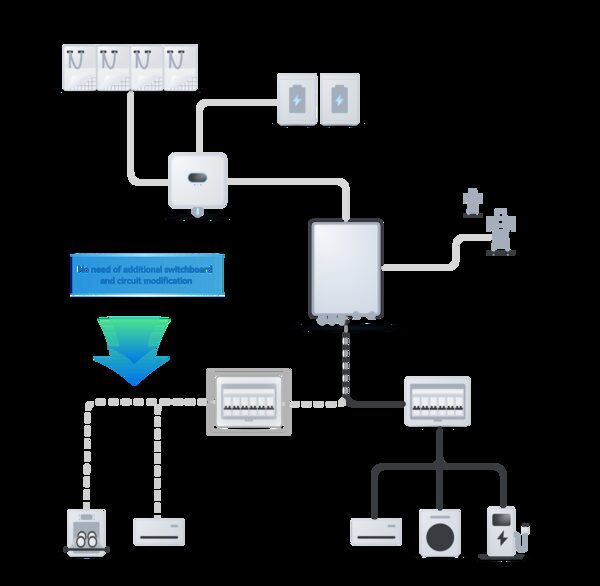
The documentation set for a change of inverter is longer than most households expect. It includes an installer report, a photograph of the new inverter's generation reading, a photograph of the inverter nameplate, the manufacturer's datasheet, a commissioning certificate, the installation invoice and an amended schematic diagram15. A battery installation adds an updated schematic diagram, battery nameplate photographs, the installer invoice and confirmation of the applicable setup scenario15.
Schematic diagrams have their own required content: the generator or generators, the name and power rating in kW of the inverter being used, live phases, neutral and earth, lockable isolators, clear demarcation between the network operator's and the customer's equipment, the G100 export limitation scheme, and any existing generation already installed at the property13. That list is worth keeping, because it is what a network operator will ask for if the connection is queried later.
What owning a Huawei inverter means for energy independence
The conversion itself is genuinely independent. Once the array and inverter are installed, the household generates its own electricity whenever the sun is up, and no supplier, network or platform is involved in that conversion. Independent analysis of the Scottish market puts the wider point plainly: more homegrown energy means greater energy independence16.
What remains dependent is a list, and it is worth being exact about it. The system stays connected to the grid, which is what allows export and what allows the house to draw power at night. It stays with an electricity supplier for whatever the array does not cover. The battery, if fitted, is a Huawei Smart ESS rather than a brand of the household's choosing2. Monitoring and app-based control run through Huawei's FusionSolar platform and the site's internet connection1. And the compliance chain, from the type test certificate to the G100 declaration, ties the installation to a network operator's process13.
The internet dependence is the one most often overstated. An inverter does not need broadband to generate, and local control continues without it. Independent guidance on home displays makes the same distinction: you do not need wifi to use the in-home display either17. What stops without a connection is remote visibility, not generation.
For a household weighing this against other options, the honest summary is that a Huawei inverter delivers independence in generation and dependence in management. The fuel is free and the sun is not metered, but the app, the battery chemistry and the compliance paperwork all belong to someone else. Households wanting a different balance of those trade-offs have alternatives across hybrid inverters and string inverters, and the wider context sits in solar panels and household energy independence.
Sources17 cited
- Smart PV Management System, Huawei, 2026-09-17
- Warranty terms and conditions, UK PSTI statements of compliance, Huawei, 2024-08-27
- World's leading photovoltaic inverter brands to launch products compatible with 210 ultra-high power modules, Trina Solar, 2021-01-29
- Managing voltage changes in your property, Electricity North West, 2026-09-19
- Certificate of compliance U20-0821, Bureau Veritas, 2020-10-21
- SUN-5/6/8/10/12/15/20/25K-SG01HP3-EU-AM2 three phase hybrid inverter, Deye, 2026-09-17
- Installations up to 3.68kW per phase at a single premises, SSEN, 2026-09-17
- Sungrow 5kW hybrid inverter, Sungrow, 2026-09-17
- Off-grid vs hybrid inverter, SolaX, 2026-03-13
- Energy Storage Solutions, Solis, 2026-09-17
- Hybrid inverter, Tigo Energy, 2026-09-17
- Energy and rating labels, Electrical Safety First, 2026-09-19
- G99 fast track process, Electricity North West, 2026-09-19
- Energy Performance Validation Scheme, EPVS, 2026-01-12
- Microgeneration, Power NI, 2026-09-17
- Solar Energy Scotland manifesto, Solar Energy UK, 2026-09-17
- Smart meters and wifi: does a smart meter need wifi, Smart Energy GB, 2026-03-16
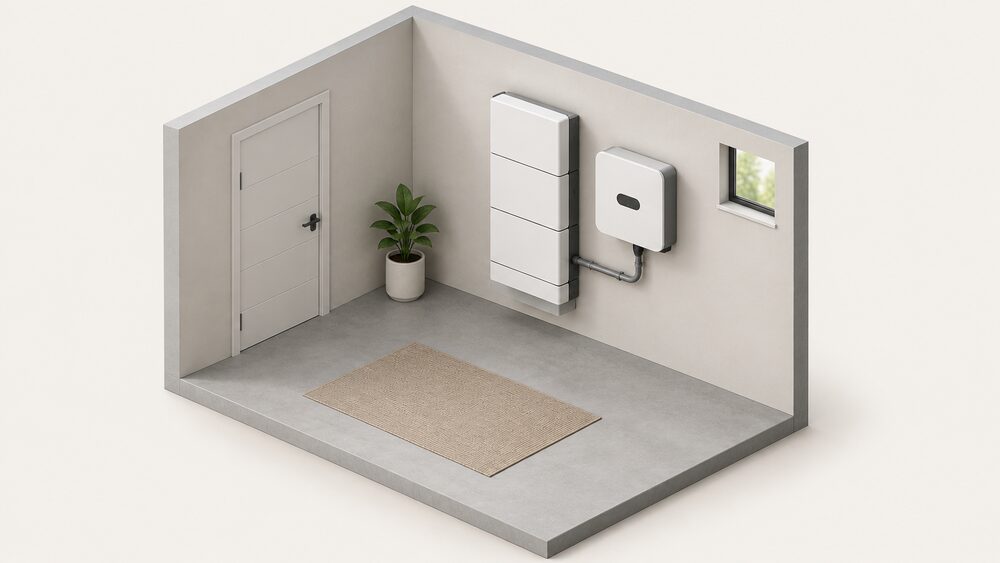 Huawei LUNA2000 Home Battery RangeThe Huawei LUNA2000 is a high-voltage LFP home battery range sold in 5 kWh and 7 kWh modules, expandable from 5 kWh to 21 kWh per system and compatible only with Huawei SUN2000 and SUN5000 inverters.
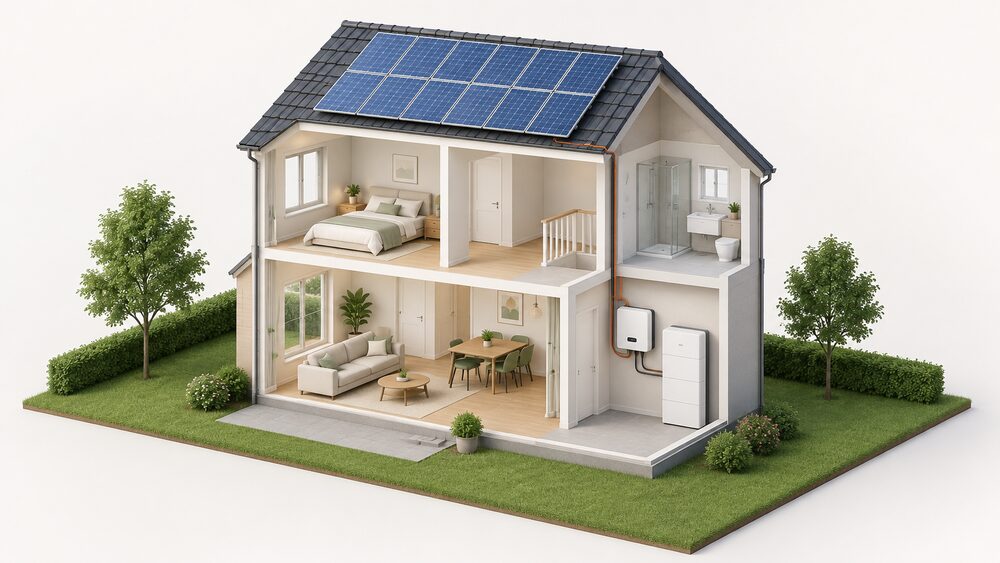 Huawei solar inverters and batteries in the UKHuawei solar panels and batteries are popular in the UK, but people want to know if the warranty is any good and whether their data is safe.