


In this guide
Warmworks is the managing agent that runs Warmer Homes Scotland, the Scottish Government's national funded retrofit scheme. It is not a grant body and it is not a government department: it holds the installer supply chain, carries out the initial survey and manages the work from referral to completion. A household does not apply to Warmworks directly. The route in runs through Home Energy Scotland, which refers eligible cases on.
Warmer Homes Scotland launched in September 2015 and was relaunched in 2023 with increased funding for clean heating systems1. It helps households in, or at risk of, fuel poverty improve their heating and energy efficiency, and it has helped more than 46,000 households throughout Scotland2. Around 21,000 households have been referred through to the scheme's fuel poverty support programme since the new scheme launched in October 20233. The scheme reached its 50,000th customer in February 20262.
The measures are heating and insulation, with a strong focus on both, and the Scottish Government describes the current scheme as one where a household can have energy efficiency measures and a heat pump installed with all the work planned and carried out for them, fully funded, if the criteria are met1. What follows is who Warmworks is, what the scheme funds, who qualifies, what it costs, how the application runs, and where the limits sit.
Warmworks: who they are and what they deliver
Warmworks operates as Warmworks Scotland LLP, a delivery partnership contracted by the Scottish Government to run the national scheme. Its role is operational rather than regulatory. It procures and manages the installers, surveys properties, arranges the work and handles complaints. The Scottish Government sets the policy, the eligibility criteria and the funding.
That division matters to a household because it determines who answers what. A question about whether a property qualifies is a scheme question. A question about when a surveyor will attend, which installer will come, or why a measure was specified a particular way is a Warmworks question. The scheme's own performance data is published by the Scottish Government rather than by the agent, and the update history on that publication records clean heating figures being updated on 17 November 2025, 2025 to 2026 figures added on 10 June 2026, and Q1 figures added on 31 July 20262.
Warmworks also manages delivery of separate area-based funding. In August 2026 the Scottish Government awarded £2.2 million to Comhairle nan Eilean Siar under the Home Energy Efficiency Scheme: Area Based Scheme for 2026-27, and £1.75 million to Orkney Islands Council for the same year, with Warmworks managing delivery in both cases2. Those are distinct from Warmer Homes Scotland and are worth separating in the mind: the national scheme is household-by-household, while area-based funding is targeted at defined geographies.
The agent has also run employment activity inside its supply chain. Using Kickstart funding, Warmworks aimed to provide up to 15 placements per year for young people within its established supply chain8. That is a supply chain development function rather than a household-facing service, but it indicates the scale at which the organisation operates across Scotland.
What Warmer Homes Scotland funds: heating, insulation and renewables
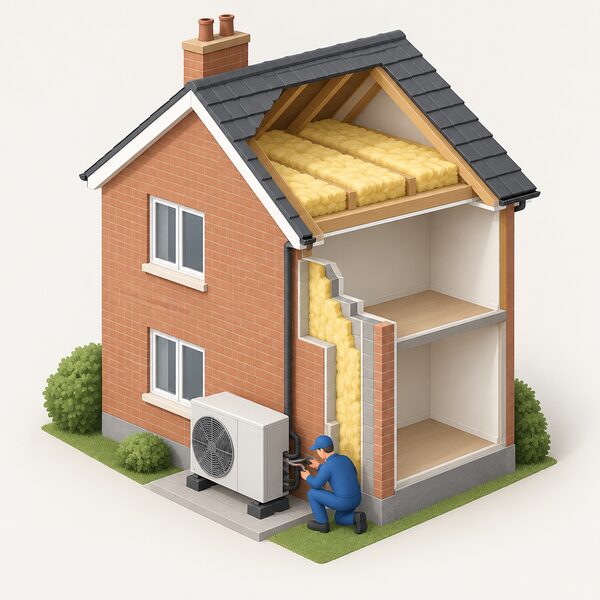
The scheme funds the installation of a range of heating measures, including renewable and micro-renewable heating, and insulation measures to improve the energy efficiency of the property6. The Scottish Government's own description of the current scheme is that a household can have energy efficiency measures and a heat pump installed, with all the work planned and carried out for them, fully funded, where the criteria are met5.
Renewable and micro-generation measures have been made available including ground source heat pumps, micro-wind, micro-hydro and micro-CHP systems1. That is a wider technology list than most UK schemes carry, and it reflects the geography the scheme serves: island and rural properties where a heat pump alone may not be the whole answer, and where micro-hydro or micro-wind can be viable in a way they are not in a city.
The scheme has a strong focus on heating and insulation measures together rather than heating alone1. That pairing is deliberate. A heat pump performs to its rated efficiency only when the building fabric holds heat and the emitters can run at a lower flow temperature, so insulation and heating are specified as a package. Comparable official scheme rules elsewhere require that resident energy bills must not increase as a result of the retrofit works, relative to what they would otherwise have been, and that bills must not increase as a net result of all retrofit works to the home9. That is the standard the package is designed against.
| Measure group | What the scheme covers | Source |
|---|---|---|
| Heating | Renewable and micro-renewable heating, including heat pumps | 6 |
| Insulation | Fabric measures to improve energy efficiency | 6 |
| Micro-generation | Ground source heat pumps, micro-wind, micro-hydro, micro-CHP | 1 |
| Clean heating focus | Heat pump plus energy efficiency measures, fully funded where criteria are met | 5 |
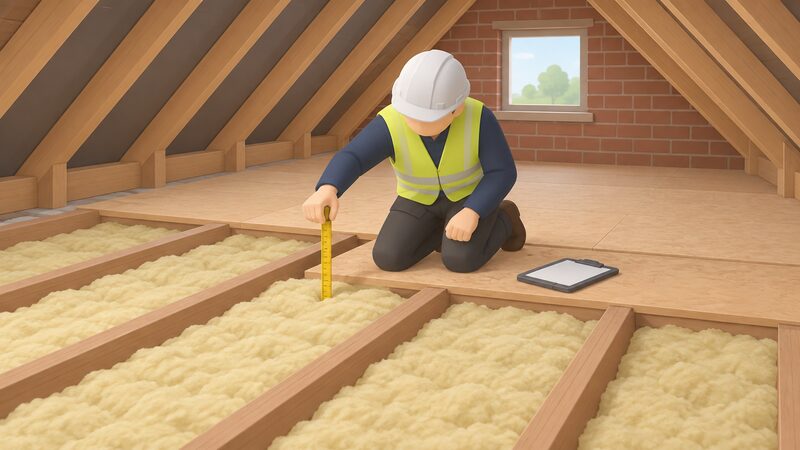
For a household, the practical consequence is that the survey determines the specification, not a wish list. A property that needs loft or cavity insulation before a heat pump will perform is likely to have both specified. A property where the fabric is already adequate may move straight to the heating measure. The scheme's own guidance describes the work as planned and carried out for the householder, which is the point of having a managing agent rather than a voucher.
Eligibility: who qualifies and the private rented sector rules
Warmer Homes Scotland is available to households, owner-occupiers and some private rented sector tenants, who are living in or at risk of fuel poverty and who meet the qualifying eligibility criteria1. Both limbs matter. The fuel poverty test is the substantive one, and the tenure test narrows who can be helped within the private rented sector.
The private rented sector restriction is the part most often misunderstood. Since 1 August 2017, privately rented properties covered by the Repairing Standard no longer receive improvements a landlord is legally obliged to provide. The practical effect is that a private let can be helped for measures the landlord is not already required to fit, and not for those they are. Private tenants also need the landlord's consent before work can take place in the property, a condition that appears in comparable official scheme rules10.
Tenure rules differ across the UK, and it is worth being precise about which apply where. In England, the Warm Homes: Local Grant covers privately rented properties with an EPC rating of Band D or E, and the Warm Homes: Local Grant eligibility route requires an EPC between D and G, private ownership whether owner-occupied or privately rented, and a low income usually £36,000 a year or less11. In Northern Ireland, the Affordable Warmth Scheme lists rent from a private landlord among eligible tenancies, subject to landlord consent10. The Energy Efficiency (Private Rented Property) (England and Wales) Regulations 2015 cover private, local authority and other public body landlords, as well as a tenant who sub-lets a property within scope13. Scotland's scheme sits alongside these rather than inside them.
What it costs: fully funded support
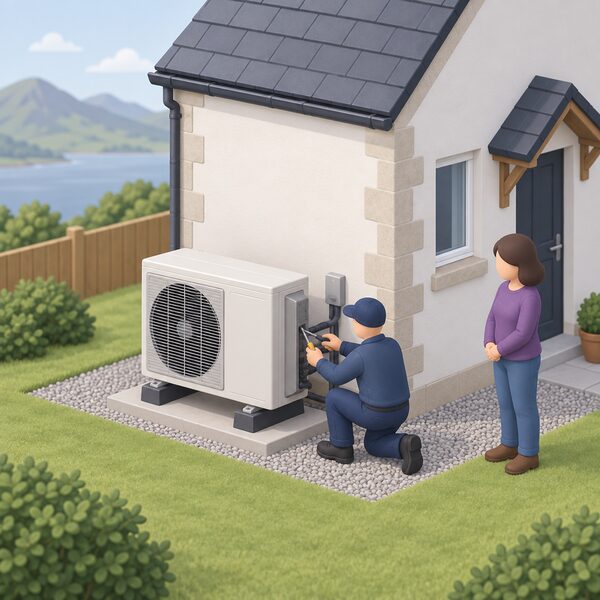
Warmer Homes Scotland is described by the Scottish Government as fully funded for eligible households, with the work planned and carried out for them5. There is no published contribution scale for the scheme, and no published per-household figure for what a Warmer Homes Scotland installation costs.
The figures that do exist in official sources belong to comparable schemes and are useful as scale rather than as a quote. The Warm Homes: Local Grant in England funds 100% of the cost up to £30,000 for an owner occupier or a private landlord's first property, and 50% of the cost up to £15,000 for a private landlord's second and subsequent properties11. Whole project averages for that scheme are estimated at up to £12,400 per household14. The Warm Homes: Social Housing Fund Wave 3 gives each home access to £7,500 of grant funding as a base cost cap, exclusive of administration and ancillary costs9. In Northern Ireland, the Affordable Warmth Scheme may pay grant aid up to £10,000 where a home is of solid wall construction and needs insulation10.
| Scheme | Published funding figure | Source |
|---|---|---|
| Warm Homes: Local Grant (England) | 100% up to £30,000, owner occupier or first private let | 11 |
| Warm Homes: Local Grant (England) | 50% up to £15,000, second and later private lets | 11 |
| Warm Homes: Local Grant (England) | Project average estimated up to £12,400 per household | 14 |
| Warm Homes: Social Housing Fund Wave 3 | £7,500 base cost cap per home | 9 |
| Affordable Warmth Scheme (Northern Ireland) | Up to £10,000 for solid wall insulation | 10 |
Those numbers are not Warmer Homes Scotland budgets and should not be read as such. They show the order of magnitude that official schemes work at, and they explain why a fully funded package of insulation plus a heat pump is a five-figure proposition in grant terms. Air source heat pump costs are given as £10,000 or more, and ground source heat pumps as more than £10,000, in official guidance16.
On fees, comparable official scheme rules are explicit: the scheme is free to eligible applicants and no application fee or other costs should be asked for at any stage17. Where a household wants work beyond what the scheme covers, Home Energy Scotland runs a separate grant and loan route, and interest-free loan schemes exist for home energy work more widely. The two routes are distinct: one is fully funded support, the other is borrowing.
How to apply: from Home Energy Scotland to the home survey
The application does not start with Warmworks. A household begins with Home Energy Scotland, which assesses eligibility and refers qualifying cases on. Warmworks then carries out the initial survey, and the survey is the point at which the specification is set.
That survey is carried out using rdSAP software, the standard reduced data SAP methodology used to assess a dwelling's energy performance18. The Scottish Government has taken an interest in how consistently that assessment is applied: in October 2017 an interactive workshop with a sample group of 6 Warmworks surveyors was organised and chaired by the Scottish Government18. The existence of that workshop is a useful signal about where scheme quality is thought to sit, because the survey determines which measures a property receives and therefore what the grant buys.
Not every application proceeds. Official statistics record 1,370 applications turned down by Warmworks in 2019-20 and 1,343 in 2024-257. A household should expect the survey to be a genuine assessment rather than a formality, and should expect the specification to follow the property's condition rather than a preference for one technology.
The sequence in practice runs:
- Contact Home Energy Scotland and complete the eligibility check.
- Referral to Warmworks for qualifying cases.
- Survey of the property using rdSAP.
- Specification agreed from the survey findings.
- Installer allocated from the 24-firm supply chain.
- Installation, then handover.
The independent Climate Change Committee has recommended that Warm Homes Plan programmes embed minimum standards for handover and structured post-installation support, with a follow-up after an initial heating season and ongoing servicing and maintenance included as standard20. Comparable schemes require a post-installation EPC funded by the scheme once all works on a property are completed, to assess achieved savings14.
Clean heating first: heat pumps, and when a boiler is installed instead
The scheme's direction since the 2023 relaunch has been clean heating, with increased funding directed to it2. The Scottish Government's description of the current scheme puts a heat pump at the centre of what a household can receive, alongside energy efficiency measures5. Renewable and micro-generation measures including ground source heat pumps, micro-wind, micro-hydro and micro-CHP are available1.
The evidence on how households respond to that shift is mixed, and it is worth stating plainly. Independent research on the heat pump transition found that those replacing previously functioning gas boilers typically expressed a preference for a new boiler over the heat pump20. That finding is about satisfaction and comfort among households making a like-for-like replacement, and it sits against a scheme that is deliberately steering toward clean heating. The two facts are not in contradiction: a scheme can prioritise heat pumps while some households, particularly those replacing a working boiler, would have chosen otherwise.
Where a boiler is installed instead, the driver is usually the property rather than the preference. A dwelling where the fabric cannot be brought up to a standard that supports low flow temperatures, or where the electrical supply or emitter sizing makes a heat pump impractical within the scheme's scope, is a candidate for a different specification. The scheme's own framing is that the work is planned for the householder, which implies the specification follows the survey.
For a household's energy independence, the distinction is significant. A heat pump moves a home off gas and onto electricity, which changes the fuel dependence rather than removing it: the home still relies on the grid and on an electricity supplier, and on the manufacturer for parts and controls. A boiler installed under the scheme keeps the home on the gas grid and on a gas supplier. Insulation reduces the size of either dependence by reducing the demand itself, which is why it is specified alongside the heating measure rather than after it.
Warmworks' supply chain: 24 approved installers across Scotland
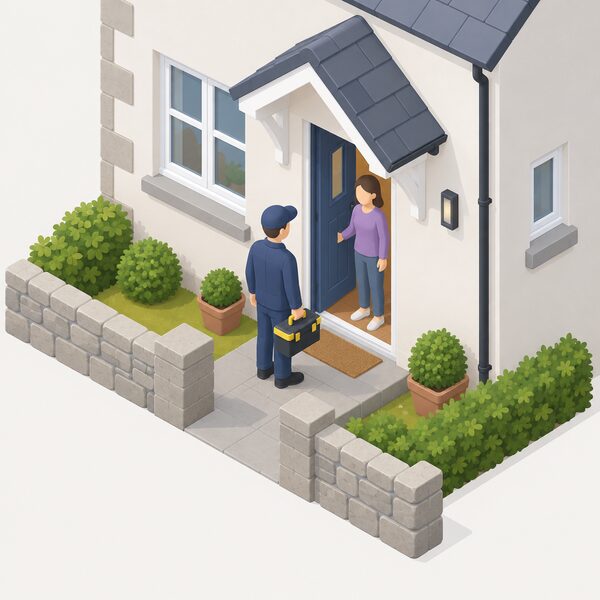
Warmworks has procured a supply chain of 24 installers, with 6 based in the islands, to deliver the scheme, 23 of which are SMEs and all of which are based in Scotland6. That structure is deliberate: island-based installers matter for island properties, and an all-Scottish supply chain shortens the distance between a household and the firm that will actually attend.
The supply chain has changed shape over the scheme's life. Warmworks Scotland LLP procured 27 subcontracted installers at the outset21. In 2016/17, Warmworks subcontracted all Warmer Homes Scotland installations to a supply chain of 30 companies, correct over the period of that review18. The current figure of 24 reflects the scheme as it stands rather than its original design.
| Period | Installers in the supply chain | Source |
|---|---|---|
| At outset | 27 subcontracted installers procured | 21 |
| 2016/17 | 30 companies, all installations subcontracted | 18 |
| Current | 24 installers, 6 island-based, 23 SMEs, all Scotland-based | 6 |
Coverage is organised geographically. Warmer Homes Scotland operates Scotland-wide across 6 delivery regions, which Warmworks further sub-divided into 16 delivery zones and sought to procure two contractors per zone to ensure coverage21. That two-per-zone structure is a resilience measure: it means a zone does not depend on a single firm, which matters for scheduling and for continuity if one contractor withdraws.
Complaint volumes give a sense of how the supply chain performs in practice. The total number of complaints received by Warmworks in 2016/17 was 165, amounting to 3% of all completed installations19. That is a historical figure from the scheme's early years and should be read as such, but it is one of the few published measures of delivery quality.
For a household, the supply chain structure has a practical consequence. The installer who attends is allocated by Warmworks rather than chosen by the householder, and the warranty and aftercare for the installed measures sit with that installer and the manufacturer rather than with the agent. The agent's role is to hold the chain and to handle complaints when something goes wrong.
Performance and impact: 50,000 customers and 46,000 households
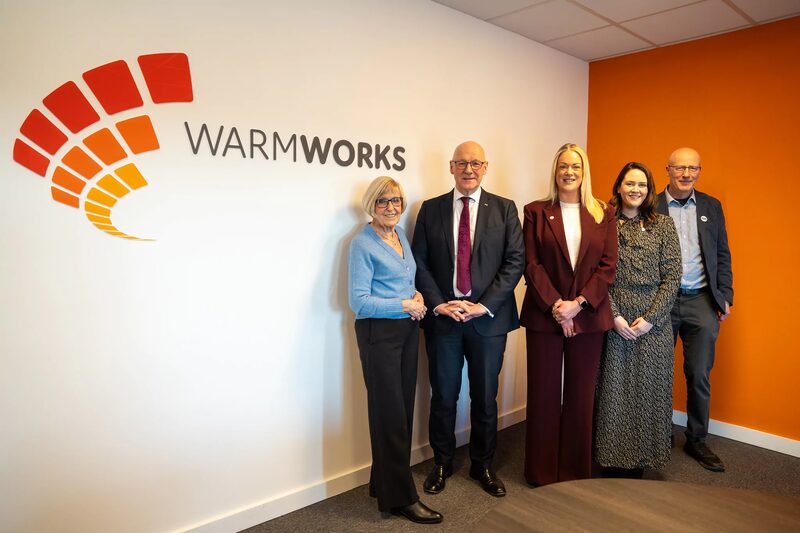
The scheme's headline numbers have moved quickly. Warmer Homes Scotland has helped more than 46,000 households throughout Scotland, and around 21,000 households have been referred through to the scheme's fuel poverty support programme since the new scheme launched in October 20233. The scheme reached its 50,000th customer in February 2026, marked by a visit from First Minister John Swinney to Warmworks' Edinburgh office2.
Those two figures measure different things and should not be added. The 46,000 is households helped by the scheme overall. The 21,000 is referrals into the fuel poverty support programme since October 2023, a subset of activity under the relaunched scheme. The 50,000th customer milestone is a cumulative count reached in February 2026.
The scheme's published performance data is maintained by the Scottish Government and updated on a rolling basis, with clean heating figures updated on 17 November 2025, 2025 to 2026 figures added on 10 June 2026, and Q1 figures added on 31 July 20262. That publication is the place to check current numbers rather than any summary, because the figures move.
On savings, the scheme's own published data does not give a single average annual saving per household. Comparable official schemes publish their own figures, and they vary: the Warm Homes Nest scheme in Wales has published average annual savings of £578 and £595 in different documents, and the two figures are not reconciled14. Where a household wants a savings estimate for its own property, the post-installation EPC required under comparable schemes exists precisely to assess achieved savings rather than modelled ones14.
For energy independence, the scheme's contribution is fabric and fuel. Insulation reduces demand permanently and does not depend on a supplier, an app or a subscription. A heat pump changes the fuel a home depends on rather than removing the dependence. The scheme does not make a household self-sufficient, and it does not claim to: it reduces the amount of energy a home needs and changes the source of what it still uses.
Sources21 cited
- Energy saving home improvements, Scottish Government, 2026-09-17
- Warmer Homes Scotland scheme headline data, Scottish Government, 2025-10-29
- Heat in Buildings progress report 2025, Scottish Government, 2025-10-02
- Home energy efficiency, Argyll and Bute Council, 2026-09-17
- Delivering net zero for Scotland's buildings consultation, Scottish Government, 2023-11
- Tackling fuel poverty in Scotland, Scottish Government, 2021-12-23
- FOI release 202400434886, Scottish Government, 2024-11-13
- Heat pump sector deal final report, Scottish Government, 2021-12
- Warm Homes: Social Housing Fund Wave 3 scheme guidance addendum, UK Government, 2026-06
- Affordable Warmth Scheme, Northern Ireland Housing Executive, 2026-09-17
- Warm Homes Local Grant, Greater Manchester Combined Authority, 2026-09-17
- Warm Homes: Local Grant research briefing, House of Commons Library, 2026-05-13
- Electrical safety standards in the private and social rented sectors, UK Government, 2026-05
- Warm Homes Local Grant, Surrey County Council, 2026-09-17
- Trading standards guidance, Isle of Anglesey County Council, 2026-05-13
- Air and ground source heat pumps, Croydon Council, 2026-09-17
- Warmer Homes, Greater London Authority, 2026-09-17
- Home energy efficiency programmes Scotland: Warmer Homes Scotland 2016-17, Scottish Government, 2018-03-26
- Warmer Homes Scotland 2016-17 progress report, Scottish Government, 2018-03
- Heat pump transition report, Climate Change Committee, 2026-05
- Warmer Homes Scotland business case, Scottish Government, 2015-07