In this guide
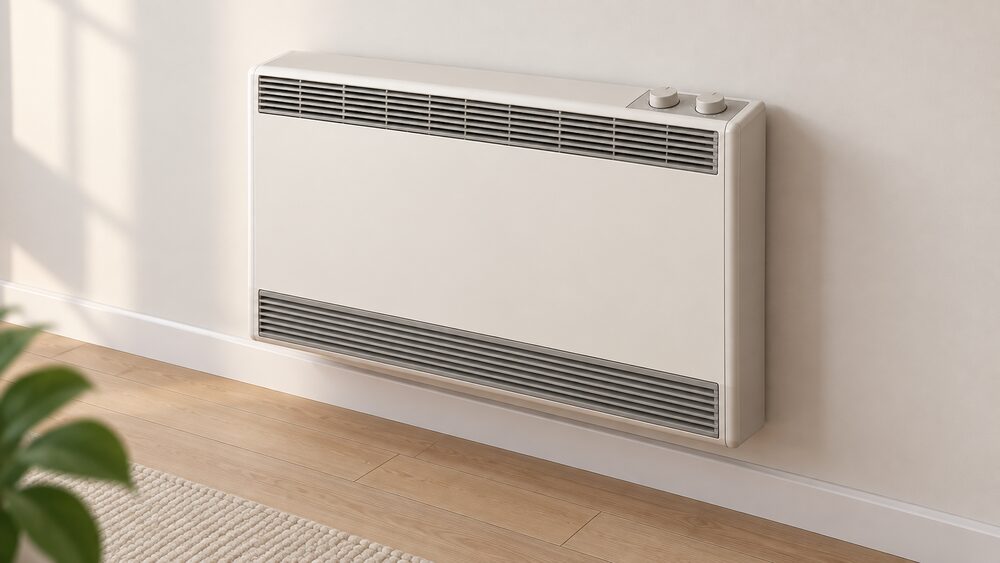
Storage heaters work by using cheaper, off-peak night-time electricity to create and store heat, which can be used the following day1. They are the established answer for homes without a gas connection, and they are the technology behind the Sunhouse name. What the evidence available does not do is confirm that Sunhouse heaters are currently manufactured or sold in the UK, so this page sets out what storage heating is, what it costs, how it is controlled and what a household owns, and marks clearly where a Sunhouse-specific answer cannot be given.
The economics turn on a single fact: electricity costs around four times as much as gas per kWh2. That is why storage heaters are paired with a tariff that makes night-time electricity much cheaper, typically about half the price, while day-time electricity is more expensive3. Run that way, and in a home with no gas main, storage heaters are cheaper to operate than standard electric heaters4. Run on a flat standard-rate tariff, direct electric heating in a typical three-bedroom semi-detached house is illustrated at £2,700 a year for space heating, against £680 for gas boiler heating5.
Sunhouse: the range at a glance
The evidence available does not list a current Sunhouse model range, outputs, efficiencies or prices, so no specification table can be built for the brand. What can be said is what applies to storage heaters as a category, which is the category a Sunhouse unit sits in.
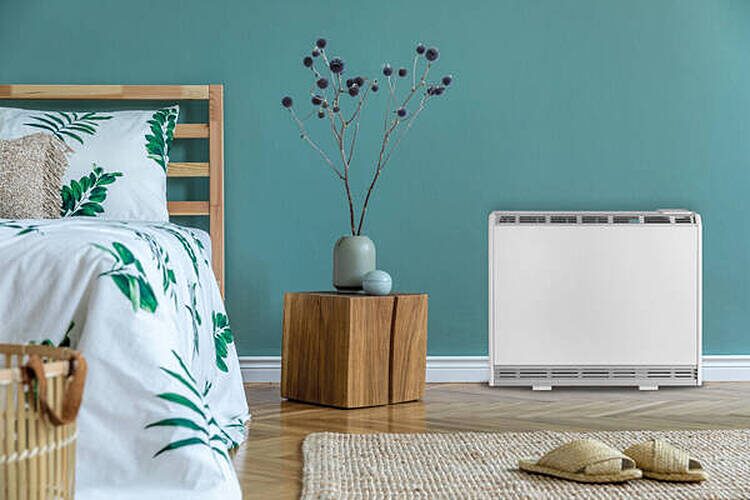
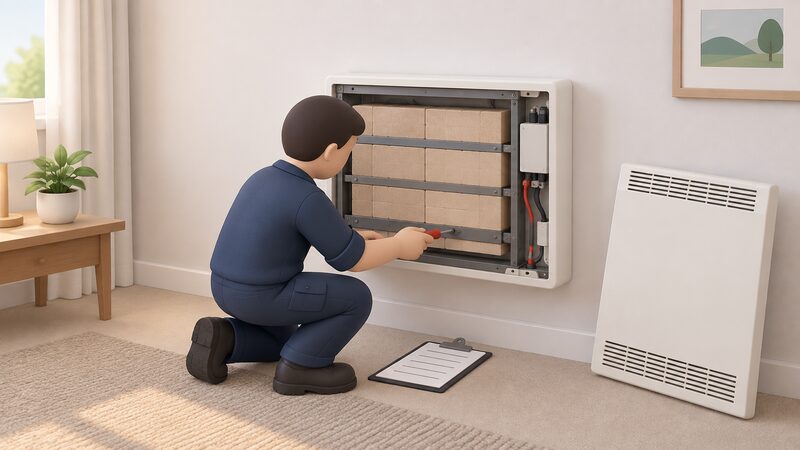
Storage heaters use cheap off-peak electricity, available with an Economy 7 tariff, to heat up high thermal capacity bricks, releasing heat the following day7. The heat source is ceramic or clay bricks heated overnight on cheaper night-time rates4. Older night storage heaters have an input setting to regulate the heat stored overnight and an output setting to regulate the heat released, with some models having a boost setting3.
Two regulatory points matter when assessing any unit, new or secondhand. Storage heaters made after 2018 must meet stricter efficiency standards and come with better controls1. Older models made before January 2018 can still be sold, so check carefully before you purchase2. A heater offered as new may therefore be old stock built to the earlier standard, and the controls are the quickest way to tell the difference.
High heat retention storage heaters are the modern category worth knowing about. They are well insulated1, they are more expensive to buy but lower to run than traditional or integrated models, making them the most cost-effective option of the three6, and they are up to 27% cheaper to run than standard storage heaters3. For a household replacing an old unit, that running-cost gap is the main reason the newer category exists.
| Category | Insulation and controls | Buy cost | Run cost |
|---|---|---|---|
| Traditional night storage heater | Manual input and output dials3 | Lower6 | Higher6 |
| Integrated model | Manual or digital controls8 | Lower6 | Higher6 |
| High heat retention | Well insulated, digital controls1 | Higher6 | Up to 27% cheaper than standard3 |
Storage heaters: how they work and what they cost to run
The principle is simple and the timing is the whole point. Storage heaters work by charging up when electricity is cheaper, then releasing heat gradually through the next day9. They store heat from cheaper night-time electricity and release it during the day3. Sometimes they are called Economy 7 heaters, because the tariff and the appliance were designed together10.
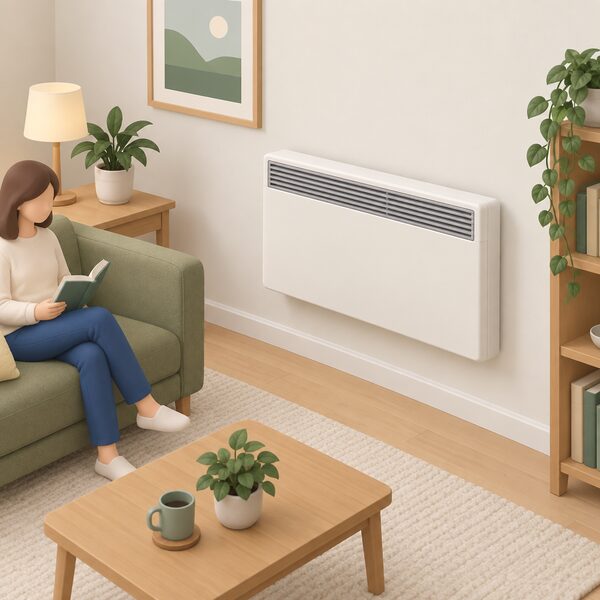
That design creates a characteristic pattern. Storage heaters can often leave your home very warm in the morning and struggle to stay warm in the evening4. They do not produce heat instantly like a regular electric heater; instead they rely on the heat stored overnight, so planning ahead is essential8. A household used to a gas boiler's on-demand heat is trading responsiveness for a lower unit rate on the electricity that does the work.
Costs split into purchase and installation. Basic storage heaters cost as little as £150, with much more spent depending on what you are looking for4. Modern storage heaters can cost from around £400 each2. Installation is the larger variable, and it is quoted per heater:
| Installation type | Cost per heater |
|---|---|
| Night storage heater | £200 to £800 depending on type6 |
| High heat retention storage heater | £400 to £8006 |
| Dynamic storage heater | £400 to £6006 |
A whole-house figure of £900 to £1,400 per room for electric storage heaters is also published9, which reflects a full installed cost rather than the appliance alone.
For a household's independence, the position is mixed. A storage heater removes the gas connection, the gas supplier and the flue, and it uses a fuel that can in principle be generated at home. It does not remove the grid: the heater still draws from the mains, and the cheap rate depends on a supplier offering an off-peak window. More on the tariff side is at Economy 7, Economy 10 and heating tariffs, and the wider comparison sits at Storage Heaters: How They Work.
Renewable status: when storage heaters count as renewable heating with solar PV
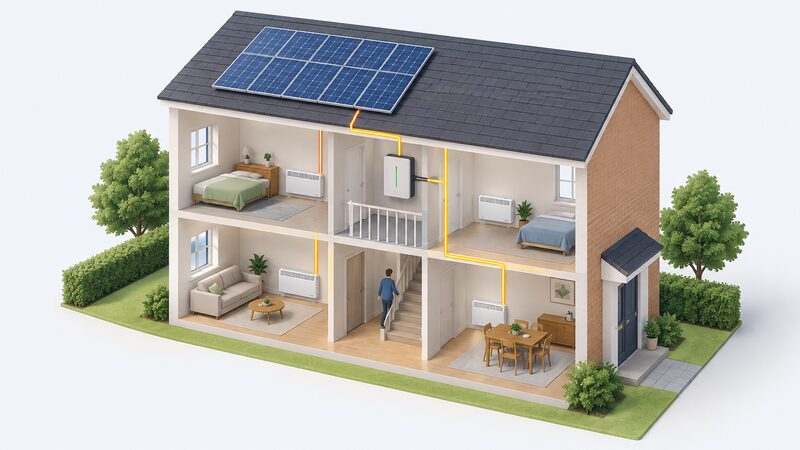
This is the point where storage heating and solar generation meet, and the rule is specific. Electric storage heaters and electric heating systems are classed as renewable heating systems when installed in a home which has solar PV or receives solar PV as part of the same project11. That is an official scheme classification, and it is the basis on which storage heating can be funded alongside generation.
The scheme rules go further. Solar PV is eligible if one of a set of measures is installed as part of the same project, including a hydronic heat pump, an electric storage heater with a SAP responsiveness of 0.8 or above, or an electric heating system with a SAP responsiveness of 0.8 or above, or if the property is already heated by one of these measures12. Responsiveness, not the badge on the heater, is what the rule turns on.
Batteries have moved into the same framework. Domestic batteries installed to be used alongside solar PV panels were included as an eligible measure for installation under the Warm Homes: Social Housing Fund in June 2025, and PV batteries have been integrated into RdSAP 1013. In Northern Ireland, solar photovoltaic systems and electrical energy storage are offered to households under the Warm Healthy Homes Fund, subject to the Home Assessment14. In Scotland, solar PV is only eligible for Private Rented Sector Landlord Loan funding as part of a package together with a heat pump or high heat retention storage heaters and an energy storage system15.
Sizing and placement: choosing the right heater for each room
Storage heaters are fixed appliances, so the decision is per room and made once. The evidence available does not give Sunhouse-specific sizing tables, but the general rules for electric heating apply.
Panel heaters, the direct-acting alternative, work best in homes that are insulated to a very high standard, such as PassiveHouse standard, or when heating individual rooms for short periods6. That is the dividing line: a well-insulated room used intermittently suits direct electric heat, while a room used through the day suits stored heat. In larger homes, a small room may be worth heating individually if it is less than a quarter of the size of the whole house, and there is less benefit if the house is well insulated16.
Placement follows the heat pattern. Because a storage heater releases gradually, it needs to be somewhere the released heat can circulate rather than be trapped behind furniture, and the output control needs to be reachable. The design principle behind good installations is to design the home to take advantage of solar heating, natural ventilation and daylight where possible17, which reduces the load the heaters have to carry in the first place.
For a household, sizing is where independence is won or lost. An undersized heater runs out of stored heat by evening and the household tops up with day-rate electricity or a portable heater, which is the most expensive way to heat a room. An oversized one wastes capacity. The practical approach is to treat the heater as a fixed part of the room's design, decided with the installer, rather than a purchase made on price alone.
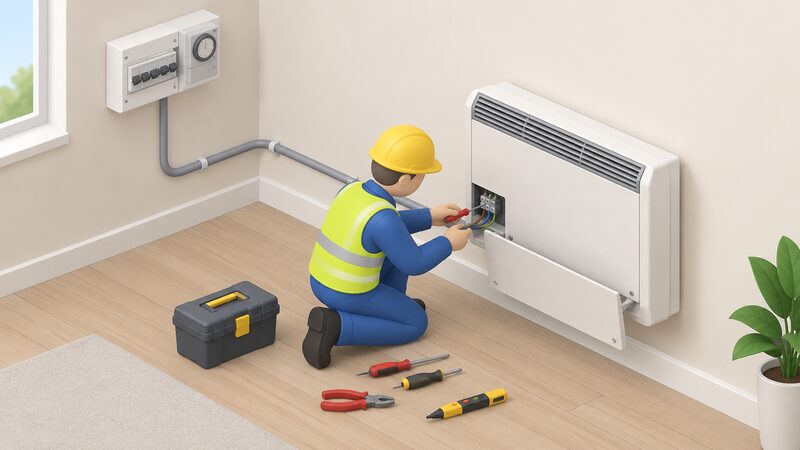
Installation and wiring requirements
Storage heaters are not plug-in appliances. They sit on a dedicated supply arranged around the off-peak tariff, which is why installation costs run per heater rather than per house. Night storage heaters cost £200 to £800 per heater depending on type, and high heat retention units £400 to £800 per heater6. That range covers the wiring, the mounting and the commissioning, not just the box.
The tariff and the appliance have to be matched. Some specific storage heater models that use particular time of use tariffs may need to be on all the time8. That is a wiring and control condition, not a preference, and it is the kind of detail that decides whether a given model suits a given supply.
Where a scheme is involved, certification requirements apply:
- Low carbon heating or solar panels under the Warm Homes: Social Housing Fund must be installed using an MCS approved product, by an MCS certified installer, to the relevant MCS installation standard, except high heat retention storage heaters covered by PAS 203013.
- Installers under the Boiler Upgrade Scheme must be MCS certified and certified to install heat pumps and/or biomass boilers18.
- Solar water heating is work covered by building regulations and should only be undertaken by competent technicians who have undertaken appropriate training and assessment19.
Controls and day-to-day use
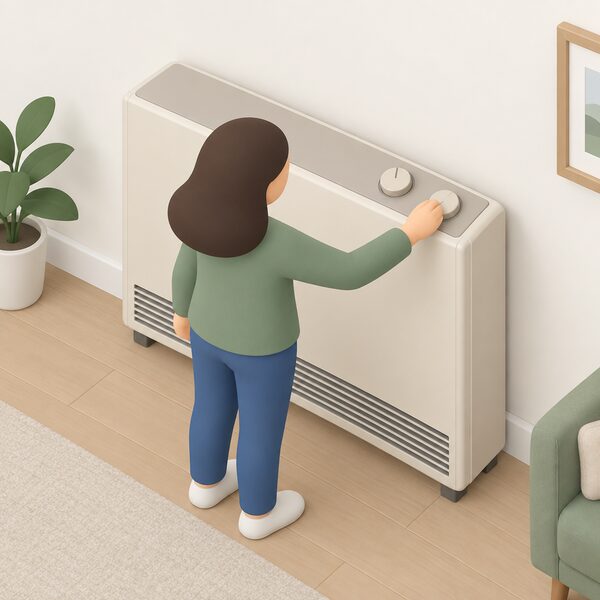
Controls are where the difference between an old and a new storage heater shows most clearly. Older storage heaters use input and output dials to control heat1. More modern storage heaters use digital controls, while older heaters have manual controls8. Digital units add automatic charge control, which regulates how much energy you use by storing more or less heat at night8.
The manual routine is well documented. You need to manually set both how much heat to store overnight and when and how much to release during the day6. The input setting is set depending on expected next day temperature, and the output setting is set to low unless extra heat is needed20. That is the whole discipline of storage heating: read the forecast, charge accordingly, and release sparingly.
The wider direction of travel is towards automatic control. Self-build sustainability guidance advises installing smart systems that control lighting, heating and cooling based on occupancy and time of day17. For storage heating that means a unit that decides its own charge rather than one that waits for a dial to be turned, which is the main practical argument for the post-2018 generation.
For independence, controls are the household's own lever. A manually controlled heater gives the occupant direct authority over how much is stored and released, with no app, no account and no server in the loop. An automatically controlled one trades some of that authority for better use of the cheap window. Neither depends on the internet, which is a meaningful difference from app-controlled electric heating.
Running costs compared with gas and other electric heating
The comparison is stark and it is the reason storage heating exists as a separate category. Electricity costs around four times as much as gas per kWh2. Direct electric heating typically has high running costs because standard rate electricity is more expensive than gas or oil9. The illustration for a typical three-bedroom semi-detached house, space heating only, puts gas boiler heating at £680 a year and direct electric heating at £2,7005.
Storage heating narrows that gap by buying its electricity at night. If you do not have access to gas mains, storage heaters are cheaper to operate than your standard electric heater4. The tariff does the work: night-time electricity is much cheaper, typically about half the price, while day-time electricity is more expensive3. The household's task is to shift as much consumption as possible into the cheap window, which is exactly what a storage heater is built to do.
The newer categories improve the position further. High heat retention storage heaters are more expensive to buy but lower to run than traditional or integrated models6, and up to 27% cheaper to run than standard storage heaters3. For comparison, running costs for heat pumps are typically lower when compared to those of traditional gas boilers, though that depends on the system being designed and operated well21.
The independence reading is this: storage heating does not escape the grid, and it does not escape a supplier, but it moves the household's consumption to the cheapest hours and removes the gas connection entirely. That is a real reduction in exposure, not a severing of it. The full fuel-by-fuel picture is at Electric Heating Running Costs.
Ownership: maintenance, lifespan and what to expect
Storage heaters have few moving parts, and the maintenance regime reflects that. For solar water heating systems, checks will typically be carried out every five years, with shorter intervals possible for peace of mind22. Heat network consumer protection guidance recommends that records of technical maintenance be kept for five years23. Keeping the paperwork is the practical habit, whatever the technology.
Where equipment is supplied under an agreement rather than bought outright, the terms matter. Under heat-as-a-service style arrangements the agreement is likely to be for ten or more years, after which the equipment belongs to the homeowner or payments would fall to a minimal amount24. Third party ownership agreements run ten or more years, after which the heat pump belongs to the homeowner or they pay a minimal yearly fee24. A household should know which of these it is signing.
On warranties, the evidence available does not give Sunhouse terms. For heating installations generally, work carried out by certified contractors comes with both workmanship and product warranties, typically several years of workmanship and longer warranties for the collectors themselves25, and most solar water heating systems come with a five-year or ten-year warranty22. The pattern to expect is a shorter workmanship term and a longer product term, with the registration route running through the installer.
For Northern Ireland, electric storage heaters on an off-peak or Economy 7 tariff qualify as efficient heating under the Decent Homes Standard26, and the 2024/25 Northern Ireland Sustainable Energy Programme annual report records 134 heating replacements27. That is the policy backdrop: storage heating is treated as a legitimate, efficient heating solution in the right tariff arrangement, not a legacy technology being written off.
Sources27 cited
- Electric storage heaters, Energy Saving Trust, 2026-05-20
- Electric central heating, Which?, 2025-09-22
- Night storage heaters, Centre for Sustainable Energy, 2025-10
- Electric heaters vs storage heaters, Energy Helpline, 2026-09-20
- Electric wallpaper explained, Energy Saving Trust, 2026-03-26
- Electric heating, Centre for Sustainable Energy, 2026-06
- Heating fuel guide, Uswitch, 2026-01-27
- A guide to using electric storage heater controls, Energy Saving Trust, 2026-05-21
- Electric heating, Energy Saving Trust, 2026-07-01
- What is Economy 7, Smart Energy GB, 2026-04-07
- Summary of updates to ECO4 delivery guidance and measures table, Ofgem, 2023-08-09
- ECO4 Measures Table v4.0, Ofgem, 2025-07-29
- Warm Homes: Social Housing Fund wave 3 scheme guidance addendum, Department for Energy Security and Net Zero, 2026-06
- Warm Healthy Homes Fund consultation, Department for Communities Northern Ireland, 2026-05
- Private rented sector landlord loan overview, Energy Saving Trust Scotland, 2026-09-20
- Heat the whole house or one room, Uswitch, 2026-08-20
- Self-build homes sustainability, Planning Portal, 2026
- Boiler Upgrade Scheme guidance for installers V5, Ofgem, 2026-04-28
- Your home guide to solar water heating, OFTEC, 2026-09-20
- Getting the most from Economy 7, National Energy Action, 2026-09-10
- What impact can heat pumps have in domestic heating today, GOV.UK, 2023-11-21
- Solar heating, MCS Certified, 2026-08-17
- Heat networks consumer protection guidance decision, Ofgem, 2026-01-13
- Heat pumps beyond affordability, Which?, 2026-06
- Could solar water heating work for you, Energy Saving Trust, 2026-05-20
- Current Decent Homes Standard summary table, Department for Communities Northern Ireland, 2025-08-05
- 2024-25 NISEP Annual Report, Utility Regulator Northern Ireland, 2026-07