
In this guide
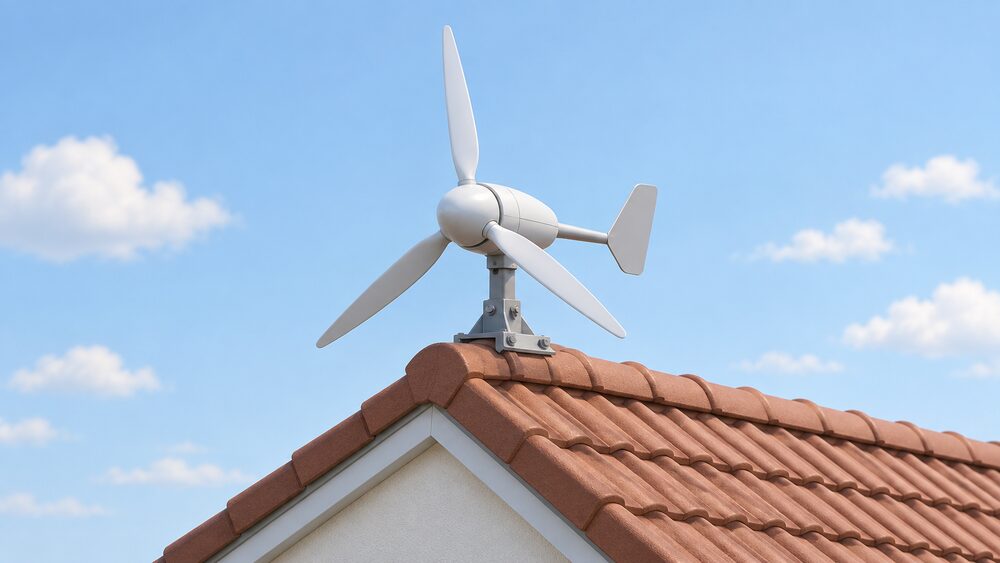
The Windsave roof turbine is the best-known British example of a domestic wind product that reached the high street and then disappeared. It was sold through B&Q, mounted on the roof rather than on a pole, and marketed to households that wanted to generate their own electricity. The company behind it ceased trading, and the product was withdrawn. There is no manufacturer support, no parts line and no warranty to claim against today.
That matters because the questions people still ask are practical ones: can an existing unit be serviced, is a second-hand machine worth buying, and what does a roof turbine actually produce. On the last point the evidence is consistent. Pole-mounted turbines typically produce 3 to 15kWh of electricity1, and a well-sited 6kW pole-mounted machine can generate around 9,000kWh a year2. A roof-mounted unit is smaller and sits in disturbed air, so it lands well below those figures.
The wider policy backdrop has also turned against small wind. The UK was required to exclude wind and water turbines from the list of qualifying energy-saving materials in 20193, and the reduced rate of VAT for their installation was withdrawn4. The Feed-in Tariff, which had supported 7,546 wind installations by scheme year 13, is closed to new applicants5. Roof turbines did not fail in isolation; the support framework moved away from them at the same time.
Windsave: the company and its roof-mounted wind turbine
Windsave built its business on a single idea: a wind turbine small enough and quiet enough to bolt to a domestic roof, sold through a national retailer rather than through specialist installers. That placed it in the building-mounted category rather than the pole-mounted one. There are two types of installation to consider, roof mounted and free-standing2, and the two behave very differently.
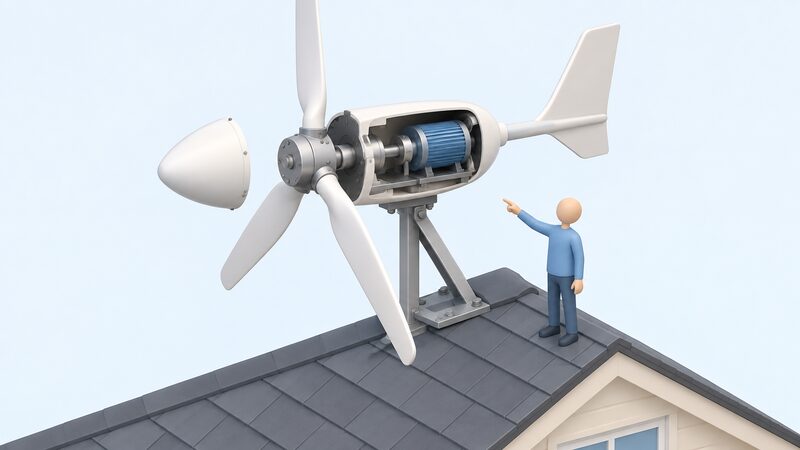
A wind turbine generates electricity by using wind to turn blades connected to a generator7. Pole-mounted turbines stand on their own pole, usually placed in a clear, open area where there is plenty of wind1. Building-mounted turbines can be installed on rooftops or building sides1, which is where the Windsave unit sat. The trade-off is structural: building-mounted turbines cost less to install than pole-mounted ones, but they tend to be smaller and less efficient7.
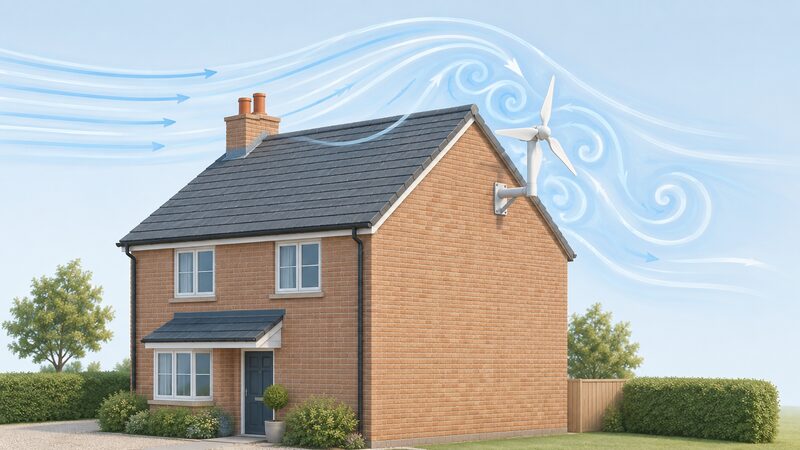
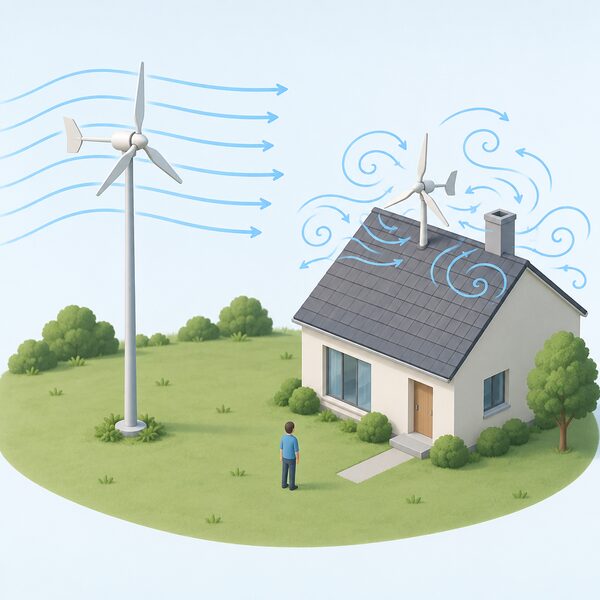
The reason is wind shear. Generally, higher placements catch stronger, steadier winds1, and a roof is a low, obstructed position with the building itself creating turbulence immediately upwind of the blades. A pole in an open field avoids that. The Windsave proposition asked a householder to accept the lower-output position in exchange for avoiding the pole, the footprint and the planning argument that a freestanding mast can provoke.
The company's failure is the fact that governs everything else on this page. Windsave ceased trading, which ended both the retail supply and the after-sales route. For a household considering any surviving unit, that is the starting point: the product has no maker behind it, and the brand name is now a historical one rather than a supplier.
How the Windsave WS1000 worked: output and specifications
The WS1000 was a small horizontal-axis machine in the sub-kilowatt class. Individual wind turbines vary in size and power output from a few hundred watts to two or three megawatts, where one megawatt equals 1,000 kilowatts9. At the bottom of that scale sit small wind turbine units that generate around 100W and charge a battery10. Building integrated turbines mounted on gable walls, roof-tops or poles are rated at 1KW to 6KW depending on the model9.
That range sets the context for what a roof turbine of this class can physically deliver. Small wind turbines that can power a single property may have an electricity generating capacity of 10kW2, and the largest machines in operation reach capacities of up to 10,000kW2. A roof-mounted domestic unit sits at the very bottom of the domestic band, and its rated figure is a laboratory condition rather than an everyday one.
| Class of machine | Typical rated capacity | Where it is mounted |
|---|---|---|
| Battery-charging micro unit | around 100W10 | Off-grid, small loads |
| Building integrated turbine | 1KW to 6KW depending on model9 | Gable walls, roof-tops or poles |
| Pole-mounted domestic | around six kilowatts of electricity7 | Own pole, open ground |
| Single-property turbine | up to 10kW2 | Pole or mast |
| Largest in operation | up to 10,000kW2 | Commercial wind farm |
The distinction that matters for a roof machine is between rated capacity and delivered output. A rating describes what the machine produces at its reference wind speed. Real roofs rarely deliver that speed, and never steadily. Small turbines usually produce less than 100 kilowatts per day11, a figure that covers the whole small-turbine class and shows how modest the daily energy is even before roof turbulence is accounted for.
The B&Q partnership: how the turbine reached the high street
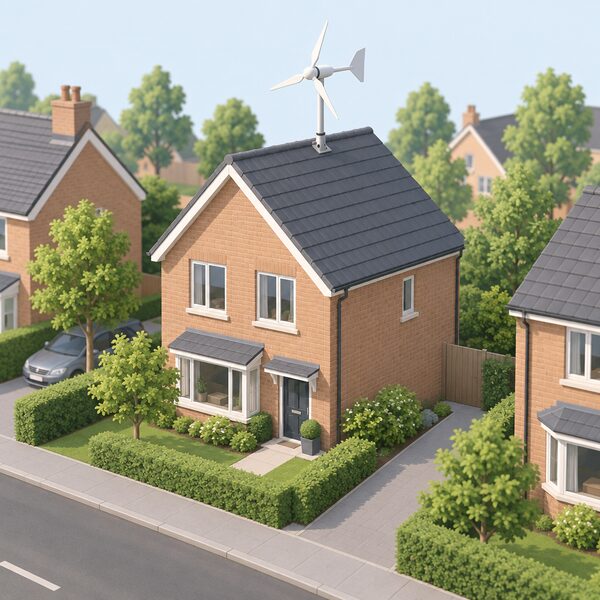
The B&Q arrangement was the reason the Windsave turbine became a household name rather than a niche product. Selling a wind turbine through a national DIY chain put it in front of shoppers who were already in the store for other reasons, and it framed domestic generation as a shelf purchase rather than an engineering project. That framing is precisely what the technology could not support.
A roof turbine is not a plug-in appliance. It needs a mounting assessment, a grid connection under the relevant engineering recommendation, and in most cases a planning application. The retail channel could supply the box; it could not supply the site survey, the wind speed measurement or the electrical work. The gap between those two things is where the product's reputation was made and lost.
The support environment of the period also shaped expectations. The Feed-in Tariff paid for generation, and wind accounted for 11.89% of scheme lifetime capacity as at 31 March 202512. By scheme year 13 there were 7,546 wind installations accredited5, a small number next to solar, and the costs per TWh of generation were £3.3 million lower in SY13 at £192.75 million than in SY11 at £196.08 million5. Wind was always the minor partner in that scheme.
The retail route also meant the product reached households that had not measured their wind resource. The Energy Saving Trust position is that a site should be considered for a wind turbine where the local annual average wind speed is five metres per second or more13. A shop counter cannot check that. A roof in a suburban street, sheltered by neighbouring buildings and trees, frequently falls short of it.
Why Windsave turbines were withdrawn from sale
The withdrawal followed the company's failure. Windsave ceased trading, and with no manufacturer there was no product to sell, no warranty to honour and no spares to distribute. For owners, that is the operative fact rather than any technical shortcoming: a working machine with no support chain becomes a maintenance liability the moment something wears out.
The commercial case had been weakening independently. Wind turbines and water turbines did not qualify as energy-saving materials during the period covered by the relevant VAT manual14, and their installation did not qualify for the reduced rate14. The reduced rate for the installation of wind turbines and water turbines was subsequently withdrawn4. Wind turbines now qualify for a lower rate of VAT in Great Britain only8, which leaves Northern Ireland outside that treatment.
The pattern is not unique to Windsave. Other small wind firms in the UK market have failed in the years since, and the same consequence follows each time: installed machines keep turning while the support structure around them disappears. The lesson for a household is to weigh the manufacturer's continued existence as heavily as the specification sheet.
Performance in practice: what owners actually generated
The honest answer for the Windsave class of machine is that no verified annual generation figure exists in the public record. What exists is the performance envelope for small wind generally, and it is not generous. Pole-mounted turbines typically produce 3 to 15kWh of electricity1. That is the range for machines on poles in reasonable positions, not for roof-mounted units in built-up areas.
The larger comparison is instructive. A well-sited 6kW turbine can generate around 9,000kWh a year and could save around 3.4 tonnes of CO2 a year2. That is a pole-mounted machine in a good location, roughly six times the capacity of a typical roof unit and sited where the wind is undisturbed. Even at commercial scale, large turbines generally produce just 30-40% of their stated capacity, depending on wind speed and air density11. If a multi-megawatt machine on a wind farm achieves a third to two-fifths of its rating, a 1kW roof unit in a suburban street cannot reasonably be expected to do better.
The physics explains the gap. Roof-mounted turbines sit in the turbulent boundary layer that the building itself creates, and turbulence both reduces the energy available and increases wear on bearings and blades. Higher placements catch stronger, steadier winds1, which is why the pole exists in the first place. A roof is the opposite of a good wind site, and no amount of blade design fully compensates.
For a household, the practical expectation is a small contribution to a base load rather than a meaningful share of annual consumption. The benefits of a domestic turbine are free electricity, electricity storage and a reduced home carbon footprint10, and those benefits are real where the site suits. On a roof, the first of them is modest and the third is proportional to it.
Cost, grants and payback: why the numbers rarely stacked up
Small wind is capital-heavy relative to what it produces. For equipment and installation, a 6kW pole-mounted system costs around £35,0007. That is the pole-mounted figure, which is the more productive configuration; building-mounted turbines cost less to install than pole-mounted ones, but they tend to be smaller and less efficient7. A cheaper install that produces less energy does not improve the payback arithmetic.
The grant landscape has narrowed rather than widened. The UK was required to exclude wind and water turbines from the list of qualifying energy-saving materials in 20193, and the reduced rate of VAT for their installation was withdrawn4. Wind turbines qualify for a lower rate of VAT in Great Britain only8. The Feed-in Tariff, which provided the original payback case for domestic wind, is closed to new applicants, and wind's share of scheme lifetime capacity was 11.89% as at 31 March 202512.
"Those technologies may offer an attractive payback to homeowners without grant support."
That statement is about solar panels, heat pumps and energy efficiency measures rather than wind, and it is the shape of current official thinking: the technologies with a self-supporting payback are named, and small wind is not among them. Where a household has a genuinely exposed site and a measured wind speed above five metres per second13, the position is different, but that is a rural and coastal set of circumstances rather than a suburban one.
Wind turbines can have a life of up to 22.5 years, but need service checks every few years to make sure they work efficiently13. Over that life a machine needs maintenance, and where the manufacturer has failed, that maintenance has to be sourced independently. The cost of ownership therefore extends beyond the install price in a way that a supported product does not.
What withdrawal meant for existing owners
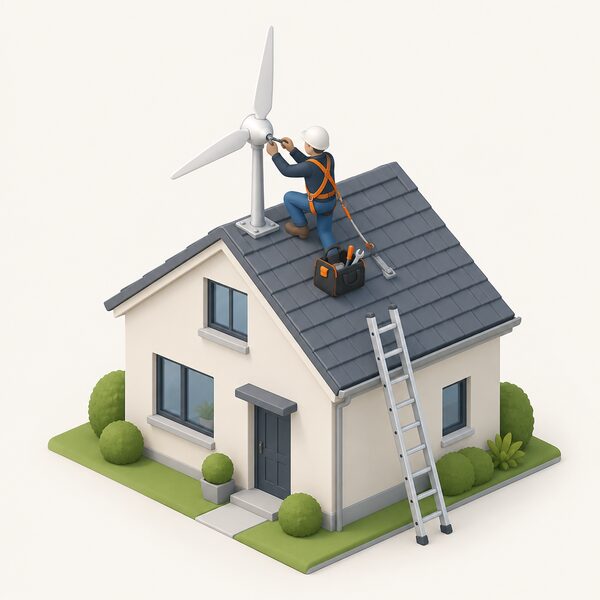
For an owner of a Windsave unit, the practical position is that the machine is orphaned. There is no manufacturer to call, no warranty to enforce and no parts channel. Servicing falls to a general renewable energy engineer or to the owner, and any failure of a proprietary component is a problem without an obvious solution. The same has happened to owners of other failed small wind brands.
Planning rules add a removal obligation that owners should understand. Under the permitted development class for wind turbines on domestic premises, the wind turbine must be removed as soon as reasonably practicable when no longer needed10. In Scotland, a free-standing wind turbine that is no longer needed for or capable of domestic microgeneration must be removed as soon as reasonably practicable16, and the same removal condition appears in the Scottish permitted development class for free-standing turbines11. A wall or roof-mounted turbine under the Scottish proposals would be removed as soon as is reasonably practical should it no longer be required or cease generating electricity17.
The wider support picture for households affected by supplier failures has also been in flux. The Welsh Government has issued a written statement on support for householders impacted by the closure of the Energy Company Obligation scheme18, and Consumer Energy Solutions ceased trading18. Support arrangements change, and a household relying on a scheme should check its current status rather than assume continuity.
Roof turbines versus other routes to household energy independence
The roof turbine's central claim was independence: generating on your own property, from a resource nobody can bill you for. What it delivered was partial. A grid-connected turbine still relies on the grid for the times it is not generating, and on a supplier for the export payments and the standing arrangement. Any unused or excess electricity can be exported to the grid and sold to the local electricity supply company13, which is a commercial relationship rather than independence from one.
The alternatives that took the domestic slot are instructive. Official self-build guidance suggests exploring options for other renewable sources like wind or heat pumps if suitable for your location19. Council-led bulk-buy schemes now offer high-quality solar photovoltaic panels and battery storage20 rather than turbines. Solar has no moving parts, no turbulence problem and a predictable annual yield, which is why it displaced small wind in the domestic market.
Where wind does work, it works on a pole. There are two main types of domestic wind turbines in the UK: the freestanding or pole-mounted wind turbine, and roof-mounted10. The freestanding form is the one that can reach the five metres per second annual average that makes a turbine worth considering13, and it is the form that avoids the removal and conservation-area complications attached to building-mounted installations.
For a household weighing the options, the honest summary is that a roof turbine offers a small, weather-dependent contribution with a manufacturer dependency attached, and that the Windsave episode shows what happens when the manufacturer goes. A pole-mounted machine on an exposed site is a different proposition with a different cost. The routes that have replaced the roof turbine in practice are solar and heat pumps, and the wind option that remains viable is the one on a mast.
Sources20 cited
- Wind power, Electricity North West
- Wind turbines, Energy Saving Trust
- Small wind turbines, MCS Certified
- Wind turbines, Uswitch
- Feed-in Tariffs Annual Report Scheme Year 13, Ofgem, December 2023
- Written statement: support for householders impacted by closure of the Energy Company Obligation scheme, Welsh Government
- Planning permission: building-mounted wind turbines, Planning Portal
- Planning permission: wind turbines, Planning Portal
- Planning permission: wind turbines introduction, Planning Portal
- Planning permission: stand-alone wind turbines, Planning Portal
- Class H: installation or alteration of wind turbine on domestic premises, legislation.gov.uk
- The Feed-in Tariffs (Amendment) (No. 2) Regulations 2024, legislation.gov.uk
- Householder permitted development rights guidance, Scottish Government, 2021
- Planning permission for wind turbines, Welsh Government
- Wind, nidirect
- Tax on shopping: energy-saving products, GOV.UK
- VAT changes to the reduced rate for energy-saving materials, legislation.gov.uk
- Draft TIIN: VAT changes to the reduced rate for energy-saving materials, HM Treasury
- Feed-In Tariffs Quarterly Report Issue 60, Ofgem, June 2025
- Renewable statistics, Uswitch