
In this guide
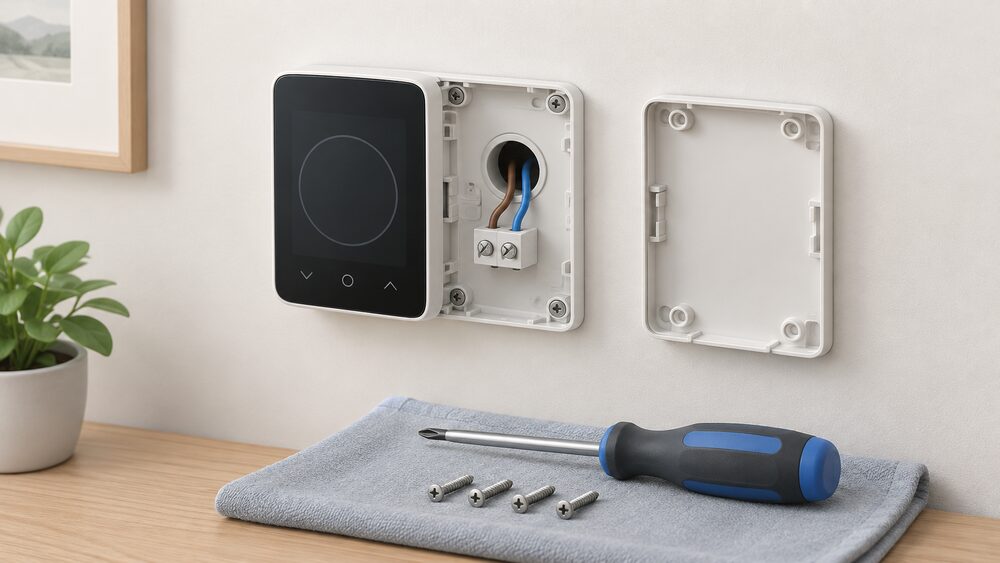
Meross is a smart home maker that sells its thermostats direct to householders rather than through a heating trade network. Its thermostat line splits into two families: the MTS300, a Wi-Fi thermostat built for low-voltage 24V HVAC systems, and the MTS215 series, which covers boilers, water-based underfloor heating and electric heating, with Matter support on the newer models1.
The distinction matters more than the branding. The MTS300 is a 24V control for American-style forced-air and heat pump systems, supporting up to 2-stage cooling, 3-stage heating, 2-stage heat pump, a 3-speed fan and a humidifier or dehumidifier2. The MTS215MA and MTS215BMA run on mains voltage, powered by live and neutral wires at 230VAC, and are the models a UK household with a gas boiler or electric heating would look at3.
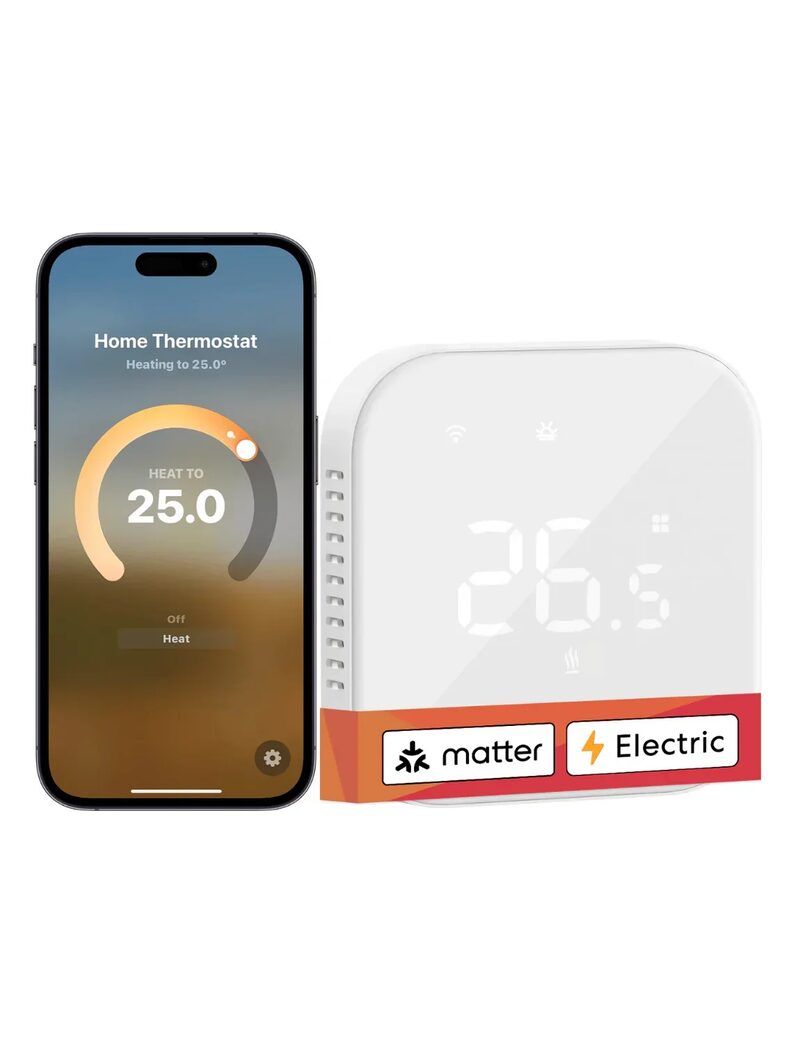
Matter is the other dividing line. The Matter models work with Apple Home, Siri, Amazon Alexa, Google Assistant and SmartThings, and Meross states that Matter devices can communicate and control each other on the local network even without an internet connection5. That local operation is the most consequential feature for a household thinking about how much of its heating depends on a manufacturer's cloud.
The Meross thermostat range at a glance
Meross sells its thermostats through its own shop, and the range is organised by what each unit controls rather than by a single model ladder. The MTS300 and its Matter variant, the MTS300MA, are for cooling and heating systems1. The MTS215MA covers electric heating and electric underfloor heating, while the MTS215BMA is the boiler and water heating version1.
The published specifications are consistent across the MTS215 family. Set point range is 5 to 35 degrees C, operating temperature is 0 to 40 degrees C, storage temperature is minus 40 to 70 degrees C, and accuracy is stated at plus or minus 0.5 degrees C3. Power consumption is under 1 Watt, and the wireless standard is IEEE 802.11 b/g/n on 2.4GHz3.
| Model | Controls | Supply | Matter |
|---|---|---|---|
| MTS300 | 24V HVAC, heat pumps, fan coils | Low voltage 24V~ | No |
| MTS300MA | Cooling and heating systems | Low voltage 24V~ | Yes |
| MTS215MA | Electric heating, electric underfloor heating | 100-250V~, rated 230V~ | Yes |
| MTS215BMA | Boiler and water heating | Live and neutral, 230VAC | Yes |
The MTS215BMA is offered in black and white and carries CE, RoHs and WEEE certification4. Both MTS215MA and MTS215BMA are listed as in stock and ready to ship3. Prices are not published as fixed list figures on these pages; the maker's own listings show promotional reductions instead, with the MTS300MA at 33%, the MTS215MA electric heating model at 27% and the electric underfloor heating variant at 23%6.
MTS300: the Wi-Fi thermostat for most 24V HVAC systems
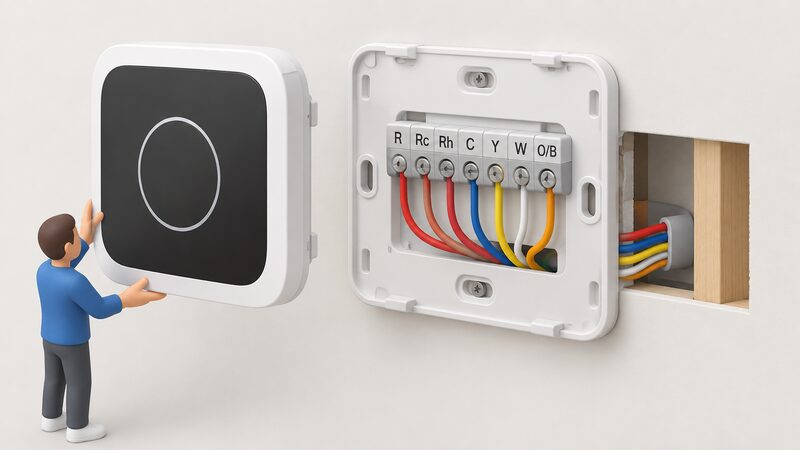
The MTS300 is a low-voltage thermostat, and Meross is explicit about what that means. It is compatible with most low-voltage 24V HVAC systems, including single or multi-stage heating and cooling systems, heat pumps with or without auxiliary heating, and fan coil units2. It is not a boiler control, and it is not designed for mains-voltage electric heating.
The terminal set explains the capability. R is the 24V single transformer for heating or cooling in conventional wiring, while Rc and Rh are the dual transformer terminals for cooling and heating respectively, and C is common2. Y is stage-1 cool in conventional systems, stage-1 compressor on a heat pump, a valve on a two-pipe fan coil and a cool valve on a four-pipe fan coil. Y2 adds stage-2 cool or a second-speed fan. W is stage-1 heat, stage-1 auxiliary heat on a heat pump, auxiliary heat on a two-pipe fan coil and a heat valve on a four-pipe fan coil, with W2 for stage-2 heat or a third-speed fan. O/B is the reversing valve on a heat pump, and E is emergency heat on a heat pump and two-pipe fan coil2.
That is a wider control set than most UK domestic thermostats offer, and it reflects the North American market the MTS300 is built for. For a UK household, the practical reading is that the MTS300 suits an air-to-air heat pump or a fan coil installation, not a gas boiler with radiators. Meross publishes a dedicated support hotline for the MTS300 on the same compatibility page2.
MTS300MA and MTS215MA: the Matter models and what Matter changes
Matter is a shared smart home standard, and Meross has adopted it across the newer thermostats. The MTS215MA, MTS215BMA and MTS300MA all carry it, and Meross states that the thermostats work with Apple Home, Siri, Amazon Alexa, Google Assistant and SmartThings through Matter technology3.
The practical benefit Meross claims is local control. Its product pages state that Matter devices can communicate and control each other seamlessly on the local network, even without an internet connection5. That is a meaningful difference from a cloud-only thermostat: a Matter controller on the same network can keep operating the heating if the broadband drops or the maker's servers are unavailable.
The Matter models also carry a dual sensor arrangement. Meross states that the sensor can be switched according to different scenarios to better control room heating, and the MTS215MA and MTS215BMA both include a built-in humidity sensor that turns the humidifier on as needed3. The MTS215BMA adds an adjustable backlight with independent settings for operation and standby4.
"Matter devices can communicate and control each other seamlessly on the local network, even without an internet connection"
What Matter does not change is the wiring. The MTS215MA and MTS215BMA still need live and neutral at 230VAC, and the MTS215MA is stated as not compatible with 24V HVAC systems such as heat pumps or conventional air conditioning7. A household choosing between the two families is choosing a system type, not a feature set.
Compatibility: which heating and cooling systems each model fits
Compatibility is the point where a Meross purchase is won or lost, and the maker's own pages set it out model by model. The MTS215BMA is described as compatible with most boilers and water underfloor heating systems, and as a thermostat for boiler and water heating1. The MTS215MA is for electric heating systems and electric underfloor heating1.
The MTS205B-EU, an earlier Meross thermostat, is described as designed to control boiler heating systems and water-based underfloor heating with thermal actuators, covering boiler and radiators, boiler and water-based underfloor heating, and boiler with a hot water tank for combined heating and hot water control9. That gives a sense of the boiler-side capability across the Meross line.
For households without a common wire, Meross sells the C Wire Adapter MCA100, which it states is designed to work not only with the Meross thermostat but also with almost all other thermostat brands10. That is a useful accessory where a boiler's existing wiring lacks a C terminal.
The MTS300 sits apart. It is for 24V HVAC, and the MTS215MA is explicitly not compatible with 24V HVAC systems such as heat pumps or conventional air conditioning7. A UK household with a gas boiler and radiators, or with electric panel heaters, is in the MTS215 territory. A household with an air-to-air heat pump or fan coil unit is in the MTS300 territory. The two do not overlap.
Scheduling, sensors and what's in the box
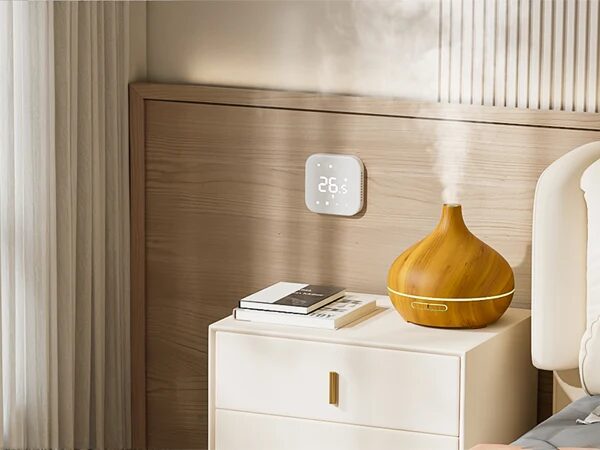
Meross builds its scheduling around a weekly graphic timetable. The MTS215MA and MTS215BMA support a 7/24 schedule with six time windows per day, including temperature and heating status3. The MTS215MA is also described as offering a 7x24-hour smart graphic schedule7.
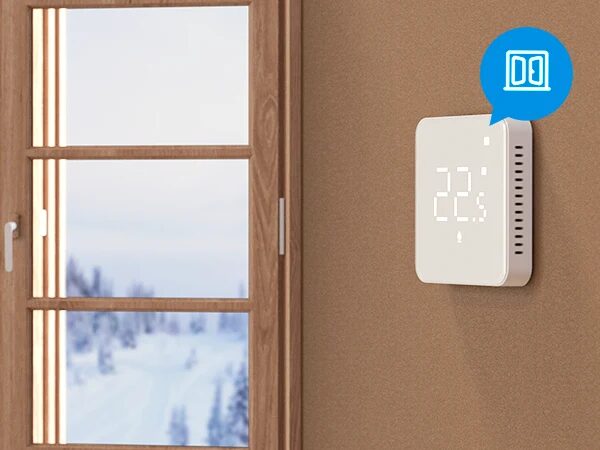
Open window detection is included across the MTS215 range. Meross states that the thermostat automatically pauses heating when a window is opened and sends a window-open notification to the phone3. On the MTS215MA the maker describes it as stopping heating for a while when a window is opened for ventilation7.
The MTS215BMA box contents are listed as one smart Wi-Fi thermostat, one wiring sticker, one user manual, one sensor rated β=3950 R25℃=10KΩ, and four screws4. Meross states the thermostat can be installed by the householder in under 30 minutes using a step-by-step setup wizard in the Meross app4.
What a Meross thermostat means for household energy independence
A thermostat is a control, not a fuel, so the independence question is about where the control logic lives and what it depends on. Meross's position is mixed, and the split runs along the Matter line.
On the local side, the Matter models keep working on the local network without an internet connection, and the thermostat itself can be adjusted by touch at the wall5. Scheduling, open window detection and the sensor logic run in the device. A household with a Matter controller retains control of its heating if broadband fails.
On the dependent side, remote control runs through the Meross app, and the maker describes adjusting temperature remotely via the app anytime, anywhere7. That is a dependence on a broadband connection, the maker's servers and a manufacturer's app that has no published end-of-support date on these pages. The MTS300 is a Wi-Fi unit without Matter, so its smart features sit more firmly in the cloud.
Meross also sells energy monitoring hardware that bears on self-consumption. The Smart Energy Monitor EM06P is stated to enable automatic utilisation of excess solar energy, increasing self-consumption11, and the Matter Smart Wi-Fi Plug with Energy Monitor reports device consumption and historical data through the Meross app12. Neither is a thermostat, but both point at the same app ecosystem. The wider question of how much a smart thermostat can shift a household's exposure is covered in heating controls and energy independence and do heating controls save money.
The Meross Hub: what it adds to thermostat automations
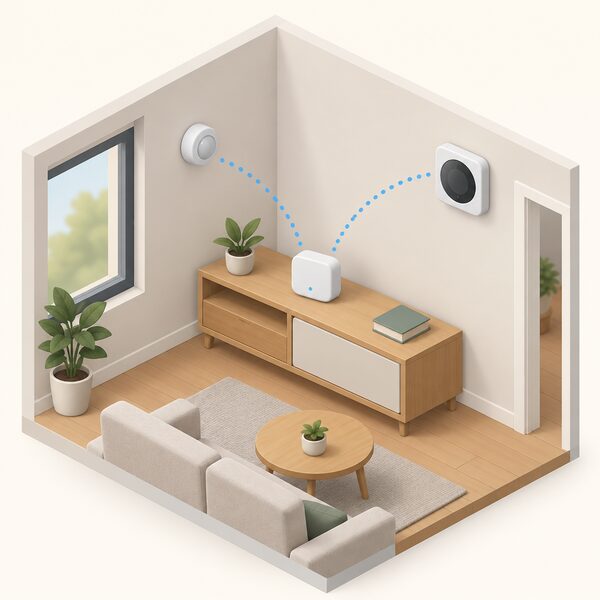
Meross has a hub in development, and its status is worth stating plainly because it affects what the thermostats can do on their own. The Meross Hub required for Meross app automations is expected to launch in 2026 Q3, according to the maker's own product pages for its presence sensor1. Until it ships, the automation layer that a hub would provide is not available.
That matters because the thermostats' own automation is limited to what runs on the device: the 7/24 schedule with six time windows per day, open window detection and the sensor switching3. Cross-device automations, such as a thermostat responding to a presence sensor or a door contact, need the hub.
For comparison, other makers already ship a hub that acts as a Matter bridge. Drayton states that the HubR in its Wiser Thermostat Kit is a Matter bridge allowing connection to Matter ecosystems13. Meross's equivalent is announced but not yet released, so a household buying a Meross thermostat today is buying the thermostat's own functions, not a hub-based automation system.
The regulatory backdrop is also moving. Ofgem added detailed guidance on smart thermostats to the ECO4 scheme14, and a later consultation states that smart thermostats under GBIS must incorporate automation and optimisation15. BEAMA's guidance on the Boiler Plus smart thermostat category sets out four required functionalities: time and room temperature control, automatic adjustment of settings, optimum start, and remote setting or adjustment with communications capability16. A Meross thermostat's schedule, sensor logic and app control map onto parts of that list, but the maker publishes no Boiler Plus or ECO4 compliance claim on these pages.
Sources16 cited
- Meross Smart Thermostat collection, Meross, 2026
- MTS300 compatibility check, Meross, 2026
- Meross Matter Smart Thermostat MTS215MA, Meross, 2026
- Meross Matter Smart Thermostat MTS215BMA, Meross, 2026
- Meross Matter Smart Thermostat MTS215BMA, Matter products, Meross, 2026
- Meross deals collection, Meross, 2026
- Meross Matter Thermostat MTS215MAUS, Meross, 2026
- Meross Matter Smart Thermostat MTS215BMA, deals, Meross, 2026
- MTS205B-EU compatibility check, Meross, 2026
- Meross C Wire Adapter MCA100, Meross, 2026
- Meross Smart Energy Monitor EM06P, Meross, 2026
- Meross Matter Smart Wi-Fi Plug with Energy Monitor, Meross, 2026
- Wiser Thermostat Kit 2 2nd Generation, Drayton Controls, 2026
- ECO4 summary updates document, Ofgem, 2022
- Summary of Guidance Updates: ECO4 and GBIS, Ofgem, 2025
- Part L 2022 Heating Controls Guidance, BEAMA, 2022
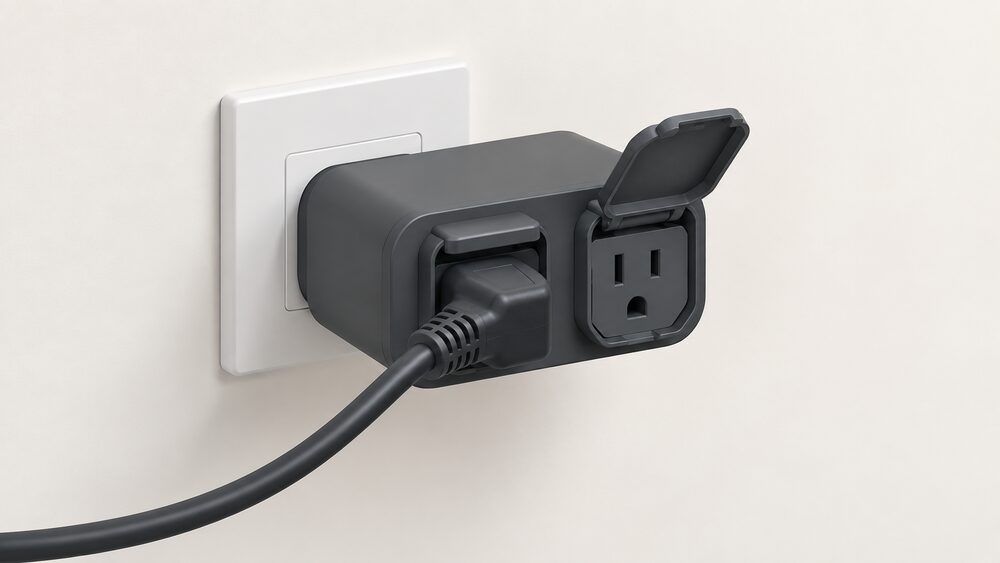 Meross Smart Plugs, Sensors and Home MonitoringWondering whether a Meross plug or energy monitor is worth fitting?