In this guide
The Eve Thermostat is a mains-powered wall thermostat for water-based underfloor heating, and it is not a boiler control. The maker states that only water-based 230 V underfloor heating systems switched by a Triac element or a classic relay are supported, and that boilers and heat pumps are not1. It measures 95 x 95 x 20 mm, reads temperature to 0.1 °C and switches on a 0.5 °C differential2.
It is a Matter and Thread device, so it needs a hub that provides both a Matter controller and a Thread border router before it will work at all1. In return it runs entirely locally, with no Eve cloud, no subscription and no registration1. For a household weighing energy independence, that is the trade: a device that keeps working without a manufacturer's servers, but only inside one narrow heating system, and only once a hub from another company is in place.
UK availability is the immediate obstacle. The European product page lists the thermostat as coming soon, and the US-facing page states it is not available in that country3. There is no published UK price and no confirmed on-sale date.
A wall thermostat for wet underfloor heating, not a boiler control
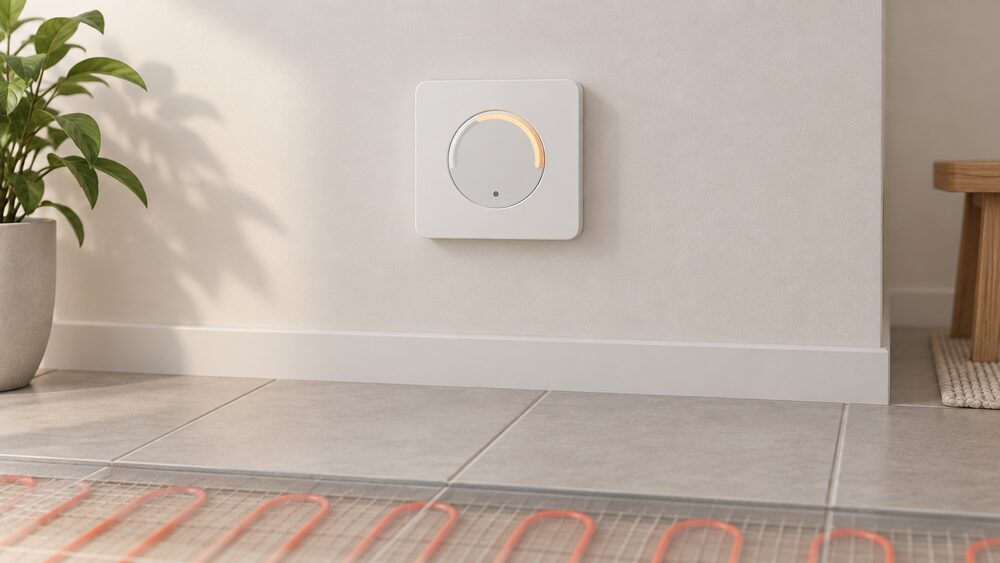
The Eve Thermostat is designed for one job. The maker describes it as intended for water-based underfloor heating systems with low-power electrothermal 230 V actuators, and states that it controls those actuators by default through a Triac output2. The supported list is explicit: only water-based 230 V underfloor heating systems switched via a Triac element or a classic relay, with boilers and heat pumps not supported1.
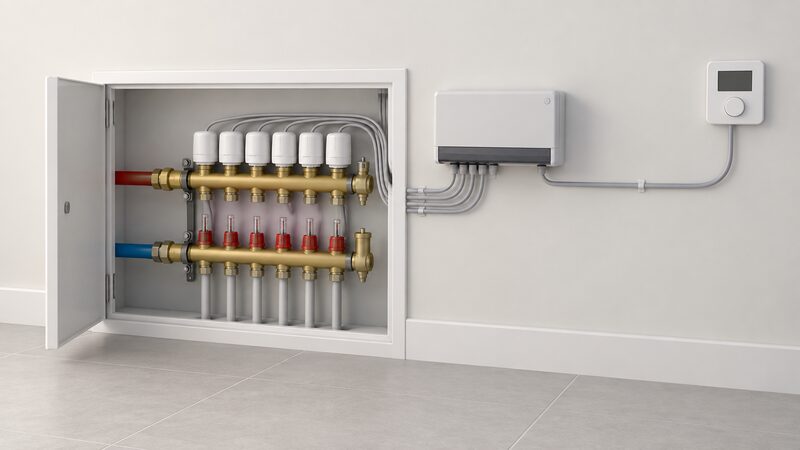
That distinction matters more than it first appears. A conventional room thermostat closes a low-voltage circuit that tells a boiler to fire, and it is wired into the boiler interlock so the boiler cannot run when there is no demand. The Eve Thermostat does something different: it switches the actuators on a manifold, which open and close the loops of a wet underfloor zone. There is no boiler interlock function and no hot water control, and the maker confirms it does not coordinate with the Eve Thermo radiator valves either, though schedules for the two systems can be aligned manually4.
For a household, this means the device sits at the zone level rather than the system level. It can hold a room at a temperature by opening and closing underfloor loops, and it can do so without a boiler, a cylinder or a gas supply being involved in the decision. It cannot replace a programmer, a boiler thermostat or a cylinder thermostat, and it is not a route to controlling a heat pump. Underfloor heating is often installed alongside a heat pump, and works with all types of heating system, but the control of that heat pump remains a separate matter5.
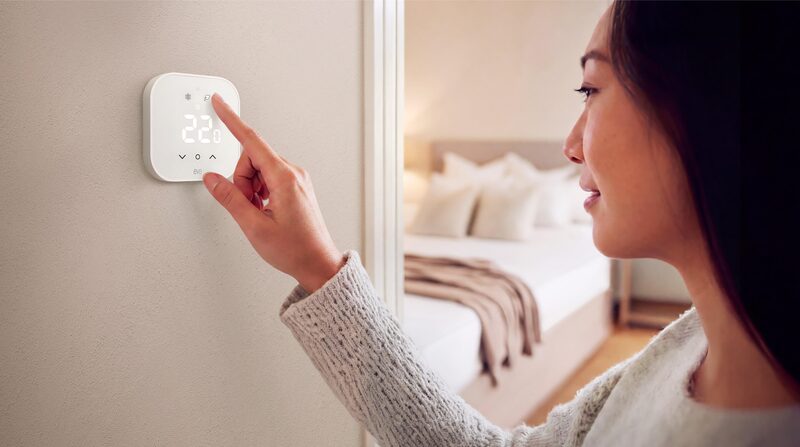
Specifications: 0.1 °C accuracy, 0.5 °C switching differential
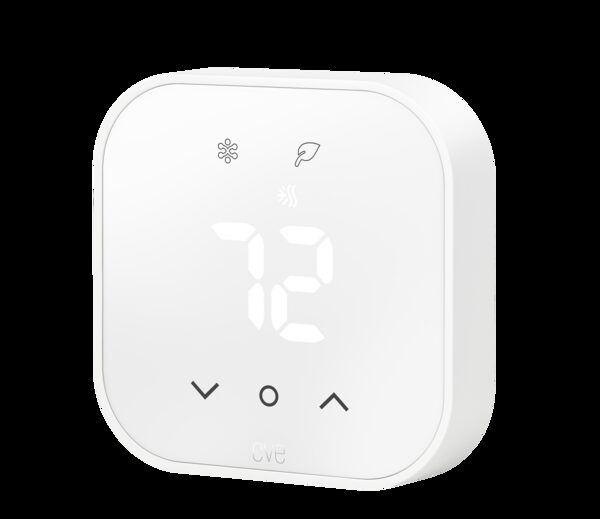
The published specification is narrow and precise, which suits a device whose whole purpose is holding a floor at a steady temperature. The table below sets out what the maker lists.
| Specification | Value |
|---|---|
| Temperature accuracy | 0.1 °C2 |
| Switching differential (hysteresis) | 0.5 °C2 |
| Dimensions | 95 x 95 x 20 mm2 |
| Power supply | 100 to 240 VAC 50/60 Hz1 |
| Ambient temperature range | 5 °C to 35 °C1 |
| Ambient humidity | 5% to 100%1 |
| IP protection rating | IP 201 |
| Wireless connection | Thread1 |
| Frequency range | 2405 to 2480 MHz (Thread), 2402 to 2480 MHz (BLE)1 |
| Maximum RF output power | under 8 dBm1 |
| App requirement | iPhone or iPad with the latest iOS or iPadOS, or Android 8.1 or later1 |
The 0.5 °C switching differential is the figure that governs comfort in practice. A thermostat with a wide differential lets the floor cool noticeably before calling for heat again, which produces a slow swing in room temperature. At 0.5 °C the band is tight, and the maker pairs it with 0.1 °C measurement accuracy, so the switching point is set close to the reading. For a wet underfloor slab, which responds slowly, a tight differential reduces the size of the overshoot and undershoot rather than making the floor heat faster.
The IP 20 rating is worth noting: it protects against solid objects but not against water, so it is a dry-room device. The 5 °C to 35 °C ambient range and the 5% to 100% humidity range cover normal domestic conditions. The mains supply is fixed wiring rather than a battery, which is a departure from the battery-powered Eve Thermo radiator valve, and it means the thermostat needs a permanent 230 V feed at the wall position1.
Thread, Matter and the hub you need before it will work
The Eve Thermostat communicates over Thread, and the maker lists a compatible hub with both Matter Controller and Thread Border Router functionality as a requirement1. That is not a soft recommendation. Without a border router, a Thread device has no route onto the home network, and without a Matter controller there is nothing to commission it into.
The maker's own guidance on its Thread accessories explains the topology: battery-operated Thread accessories such as the Eve Thermo are endpoints in the Thread network, and a home hub acting as a Thread border router is needed to connect them6. Mains-powered Thread devices that are always on, such as the Eve Energy range, can act as router nodes and relay data packets, strengthening the mesh2. The Eve Thermostat is mains powered, so it can serve that relaying role as well as being an endpoint.
In practice the hub is usually an Apple device. The maker's Eve Thermo Control lists an Apple home hub with Thread, naming the Apple TV 4K second generation, the Apple TV 4K third generation with 128 GB, the HomePod second generation and the HomePod mini7. The same requirement appears across the maker's Matter devices, including the Eve Motionblinds upgrade kit, which states plainly that a Matter-enabled device requires a hub supporting both Thread and Matter8.
Local control with no cloud, no subscription and no registration
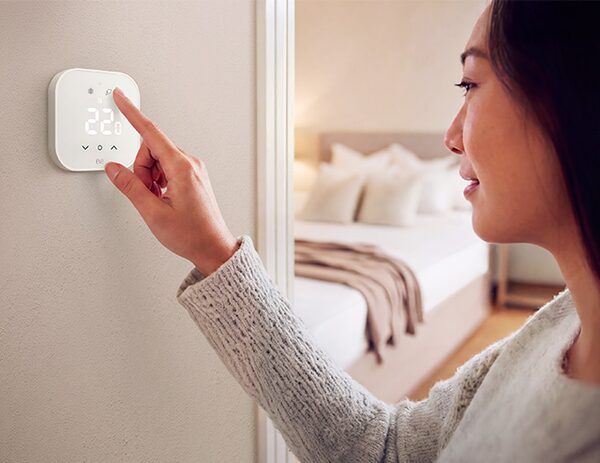
This is the strongest part of the case for the Eve Thermostat, and it is unusual in the smart heating market. The maker states that the thermostat works entirely locally and on its own terms, that Eve will never access, store or process personal data, and that there is no Eve cloud1. The same page lists no subscription and no registration1, and the support article repeats that all features can be used whenever wanted without registering or subscribing2.
The practical effect is that the thermostat does not depend on a manufacturer's servers to run a schedule or hold a temperature. If the company's cloud were withdrawn, or the household's broadband went down, the local control loop between thermostat and actuators would continue. That is a meaningful difference from controls whose scheduling lives in an app account, and it is the point at which a heating control stops being a service and becomes a piece of equipment.
The dependence that remains is the hub. Local operation still runs through a Matter controller and a Thread border router, which in most homes is a smart speaker or streaming box made by Apple, Google, Amazon or Samsung. The household is not tied to Eve's servers, but it is tied to a platform, and to that platform's continued support for Matter and Thread. The Eve app itself is free and controls HomeKit-enabled accessories including switches, thermostats, cameras and locks, and it shows how appliances influence power consumption9.
"Eve Thermostat works entirely locally and on your terms, Eve will never access, store, or process your personal data, and there is no Eve cloud."
Platforms and app support: Apple Home, Google Home, Alexa, Home Assistant, SmartThings
The thermostat is listed as compatible with Apple Home, Google Home, Amazon Alexa, Home Assistant and Samsung SmartThings1. That breadth is a consequence of Matter rather than of bespoke integrations, and it means the device can be commissioned into whichever of those platforms the household already uses.
The platforms are not equal, though, and the difference falls on scheduling. On-device schedules are not supported on the Amazon Alexa or Samsung SmartThings platforms2. Schedules require the Eve app, available on iPhone and iPad for devices connected through the Apple Home platform, and on Android for devices connected through the Google Home platform3. The maker repeats the same limitation on its other heating products, including the Eve Thermo fourth generation and fifth generation10.
So a household running Alexa as its primary platform can use the thermostat and control it by voice, but cannot set its schedules there. Voice control of heating is a common expectation, and other makers advertise it: the Homematic IP radiator thermostat Evo offers voice control via Amazon Alexa or Google Assistant12, and Hive states that some of its thermostats link to Alexa or Google Assistant13. The Eve Thermostat supports the assistants, but the scheduling layer sits in the Eve app on a phone, which is a narrower arrangement than the platform list alone suggests.
For a household already inside Apple Home, none of this is a constraint. For one built on Alexa or SmartThings, the thermostat is a device that can be operated but not fully programmed from the platform it lives in. A wider comparison of assistant compatibility is at Which smart thermostats work with Alexa or Google Assistant.
Eco Mode, schedules and what the Eve app adds
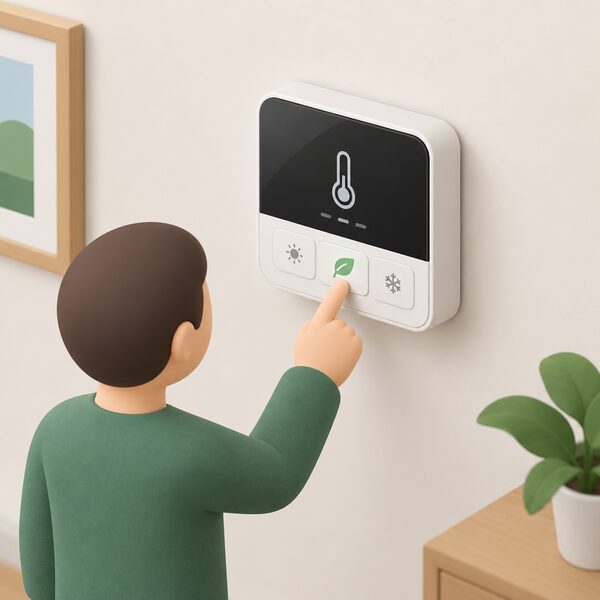
Eco Mode is the on-device control. The maker states that it reduces heating costs by allowing a reduced-temperature preset to be activated directly on the device, and that it can be paused or adjusted at any time1. Because it is a device-level preset rather than a cloud routine, it works without the app and without a network round trip.
Scheduling is where the Eve app earns its place. Schedules require the Eve app, on iPhone and iPad for Apple Home devices and on Android for Google Home devices3. The app also provides advanced features beyond what the platform alone exposes1, and it controls HomeKit-enabled accessories including switches, thermostats, cameras and locks, and shows how appliances influence power consumption9.
The maker's wider heating range shows how the pieces are meant to fit together. The Eve Thermo is a battery-powered radiator valve that supports Thread for a responsive and robust smart home14, and the Eve Thermo Control is a separate temperature sensor with an integrated rechargeable battery that works only with Eve Thermo and not with thermostats from other manufacturers15. The maker states that direct communication with the Eve Thermo Control enables precise automated heating11. The Eve Thermostat does not take part in that pairing: the maker confirms that Eve Thermo Control is not supported, and that it only supports Eve Thermo4.
Where the Eve Thermostat falls short
The limits are structural rather than incidental, and they should be weighed before an installation is planned around the device.
- No boiler or heat pump control. The maker states that boilers and heat pumps are not supported, and that only water-based 230 V underfloor heating switched by a Triac element or a classic relay is supported1.
- No hot water function. There is no cylinder control, and the device has no role in domestic hot water.
- A hub is mandatory. A compatible hub with Matter Controller and Thread Border Router functionality is required before the thermostat will work1.
- Scheduling is platform-dependent. On-device schedules are not supported on Amazon Alexa or Samsung SmartThings2.
- No UK availability confirmed. The European page lists it as coming soon, and the US-facing page states it is not available in that country3.
- No published UK price. Prices are installer-quoted, and no range is published for this device.
The electrical side is also worth stating plainly. The thermostat is mains powered at 100 to 240 VAC 50/60 Hz1, and in relay mode the maker states that the 230 V supply voltage from terminal L must be supplied to terminal COM via a cable bridge, spring clamps or similar2. That is fixed wiring work at mains voltage, and in the UK it falls within the scope of work that a registered electrician handles; the competent person scheme route means a registered electrician's work does not attract building control charges16. Underfloor heating controls sit alongside the manifold and wiring centre, and the wider subject is covered at Underfloor heating controls, manifolds and wiring centres.
What it means for a household's energy independence
The Eve Thermostat is a clear case of a control that keeps working without a manufacturer's permission. No subscription, no registration, no Eve cloud, and local operation between the thermostat and the actuators1. If the maker's servers were switched off, the device would carry on holding a floor at temperature. That is the independence it offers, and it is real.
The dependence that remains is threefold. The first is the hub: a Matter controller and Thread border router from Apple, Google, Amazon, Samsung or another platform is a precondition, so the household depends on that platform's continued support for Matter and Thread1. The second is the heating system itself: the thermostat only works on water-based 230 V underfloor heating, so a home heated by a gas boiler, a heat pump or electric panel heaters gets nothing from it1. The third is the wider energy supply. A wet underfloor system is still fed by whatever heats the water, whether that is a gas boiler, a heat pump or a district heat network, and the thermostat does not change the fuel or the supplier.
For a household with a wet underfloor zone, the device is a local, subscription-free way to control that zone, with the scheduling caveats noted above. For everyone else, it is not a heating control at all. The broader question of which controls keep working when a manufacturer withdraws is covered at Heating controls and energy independence, and the platform layer at Zigbee, Matter, KNX and Wi-Fi: protocols for heating controls.
Sources16 cited
- Eve Thermostat product page, Eve
- Eve Thermostat (Europe) support article, Eve
- Eve Thermostat (US) product page, Eve
- Eve Thermostat (Europe) support article, US edition, Eve
- Underfloor heating system guidance, NICEIC
- Eve Thermo (5th generation) support article, Eve
- Eve Thermo Control support article, Eve
- Eve Motionblinds Upgrade Kit for Roller Blinds, Eve
- Eve app product page, Eve
- Eve Thermo (4th generation) product page, Eve
- Eve Thermo Control product page, Eve
- Radiator thermostat Evo, silver, Homematic IP
- How to save money with smart home devices, Hive
- Eve Thermo Switch Now product page, Eve
- Eve Thermo Comfort product page, Eve
- Building regulations and registered electricians, Electrical Safety First
 Eve Smart Plugs, Sensors and Energy MonitoringWhich Eve plug or sensor shows what each appliance is costing you, and does it work with your phone?