
In this guide
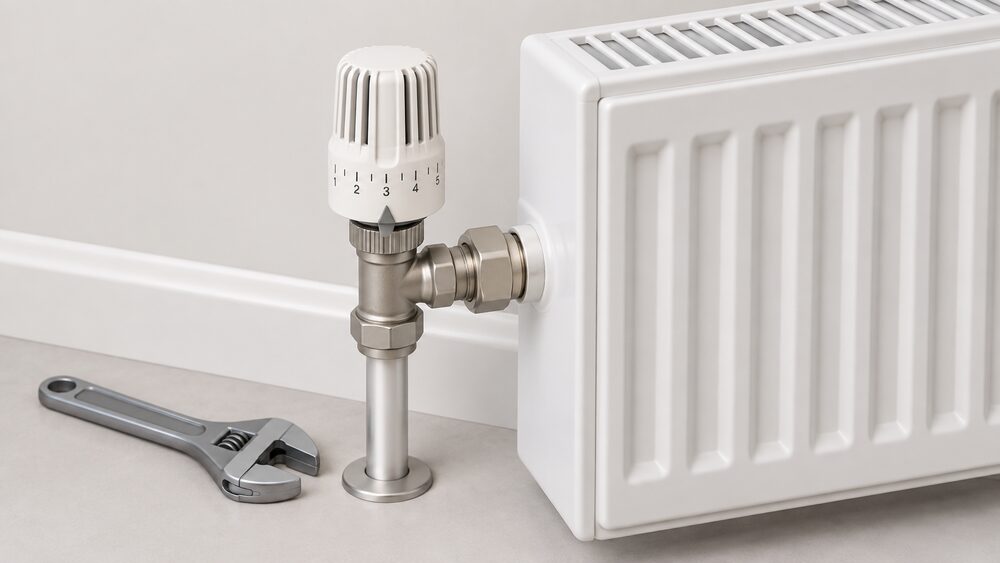
Danfoss is one of the names a UK householder is most likely to find stamped on a radiator valve, and the company's controls sit at the simple end of the heating market: a thermostatic head that senses room temperature and throttles the flow of hot water into a radiator. A TRV gives better control over the individual room temperatures, and it works by regulating the flow of hot water to the radiator based on the room's temperature1. That is the whole function, and it is why the valve matters more than the badge on it.
The practical question for most homes is compatibility. Danfoss valve bodies appear in two main families, and the smart radiator valve market has settled around them. A compatibility list covering many makers records the Danfoss RAS-DK and RAS-CK as M30 x 1.5 bodies, and the RA, RA-FS, RA-URX, RTW, RAS-C2 and RAS-D2 as RA bodies, all of which accept the Genius Hub Wireless Radiator Valve, while the RAV and RAVL bodies do not3. Some smart thermostats ship with adapters for Danfoss RA, RAV and RAVL instead4.
Danfoss also makes controls well beyond the domestic radiator, including the NovoCon digital actuator range for AB-QM valves in higher flow applications, expanded with M, L and XL models5. Those are commercial and district heating products. For a household, the value of a Danfoss TRV is local: it holds a room at a temperature without a phone, an app or a broadband connection, and it keeps working when the network does not.
What Danfoss makes for radiator control
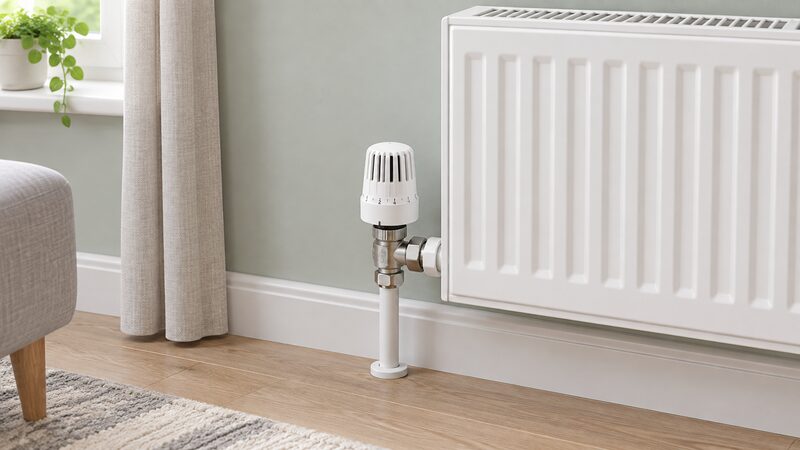
The core product is the thermostatic radiator valve, a two-part device: a valve body plumbed into the radiator and a head that senses air temperature and opens or closes the flow accordingly. TRVs automatically adjust the heat output of each radiator to maintain a comfortable room temperature, reducing hot water flow once the desired temperature is reached8. Independent guidance recommends using TRVs on individual radiators to adjust the temperature in different rooms based on usage, turning down TRVs in unused rooms9.
Danfoss's own product development has moved into balancing as well as temperature. The Danfoss RAS-B2 Dynamic Valve is described as a 2-in-1 temperature control and automatic balancing valve5. Balancing matters because a system where the nearest radiator takes most of the flow leaves distant rooms cold, and a valve that combines both functions removes a separate commissioning step.
The regulatory backdrop is straightforward. Any new radiator installed will require a thermostatic radiator valve to be installed, under the building regulations energy efficiency requirements for extensions6. That applies in England and, through the equivalent Welsh guidance, in Wales1. Fitting individual room temperature controls such as TRVs is also among the requirements under the Energy Performance of Buildings Directive10.
TRVs are not a niche accessory. Both TRV and Smart Thermostat appear as named measure types in the ECO4 measures table, the official list of measures that can be funded through the Energy Company Obligation7. That places a Danfoss valve in the same administrative category as a smart thermostat, which is a fair reflection of what each does: both control room temperature, one locally and mechanically, the other through software.
TRVs and smart thermostats: the range
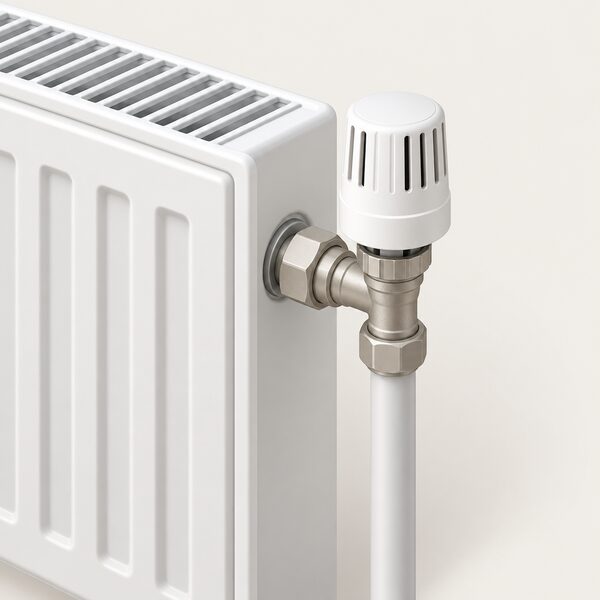
Danfoss's domestic range is best understood as a set of valve bodies rather than a set of finished smart products. The bodies carry the compatibility, and the head or actuator on top is what changes. The RA family covers the RA, RA-FS, RA-URX, RTW, RAS-C2 and RAS-D2, all listed as compatible with the Genius Hub Wireless Radiator Valve. The M30 x 1.5 family covers the RAS-DK and RAS-CK, also listed as compatible. The RAV and RAVL bodies are listed as not compatible with that valve3.
That split is the single most useful thing to know before buying any smart radiator control for a Danfoss system. A householder with RA or M30 bodies has a wide choice of third-party heads. A householder with RAV or RAVL bodies is in a narrower position, though some products supply adapters to cover them: the Eve Thermo ships with an adapter set for Danfoss RA, RAV and RAVL4.
| Danfoss body | Listed thread or family | Compatible with Genius Hub WRV |
|---|---|---|
| RAS-DK | M30 x 1.5 | Yes3 |
| RAS-CK | M30 x 1.5 | Yes3 |
| RAS-C2 | RA | Yes3 |
| RAS-D2 | RA | Yes3 |
| RA | RA | Yes3 |
| RA-FS | RA | Yes3 |
| RA-URX | RA | Yes3 |
| RTW | RA | Yes3 |
| RAV | RAV | No3 |
| RAVL | RAVL | No3 |
The wider controls market is dominated by brands with their own ecosystems. Drayton is described as one of the UK's leading heating control brands, and its Wiser system is a smart home heating system11. British Gas sells smart products from its Hive brands, including smart thermostats, smart plugs and smart light bulbs12. Danfoss's position is different: it supplies the valve bodies that other systems attach to, and its own digital actuation work sits in commercial hydronics.
For a household, that means the Danfoss decision is usually made once, at the valve, and rarely revisited. A smart TRV fitted to a Danfoss RA body can be replaced or upgraded without touching the plumbing. A thermostatic radiator valve left as a manual head needs no power, no pairing and no account.
Compatibility: the M30 x 1.5 thread standard
The M30 x 1.5 thread is the de facto standard for thermostatic heads in the UK and across Europe, and it is why heads from one maker often fit bodies from another. A compatibility list covering many manufacturers records M30 x 1.5 on Honeywell VT15, VT200E and VT117E, Drayton RT313, TRV4 and RT112, Heimeier, IMI Calypso, Pegler, Siemens Landis and Staefa, Oventrop Direct Acting, Landis and Gyr Duodyr, Braukmann, IVAR, Reglo, SALUS, Altechnic Eres, Evolve Contract, Honeywell HomeXpert, Grasslin Tower, TFC Group Tower, Geyser, MNG, Mertik Maxitrol, R.B.M., Schlosser, Trago Mills, Viega, Genebre and Wingenroth (Wiroflex)3.
The exceptions matter as much as the standard. M28 appears on Sunvic TRV200, Myson M28 TRV, Drayton TRV3, TA, Markayrds, Comap Senso TRV and Conic. A 26.5mm thread appears on Pintossi, Harvey Habridge Temtrol and on Honeywell 1970s models3. Those older and specialist bodies need an adapter, and a householder should read the marking on the valve rather than assume the standard applies.
Danfoss's own bodies sit on both sides of the line. The RAS-DK and RAS-CK are M30 x 1.5. The RA, RA-FS, RA-URX, RTW, RAS-C2 and RAS-D2 are RA bodies, which are a Danfoss pattern rather than the M30 standard, and the RAV and RAVL are separate again3. In practice this means a Danfoss RA body and a Honeywell M30 body are not interchangeable even though both accept third-party smart heads, because they accept different ones.
For a household planning to add smart TRVs room by room, the sensible sequence is to identify every valve body in the house first. A mix of RA and M30 bodies across a property is common where radiators have been replaced at different times, and it determines how many adapters are needed and whether one product can cover the whole house.
What the NovoCon digital actuators add
The NovoCon range is Danfoss's digital actuator line, and it sits well above domestic radiator control. Danfoss expanded the range with the NovoCon M, L and XL digital actuators for use with AB-QM valves in higher flow applications5. The three sizes cover progressively larger flow duties, which is why the naming runs M, L and XL rather than describing different control functions.
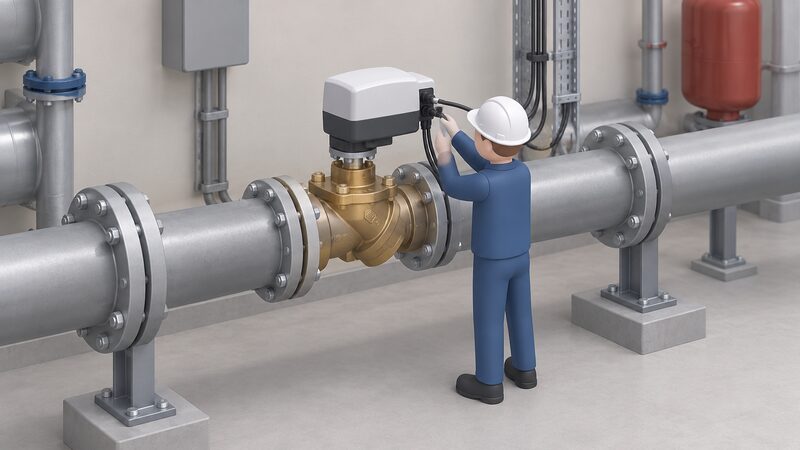
AB-QM valves are pressure-independent balancing and control valves used in commercial hydronic systems, and the NovoCon actuator mounts on them to give digital control rather than a thermal or motorised analogue action. The relevance to a household is indirect but real: the same company that supplies the domestic TRV body also supplies the balancing and actuation hardware used in larger buildings and district heating schemes, and the engineering culture behind both is the same.
Danfoss has also invested in installer-facing material. It launched the digital magazine Even Flow in July 2025, described as a resource for installers, specifiers and industry professionals covering Building Solutions and Danfoss Hydronic Systems5. In August 2025 CIPHE published Danfoss guidance on optimising commercial heating systems with TRVs, covering single and two pipe TRV options, automatic balancing benefits and radiator upgrade routes to heat pump transition5.
That last point connects the commercial range to the domestic one. Radiator upgrade routes matter for heat pump transition because a heat pump runs at lower flow temperatures than a gas boiler, and undersized or unbalanced radiators cannot deliver the required heat output at those temperatures. A TRV that also balances, such as the RAS-B2 Dynamic Valve, addresses part of that problem at the emitter rather than at the heat source5.
Danfoss and CIPHE: industry standing

Danfoss is an Industrial Associate of CIPHE, the Chartered Institute of Plumbing and Heating Engineering5. That is a trade affiliation rather than a product certification, and it places Danfoss in a large group: the CIPHE and its objectives are supported by over 150 companies manufacturing and supplying quality products5. Other Industrial Associates include Viessmann Climate Solutions, Triton Showers, Luthmore, Rinnai, Stelrad, Myson, Instantor and Mixergy5.
What Industrial Associate status signals is that a manufacturer engages with the professional body whose members install its products. It does not certify any individual valve, and it is not a substitute for the compatibility lists that determine whether a head fits a body. A householder weighing a Danfoss valve against another maker should treat the CIPHE relationship as background on the company rather than as evidence about a specific product.
The more useful industry evidence for TRVs as a category comes from testing rather than affiliation. A BEAMA technical bulletin reports on an air source heat pump TRV test at the Salford Energy House, commissioned by a number of BEAMA Heating Controls manufacturers13. The tests found that trimming internal temperatures with both traditional and smart TRVs reduced ASHP space heating energy, and that this did not significantly impact the system's coefficient of performance13. That is a measured result on a real heat pump installation, and it applies to TRVs generally rather than to one brand.
For a household, the practical reading is that the valve body is a long-lived plumbing component and the head is the part that dates. Danfoss bodies installed years ago remain usable with current smart heads where the family matches, which is a form of independence in itself: the control layer can be replaced without disturbing the pipework.
What a Danfoss TRV means for household energy independence
A thermostatic radiator valve is one of the few heating controls that asks nothing of the outside world. It has no power supply, no radio, no account and no server. It senses air temperature and moves a pin. In a house where the heating depends on a gas boiler and a gas supplier, that is a small but genuine piece of local control: the room temperature is set at the radiator, by the occupant, and it holds whether or not the broadband is up.
The measured benefit is real but bounded. TRVs are described as providing energy saving benefits14, and effectively selected and installed, they are proven to provide temperature control in individual rooms, thus reducing heating costs and enhancing comfort for consumers10. The Salford Energy House testing found that trimming internal temperatures with traditional and smart TRVs reduced heat pump space heating energy without significantly affecting coefficient of performance13. None of that changes the fuel: a TRV reduces how much heat a room receives, not where the heat comes from.
The dependence that remains is the one the valve cannot touch. A Danfoss TRV on a gas system still relies on the gas grid, a supplier and a boiler. Where a household adds renewable generation, the wider benefit is described in terms of meeting your own energy requirements and reducing your home's carbon dioxide emissions15, and reducing reliance on fossil fuels such as gas and oil and therefore reducing fuel bills and carbon emissions16. More homegrown energy means greater energy independence17, and a heating load that is independent of tariff changes is a different kind of security again18.
A smart head on a Danfoss body changes that balance. It adds scheduling, room-by-room zoning and remote control, and with them a dependence on a hub, an app and often a manufacturer's cloud service. The valve body underneath stays passive. For a household weighing heating controls and energy independence, the Danfoss TRV is the low-dependence end of the scale: it does less, and it needs less. Where a home has a heat pump, the interaction between TRVs and low flow temperatures is covered in why TRVs are often left off heat pump installations, and the wider control picture sits in the heating controls guide.
Sources18 cited
- Building regulations: energy efficiency, Welsh Government
- Radiator valves, Smart Energy GB
- TRV compatibility check, Genius Hub, 2 February 2026
- Eve Thermo Comfort, Eve, 2026
- Danfoss boiler efficiency, CIPHE, 26 July 2024
- Building regulations: energy efficiency, Planning Portal
- ECO4 measures table v4.0, Ofgem, 29 July 2025
- Smart heating controls: what they do and why they matter, BEAMA, 7 April 2025
- The best way to run your central heating, ivie
- HHIC launch TRV guide for consumers, HHIC, 8 January 2020
- What are smart thermostats?, Uswitch, 5 February 2026
- How to choose the best energy company, Which?, 19 January 2026
- BEAMA air source heat pump TRV Salford Energy House test, BEAMA, April 2026
- TRV factsheet for householders, BEAMA, 13 May 2022
- Home energy generation, Planning Portal, 2026
- Renewable energy, Carmarthenshire County Council, 1 July 2025
- Solar Energy Scotland manifesto, Solar Energy UK, 17 September 2026
- Radio teleswitch, Energy Networks Association, 17 September 2026