In this guide
Keston is a British boiler brand whose current domestic and commercial ranges are sold through keston.co.uk. The maker's own product pages list the Combi 2, the System 2 S30 and the Heat 2 Cascade, and each carries the claim that the boilers are British built, with the Combi 2 and System 2 pages dating that claim to 20131.
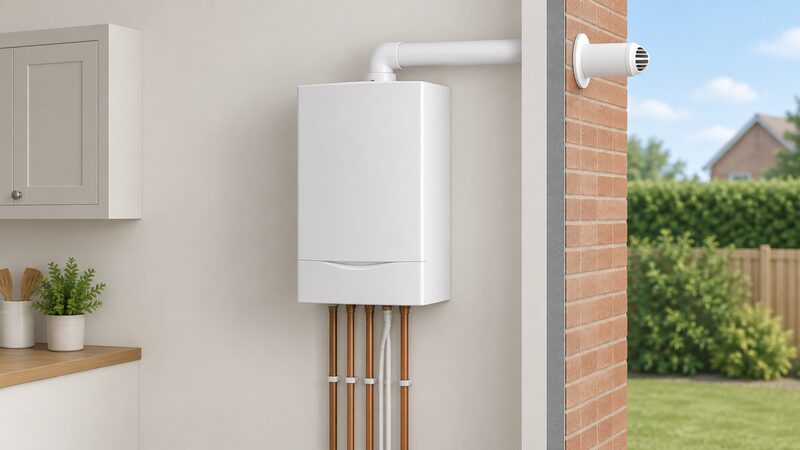
The distinguishing technical feature is the flue. The Keston Combi 2 uses a 50mm muPVC (PVC-C) solvent weld flue, which the maker describes as allowing simple, cost effective installations1. That is a different approach from the concentric flue most UK combis use, and it is the main reason Keston comes up in conversations about awkward installations.
For a household, the practical questions are output, system type and what the boiler leaves you dependent on. The System 2 S30 is a 30kW system boiler2. Independent sizing guidance suggests a 24 to 30kW boiler suits a home with up to three bedrooms, while larger houses need 35kW or more4. The Heat 2 Cascade is a commercial-scale product rather than a domestic one3.
What Keston boilers are and who makes them
Keston manufactures and sells its own boilers under the Keston name. The brand is not among those that independent guidance names as the boilers a UK household is most likely to end up with, which it lists as Worcester Bosch, Vaillant, Alpha, Viessmann or Ideal6. That is a statement about market share rather than about quality, but it is worth knowing: Keston is a smaller presence in the domestic market than the names most installers quote for first.
The company's product line extends beyond boilers. It makes system filters designed for its own installations, including a 22mm magnetic filter for use with Keston Combi and System boilers, and a 1.25 inch filter specifically designed for Keston Heat 2 single boiler installations on larger heating systems1. That filter carries a 5 year warranty, available subject to being commissioned by Keston Boilers5.
The range splits along the usual UK lines. The Combi 2 is a combination boiler, producing hot water on demand with no stored cylinder. The System 2 is a system boiler, which heats a separate hot water cylinder. The Heat 2 Cascade sits above both as a commercial product, and the maker notes that separate single boiler frame kits are available for use with in-line kits where that better suits the installation3.
For a household, the manufacturer's identity matters less than the support network behind it. A brand with a smaller UK installed base can mean fewer engineers who know the appliance, and parts availability that depends on one company rather than a broad supply chain. That is a consideration to weigh alongside the specification.
Twin flue technology: what it does and why it matters
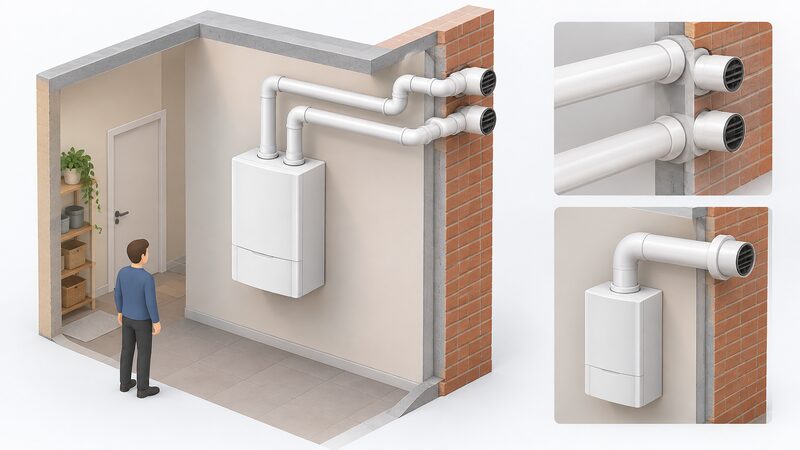
A twin flue system runs the flue in two separate routes rather than through a single concentric duct. The Keston Combi 2's flue is a 50mm muPVC (PVC-C) solvent weld type, which the maker describes as allowing simple, cost effective installations1. The material and the solvent weld joint are the practical detail: muPVC is a plastic flue material, and solvent welding is a glued joint rather than a push-fit connection.
That contrasts with the push-fit flue systems used elsewhere in the market, which independent product listings describe on other makers' combi ranges7. Neither approach is inherently better; they suit different installation routes and different installers' working methods.
The reason flue type matters at all is that flue gases carry away heat. A condensing boiler recovers more heat and loses less heat through its flue pipe than older models, which is the basis of its efficiency advantage8. Boilers are also more efficient when the return temperature is low, and that can save both energy and money9. A flue that allows a shorter or straighter route, or one that avoids a difficult wall, can make an installation possible where a standard concentric flue would not fit.
There is a caveat that applies to twin wall flue systems generally. Independent guidance on stove flues notes that cold plug formation is more common in a twin wall flue system because such systems can be more exposed10. Cold plug is a blockage that forms in the flue, and exposure to cold is what drives it. That guidance is written about solid fuel appliances rather than gas boilers, so it should be read as a general property of twin wall flue arrangements rather than a Keston-specific finding.
"Also, it's more common to happen in a twin wall flue system as they can be more exposed."
British built: where Keston boilers come from
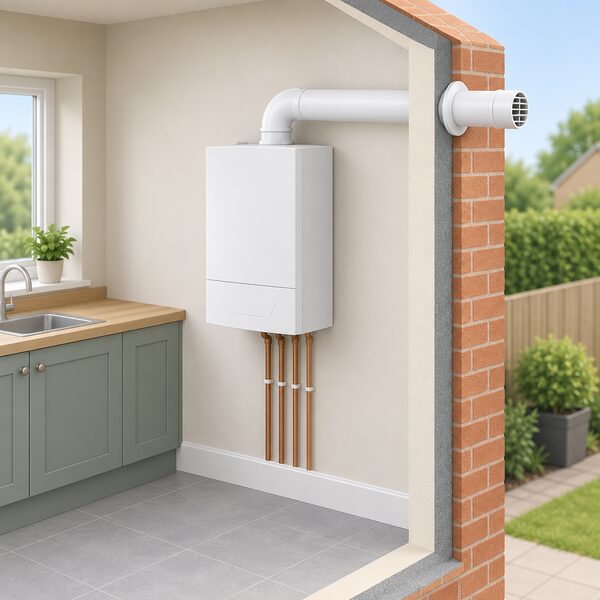
Keston states that its boilers are British built. The Combi 2 page carries the claim "BRITISH BUILT SINCE 2013", and the System 2 S30 page carries the same wording1. The Heat 2 Cascade page carries the claim "BRITISH BUILT" without the date3. That is the maker's own statement about its manufacturing, and it is the only manufacturing location claim the available material gives for the brand.
For context, British manufacturing is not unusual in this market. Worcester Bosch makes its gas boilers at its headquarters in Warndon, Worcestershire11. Independent guidance states that both Baxi heating boilers and Glow Worm boilers are British-made12. Vaillant's ecoTEC pro range is described as engineered in Germany and manufactured in the UK, and the ecoTEC plus system range carries the same description13.
The distinction between engineered and manufactured is worth holding on to. A boiler can be designed abroad and assembled in Britain, or designed and built in Britain. Keston's claim is about being British built, which speaks to where the appliance is made rather than where it was designed.
What British manufacturing does for a household is shorten the supply chain. Parts and service support travel a shorter distance, and a UK production line is easier to visit or query than an overseas one. It does not by itself determine reliability, efficiency or lifespan, and it does not change the fact that a gas boiler still runs on gas delivered through the grid.
The Keston range at a glance
The domestic and commercial ranges differ in output, system type and intended installation. The table below sets out what the maker's own pages state for each.
| Product | Type | Key stated detail |
|---|---|---|
| Keston Combi 2 | Combi | 50mm muPVC (PVC-C) solvent weld flue; British built since 20131 |
| Keston System 2 S30 | System | 30kW output; British built since 20132 |
| Keston Heat 2 Cascade | Commercial | British built; compact size allows replacement of existing floor-standing boilers3 |
| Keston 22mm System Filter | Accessory | Magnetic filter for Keston Combi and System boilers1 |
| Keston 1.25" System Filter | Accessory | For Keston Heat 2 single boiler installations on larger systems; 5 year warranty5 |
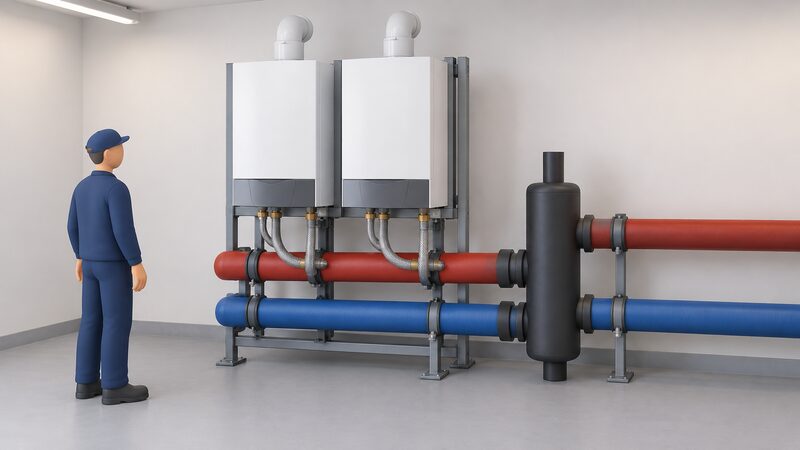
The Heat 2 Cascade is the outlier. Its compact size means it is possible to replace existing standard efficiency floor-standing boilers with ease, and the maker notes that flow, return and low loss headers, together with the flexible boiler connections, are all pre-insulated for extra convenience3. Separate single boiler frame kits are available for use with in-line kits where that better suits the installation3.
The filters carry conditions worth reading closely. The 1.25 inch filter enables free commissioning on single Keston Heat boilers, but free commissioning is only available when a Keston 28mm System Filter is installed with a single Keston Heat boiler, and it is not available on multiple boiler installations5. The 22mm filter fits on horizontal or vertical pipework in both flow directions1.
What owning a Keston boiler means for household energy independence
A gas boiler, whatever the brand, keeps a home on the gas grid and on a gas supplier. That is the central fact of the fuel. The boiler itself does not change it, and no flue arrangement or manufacturing location alters it.
What a household can control is the efficiency of the system around the boiler. Boilers are more efficient when the return temperature is low, and this can save both energy and money9. Using a high efficiency boiler could save money and significantly cut a home's CO2 emissions, according to official guidance15. A condensing boiler recovers more heat and loses less heat through its flue pipe than older models8. Switching to a condensing boiler increases efficiency and cuts emissions16.
Heating controls are a separate lever. You can upgrade or install heating controls independently of your boiler, which means the control layer can be improved without replacing the appliance17. That is a genuine measure of independence within a gas system: the household decides when heat is produced, even if it does not decide where the gas comes from.
The limits are firm. A gas boiler depends on mains gas, a supplier and the grid. It depends on an installer for commissioning, and on the manufacturer for parts and, where a warranty applies, for the terms of that warranty. The Keston filter warranty is available subject to being commissioned by Keston Boilers, which ties the term to a specific commissioning route5. Where a household wants to reduce dependence on a gas supplier altogether, the alternatives are covered in heating and energy independence and heating a home off the gas grid.
Where Keston fits in the UK market
The UK has the largest boiler market in Europe, which independent consultation work describes as putting it well placed to take the lead in widespread deployment of low carbon heating18. That is the backdrop against which any boiler brand now sits.
Policy is shifting the market underneath the products. The Clean Heat Market Mechanism applies to manufacturers that sell more than 19,999 gas boilers to the UK market, or 999 oil boilers19. That is a threshold that captures the large manufacturers, and it is a mechanism designed to move the market toward heat pumps rather than to regulate individual installations.
Hydrogen-ready boilers are sometimes presented as the bridge. Official statistics state plainly that this technology is not yet available20. A boiler described as hydrogen-ready is built to tolerate a blend in the existing gas network, not to run on pure hydrogen, and there is no domestic hydrogen supply to feed one. The claim is covered in more detail in hydrogen-ready boilers.
Keston's position within that market is as a smaller British manufacturer with a distinctive flue approach and a commercial product line alongside its domestic combi and system boilers. Availability is direct: the 1.25 inch filter is sold via keston.co.uk with specification sheets available for download5. For households comparing brands, the relevant pages are boiler flues for the flue question and boiler warranties for the terms that apply after installation.
Sources20 cited
- Keston Combi 2 C30 C35, Keston, 2026-09-20
- Keston System 2 S30, Keston, 2026-09-20
- Keston Heat 2 Cascade, Keston, 2026-09-20
- Boiler statistics, Uswitch, 2024-01-04
- Keston 28mm System Filter, Keston, 2026-09-20
- New boiler cost, Uswitch, 2024-11-06
- Vaillant ecoTEC sustain combi boilers, Quiet Mark, 2026-09-17
- Boilers, Home Energy Scotland, 2026-09-20
- Should I turn my boiler's flow temperature down?, Energy Saving Trust, 2026-05-20
- Cold plug winter safety advice for stove users, HETAS, 2026
- Worcester Bosch boilers, Uswitch, 2024-11-13
- Different boiler types, Uswitch, 2026-09-18
- Vaillant ecoTEC pro, Quiet Mark, 2026-09-17
- Vaillant ecoTEC plus system boiler range, Quiet Mark, 2026-09-17
- Boilers and heating, Planning Portal, 2026
- Energy efficiency tips, UKIFDA, 2026-02-18
- Thermostats and heating controls, Home Energy Scotland, 2026-09-20
- Fitting the future, CIPHE, 2025-07-29
- HHIC response, HHIC, 2026-09-17
- Struggling to pay your heat network bills, Citizens Advice, 2026-09-17