
In this guide
REHAU is a polymer manufacturer, not a window company in the ordinary sense. It extrudes the uPVC profile that independent fabricators turn into finished windows and doors, and it has now moved into complete door systems of its own. The ARTEVO front door was launched in June 20261, and in May 2026 REHAU Window Solutions received the Passive House Certificate for it from the Passive House Institute in Darmstadt, presented at Fensterbau Frontale in Nuremberg2. A flush-glazed sash is planned to extend the ARTEVO portfolio in December 20262.
For a household, the practical consequence is that the name on the frame is not usually the name on the contract. REHAU supplies profile and, increasingly, a certified door system; the fabricator assembles it and the installer fits it. That distinction shapes everything from warranty claims to how a serial number is traced.
Who REHAU is and its place in the UK market
REHAU's position in the UK glazing market is upstream. It makes the polymer profile, the material that gives a uPVC window its shape, its colour and much of its thermal performance, and sells it to fabricators who weld, glaze and finish the units. The householder therefore buys a REHAU profile inside a window made by someone else. That is a different arrangement from a company that manufactures and installs its own finished product, and it matters when something goes wrong.
The wider retrofit market in which these products sit is quality-assured through TrustMark, which oversees quality assurance of retrofits to both technical and consumer protection standards and is the government endorsed quality scheme for domestic retrofits7. That is the framework a householder is relying on when an installer is described as registered, and it applies to the installation rather than to the profile.
REHAU's own UK window and door business publishes consumer-facing material directly: a homeowner sales brochure issued in February 2026, a Rio flush fit consumer sales brochure issued in January 2026, and an operation and maintenance guide published in July 20237. These are the documents that carry the maker's own description of how its products should be operated and looked after.
The company's reach extends beyond windows. REHAU is a polymer group whose products appear across building services, and the same extrusion expertise sits behind profile systems for windows, doors and other building elements. For a householder, the relevant point is narrower: the profile is a component, the window is a product, and the two have different makers.
Windows and doors: what one in seven uPVC installations have in common
uPVC window and door frames are available in a variety of colours and finishes, including wood effect, though they are most commonly white5. That single fact explains a great deal about the UK market. The overwhelming majority of uPVC installations look the same from the street, and the differences that matter are in the profile system, the glazing unit, the hardware and the quality of the installation rather than in the colour.
The material itself is described as recyclable, durable and energy efficient5. Those three properties are the commercial case for uPVC over timber: it does not need painting, it does not rot, and it can be reprocessed at end of life. The trade-off is that it is a petrochemical product, and its appearance is fixed at manufacture in a way that timber's is not.
Composite and uPVC doors often have insulated cores8. That is what allows a solid-looking door to meet the thermal requirements that apply to entrances, and it is why the door market has moved away from hollow panels.
The regulatory floor is set by U-values. Windows and doors need to comply with the Building Regulations in relation to the amount of heat that can pass through the door or window, including the frame, which is measured as a U-value, and this U-value should not be exceeded9. In new dwellings, doors with more than 60% internal face glazed and all other doors are limited to 1.4 W/(m2.K)3, while the area-weighted average for doors including glazed doors is 1.6 W/(m2·K)4. The two figures are not in conflict: one is a worst acceptable individual value, the other an average across the dwelling.
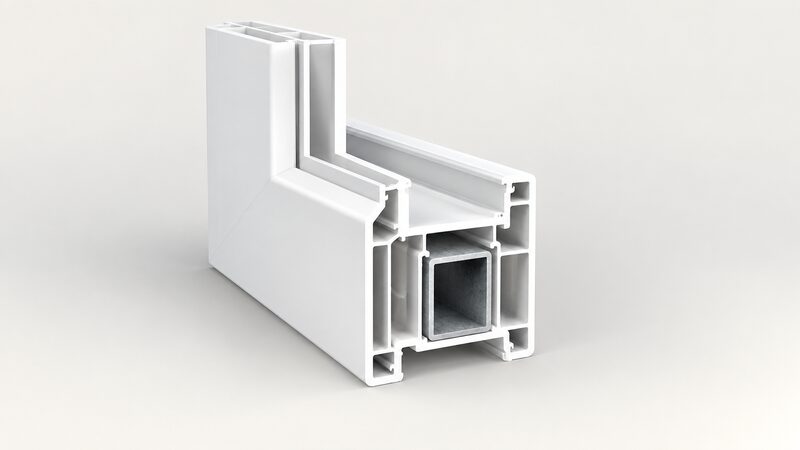
The REHAU door range for the front of the house
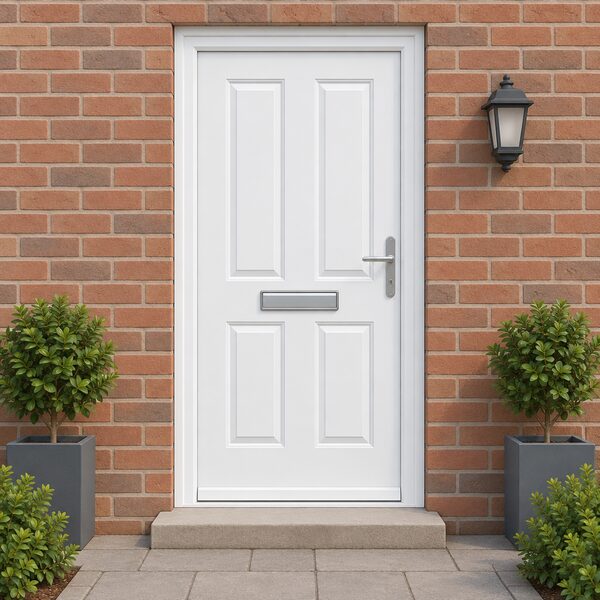
REHAU's door business spans the profile systems that fabricators build entrance doors from and, since 2026, a complete front door system of its own. The ARTEVO front door is described by REHAU Window Solutions as a premium front door system for residential and commercial buildings, launched as an expansion of the ARTEVO platform1.
The wider door types that uPVC profiles are used for are worth separating, because they behave differently at an entrance. Bi-fold doors come in aluminium and uPVC and various colours5. French doors open out like casement windows, and although both leaves can open, one can be kept closed at a time5. Tilt and turn windows typically open slightly so that they can be left ajar, but some can tilt up to 90 degrees11. Each of these is a different hardware system built into a similar frame, and each has different maintenance needs.
For the front of the house specifically, the choice is usually between a panelled entrance door, a glazed door and a door with a glazed panel above or beside it. The U-value rules treat these differently depending on how much of the internal face is glazed, which is why a heavily glazed entrance door is held to the same 1.4 W/(m2.K) limit as a solid one in new dwellings3.
| Door or window type | Opening behaviour | Frame material |
|---|---|---|
| Bi-fold | Folds to one side | Aluminium or uPVC5 |
| French | Opens out like a casement; one leaf can stay closed | uPVC or timber5 |
| Tilt and turn | Tilts ajar; some tilt to 90 degrees | uPVC11 |
| Entrance door | Single leaf, solid or glazed | uPVC or composite8 |
ARTEVO: the front door with a Passive House certificate
The ARTEVO front door carries a Passive House Certificate awarded by the Passive House Institute in Darmstadt in May 2026, presented at Fensterbau Frontale 2026 in Nuremberg2. It is worth being precise about what that certificate is and is not.
Certification is available for specific components as well as for whole buildings, designers, consultants and tradespeople12. Certified Passivhaus components have undergone independent uniform testing13. A certificate is only issued by a Passivhaus Certifier if the defined criteria have been met without exception13. So the ARTEVO certificate is a statement that the door, as a component, has been tested against the Passive House Institute's criteria and met them.
It is not a statement about the house. Passivhaus, literally passive house in English, refers to buildings created to rigorous energy efficient design standards14. A whole-building certificate requires a rigorous compliance process, and the certifier organisations approved to assess and issue the Passivhaus Certificate in the UK must be separate to the main design team and provide impartial verification that all Passivhaus criteria have been satisfied12. A certified door fitted into a leaky house does not make the house a Passivhaus.
"Certified Passivhaus components have undergone independent uniform testing."
The scale of what a whole-building standard delivers is set out in independent guidance: Passivhaus buildings achieve impressive airtightness levels, around 20 times more than a standard build14. A case study of a Chippenham Passivhaus records Passivhaus certified triple glazed windows and a Passivhaus certified MVHR with high airtightness rated metal spiral ductwork15. That is the context in which a certified front door sits: one component in a fabric-first assembly.
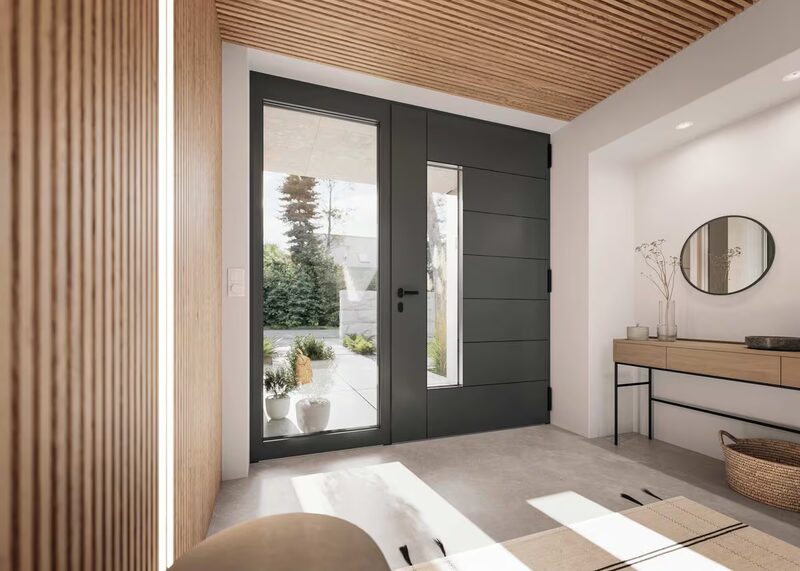
Rio flush fit windows and the flush-glazed sash
REHAU published a consumer sales brochure for the Rio flush fit window in January 20267. The flush fit principle is that the opening sash sits level with the outer face of the frame rather than standing proud of it, which gives a flatter elevation and a more contemporary appearance than a standard rebated window.
The same principle is being extended to doors. REHAU Window Solutions plans to extend the ARTEVO portfolio with a flush-glazed sash in December 20262. A flush-glazed sash is the door equivalent of the flush fit window: the glazing sits flush with the leaf rather than in a raised bead, which changes both the appearance and the way water and dirt behave on the surface.
For a householder weighing these against a standard window, the differences are largely visual and practical rather than thermal. The U-value of a window is determined by the glazing unit, the frame profile and the spacer, not by whether the sash is flush. What flush fitting changes is the depth of the frame in the reveal, the sightline, and how easy the outer face is to clean.
Flush fit also interacts with the reveal. Where internal wall insulation is being added, the depth available for the frame changes, and a flush sash sits differently in that depth than a rebated one. The general principles for that junction are set out in insulating a window reveal.
Living with REHAU products: operation and maintenance
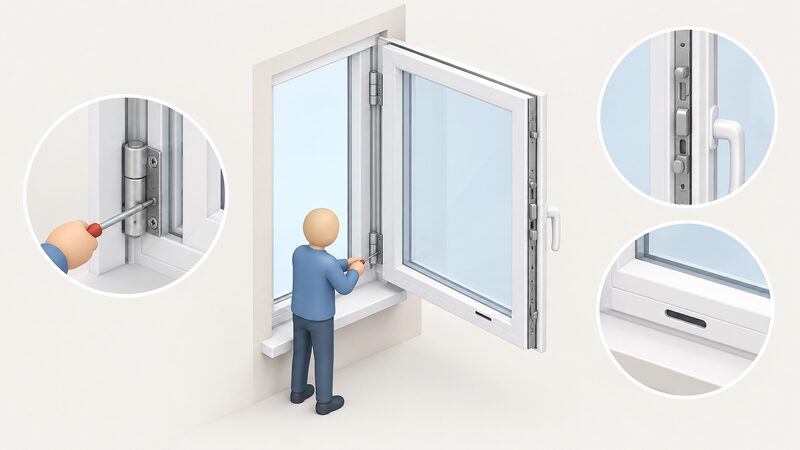
A window or door is a moving assembly, and the moving parts are what fail first. The frame itself needs little: uPVC is described as recyclable, durable and energy efficient5, and cleaning the profile and glass is the bulk of the routine work. Hinges, locking gear, sliding mechanisms and drainage slots need periodic attention, and REHAU publishes an operation and maintenance guide for its windows, issued in July 2023, which sets out the checks the maker expects7.
The principle that applies to any installed product is that it should be adequately and regularly serviced and maintained to continue to work safely and effectively16. For windows and doors that means checking that locks engage fully, that hinges are not dropping, and that the frame has not moved in relation to the opening. A door that has dropped on its hinges will not seal, and an unsealed door loses heat regardless of its tested U-value.
Some maintenance work is reserved to qualified people. Servicing and maintaining certain systems is a reserved activity under the F-Gas regime17, which applies to refrigeration, air conditioning and heat pump equipment rather than to windows. It is a useful reminder that not every trade task is a householder task, though window and door hardware is not in that category.
Brochures and information for homeowners
REHAU's UK window and door business publishes its consumer documents directly. The homeowner sales brochure was issued in February 2026 as a 5 MB PDF, the Rio flush fit consumer sales brochure in January 2026 as a 2 MB PDF, and the operation and maintenance guide in July 2023 as an 8 MB PDF7. These are the maker's own descriptions of its products and of the care they need.
Official guidance in the same territory is published free of charge. The Building Standards Technical Handbook, Domestic is available in electronic form and available free of charge on the Building Standards Division website18, and Welsh Government guidance documents are published as PDFs19. These set the regulatory floor that any window or door must meet, and they are the documents to check when a specification is being questioned.
For a householder, the useful sequence is to read the maker's brochure for the product description, then check the regulatory requirement for the U-value, then confirm with the fabricator which profile system is actually being supplied. The three are separate documents from three separate parties, and none of them substitutes for the others.
What REHAU frames mean for household energy independence
Windows and doors are the part of the fabric a householder is most likely to replace, and they are also the part with the least control over what happens next. Properly installed insulation, energy efficient windows and doors and reducing draughts can significantly reduce energy use20, and energy efficient windows and doors help reduce heat loss, lowering energy bills and improving the home's comfort8. They also insulate against external noise and reduce condensation8.
The independence a household gains from new glazing is real but partial. It reduces the rate at which heat leaves the building, which reduces the amount of gas or electricity needed to keep it warm. It does not change the fuel. A home with REHAU profile in its windows is still on the grid and still buying gas or electricity from a supplier, and the frames themselves create no generation or storage.
Where the fabric route goes further is in the Passivhaus direction. Passivhaus alone cannot guarantee a house with no bills, but it does give proven reductions in heating demand of up to 80%6. That is a modelled and independently checked figure, verified through modelling and testing, and it is a whole-building outcome rather than a window outcome. A component-based route offers greater flexibility in achieving Passivhaus retrofit certification6, which is where a certified front door or a high-performance window system earns its place.
The remaining dependence is on the manufacturer and the supply chain. A REHAU profile is made by REHAU, assembled by a fabricator and fitted by an installer, and the guarantee sits with the last of those. The National Energy Efficiency Data-Framework assesses the impact of installing home efficiency measures such as loft insulation on household energy consumption21, which is the kind of evidence base that applies to fabric measures generally. For the wider picture of how glazing fits into a whole-house approach, see double glazing and external doors.
Sources21 cited
- Market launch of the REHAU ARTEVO front door, REHAU, 2026-06-17
- ARTEVO Passive House Certificate, REHAU, 2026-05-21
- Approved Document L Volume 1 2026, Welsh Government, 2026-04
- Approved Document L Volume 1, 2021 edition incorporating 2023 amendments, HM Government, 2023
- Choosing double glazed windows and doors, Which?, 2026-09-16
- Passivhaus retrofit, Passivhaus Trust, 2026-09-20
- REHAU uPVC windows and doors, REHAU, 2026
- Windows and doors, Energy Saving Trust, 2026-05-20
- Building regulations: rooflights, Planning Portal, 2026
- Approved Document L Volume 1 consultation version, Welsh Government, 2025-08
- Types of double glazing, Which?, 2026-09-16
- What is Passivhaus, Passivhaus Trust, 2026-09-20
- Passivhaus certification, Passivhaus Trust, 2026-09-20
- Passivhaus: what you need to know, Energy Saving Trust, 2026-02-16
- Chippenham Passivhaus, Future Homes, 2025-03-04
- Building regulations guidance Part J, Welsh Government, 2025-01
- F-Gas Handler for Stationary Refrigeration, Air-Conditioning and Heat Pump Equipment, Regulated Professions Register, 2026-09-17
- Building Standards Technical Handbook, Domestic, Scottish Government, 2026-03
- A Consumer Guide to issues arising from Cavity Wall Insulation installations in Welsh properties, Welsh Government, 2022-02-07
- Energy efficiency advice and assessment, London Borough of Bromley, 2026-09-17
- National Energy Efficiency Data-Framework, HM Government, 2025-06-26