
In this answer
Short answer
A gas meter measures volume. A gas bill charges for energy. The multiplier that bridges the two depends on the meter: an imperial meter reading in cubic feet uses a combined factor of 31.6586 to reach kWh, while a metric meter reading in cubic metres uses 11.18681. Both figures fold in the same three steps: a volume correction factor of 1.02264, a calorific value of 40.0 MJ/m³ in the worked example, and division by 3.61.
The reason a conversion exists at all is that gas is sold by energy content, not by volume. Gas meters measure in units of 100s of cubic feet (hcf) or cubic meters (m3), but gas is sold in kilowatt hours (kWh)2. Electricity meters already read in kWh, so only the gas side of a dual-fuel bill needs the arithmetic3.
What follows is the full formula, the two combined multipliers, the calorific value that varies by network and by bill, and what the resulting kWh figure means when it meets a unit rate of around 7p per kWh4.
Why the conversion is needed: meters read in units, bills charge in kWh
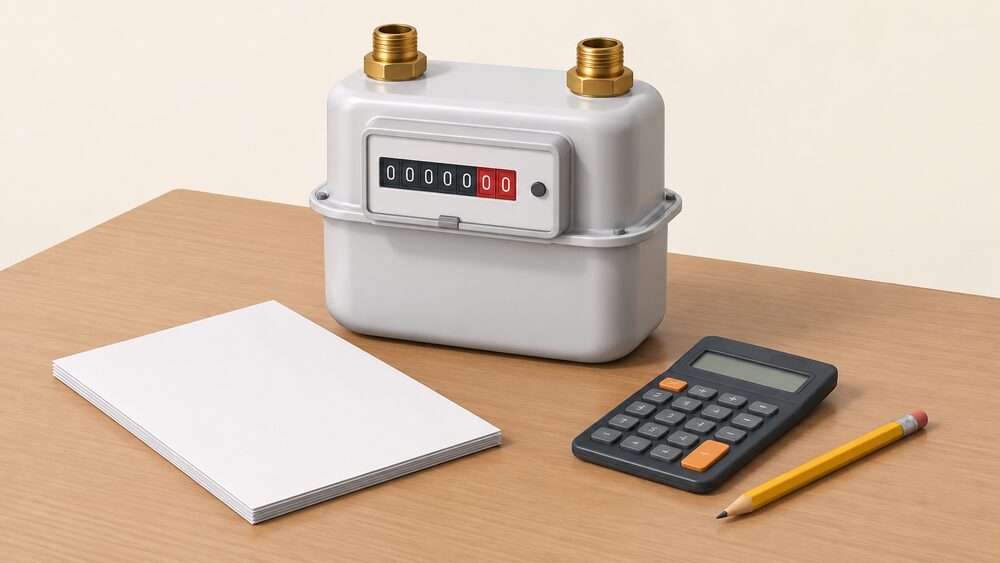
Gas and electricity are both billed in kWh, and both are measured in kWh on the electricity side, but the gas meter itself does not read in kWh7. It reads volume. Gas meters measure in cubic metres or cubic feet and your supplier will then convert this to kWh when working out how much to charge8. The same split appears in official metering guidance: heat and electricity meters are read in kilowatt hours or megawatt hours, while gas and oil meters are read in m³ or litres9.
The unit itself is worth pinning down. One unit of electricity or gas refers to the use of 1,000 watts over one hour6. That definition is what makes a single national unit rate possible: once every meter reading has been turned into kWh, a supplier can apply one price per kWh regardless of whether the property has an old imperial meter or a modern metric one.
Good Energy states the position plainly for its own customers: gas is measured differently, but we convert that measurement to kWh for convenience10. The conversion is not a billing quirk or an optional extra. It is the step that turns a volume of gas into a quantity of energy, and it is why the number on the meter and the number on the bill never match.
For a household, the practical consequence is that the meter reading is an input, not the charge. The reading is submitted, the supplier applies the formula, and the bill shows kWh. That is also why a meter reading taken on the wrong date, or an estimated reading, changes the bill: the conversion is applied to whatever volume the supplier believes was used. Guidance on how to take a meter reading and on submitting meter readings covers the timing side of that.
The full formula: volume correction factor, calorific value and 3.6
The industry formula runs in four steps, and consumer guidance sets them out in order: multiply by 1.02264, multiply by the calorific value, then divide by 3.6 to work out your kWh figure5. The same sequence appears in a worked example from an energy supplier: multiply the m³ measurement by 1.02264, followed by the calorific value, then divide this figure by 3.6 to show your usage11.
Each step does a distinct job.
- Volume correction (1.02264). Gas expands and contracts with temperature and pressure, so the metered volume is adjusted to standard conditions before anything else is done with it1.
- Calorific value. The energy released by burning a cubic metre of the gas actually delivered. It is not a constant, and the figure that applies is the one shown on the bill4.
- Division by 3.6. The calorific value is in megajoules per cubic metre, and one kilowatt hour is 3.6 megajoules, so the division converts megajoules into kWh5.
- Multiplication by the unit rate. The kWh figure is then charged at the pence per kWh rate on the tariff4.
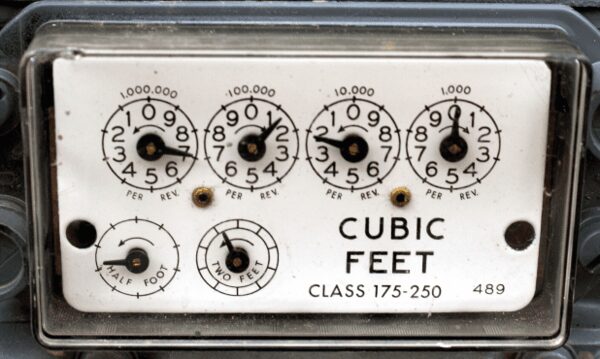
For an imperial meter there is a preliminary step. The reading is in hundreds of cubic feet, so the difference is multiplied by 2.83 first to convert to cubic metres, after which the standard formula applies1. That is where the combined imperial multiplier of 31.6586 comes from: it is the 2.83 conversion, the 1.02264 correction, a 40.0 MJ/m³ calorific value and the 3.6 divisor rolled into one number1.
"Multiply by 1.02264."
The combined multipliers are a convenience, not a replacement for the formula. They are built on a fixed calorific value, so a household whose bill shows a different calorific value will get a slightly different answer from the long form. The long form is the one the supplier uses.
Calorific value: typically around 39.5 MJ/m³
The calorific value is the only figure in the formula that genuinely moves. Guidance for householders describes it as typically around 39.5 MJ/m³, with the instruction to multiply by the calorific value shown on your bill6. A worked example from an energy supplier uses 40.0 MJ/m³ as the average value in its calculation1. The two are close, and the difference between them is small in cash terms, but the bill figure is the authoritative one for a given property because it reflects the gas actually delivered.
The variation is real rather than theoretical. Gas composition differs between networks and over time, and the calorific value is measured and published so that suppliers can bill accurately. That is why the formula is written with the calorific value as a variable rather than a constant, and why a household comparing its own arithmetic against a bill should use the number printed on that bill rather than a remembered average.
The correction factor is fixed by contrast. The volume correction factor of 1.02264 appears identically in consumer guidance5, in supplier guidance1 and in a worked example from a heat pump manufacturer11. It adjusts for the difference between the temperature and pressure at the meter and the standard conditions the calorific value is defined at. Because it is a physical correction rather than a property of the gas, it does not vary between regions or suppliers.
For a household, the calorific value is the reason two identical meter readings can produce slightly different kWh figures on two different bills. It is also the reason the combined multipliers of 31.6586 and 11.1868 are approximations: they assume a calorific value of 40.0 MJ/m³, and any deviation from that shifts the result1.
Cubic metres to kWh: the 10.3 conversion factor
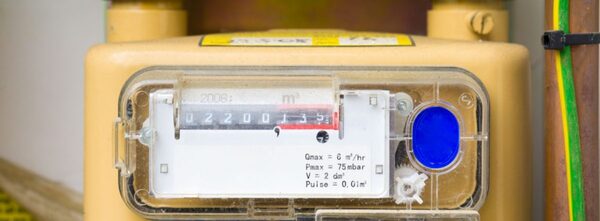
For a metric meter, the arithmetic is shorter. If you have a Metric Meter (m³), multiply your units by 11.1868 to work out the kWh1. That single multiplier replaces the whole four-step formula for a household that wants a quick estimate rather than a bill-accurate figure.
The number is worth unpacking because it explains why it is only an estimate. It combines the 1.02264 volume correction factor, a calorific value of 40.0 MJ/m³ and the division by 3.61. Change any one of those and the combined figure moves. A household whose bill shows a calorific value below 40.0 will find the combined multiplier slightly overstates its kWh, and one above 40.0 will find it understates.
The same logic produces the imperial multiplier. An imperial meter reads in hundreds of cubic feet, so the reading is first multiplied by 2.83 to reach cubic metres, and the combined factor of 31.6586 then takes it to kWh1. The ratio between the two combined multipliers reflects the size difference between a cubic metre and a hundred cubic feet.
| Meter type | Reading unit | Combined multiplier | What it folds in |
|---|---|---|---|
| Metric | m³ | 11.1868 | 1.02264 correction, 40.0 MJ/m³, 3.6 divisor1 |
| Imperial | ft³ (hcf) | 31.6586 | 2.83 to m³, then as above1 |
A household that wants the exact figure rather than an estimate should apply the four steps in order using the calorific value on its own bill5. The combined multipliers are useful for a sanity check on a bill, or for estimating what a period of usage will cost before the bill arrives. They are not what the supplier uses.
What it means for your bill: unit rates around 7p per kWh
Once the meter units have become kWh, the charge is straightforward: multiply the kWh figure by your pence per kWh rate, which for many people will be around 7p per kWh4. That is the point at which the conversion stops being arithmetic and starts being money.
The unit rate itself has moved sharply. Gas costs per kWh rose from 5.74p to 7.33p at the start of July 2026 under the price cap12, and the cap level for July to September 2026 was 7.33p per kWh for gas13. The same 7.33p figure is quoted for England, Scotland and Wales on a standard variable tariff paid by Direct Debit including VAT14. Regional variation sits underneath that average: gas unit costs ranged from 7.19p per kWh in the East Midlands to 7.53p per kWh in the Southern region over the same period15.
Prepayment customers pay more. The average gas prepayment unit rate was 7.7p per kWh for Great Britain from 1 October to 31 December 202616, against 7.07p per kWh for July to September 202617. The cap for Great Britain moved from 7.33p to 7.97p between the July to September and October to December 2026 periods18.
| Period | Gas unit rate | Basis |
|---|---|---|
| July to September 2026 | 7.33p per kWh | Price cap, England, Scotland and Wales, Direct Debit, inc VAT14 |
| July to September 2026 | 7.19p to 7.53p per kWh | Regional range, East Midlands to Southern15 |
| July to September 2026 | 7.07p per kWh | Prepayment17 |
| October to December 2026 | 7.97p per kWh | Price cap, Great Britain18 |
| October to December 2026 | 7.7p per kWh | Average prepayment rate, Great Britain16 |
The direction of travel is upward. Gas unit rates were reported as set to rise from 6.29p per kWh last winter to 8p from 1 October 2026, up around 27% year on year and the highest level since early 202319. A separate figure puts last winter's unit cost at 6.29p per kilowatt hour20. 97p given as the cap level18 and 8p reported as the expected rate19; both are stated here as published.
What this means for a household is that the conversion is not a neutral step. Every cubic metre of gas is turned into kWh at a fixed formula, and every kWh is then charged at a rate that has risen substantially. A medium gas consumption figure used for bill values is 11,500 kWh21, while the price cap assumes 9,500 kWh for gas22. The gap between those two assumptions is itself a reminder that the kWh figure, not the meter reading, is what determines the bill.
Where the conversion leaves a household

The formula is fixed, published and applied by every supplier, which makes it one of the few parts of a gas bill a household can check independently. The meter reading is the household's own input, the calorific value is printed on the bill, and the arithmetic is four steps5. Nothing in the chain depends on a supplier's discretion.
What remains outside a household's control is everything after the conversion. The unit rate is set by the tariff and, for most households, by the price cap23. The calorific value is a property of the gas delivered to the network, not something a household can influence. The volume correction factor is a physical constant. A household can verify the kWh figure on a bill, and can time a meter reading to make sure the volume it is based on is accurate, but it cannot change the multiplier.
That is the honest limit. Converting gas units to kWh gives a household an independent check on its bill and a way to estimate costs between readings. It does not reduce the gas used, and it does not reduce the dependence on the network that supplies it. The practical value is accuracy: a household that understands the formula can spot an estimated reading, query a figure that looks wrong, and see exactly how a change in the unit rate translates into money. Guidance on reading a gas meter and on converting gas meter units to kWh covers the reading and calculation steps in more detail.
Sources23 cited
- How to convert gas units to kWh, The Energy Shop
- Understanding your gas or electricity bill, Centre for Sustainable Energy
- How to read your gas and electricity meter, Confused.com
- How to estimate your energy use, Which?
- Gas meters and electricity meters: what you need to know, Which?
- What is a kWh and how much do they cost, The Energy Shop
- Consumers, RECC
- Reading your gas or electricity meter, Centre for Sustainable Energy
- How to read your bill, Good Energy
- Top energy savings tips, National Energy Action
- Summary of changes to energy price cap 1 October to 31 December 2025, Ofgem
- Tariff watch, End Fuel Poverty Coalition
- Average gas and electricity bills in the UK, Uswitch
- Current gas and electricity prices, Centre for Sustainable Energy
- What is the energy price cap, Energy Saving Trust
- Regional UK energy prices, Confused.com
- Prepayment meters, Uswitch
- Two weeks to price hikes: checklist to beat soaring energy costs, Uswitch
- How much does a heat pump cost, NIBE
- End Fuel Poverty Coalition feed, End Fuel Poverty Coalition
- Energy price cap levels 1 July to 30 September 2025, Ofgem
- Energy price cap explained, Welsh Government
- Energy price cap, Ofgem
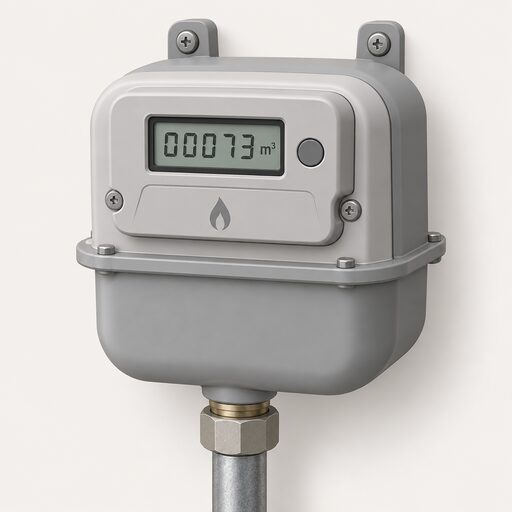 Convert Gas Units to kWhWorking out gas from your meter reading means turning cubic metres into kilowatt hours, the units your bill uses.
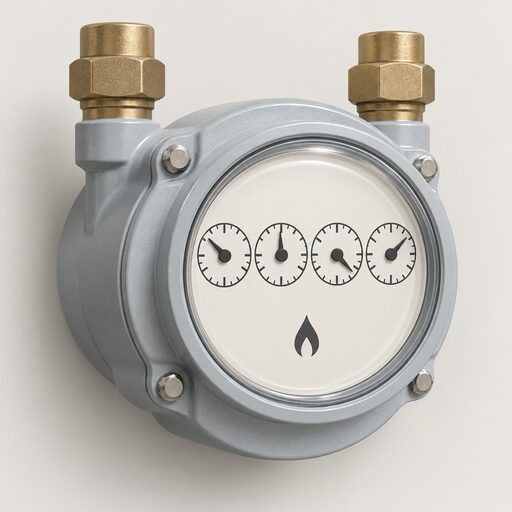 Read a Gas MeterHow to read dial, digital metric and older imperial gas meters, including which dials to ignore and what to record when a pointer sits between two numbers.
 Prepayment MetersHow do you top up a prepayment meter for gas or electricity, and what happens when the credit runs out?
 Unit Rates by RegionWhy do electricity and gas prices differ depending on where you live?
 Reading an Energy BillA line-by-line walk through a domestic gas and electricity bill: unit rate, standing charge, kWh consumption, meter readings, tariff name and balance, plus the 12-month back billing limit and the guaranteed standards payments that apply when a supplier or network operator gets it wrong.
 Baseline Your Energy UseBefore spending money on a heat pump, solar panels or a battery, you need to know what your home actually uses now.