
In this guide
Sangamo is a Scottish name in UK heating controls, now sold under ESP, and its range splits into two halves: wired thermostats and time controls that have been on British walls for decades, and a newer Choice Wi-Fi Thermostat that adds app control. The Choice PR3n is a three channel programmer with three completely independent time controlled channels, a 12 hour am/pm clock with one minute resolution and automatic BST and GMT change1. The Choice PR2n is the two channel version, built for separate control of heating and stored hot water2.
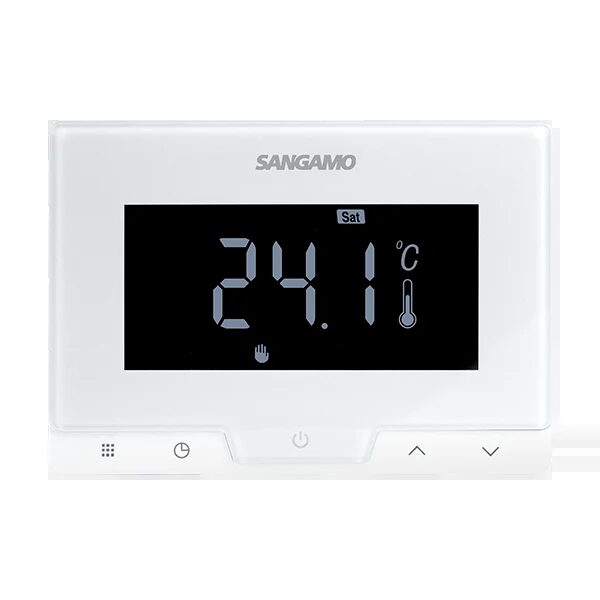
The thermostat side is simpler. The Choice RSTAT1 is a basic mechanical room thermostat with a temperature setting range of 10°C to 30°C and a dual diaphragm temperature sensing element3. The Choice CSTAT covers a much wider band, 0°C to 90°C, which points to a different job: pipe or cylinder sensing rather than room comfort4. The Choice RSTAT5 RF is the wireless programmable room thermostat, with a transmitter temperature control range of 0 to 50°C in 0.5 degree steps and a display range of 5 to 35°C in 0.1 degree steps5.
The Choice Wi-Fi Thermostat is the app-connected model, published on the Sangamo site on 8 November 2019, with a free app and no subscription fees, room temperature and thermostat activity monitoring, and frost protection6. It requires a 2.4GHz Wi-Fi connection7. Availability is the catch: the maker's own listings for the Wi-Fi Thermostat and for the PSPSF247 timer both show the products as unavailable, with zero inventory8.
The Sangamo range: thermostats and time controls under ESP
The range divides by function rather than by technology. At the simple end sits the Choice RSTAT1, described by Sangamo as a basic mechanical room thermostat that is economical and simple to use3. It has no clock and no schedule: it opens and closes on temperature alone, with a setting range of 10°C to 30°C3. The Choice CSTAT reaches 0°C to 90°C, a span that suits cylinder or pipework sensing rather than a living room4.
The wireless programmable model is the Choice RSTAT5 RF, which pairs a transmitter with a receiver and carries a temperature control range of 0 to 50°C in 0.5 degree increments, with a display range of 5 to 35°C in 0.1 degree increments5. That combination of time and temperature in one unit is what the Energy Saving Trust calls a programmable room thermostat, which combines time and temperature controls in a single unit and can set different temperatures for different times of the day9.
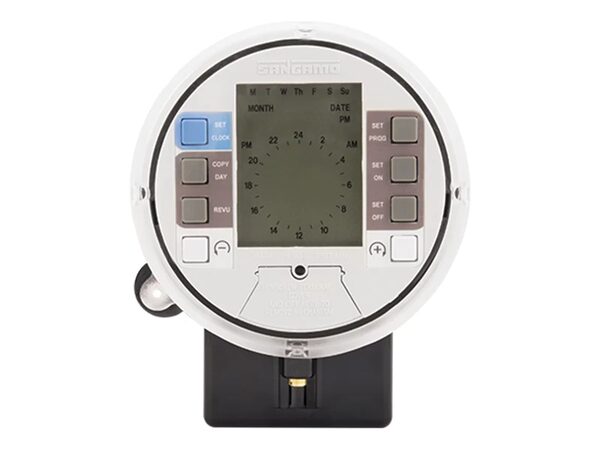
The time control side runs from the E855 general purpose timeswitch, intended for heating and ventilation equipment control applications, with a two hour boost override and an Advance function that holds the programme off until the next on period10, through to the Choice PR2n and PR3n programmers1. The PSPSF247 is a Powersaver Plus Select 24 hour timer with fuse, listed by the maker as unavailable8.
Who makes Sangamo: ESP and the brand's place in UK heating controls
Sangamo is a Scottish controls brand now owned and sold by ESP, part of the Scolmore Group. The brand's product pages carry publication dates that show a steady refresh rather than a burst of new development: the Choice PR1n, PR2n and PR3n pages were all published on 14 October 2022, the CHPWIFI listing on 25 October 2023, and the earlier Powersaver and Choice Plus pages in 2020 and 20211. ESP appointed a new National Sales Manager for Sangamo in May 2023, which indicates the brand is still being actively sold into the trade rather than wound down.
That trade route matters for a householder. Sangamo controls are sold through electrical wholesalers and heating merchants rather than direct to consumers, and the brand sits alongside other controls makers in the BEAMA Heating Controls group, whose members commission independent test work on control performance11. The wider UK controls market includes specialist British manufacturers and a heat pump industry body whose membership covers manufacturers, components, energy companies, certification bodies, installers and training providers12.
The practical consequence is that Sangamo is a controls brand, not a heating brand. It does not make boilers, and its controls are fitted to whatever boiler is already in the house. That keeps the choice of control separate from the choice of heat source, which is useful for a household that wants to change one without the other.
The Choice Wi-Fi Thermostat: app control, monitoring and frost protection
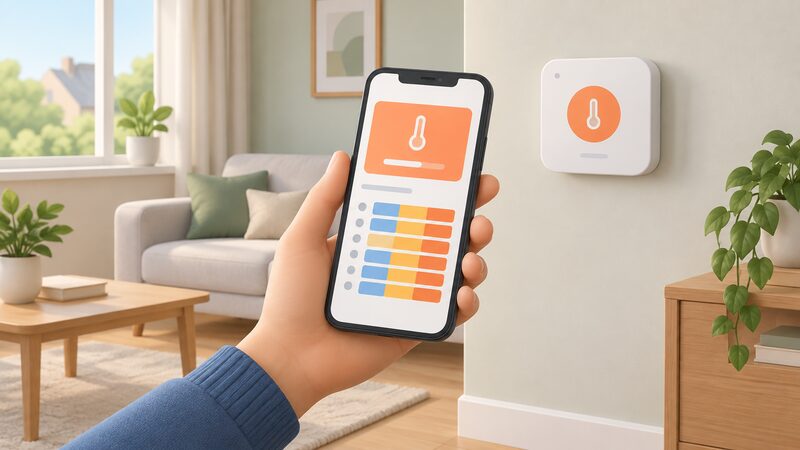
The Choice Wi-Fi Thermostat is Sangamo's connected model. Sangamo describes it as a Wi-Fi controlled thermostat with a free SANGAMO CHOICE app and no subscription fees, and lists monitoring of room temperature and thermostat activity among its functions, alongside frost protection6. The app carries no recurring charge, which separates it from subscription-based control platforms.
The connection requirement is specific: a 2.4GHz Wi-Fi connection is required7. That is the older of the two common domestic Wi-Fi bands, and it is the band most heating controls use because it travels further through walls than 5GHz. A smart thermostat connects to Wi-Fi, which allows it to form part of a more connected home heating system13.
Frost protection is a background function rather than a comfort setting. It runs the heating at a low temperature to keep pipework from freezing when a home is empty or the weather turns cold. It is listed on the Sangamo product page among the thermostat's features6, and it is a common feature of wireless thermostats generally, with built-in frost protection appearing on comparable models14.
Programmers and time switches: Choice PR1n to PR3n, Powersaver and timer models
The Choice programmer family is the core of the Sangamo range, and the differences between the models are channel count and switching capacity rather than features. The PR2n is a two channel programmer designed for separate control of heating and stored hot water2. The PR3n is a three channel programmer offering three completely independent time controlled channels1. The PR1n is the single channel member of the family.
Both the PR2n and PR3n share the same clock and the same override behaviour. The clock is 12 hour am/pm with one minute resolution and an accuracy of +/- 1.5 sec/day, and the BST and GMT change is automatic1. Programme override offers 1, 2 or 3 hour boost plus Advance1. Programme selection runs Auto, On all day, On constant, off, and the daily programme can be set as 2 on/off or 3 on/off periods1. The PR3n adds a selectable programme cycle of 24hr, 5/2day or 7day1.
| Model | Channels | Contact type | Backplate | Override |
|---|---|---|---|---|
| Choice PR2n | 2, heating and stored hot water2 | 1B, Micro-Disconnection2 | Industry standard2 | 1, 2 or 3 hour boost, Advance2 |
| Choice PR3n | 3, independent1 | 1B, Micro-Disconnection (Voltage Free)1 | Industry standard1 | 1, 2 or 3 hour boost, Advance1 |
The wiring terminals follow the conventional pattern. The PR2n uses N and L for the clock supply, then 1 HW Off, 2 CH Off, 3 HW On and 4 CH On2. The PR3n adds a second heating channel: N and L for the clock, then 1 HW Off, 2 CH1 Off, 3 HW On, 4 CH1 On, 5 CH2 Off and 6 CH2 On1. The industry standard backplate means a replacement programmer can often be fitted to existing wiring, which is covered in more detail in heating control wiring.
The E855 general purpose timeswitch sits outside the Choice family. Sangamo describes it as a general purpose timeswitch for heating, ventilation equipment control applications and similar, with a two hour boost on a manual button and an Advance function that holds the programme off until the next on period10. The PSPSF247 Powersaver Plus Select is a 24 hour timer with fuse, listed by the maker as unavailable8.
Choosing between a smart thermostat, programmer and time switch
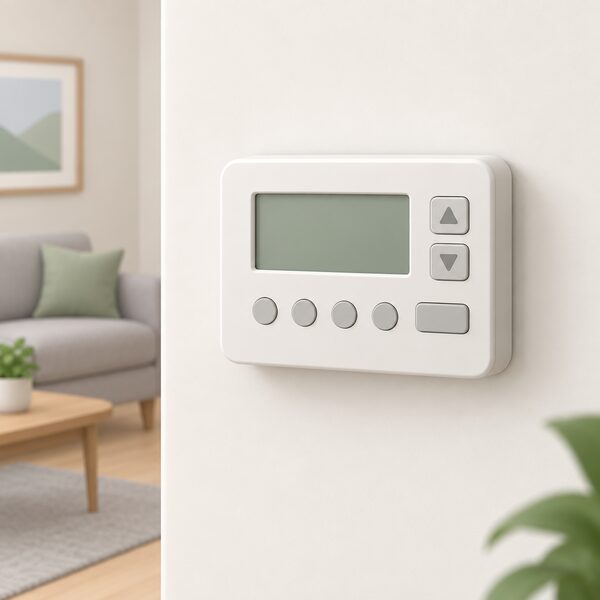
The three control types do different jobs, and the choice follows from the boiler and the household's routine rather than from the technology. A programmable room thermostat combines time and temperature controls in a single unit and can set different temperatures for different times of the day9. A programmer switches the heating and hot water circuits on and off on a schedule but leaves temperature to a separate thermostat. A time switch does the same for a single circuit, often a pump or a ventilation unit.
Smart thermostats add remote control and multiple routines. Most smart thermostats allow multiple routines to be programmed so that a home is at the desired temperature at the right times, and they can be programmed or remotely controlled to manage the home's temperature15. Independent guidance notes that smart thermostats typically work with most boilers but that compatibility should be checked with the manufacturer before buying13.
For a combi boiler, the hot water channel of a two or three channel programmer has nothing to control, because a combi heats water on demand rather than storing it in a cylinder. A single channel programmer or a programmable room thermostat is the natural fit. Building guidance for electric warm air systems in Wales specifies a programmable room thermostat or a time switch and room thermostat as the control requirement16, which is the same principle: time and temperature control together.
"A programmable room thermostat combines time and temperature controls in a single unit and can set different temperatures for different times of the day"
The independent evidence on savings is narrower than the marketing. A Salford University test programme for BEAMA varied set-point temperatures and times of operation against the standard time and temperature profile defined in the SAP methodology, which is a measure of how much a schedule change moves consumption rather than a promise about any one product11. A comparison of control types is at smart thermostat vs traditional programmer.
What owning a Sangamo control means for energy independence
A Sangamo control is a local device. The wired thermostats, programmers and time switches have no network connection, no app and no manufacturer account: the schedule lives in the unit on the wall, and it keeps running if the broadband goes down. That is the strongest form of control independence available in a heating system, and it is the reason wired programmers remain common in homes that want nothing to do with cloud services.
The Choice Wi-Fi Thermostat changes that balance. It requires a 2.4GHz Wi-Fi connection7, and its app functions, including monitoring of room temperature and thermostat activity, depend on the home network and on Sangamo's app continuing to be supported6. The app carries no subscription fee6, which removes one recurring cost, but it does not remove the dependence on a manufacturer's software staying available. The wider question of what happens when a maker withdraws an app is covered in smart heating control security and data.
What a control does not change is the fuel. A Sangamo thermostat or programmer switches a gas, oil or electric system on and off; it does not alter what the system burns or where that fuel comes from. A smart thermostat helps control how much energy is used but is not a barrier to switching energy deal17, so the control and the tariff decision stay separate. For a household weighing independence, the position is that a wired Sangamo control keeps scheduling entirely local, while the Wi-Fi model trades some of that locality for remote access and monitoring. The broader picture is at heating controls and energy independence.
Availability and support in the UK
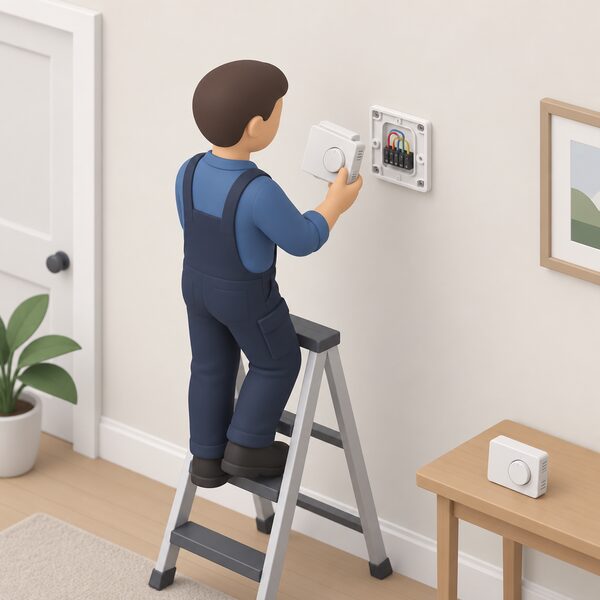
Availability is the practical issue with the current range. The maker's own listings show the Choice Wi-Fi Thermostat and the CHPWIFI variant as unavailable with zero inventory6, and the PSPSF247 Powersaver Plus Select 24 hour timer with fuse carries the same status8. The Choice PR2n and PR3n programmer pages and the Choice thermostat pages remain published, but a published page is not the same as stock on a wholesaler's shelf.
Support runs through the trade rather than direct to the householder. Sangamo's product pages do not publish a consumer fault line or email address, so the route for a fault is the installer who fitted the control or the supplier it came from. For heat pump systems, the guidance is to check the fault log for recurring fault messages and speak to the installer and manufacturer18. For a suspected gas leak, the National Gas Emergency Service should be called immediately on 0800 111 99919.
Registration is not part of the Sangamo process. The brand publishes barcodes for its Choice thermostats, 5026961006825 for the RSTAT1 and 5026961006856 for the CSTAT3, but no registration portal or extended guarantee scheme. Registration and extended guarantees belong to boiler makers' own controls and warranties, not to Sangamo. Where a control is being replaced rather than installed new, the wiring and siting questions are covered in installing and replacing heating controls and room thermostats explained.
Sources19 cited
- Choice PR3n three channel programmer, Sangamo, 2022-10-14
- Choice PR2n two channel programmer, Sangamo, 2022-10-14
- Choice RSTAT1 mechanical room thermostat, Sangamo, 2017-04-05
- Choice CSTAT thermostat, Sangamo, 2017-04-05
- Choice RSTAT5 RF wireless programmable thermostat, Sangamo, 2017-04-05
- Choice Wi-Fi Thermostat, Sangamo, 2019-11-08
- CHPWIFI Wi-Fi controlled thermostat, Sangamo, 2023-10-25
- PSPSF247 Powersaver Plus Select 24 hour timer, Sangamo, 2021-02-24
- Thermostats and heating controls, Energy Saving Trust, 2026-02-10
- E855 general purpose timeswitch, Sangamo, 2017-04-05
- Salford University tests on energy savings from programmable room thermostats, BEAMA, 2014
- HPA UK response to Climate Change Committee adaptation report, Heat Pump Association, 2026-05-20
- How does a smart thermostat connect to a boiler, Hive, 2025-12-17
- Wireless thermostats: all you need to know, Ideal Heating, 2026
- How a smart thermostat can save you money this winter, ivie, 2025-11-18
- Approved Document L Volume 1 consultation version, Welsh Government, 2025-08
- What are smart thermostats?, Uswitch, 2026-02-05
- How to ensure a heat pump runs efficiently, Energy Saving Trust, 2026-05-19
- Find out if your energy meter is faulty, Citizens Advice, 2026-09-20