
In this guide
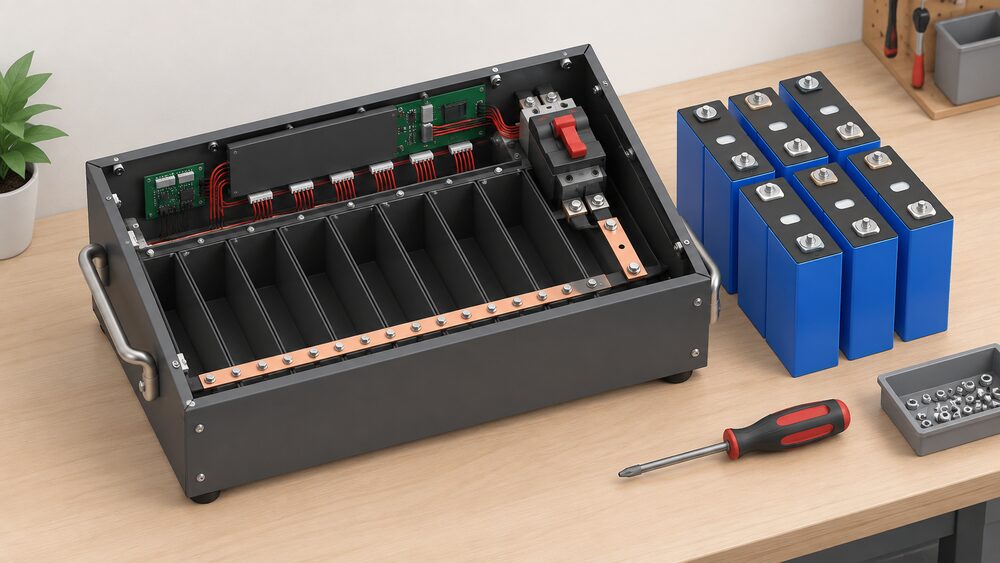
Seplos is the name that comes up most often when a UK household decides to build its own battery bank rather than buy a finished one. The Seplos V4 48V DIY Kit is an enclosure and battery management system supplied as a kit, rated to build a pack of up to 16kWh, with cells bought separately1. It is listed at £599.99, and it was showing as sold out on 19 September 20261.
That combination, a low headline price, a high headline capacity and no cells in the box, is what defines the product. The kit gives the household the case, the breaker, the balancing electronics and the busbars. It does not give the energy storage itself, the inverter, the wiring to the house, or the electrical sign-off. A finished 16kWh battery is the result of a build, not a purchase.
For a household weighing energy independence, the appeal is obvious and the dependence is real. A self-built bank can store surplus solar generation and cut the share of power drawn from a supplier, and official guidance states that adding a battery to a solar installation increases self-consumption from 30 to 40% to 70 to 80%2. What it does not do is take the home off the grid, and it adds a dependence on the household's own assembly work, on a separate inverter, and on a maker whose UK stock position is not guaranteed.
What the kit offers a UK household
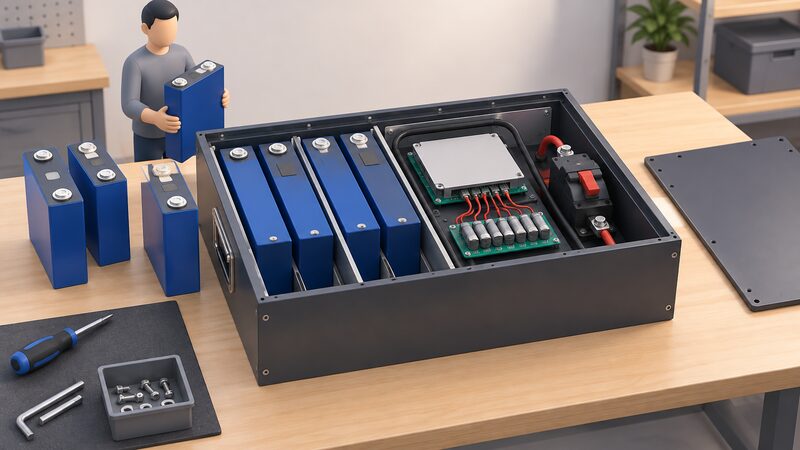
The Seplos V4 48V DIY Kit is a self-assembly product. The maker's own description is that a buyer can "build a battery pack up to 16kWh in size (cells supplied separately)", and the buying process is framed around choosing cells: "Simply select your desired cells (sold separately)"1. Nothing about the kit is plug and play in the way a finished home battery is.
The chemistry is LiFePO4, described by the maker as offering "the proven performance and safety of LiFePO4 cells"1. That is the same lithium iron phosphate family used across most UK home batteries, and it is the chemistry the wider market has settled on for stationary storage. The kit is built around cells from named suppliers: "Choose from popular cell suppliers like EVE and Envision"1.
Two variants exist, and the choice is dictated by the cells rather than by the house. "Type A is designed for EVE terminals, while Type B is for screw terminals"1. A buyer who orders the wrong variant has an enclosure that will not accept the cells on the bench.
Protection inside the kit is a 250A DC breaker, which the maker says "provides reliable protection and safeguards your battery system from excessive currents and short circu"1. The kit also now ships with an upgraded balancing board: "Our Seplos V4 Kits now come with an upgraded JK Active Balancer"1. Active balancing matters more in a self-built pack than in a factory one, because cell-to-cell variation in a hand-assembled bank is what shortens its life.
Availability is the weak point. The product page carried the status "Sold out" as of 19 September 20261. No restock date or lead time is published, so a household planning a build around this kit has no stated date on which the enclosure will be obtainable. Cells ordered in advance may sit unused while the kit is unavailable.
Specifications of the V4 48V kit
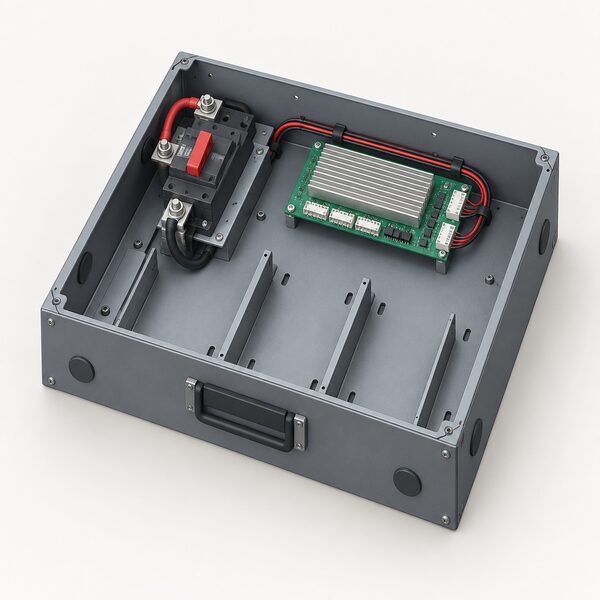
The published specification is short, and it is worth reading as a list of what the kit is rather than what the finished battery will be. Capacity is a ceiling, not a rating: up to 16kWh, and only if cells of that total capacity are fitted1.
| Attribute | Published figure |
|---|---|
| Maximum pack size | up to 16kWh1 |
| Cells | sold separately1 |
| Chemistry | LiFePO41 |
| Named cell suppliers | EVE and Envision1 |
| Protection | 250A DC breaker1 |
| Balancing | JK active balancer (upgraded)1 |
| Variants | Type A for EVE terminals, Type B for screw terminals1 |
| Price | £599.991 |
| UK stock | sold out as of 19 September 20261 |
The 48V nominal figure places the kit in the low-voltage class used by most domestic hybrid inverters, rather than the high-voltage stacks used by some all-in-one systems.
Capacity itself is not a simple number. A pack described as 16kWh is nominal, and the energy actually available sits below that once depth of discharge is accounted for, a distinction set out in battery capacity and usable capacity. For a self-build, the gap between the two is set by the BMS configuration as much as by the cells.
Warranty: what is published and what is not
No warranty term for the Seplos V4 48V DIY Kit appears in the material available here. That is the honest position, and it is a material gap for a product at this price. A household comparing a £599.99 kit against a finished battery is comparing a kit with no stated warranty against products that publish terms.
Terms do exist elsewhere in the adjacent market, and they show what a published commitment looks like. UKSOL plug-in solar kits come with a "10-year UKSOL warranty, plus UK-based customer service and technical support"3, and UKSOL solar modules are "supported with a 30-year British warranty"4. Those are different products from different makers, and they do not transfer to Seplos. They illustrate the point that a warranty is a written term a buyer can hold a seller to, and that where none is published, none can be relied on.
There is a second warranty-adjacent issue specific to this product family. Kits made before December 2023 use the V2 BMS and kits made after use the V3 BMS, and the two are not compatible. That matters for anyone buying second-hand, adding a second enclosure to an existing bank, or seeking a replacement board. A buyer matching a new unit to an older installation needs to establish which version is already in place before ordering, because a V3 board will not simply drop into a V2 build.
What the kit costs, and what the build costs on top
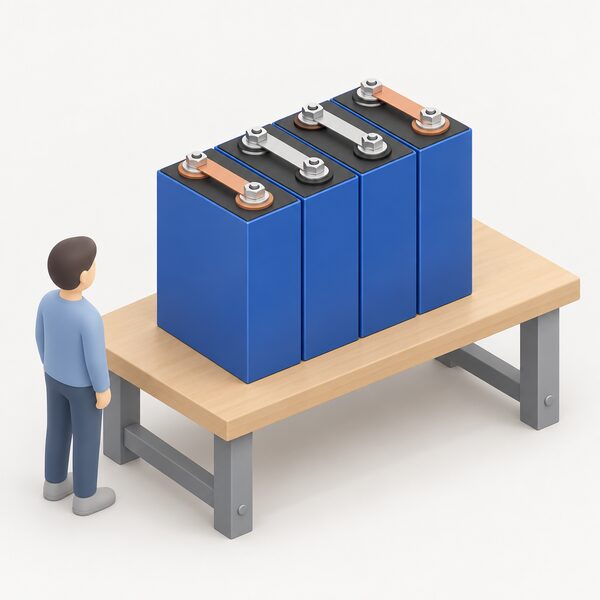
The kit is listed at £599.991. That figure covers the enclosure, the breaker and the balancing electronics. It does not cover cells, an inverter, cabling, protection, labour or certification, and the maker's own page states that cells are sold separately1. The true cost of a working 16kWh battery is therefore the kit price plus the cells plus everything needed to connect it to the house.
For scale, independent guidance puts complete solar battery storage at £2,000 to £12,500, "depending on several factors" including capacity, chemistry and lifespan5. That range describes finished systems rather than kits, and it is wide because capacity and specification vary so much. A self-build sits at the lower end of the market before the household's own labour is counted, and the saving comes precisely from the work being done at home.
Two further cost points bear on the decision. First, the kit is out of stock, so the price is a list price rather than a price at which a unit can currently be bought1. Second, the wider UK market for self-generated power is moving: plug-in solar panels "are available to buy in the UK"6, and plug-in solar batteries are "already being developed for the UK market"7. A household weighing a self-build against a smaller plug-in route has more options than it did, and the trade-offs between them are set out in plug-in and balcony battery storage.
The company position and the UK supply chain
Seplos is not a UK company, and the material available here does not give its registration, ownership or financial status. What can be said is narrower and more useful: the kit is sold into the UK through a distributor, and the product page is a distributor page rather than a manufacturer's own UK site1. That means the commercial relationship a buyer has is with the seller, not with the maker, and the warranty question above sits with that seller.
The wider pattern in this market is worth stating plainly, because it is the context a household is buying into. A long list of energy supply and services companies appear as active in the Energy Ombudsman's dispute scheme, including SWS Utilities Ltd8, Business Utility Services Ltd9, SAA Energy Solutions Ltd10, Utility Outlet Ltd11, Power Savings Network Limited12, Powercuts UK Limited13, Hypertech Partnership Ltd14, Enetic Utilities Ltd15, Metric Energy Limited16, Flexivolt17, Corporate Utility Solutions Limited18, Base Utility Ltd19, Smart Energy & Powwer Limited20, Arcadia Energy Data Solutions UK Limited21, Carbon Sense Ltd22, Abel Utilities Ltd23, Officefones Ltd24, Beam Utilities Ltd25 and Energy Swap26. EPC Improvements Ltd appears as a RECC member27. None of these is Seplos, and none should be read as a statement about it. The point is that company status in this sector is checkable, and a buyer can check it.
There is also a cautionary precedent for government intervention in the installation market. In Wales, the UK Government took "immediate action to suspend installers and protect consumers" under the GBIS scheme28. That concerned installers rather than equipment makers, but it shows that scheme status can change and that a household should verify who it is dealing with.
What a self-built bank does for energy independence
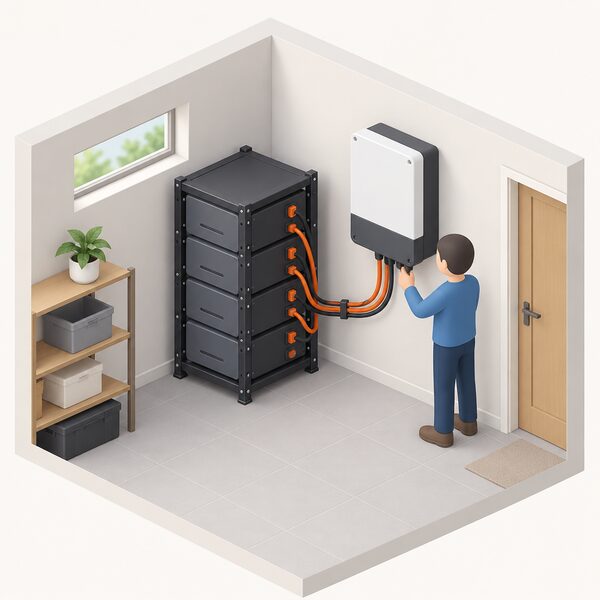
A DIY battery kit changes where the energy in a home comes from and when it is used, and it changes who owns the hardware. It does not remove the grid connection, and it does not remove the household's dependence on a supplier for whatever the battery cannot cover.
The gain is measurable. Official guidance states that adding a battery to a solar installation increases self-consumption from 30 to 40% to 70 to 80%2. That is the core benefit: generation that would have been exported is used on site instead. A self-built bank can capture that gain at a lower hardware cost than a finished system, which is the whole reason the kit route exists.
The dependencies that remain are worth naming. The home stays connected to the grid and to a supplier. The battery depends on an inverter, on the BMS inside the kit, and on the household's own assembly and maintenance. It depends on cells from a third party, and on a kit that is currently out of stock1. It depends on the electrical installation being done to the standards that apply to any domestic battery, and on the household understanding the difference between nominal and usable capacity.
There is a regulatory dimension too. The term "stand-alone Battery Energy Storage System (BESS)" is defined in legislation as "a grid scale energy storage system, consisting wholly or partly of lithium-ion batteries to store energy"29. That definition is aimed at grid-scale installations rather than a home pack, and it is not a rule a domestic self-build must satisfy. It does show that battery storage is a regulated subject, and that the rules are written for the scale of the installation. Solar deployment statistics are recorded for the "United Kingdom" as a whole30, so the framework a household operates in is national, with planning differences between England, Scotland, Wales and Northern Ireland covered in the site's planning pages.
For a household, the practical position is this. A Seplos kit is a route to a larger battery bank at a lower hardware cost, with the assembly work and the warranty risk carried by the buyer. It is not a route off the grid, and it is not a finished product. The wider choices are set out in DIY home battery builds and in the home battery storage guide.
Sources30 cited
- Seplos V4 48V DIY Solar Battery, Fogstar, 2026-09-19
- Energy storage research briefing, UK Parliament, 2026-06-25
- Plug-in solar panels, Which?, 2026-09-15
- Smith Bros becomes UKSOLS distributor for the United Kingdom, Flexi-Orb, 2021-07-13
- Battery storage and solar panels, The CPA, 2026-01-06
- Responding to the roll-out of plug-in solar panels, Electrical Safety First, 2026-09-17
- Plug-in solar explained, Low Carbon Hub, 2026-07-09
- SWS Utilities dispute, Energy Ombudsman, 2026-09-19
- Business Utility Services Ltd dispute, Energy Ombudsman, 2026-09-19
- SAA Energy Solutions Ltd dispute, Energy Ombudsman, 2026-09-19
- Utility Outlet dispute, Energy Ombudsman, 2026-09-19
- Power Savings Network Limited dispute, Energy Ombudsman, 2026-09-19
- Powercuts UK Limited dispute, Energy Ombudsman, 2026-09-19
- Hypertech Partnership Ltd dispute, Energy Ombudsman, 2026-09-19
- Enetic dispute, Energy Ombudsman, 2026-09-19
- Metric Energy Limited dispute, Energy Ombudsman, 2026-09-19
- Flexivolt dispute, Energy Ombudsman, 2026-09-19
- Corporate Utility Solutions Limited dispute, Energy Ombudsman, 2026-09-19
- Base Utility dispute, Energy Ombudsman, 2026-09-19
- Smart Energy & Powwer Limited dispute, Energy Ombudsman, 2026-09-19
- Arcadia Energy Data Solutions UK Limited dispute, Energy Ombudsman, 2026-09-19
- Carbon Sense Ltd dispute, Energy Ombudsman, 2026-09-19
- Abel Utilities Ltd dispute, Energy Ombudsman, 2026-09-19
- Officefones Ltd dispute, Energy Ombudsman, 2026-09-19
- Beam Utilities Ltd dispute, Energy Ombudsman, 2026-09-19
- Energy Swap dispute, Energy Ombudsman, 2026-09-19
- EPC Improvements Ltd, RECC, 2026-09-17
- Written statement: Housing Cabinet Secretary responds to UK Government action on GBIS and ECO4, Welsh Government, 2025-01-23
- [Lithium-ion Battery Safety Bill [HL]](https://bills-api.parliament.uk/api/v1/Publications/56005/Documents/4984/Download), UK Parliament, 2024-07-29
- Solar PV deployment, December 2014, Department for Energy Security and Net Zero, 2015-01-29