In this guide
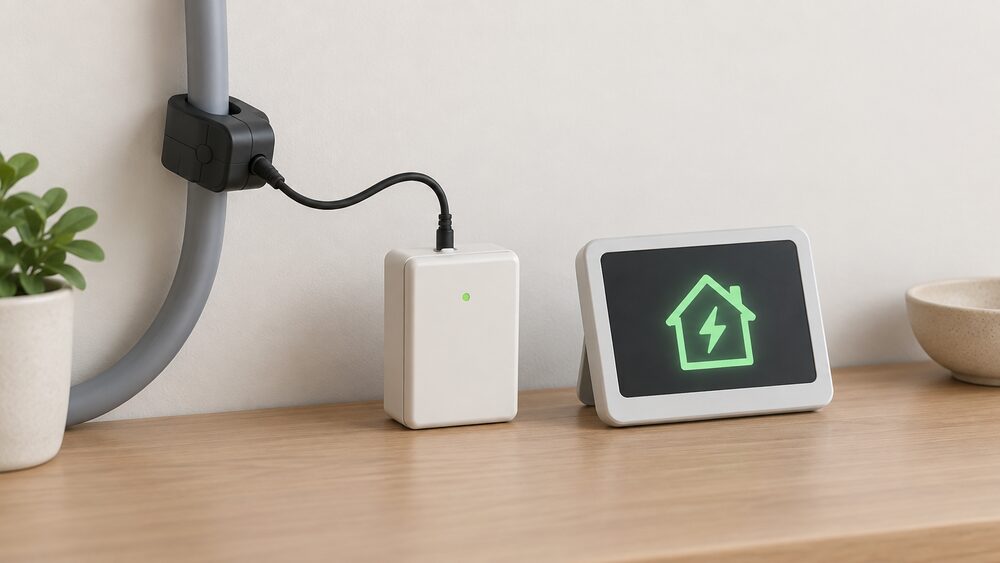
An Eco-eye monitor is a standalone electricity monitor: a sensor that clips around the live cable from the electricity supply, a transmitter that sends the reading by radio, and a display unit that shows a single, easily readable number the householder can choose to see either as electrical units or as money1. It is not a smart meter, it is not installed by a supplier, and it does not send readings anywhere. It is a private instrument for seeing what a home is drawing, in near real time.
The range is small and long-established. Eco-eye sells the Elite, Mini and Smart families, with the Smart adding logging to a memory card for computer analysis1. The Smart PC is described as a demand-only monitor with data logging and a programmable display, recommended by the maker for families, couples and small offices2. The company states that its products are British designed, and that low volume orders are still made in its UK factory while high volume production has moved to its own factory in the PRC3.
The commercial case rests on a claim the maker makes plainly: that Eco Eye Monitors can save 15% off energy bills1. Independent and official figures are lower and more conditional. Northern Ireland's official energy efficiency guidance puts the first-year reduction for people who fit home energy monitors at between five and 15 per cent, which it translates as £25 to £75 off a £500 bill4. The Centre for Sustainable Energy puts a typical saving at £69 a year5. The monitor is a feedback device; the saving comes from what the household does with the information.
What an Eco-eye monitor does: real-time electricity and CO2 readings
Every Eco-eye system consists of three components: a sensor, a transmitter and a display unit6. The sensor clips around the live cable from the electricity supply and plugs into the transmitter, which sends the reading to a display indoors6. The display shows a single, easily readable number that the user can choose to see either as electrical units or as money1. The data is translated into meaningful information and displayed in a variety of modes and time periods, including kilowatts and cost6.
The sensitivity is finer than a monthly bill. Eco-eye states that its monitors can detect a single light bulb being switched on or off, and that they work best when the background load is in excess of 50 watts3. The current is sampled many times a second and the average of those readings is sent to the display every 4 seconds3. That is fast enough to watch a kettle, an oven or a tumble dryer move the number in real time, which is the whole point of the device.
The limits are worth stating as firmly as the benefits. A home energy monitor mainly tracks electricity use, and a plug-in monitor can only measure electricity, not gas7. Eco-eye's own range is electricity monitoring: the display shows electrical units or money, and the money figure is derived from a tariff the user enters. The monitor does not know what tariff is actually being charged, does not read the meter, and does not communicate with a supplier. It is a local instrument, and its accuracy depends on the settings a householder puts into it.
For a household's energy independence, this is a modest but real gain: the home can see its own consumption without asking a supplier, an app or a network for the data. What remains is that the monitor measures the grid supply rather than replacing it, and that the household still buys every unit from a supplier.
How it measures: non-contact current transformer and what that means for accuracy
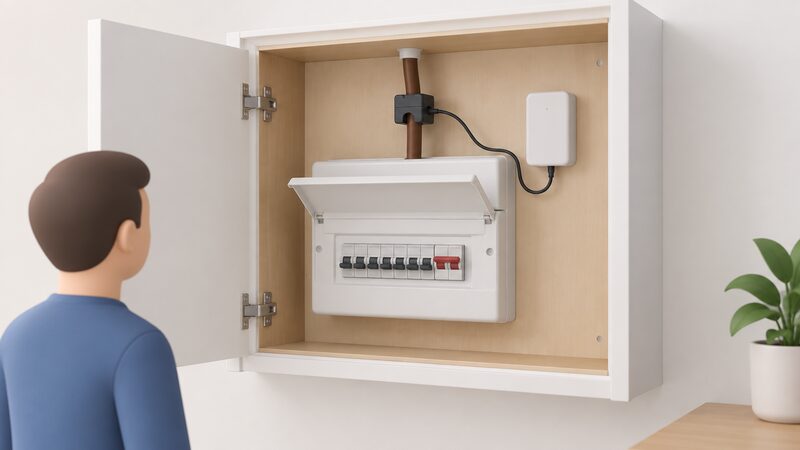
Each Eco-eye monitor uses a non-contact current transformer to measure the current passing through the wire or wires being monitored, and it does not measure voltage3. This is the single most important technical fact about the range, because it explains both the installation and the accuracy.
Because voltage is not measured, the user sets it. All versions of Eco Eye can be set to any voltage from 90 to 255 volts, and the user sets the voltage from 90 to 255 volts, which is then used to calculate the displayed kW and cost figures3. The monitor is therefore multiplying a measured current by an assumed voltage. Where the actual supply voltage sits away from the figure entered, the power and cost readings drift with it. The device is a good indicator of relative load, of what changed and when, rather than a calibrated billing instrument.
The non-contact design is what makes the installation non-invasive. The sensor clips around the live cable rather than being wired into the circuit, so no cutting or re-termination is needed. The transmitter runs on 2 x AA batteries, and Eco-eye transmits on the 433 MHz waveband3. Both the transmitter and display can be used with batteries or optional mains adapters6, and the maker sells an AC/DC power adaptor for mains powering9.
Most Eco-eye electricity monitors are suitable for three phase supplies with the use of additional sensors3, and the maker sells monitors for single phase or 3 phase supplies1. The Elite 100 and Elite 200 come with three sensors as standard and are used primarily in business premises and not in domestic ones3. For a domestic single-phase installation, one sensor on the live tail is the normal arrangement.
The Eco-eye Smart: third generation design and who it suits
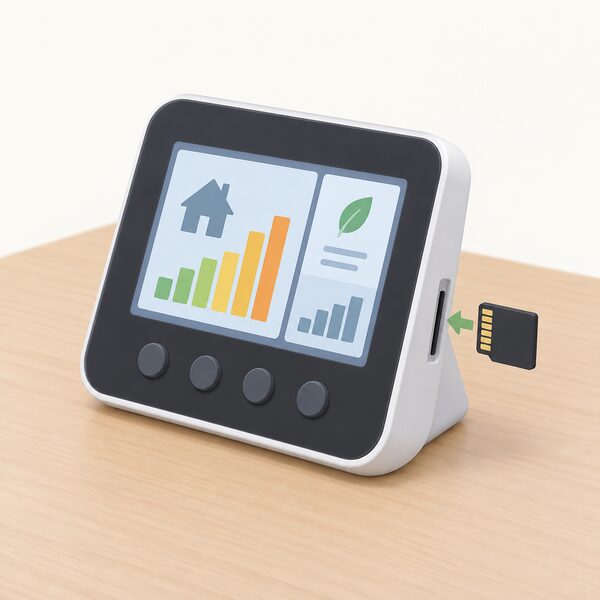
The Smart sits at the top of the domestic range. Eco-eye describes it as adding logging to a memory card for computer analysis, and as offering computer connectivity for more complex data management via the optional Data Storage Card or USB card1. That is the difference between the Smart and the simpler Elite and Mini: the Elite and Mini display one piece of information, while the Smart records it10.
The Smart PC is the variant the maker points at households with more than one person and at small workplaces. Its product page lists it as a demand-only monitor with data logging, and recommends it for families, couples and small offices2. The display readings listed for it include kilowatts on an hour, day, week, month and year basis for instant load, cost in pounds, dollars or euros, amps, time, temperature at the display, a programmable display, a target graph and a memory card2.
The Smart system also supports extra displays. The Eco Eye Smart Solo is an additional display unit only, used in conjunction with a main Eco-eye Smart system, and it ships as one Smart display unit on its own9. The maker's point is flexibility: a household can display identical information on two units, or have one unit showing cost and another showing kilowatts11. The Solo is recommended for Mini 2, Elite V2 and Smart systems11.
Eco-eye Smart PC: data logging and demand-only monitoring
The Smart PC is the model to understand if the interest is in records rather than a live number. Eco-eye labels it a demand-only monitor with data logging2. Demand-only means it reports what the property is drawing at any moment and over time; it does not control anything, switch anything, or export data to a supplier or a platform.
The logging is the substance. The Smart family adds logging to a memory card for computer analysis1, and the Smart PC's listed display readings include a memory card and a target graph2. A card reader is sold as an accessory, suitable for use with the Eco-eye Memory Card which comes with the Eco-eye Smart PC9. A USB data cable is also available, for use with Eco-eye Smart and Eco-eye Elite 100/2009.
That combination gives a household a local dataset it owns. The readings live on a card in the home and are read on a computer, not in a manufacturer's cloud account. For anyone weighing up where their energy data sits, this is the clearest independence advantage of the range: no broadband connection, no app and no third-party server is needed to retrieve the history.
The trade is convenience. There is no remote access, no phone app and no automatic tariff update. The Smart PC is a bench instrument for someone willing to pull a card and open a spreadsheet, which is why the maker's own recommendation for it is families, couples and small offices rather than the whole market2.
Where the readings are stored and how you use them
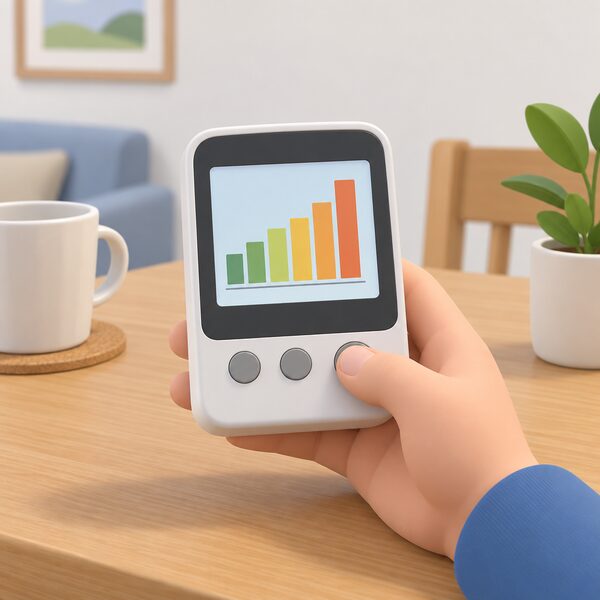
Storage is built into the displays rather than held elsewhere. Eco-eye states that all of the energy monitoring displays store the readings1, that all display units store historical data which can be retrieved at the press of a button6, and that every monitor has a memory facility so a household can recall historical usage to compare consumption over various time periods3. The Smart and Smart PC add the memory card route for computer analysis1.
In practice the workflow is: watch the live number to find what is drawing, then use the stored history to compare one week or month against another. The 4-second update makes the first part immediate3; the memory facility makes the second part possible without writing anything down3. The target graph on the Smart PC is the maker's attempt to turn that history into a comparison against a goal2.
Two boundaries apply. The monitor tracks electricity, and a home energy monitor is usually bought separately and mainly tracks electricity use in the home7. And it does not replace a smart meter, because it cannot automatically send meter readings to an energy supplier7. A household with an Eco-eye still has whatever meter the property already has, and still reads it or lets it report in the usual way. For how the two devices differ in what they record and who can see it, see smart meter vs standalone energy monitor and consumer access devices.
The claimed 15% bill saving: what it rests on
The maker's claim is direct: Eco Eye Monitors can save you 15% off energy bills1. That is the top of the range, and it is a maker's claim rather than a measured outcome for a particular home.
The official figure is a range with a worked example. Northern Ireland's energy efficiency guidance states that people who fit home energy monitors tend to find their energy use drops by between five and 15 per cent in the first year of use, and that customers have typically saved five to 15 per cent in the first year of owning a monitor, which could be £25 to £75 off a £500 bill4. The Centre for Sustainable Energy gives a single typical figure: people monitoring their use in this way typically save £69 a year5.
Independent consumer guidance is blunter about the mechanism. Which? states that simply buying and plugging in an energy monitor won't automatically reduce your bills, and that seller or manufacturer claims that a monitor saves energy and cuts bills should be treated with scepticism8. The saving is behavioural: it comes from acting on what the display shows, and it stops when the household stops looking.
"People who fit home energy monitors tend to find their energy use drops by between five and 15 per cent in the first year of use"
The documents do not conflict so much as differ in scope: the maker quotes the top of the observed range, the official guidance gives the range and a cash translation, and the consumer body warns that the range is not a promise. A household should read the 15% as the best case in the evidence, not the expected case.
British design and UK availability
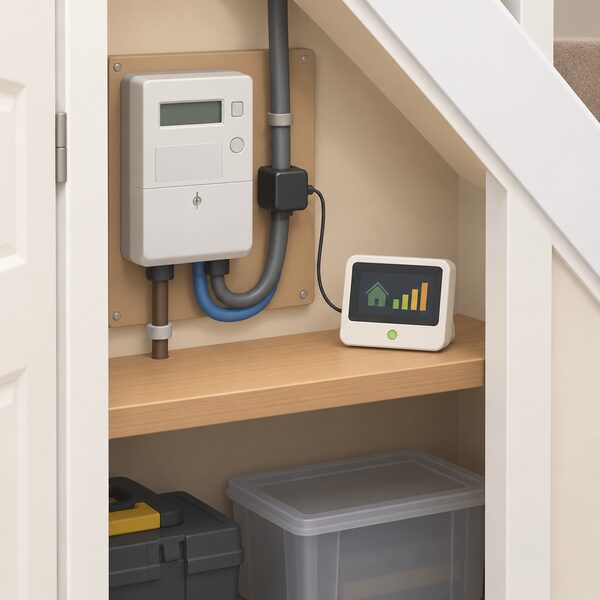
Eco-eye states that its products are British designed1. The manufacturing position is more layered, and the maker sets it out itself: all Eco-eye products are designed in the UK, products for low volume orders are still made in the UK factory, and high volume production has been transferred to the maker's own factory in the PRC3. The Smart PC product page carries a Made in Britain line2. Read together, the two statements describe a company that designs and prototypes in Britain and manufactures at volume overseas.
Availability is the practical issue. The Eco-Eye Smart PC is listed as out of stock2, the Eco Eye Smart Solo is listed as out of stock11, and the Eco-Eye Solo SmartPV is listed as out of stock9. The maker sells accessories alongside the monitors, including extra display units sold separately as Eco-eye Elite Solo, Mini Solo, Smart Solo and Smart PV solo, which work with an existing transmitter and sensor3, and a mains power supply for running an Eco-eye from the mains using optional AC/DC power adaptors9.
On returns, the maker offers a full money-back guarantee for sales within the UK should a customer find there is any issue3. Support runs through a published phone line, 01903 8519103. For a household comparing this with what a supplier provides, the relevant contrast is that a smart meter comes with an in-home display as part of the national programme12, while a standalone monitor is not included in that programme and is usually purchased separately8. The wider field is set out in home energy monitors and in-home displays.
Eco-eye beyond the home: commercial and micro-generation uses
Eco-eye lists its applications as home, commercial and micro-generation1, and the product range reflects that. The Elite 100 and Elite 200 come with three sensors as standard and are used primarily in business premises and not in domestic ones3. Most Eco-eye electricity monitors are suitable for three phase supplies with the use of additional sensors3, which is what makes the commercial use practical: a three-phase site can be monitored without a bespoke system.
On generation, the maker's approach is to measure both sides of the meter. The Eco-eye SmartPV uses 3 sensors to measure what a household is generating and what it is using, and displays real-time information on the power being consumed as well as the power being generated10. For a simpler setup, an Elite or Mini can be attached to the live cable after the inverter for simple monitoring of generated power10. The Eco-Eye Solo SmartPV is an additional display for a main Eco-eye Smart PV system, showing the same range of information and updating simultaneously over the same wireless connection9.
Independent work on self-consumption has assessed the Eco Eye Smart PV alongside other monitors, listing it among the devices examined for increasing self-consumption of solar PV13. That places it in the category of monitoring rather than export metering: it tells a household what its panels are producing and what the house is drawing, so that loads can be shifted into the generating hours. It does not measure exported units for payment, and it does not report to a supplier. For the metering side of that boundary, see export metering and limitation and solar and battery system monitoring.
Sources13 cited
- Eco-eye home page, Eco-eye, 2026-09-20
- Eco-Eye Smart PC, Eco-eye, 2026-09-20
- Eco-eye FAQs, Eco-eye, 2026-09-20
- Energy efficiency tips, nidirect, 2026-09-17
- Tips for lower energy bills, Centre for Sustainable Energy, 2024-02-29
- Monitoring your home, Eco-eye, 2026-09-20
- Smart meters vs home energy monitors, Smart Energy GB, 2026-08-17
- Are energy monitors the best way to measure your power usage?, Which?, 2026-03-31
- Eco-eye accessories, Eco-eye, 2026-09-20
- Monitoring micro-generation, Eco-eye, 2026-09-20
- Eco Eye Smart Solo, Eco-eye, 2026-09-20
- Smart facts: bills, Smart Energy GB, 2026-03-16
- Increasing self-consumption of solar PV: monitors and solar immersion controllers, National Energy Action, 2023-06-09