
In this answer
Short answer
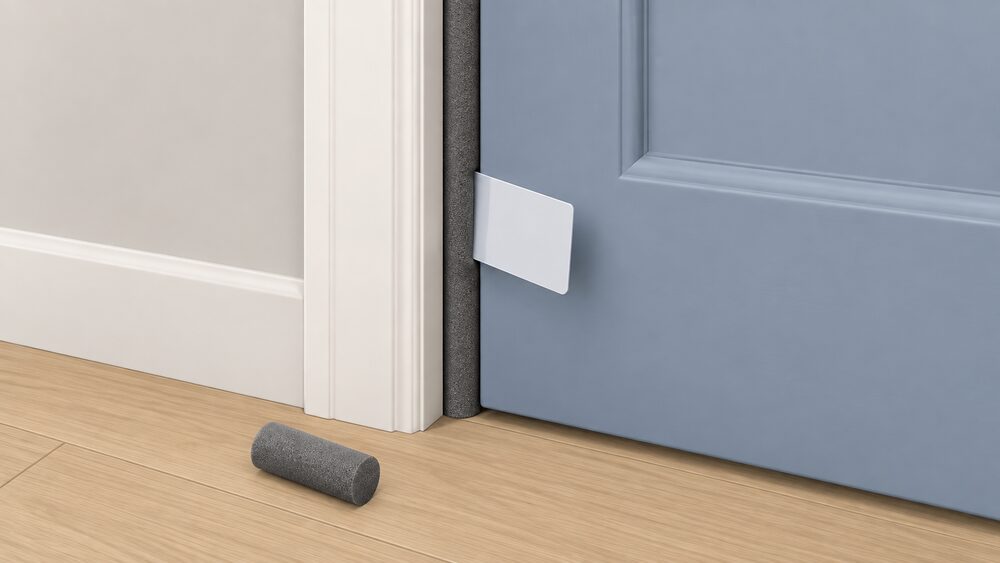
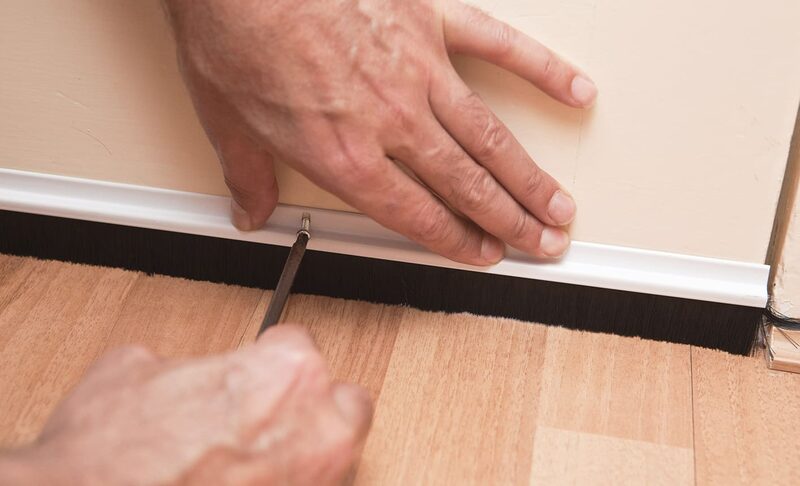
Draught-excluder strip is sold by profile and by depth, but the number that matters is the gap being closed, not the size printed on the packaging. The practical method is to buy a short length of foam strip, about 50mm, close the door on it and check that a plastic card slips between the strip and the door as a comfortable fit1. If the card will not pass, the strip is too thick; if it drops through, the strip is too thin.
That test exists because a seal works by compression. Guidance on foam strips for windows is blunt about the two failure modes: a strip that is too wide will hamper shutting the window, and one that is too narrow will have no effect at all2. Thickness is therefore a fit question, not a performance rating, and the same strip depth can be right on one door and wrong on the next.
The type of strip matters as much as its depth. Brush strips are recommended for sash windows, where the bristles flex against a sliding section3, while foam, metal or plastic strips suit the frame of an exterior door, with brush strips along the bottom1. Draught stripping for windows and doors also qualifies as an energy-saving material for a lower rate of VAT4.
Strip thickness at a glance: what the common sizes fit
There is no published table of draught-excluder strip thicknesses in the evidence, and no figure should be assumed. What the guidance gives instead is a method and a set of material choices, and those are what determine whether a strip of a given depth will work in a given gap.
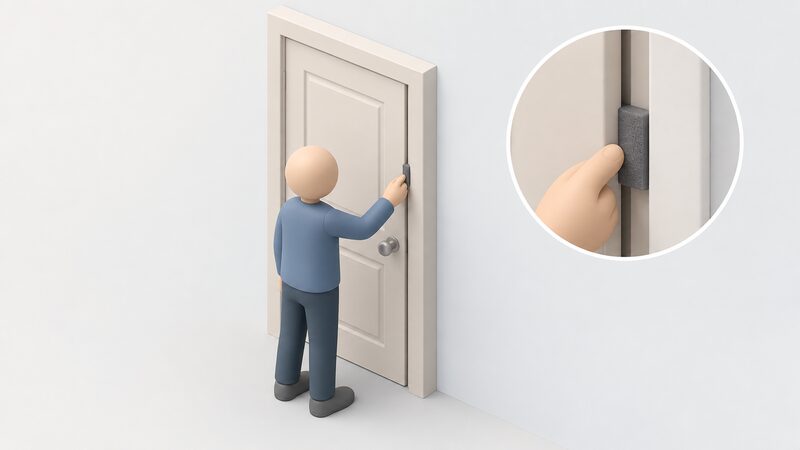
The method is the 50mm test strip1. A short offcut costs almost nothing and answers the question directly: place it in the gap, close the door or window, and judge the compression. The card test then confirms it, with a comfortable fit between strip and door meaning the seal is filling the gap without being crushed flat1. This is why buying a single long length before testing is a mistake: the depth that works on the front door may be wrong on the back door, and wrong again on a loft hatch.
Material choice narrows the field before depth is considered. Foam, metal and plastic strips are described for door frames, with brush strips along the bottom of doors1. Brush strips are also the type recommended for sash windows3. Foam strips are described for filling the gaps between a window and its frame2. Door sweeps and brushes attach to the base of doors, and letter box brushes and chimney draught excluders cover the other common openings7.
For a household, the independence point is modest but real. A sealed door or window reduces the rate at which heated air leaves the home, which is the same mechanism that draught sealing is credited with in overheating guidance, where infiltration is reduced by draught sealing8. It does not remove the need for heating or ventilation, and it does not change the fuel a home runs on. It reduces waste at the point where the building meets the outside.
Why thickness matters: compression, gaps and the seal
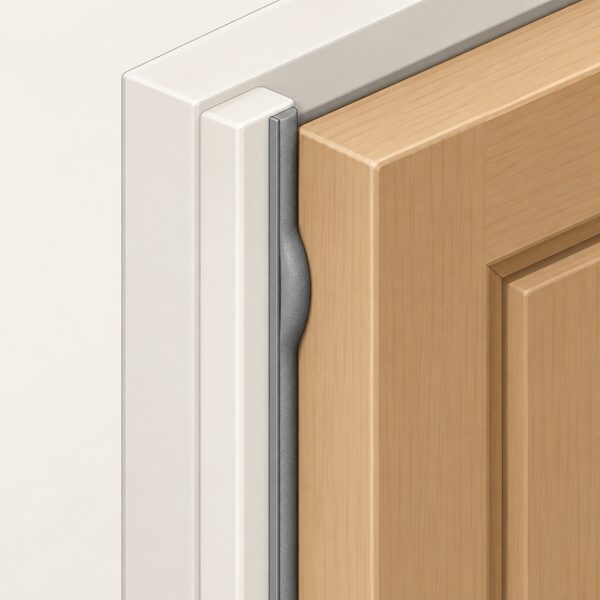
A draught-excluder strip is a compressible gasket. It only blocks air if it is squeezed between two surfaces at the moment the door or window is closed, and that squeeze is what sets the usable thickness range for any given gap.
The two failure modes are documented. Too wide, and the strip hampers the window shutting2. Too narrow, and it has no effect2. Between those extremes the strip touches both faces, compresses slightly, and closes the path the air was using. The same logic applies to a door: an over-thick strip holds the door off its latch or stops it closing, while an under-thick strip leaves a visible line of daylight and a measurable draught.
Seals also degrade. Over time, seals deteriorate due to weather exposure and regular use, which is what produces draughts at a door or window that was previously sealed9. That is a maintenance point rather than a specification point: the strip that fitted correctly when installed may need renewing, and the replacement should be chosen by the same test rather than by matching the old pack.
Where draught-proofing is delivered as a funded measure, the standard is exacting. Under ECO, 100% draught-proofing must be achieved when delivering that measure type10. That is a completion requirement for the scheme, not a thickness figure, but it shows the intent: a partial seal is treated as a failed seal.
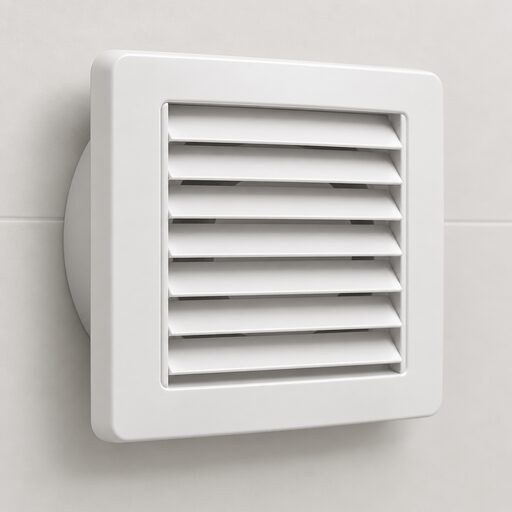
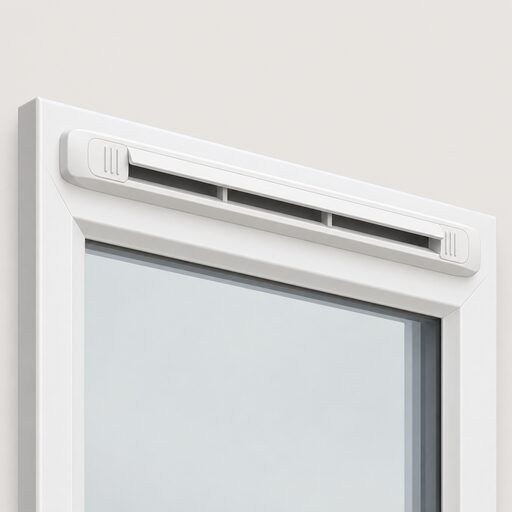
The limits are worth stating plainly. A strip cannot fix a warped door, a dropped hinge or a frame that has moved. It also cannot be used everywhere: extractor fans, trickle vents, wall vents, heater flues and underfloor grilles or airbricks should not be blocked or sealed, because they ventilate the home11. Boiler flues, air bricks and window trickle vents must never be blocked, and over draught-proofing windows in kitchens and bathrooms should be avoided where moist air needs to escape and there is no mechanical ventilation such as an extractor fan1.
Choosing by gap width: measure first, buy second
The gap decides the strip, and the gap is measured by testing rather than by guessing. The sequence is short: identify where the air is coming in, test a short length of strip in the gap, then buy the profile and depth that passed the test.
Start with the common locations. Draughts are found around external windows and doors, open chimneys, loft hatches, and in gaps around floorboards and skirting boards7. Each of those has a different gap geometry. A door frame gap is narrow and even down the sides and across the head. A threshold gap is wider and changes as the door passes over the floor covering. A loft hatch has a continuous gap around the frame, where strips of draught-excluder are fitted around the edges of the frame, with the hatch itself insulated with fibrous or solid board insulation1. An unused chimney takes a different product entirely: chimney draught excluders such as chimney sheep or balloons, removed in summer to let air circulate, and never installed on a chimney that is in use1.
The card test is the confirmation step. Close the door and slip a plastic card between the test strip and the door; it should be a comfortable fit1. A card that will not pass means the strip is too thick for that gap. A card that falls through means the strip is too thin.
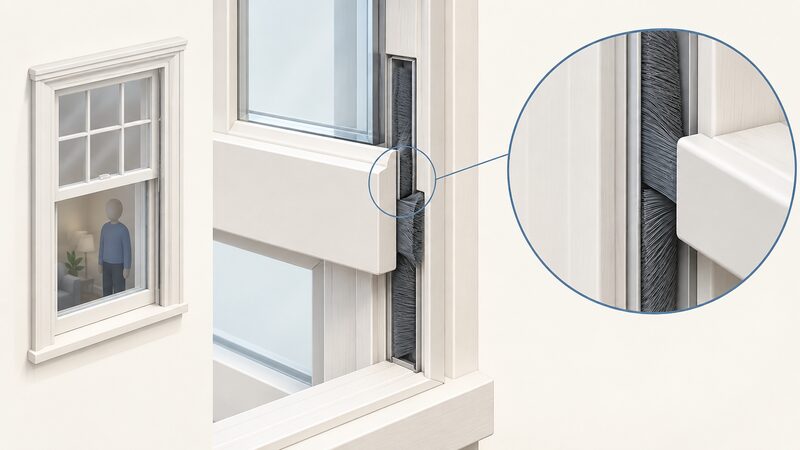
For windows, the same principle applies with a different profile. Self-adhesive foam strips fill the gaps between the window and the frame2, and the size check is the one already described: too wide hampers shutting the window, too narrow has no effect2. For sash windows, brush strips work better3, because the bristles flex against the moving section rather than resisting it.
Where a household is working through a whole house, it helps to treat the strip as one part of a wider sequence. The draught-proofing guide covers where to seal and where not to, and the airtightness and air leakage page explains how sealing relates to controlled ventilation. Strip thickness is the last decision in that chain, not the first.
Brush, foam, rubber or wiper: which strip suits which gap
The profile follows the gap, and the evidence points to a small number of pairings rather than a single best product.
Foam, metal and plastic strips are described for door frames, with brush strips along the bottom of doors1. That split reflects the two gap types: an even compression gap at the sides and head, and a sweeping gap at the threshold where the door passes over the floor. Door sweeps and brushes attach to the bottom of doors, and letter box brushes cover the letter plate7. For interior doors, snake draught excluders reduce draughts, but only as a temporary measure1.
For windows, self-adhesive foam strips fill the gaps between the window and the frame2. For sash windows, brush strips work better3. The reason is mechanical: a sash slides vertically, so a rigid foam seal in the channel would resist movement, while bristles flex and still close the gap.
Chimneys take a dedicated product. Chimney draught excluders such as sheep or balloons are available from most DIY stores, should be removed in summer to let air circulate, and must not be installed on any chimney that is in use1.
A wider list of methods shows the same logic applied across a home: draught-proofing strips for windows and door edges, brush or hinged-flap draught excluders at door bottoms, an inflatable chimney pillow for open chimneys, flexible silicone-based filler for floorboards, and foam strips for loft hatches12. Insulating tape around door frames, a door brush, a keyhole cover, letterbox draughtproofing and a draught excluder are the door measures listed in draught-busting guidance13.
| Gap | Profile described | Source |
|---|---|---|
| Door frame sides and head | Foam, metal or plastic strip | 1 |
| Door bottom or threshold | Brush strip, door sweep | 1 |
| Window to frame | Self-adhesive foam strip | 2 |
| Sash window channel | Brush strip | 3 |
| Loft hatch edges | Draught-excluder strip around the frame | 1 |
| Unused chimney | Chimney sheep or balloon, removed in summer | 1 |
Where thicker is not better: doors, sashes and sticking

Thicker is not a safer choice. The evidence names the consequence directly: a foam strip that is too wide will hamper shutting the window2. On a door, the same over-thickness shows up as a door that will not latch, a handle that needs force, or a frame that flexes when the door is pushed home.
The areas where sealing should not happen at all are as important as the thickness question. Extractor fans, trickle vents, wall vents, heater flues, and underfloor grilles or airbricks should not be blocked or sealed, because they play a role in ventilating the home11. Boiler flues, air bricks and window trickle vents must never be blocked, and over draught-proofing windows in kitchens and bathrooms should be avoided where moist air needs to escape and there is no mechanical ventilation such as an extractor fan1.
Condensation is the practical risk that follows over-sealing. Draughtbusters visits found that the most common jobs were fixing draught excluder to windows and doors, but the biggest issue was condensation14. That is the trade-off in one line: sealing reduces unwanted air movement and can raise indoor humidity if the ventilation routes are closed at the same time.
There is a wider lesson in how insulation thickness is specified elsewhere. For roof insulation, the thickness required varies depending on the material used and the manufacturer's specification15. For pipe insulation, the advice is to choose the thickest insulation that will fit around the pipe16. Both point the same way: thickness is set by the material and the space available, not by a universal number. Draught-excluder strip follows that pattern, with the added constraint that the door or window must still operate.
Where a home is being sealed as part of a wider retrofit, the condensation, damp and mould page sets out what to watch for, and the home ventilation page covers the systems that replace the air movement a seal removes.
Fitting the strip so it actually seals
A correctly sized strip still fails if it is fitted badly. The steps below follow the sequence the guidance implies: clean and prepare, test, cut, fix, then check the operation of the door or window.
- Identify the draught path. Common locations are around external windows and doors, open chimneys, loft hatches, and gaps around floorboards and skirting boards7.
- Test a short length of strip, about 50mm, in the gap with the door or window closed1.
- Confirm with the card test: a plastic card should be a comfortable fit between the test strip and the door1.
- Choose the profile for the gap: foam, metal or plastic for door frames, brush for door bottoms and sash windows1.
- Fit the strip around the frame, or along the bottom of the door for a brush or sweep1.
- For a loft hatch, fit strips of draught-excluder around the edges of the frame, and insulate the hatch itself with fibrous or solid board insulation1.
- Check the door or window still closes and latches without force, and that a sash still runs freely2.
The VAT position is worth knowing before buying materials. Draught stripping for windows and doors qualifies as an energy-saving material5, and draught stripping, for example insulation fixed around windows and doors, qualifies for a lower rate of VAT4. The legislation lists draught stripping for windows and doors among the energy-saving materials6. The relief applies to the supply and installation as two separate supplies whose elements are not interdependent or connected17.
For households in Northern Ireland, draught-proofing appears among the measures available through NISEP individual measure schemes18. In the 2023/24 NISEP annual report, the predominant loft insulation measure was 100 to 300mm thickness, representing 72% of all loft insulation installations19, which shows how a funded programme specifies thickness by measure type rather than leaving it open.
Finally, the independence question. A sealed home depends less on the rate at which it loses heat, and that reduces the work the heating system has to do. It does not remove the gas connection, the electricity supply or the boiler, and it does not make a home self-sustaining. What it does is close the cheapest and most immediate leaks first, before any larger measure is considered. The low-cost and DIY insulation measures page places strip alongside the other small measures, and the insulation and energy independence page sets out what sealing can and cannot do for a household's independence.
Sources19 cited
- DIY draught-proofing, Centre for Sustainable Energy, July 2026
- Draught proofing your home, Smart Energy GB, 16 March 2026
- Five top tips from Which? to cut your energy bills, Welsh Government Climate Action, 18 March 2026
- Tax on shopping: energy-saving products, GOV.UK, 17 September 2026
- VAT energy-saving materials: VENSAV3040, HM Revenue and Customs, 17 September 2026
- Finance Act 1994, Schedule 8, Part II, Chapter 23, legislation.gov.uk, 17 September 2026
- Cheap and easy ways to insulate your home over a weekend, Which?, 6 October 2025
- Overheating guidance v3, BRE, 17 September 2026
- Stop heat loss: a complete guide to insulating around your roof windows, FAKRO, 2026
- ECO4 new measures and products guidance v3.0, Ofgem, 26 March 2026
- Draught-proofing, Which?, 5 May 2026
- Make your home more energy efficient in one weekend, Which?, 28 August 2026
- Draught busting, Low Carbon Hub, 5 August 2026
- Draughtbusters: it's easier than you think to set up, Low Carbon Hub, 31 July 2023
- Building regulations: new roofs, thermal resistance and insulation, Planning Portal, 2026
- Insulating tanks and radiators, Energy Saving Trust, 3 November 2025
- VAT energy-saving materials: VENSAV3230, HM Revenue and Customs, 17 September 2026
- Energy grants Northern Ireland, Energy Saving Trust, 17 September 2026
- NISEP annual report 2023-24, Utility Regulator Northern Ireland, July 2025
 Loft InsulationHow much loft insulation do you need, and is your current depth enough?
 Draught-Proofing a HomeCovers sealing around windows, doors, floorboards, loft hatches, letterboxes and chimneys, and the products used for each.
 External Doors and U-ValuesWhich front door keeps the heat in best, and how much does it really matter?
 Home Ventilation SystemsWhy do modern insulated homes need extra ventilation, and what happens if they do not get it?
 Airtightness and Air LeakageDraughty rooms, cold spots and higher bills often come down to air leaking through gaps in the walls, floors and roof.
 Building Regs Part F VentilationMaking a home airtight without ventilation traps moisture, and Part F is the rule that stops that happening.