

In this guide
STEICO wood fibre insulation is a bio-based insulation range for walls, roofs, ceilings and floors, made from timber rather than oil-derived chemistry. STEICO states that its wood fibre insulation boards are made up of at least 86% PEFC certified timber, and that its wood fibre insulation generally is manufactured from at least 81% PEFC certified timber, under certificate number PEFC/04-31-25501. The rest is a small number of binding agents working with the wood's natural lignin1.
The range covers rigid boards, flexible batts, air-injected loose fibre and sheathing boards, plus the membranes that go with them. It is used for internal wall insulation, external wall insulation, between and over rafters, between floor joists and as structural sheathing1. The appeal for a household is twofold: a lower heating demand, and a building fabric that can manage moisture rather than trap it.
The trade-off is that wood fibre is a fabric measure, not an energy supply. It reduces the heat a home must buy, but the home stays on the grid and on a supplier. Independent analysis states that insulating homes and running electric heat pumps and cars on an even greener grid would boost energy independence2, and that clean energy system investment reduces dependency on imported gas3. That is the frame this page works in.
What STEICO wood fibre insulation is made from
The material is untreated softwood from sustainably managed, PEFC-certified forests, and STEICO states that all timber used is from responsible, PEFC-certified forestry6. The boards are held together by only a small number of binding agents, working in harmony with the wood's natural lignin, which is the substance that stiffens timber in the tree1. That is why the wood content is quoted as a percentage rather than as a single figure: the boards reach at least 86% PEFC certified timber, while the wider wood fibre insulation range is quoted at at least 81%1.
The air-injected products sit at the same order of magnitude. STEICO zell is an air-injected insulation made of 81% PEFC certified timber, and STEICO states that all timber used in STEICO zell and STEICO timberfloc is sourced from PEFC-accredited forests under the same certificate number1. STEICO timberfloc differs in composition: it is an air-injected insulation from wood fibres and cellulose6.
Two physical properties follow from the material. STEICO states that its wood fibre insulation materials have low thermal conductivity and high density, and that this combination helps slow down and buffer heat transfer, which matters most in summer6. The same density and fibre structure give the acoustic performance the maker describes, with sound insulation properties helping to create a quiet home environment in roofs, walls and ceilings6.
"Wood fibre boards incorporate only a small number of binding agents and work in harmony with the wood's natural lignin"
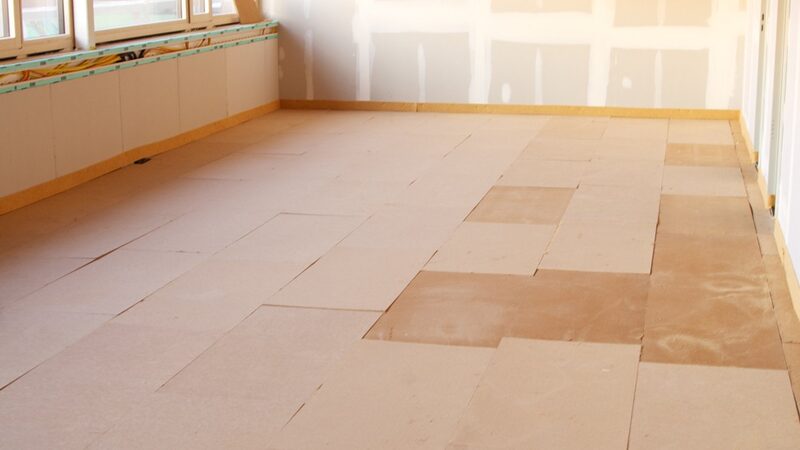
The range: boards, batts, blown fibre and sheathing
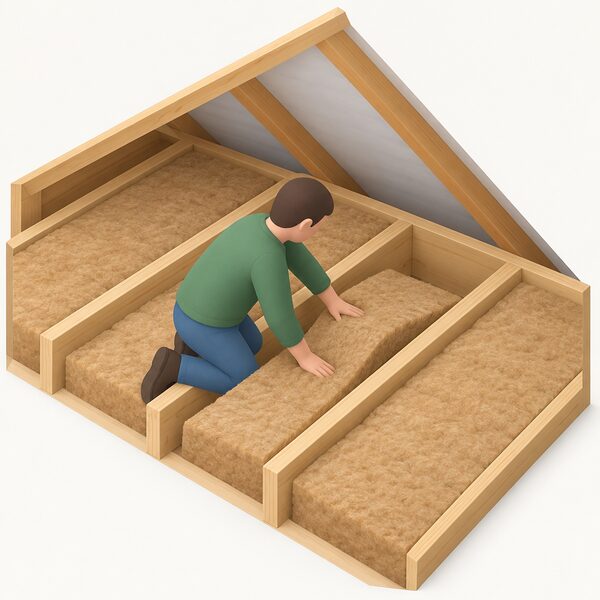
STEICO's UK range divides by form rather than by application, and the same material appears in several forms because different parts of a building need different things. Rigid boards take render, plaster or a facing. Flexible batts fill irregular voids between timbers. Air-injected fibre fills closed cavities that cannot be reached by hand. Sheathing boards close the outside of a timber frame.
| Product | Form | What STEICO lists it for |
|---|---|---|
| STEICO protect L dry | Rigid board | Facade insulation, λ D 0.0375 |
| STEICO universal dry | Sarking and sheathing board | Made by the dry process, secure rain protection5 |
| STEICO flex | Flexible batt | Stud walls, loft joists, rafters, between suspended ground floor joists9 |
| STEICO zell | Air-injected wood fibre | Closed cavities in timber frame walls, between rafters or beams, exposed horizontal or shallow-pitch areas1 |
| STEICO timberfloc | Air-injected wood fibre and cellulose | Stud walls6 |
| STEICO Ecosilent | Underlay | Impact sound insulation for parquet and laminate flooring6 |
| STEICO safe | Sheathing board | Integrated laminated membrane, base sheet for flat sloping roofs and behind facings10 |
The air-injected products are the ones most households will not have seen. STEICO zell is described as space-filling insulation for closed cavities of external and interior walls of timber frame constructions and similar structures, for closed cavities between rafters or timber beams, and as exposed insulation on horizontal or moderately pitched areas of around 10 degrees, such as topmost storey ceilings that are not walked on but are accessible1. STEICO describes it as a lightweight product with no loss of performance, thanks to the three-dimensional interlocking of the wood fibres1. Both zell and timberfloc are suitable for on-site assembly and prefabrication, and for new build and renovation alike8.
The batts are the simplest part of the range to understand. STEICO flex is a flexible wood fibre insulation batt that can be used inside stud walls, between loft joists and between rafters, and is suitable for insulating between the joists in a suspended timber ground floor or loft space9. STEICO states that it can be modified using standard tools for ease of installation on site9. For a household comparing materials, the wider market offers rigid boards, batts, loose injected fibre and quilts depending on the intended application11, and mineral wool alone spans loose granular material for blown cavity walls, slabs, rolls, pipe sections, ceiling tiles and acoustic panels12.
Where it fits: walls, roofs, floors and sheathing
STEICO lists its insulation materials as suitable for roofs, walls, ceilings and floors, for new build and renovation6. The board range is set out by application: internal wall insulation as part of a moisture regulating system, floor insulation between floor joists, loft insulation in the floor of the loft, roof insulation between rafters, and external thermal insulation composite systems1.
Internal wall insulation is the application most often reached for in older UK housing, where solid walls cannot be filled. STEICO describes two build-ups. The single-layer system is an existing solid brick wall, a render bonding coat, 40 to 80mm of STEICO internal board, and a lime base finish with mesh4. The multi-layer system is an existing interior render, solid timber or LVL studs acting as a framework, biobased cavity insulation in the form of STEICO flex 036, a STEICO multi renova vapour control membrane, and 12.5mm plasterboard4. STEICO notes that a 40 to 60mm layer can improve thermal performance while helping to limit the impact on room space4.
External work uses thicker layers because there is more room outside. A single-layer external system takes 100 to 240mm of STEICO protect L dry, and a multi-layer system takes 40 to 60mm of STEICO universal dry5. STEICO states that its facade insulation is suitable for use in an external wall insulation system and can help mitigate some of the potential challenges of installing this type of insulation, including potential water penetration and moisture management issues5.
The thicknesses sit within the ranges other sources give. Official guidance on solid wall insulation states that the thickness of the insulation needs to be between 50 and 100mm13. Independent guidance for older homes puts external walls at 100 to 200mm of cork, wood fibreboard or mineral wool, and internal walls at typically 50 to 60mm of breathable insulation such as wood fibreboard14. The documents differ on the external figure, and the difference is one of system design rather than of material performance: a rendered external system can carry more thickness than an internal drylining.
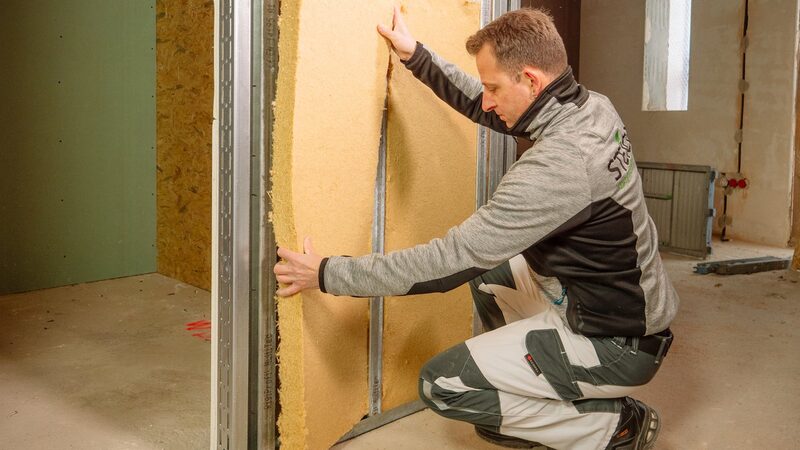
Moisture and vapour permeability: why it protects the fabric
Wood fibre's central claim is that it lets a wall dry. STEICO states that its insulations are permeable to water vapour, which helps prevent moisture build-up and helps to protect and preserve the building fabric6. In internal wall systems, the diffusion-open wood fibre structure allows moisture to be absorbed, distributed and quickly dried through evaporation4. STEICO flex is made from wood fibres which can help prevent mould and moisture damage when specified and installed correctly9.
That behaviour matters most in older buildings. Official guidance states that the fabric of a traditional building needs to breathe, so that moisture within walls from rising damp, driving rain or condensation can be released through evaporation15. Scottish guidance goes further, stating that vapour permeable, capillary active and hygroscopic materials can safely absorb, transfer and release moisture, and can be used to reduce moisture build-up risk without the need for cavities16.
The contrast is with closed-cell materials. Independent guidance states that closed-cell foam is not vapour permeable, which makes it a better insulator but also means that moisture cannot move through it, which can cause trapped moisture and rot17. The Energy Saving Trust makes the same point about closed-cell polyurethane foam: its main drawback is that it is not vapour permeable, so any moisture in the surrounding air or other building materials cannot travel through and escape18.
Permeability is not the same as airtightness, and the two are managed by different layers. STEICO states that vapour control layers should be installed on the warm side of the insulation in walls, roofs and floors, limiting the amount of moisture that can enter the building fabric and helping prevent interstitial condensation19. The same membranes improve airtightness, which STEICO describes as important for eliminating draughts and other leaks that affect thermal performance19. STEICO also states that incorporating membranes which allow a controlled migration of moisture through the building fabric can reduce the reliance on mechanical ventilation systems19.
Standards, certification and timber sourcing
The certification that appears throughout STEICO's UK literature is PEFC/04-31-2550. STEICO states that all of its wood fibre insulation products are manufactured from PEFC-certified forests under that number6, that its wood fibre interior wall insulation products are manufactured from PEFC certified timber under the same number4, and that STEICO flex is manufactured from PEFC certified timber under it and is fully recyclable at the end of its life9. STEICO sheathing boards are manufactured from PEFC-accredited timber under the same certificate10, and the products used in STEICO external wall insulation systems are sourced from PEFC certified forests under it5.
The number is a chain-of-custody reference. It identifies the certified forest supply behind the timber rather than a performance rating of the finished board, and it is the same number across boards, batts, sheathing and the air-injected products, which indicates a single sourcing scheme rather than product-by-product certification1.
On the wider standards picture, the Energy Saving Trust's guidance on product standards and selection sets out that insulation is available in various forms including rigid boards, batts, loose injected and quilts, depending on the intended application11. That is the frame a household should use when comparing a wood fibre system with anything else: match the form to the application first, then compare the declared performance.
For the household, the practical consequence of the certification is limited but real. It is evidence about where the timber came from, not about how the installed system will perform. Performance depends on the thickness specified, the continuity of the layer, the detailing at junctions, and the competence of the installer. STEICO's own case study material reports a Herefordshire self-build using STEICO joist I-joists and STEICO zell in a timber frame panel, with reported U-values of 0.13W/(m²K) for walls and 0.11W/(m²K) for roofs, which are system results rather than product claims20.
Membranes and system compatibility
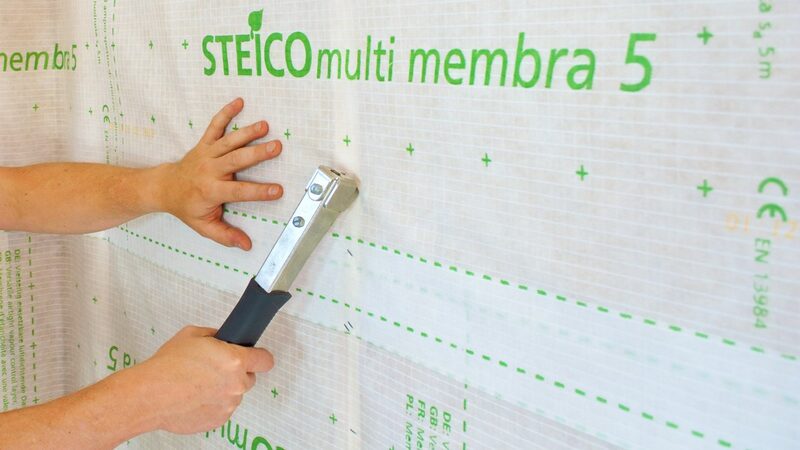
STEICO's membranes are designed to work in conjunction with its wood fibre insulation systems and structural products, so the vapour and weather layers are specified as part of the same system rather than bought separately21. The range splits into vapour control layers, which sit on the warm side, and breather or weatherproof membranes, which sit on the cold side.
The construction is consistent across the range: STEICO states its membranes are made up of a three-layer coated PP-woven fabric with mesh reinforcement that helps them be more resistant to tearing21. Within that, the products differ by function. STEICO multi UDB is a vapour permeable windproof membrane21. STEICO multi cover 5 is a walk-on, rain-proof vapour control layer with two self-adhesive areas21. STEICO multi CAPclear is a fully self-adhesive and airtight weather protection membrane21. STEICO multi renova is the vapour control membrane specified in the multi-layer internal wall system4.
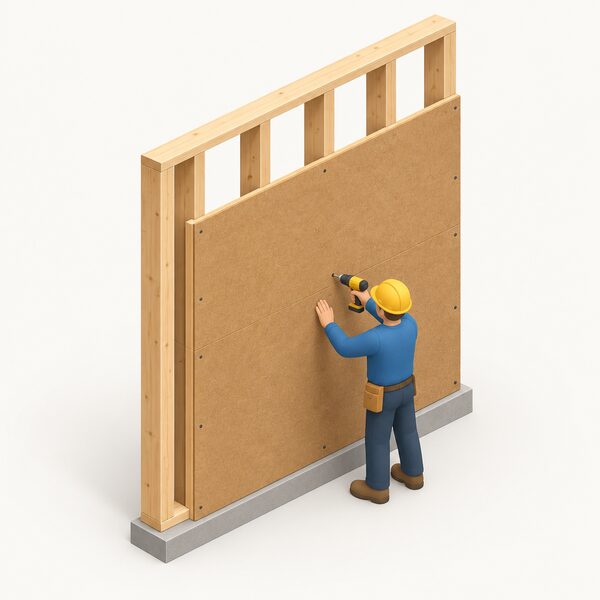
The sheathing boards carry some of the same work. STEICO safe is a sheathing board with an integrated laminated membrane to offer additional weathering protection, and is listed as a base sheet for flat sloping roofs and for use behind facings10. STEICO underlay boards are water-repellent and rainproof, providing temporary protection for the structure against the weather during the construction phase6.
What a bio-based insulation system means for energy independence
Wood fibre insulation reduces the heat a home loses, which reduces the fuel it has to buy. The scale of that reduction depends on the wall and the thickness. Independent guidance states that about 5 centimetres of something like wood fibre insulation board could cut heat loss through the walls by about 75%, in a case where space is really limited7. That is a modelled figure for a specific build-up, not a guarantee for any particular house.
Beyond the fabric, the independence question is about what the home still depends on. Insulation does not generate anything, so a home insulated with wood fibre remains connected to the electricity grid and, if it heats with gas, to a gas supplier and to imported gas. Independent analysis states that if the Government wants to boost energy independence, insulating homes and running electric heat pumps and cars on an even greener grid is the way to do it2, and that clean energy system investment reduces dependency on imported gas3. A decentralised energy system is described as bringing better energy security, cost savings for homes, reduced carbon emissions, increased grid resilience and empowerment for people22.
The material itself carries a stored-carbon claim. STEICO states that storage refers to CO2 equivalent in life cycle phase A1 according to EN 15804+A2, which is the product stage of a life cycle assessment rather than the whole life of the building6. That is a statement about the material's accounting, not about a household's bills.
For grant purposes, insulation for walls, floors, ceilings, roofs or lofts, and for water tanks, pipes and other plumbing fittings, is treated as an energy-saving material in the relevant legislation23. The ECO scheme funds insulation alongside central heating where a home has none, and renewable heating such as heat pumps or biomass boilers25. Households in Wales can get help with the cost of energy efficiency through the routes set out by Citizens Advice25. What none of this changes is the underlying position: a wood fibre system lowers demand, and the household still buys its energy from someone.
Sources25 cited
- Wood fibre insulation solutions, STEICO, 2026-09-20
- Household energy buying British, ECIU, 2024-04-15
- Response to Ofgem's call for input on energy system cost allocation, Citizens Advice, 2025-09-26
- Internal wall insulation, STEICO, 2026-09-20
- External wall insulation, STEICO, 2026-09-20
- 10 good reasons for STEICO wood fibre insulation, STEICO, 2026-04-13
- Understanding insulation, CAT, 2023-12-10
- Air-injected insulation, STEICO, 2026-09-20
- Insulation between joists, STEICO, 2026-09-20
- Sheathing boards, STEICO, 2026-09-20
- Product standards and selection, Energy Saving Trust, 2025-04-02
- Mineral wool FAQs, MIMA, 2026-09-20
- Solid wall insulation, Planning Portal, 2026
- How to make a Victorian house more energy efficient, Uswitch, 2025-09-25
- Improving energy saving and sustainability in conservation areas and listed buildings, Brighton and Hove City Council, 2026-09-17
- Guide to the conversion of traditional buildings, Scottish Government, 2026-08-10
- Spray foam insulation, Centre for Sustainable Energy, 2025-11
- Spray foam insulation, Energy Saving Trust, 2024-12-05
- Vapour control, STEICO, 2026-09-20
- Room in roof insulation, STEICO, 2026-09-20
- Vapour control and breather membranes, STEICO, 2026-09-20
- How does energy get to our homes?, Low Carbon Hub, 2023-06-02
- Energy-saving materials, Schedule 7A, legislation.gov.uk, 2026-09-17
- VAT on energy-saving materials, HMRC, 2026-09-17
- Get help with the cost of energy efficiency, Citizens Advice, 2023-03-17