
In this comparison
Lighting is one of the few home energy measures where the saving is immediate, the disruption is close to zero and the payback is measured in months rather than years. The Energy Saving Trust states that LED light bulbs typically use around 80% less energy than halogen lights, and that replacing all of a home's halogen bulbs with LED bulbs could save £45 a year in Great Britain and £55 a year in Northern Ireland1. Those are the two figures that matter most: roughly four fifths of the electricity, and a saving in the tens of pounds each year.
The lifespan case is just as strong. Energy efficient bulbs such as LED lights can last between 20 times as long as halogen bulbs, according to Smart Energy GB2, while halogen bulbs typically have a lifespan of 2,000 hours, or about two years, against LED bulbs that can typically last for up to 20 years3. A household that replaces a halogen bulb is not buying a slightly better bulb; it is buying one that will very likely outlast the fitting it sits in.
What follows is what the independent and official guidance says about the size of the saving, why the published figures differ, how long each type lasts, and how to work out payback on a single bulb. It also sets out plainly what a bulb swap does and does not do for a household's energy independence.
How much less energy an LED uses: 75% to 90% depending on the source
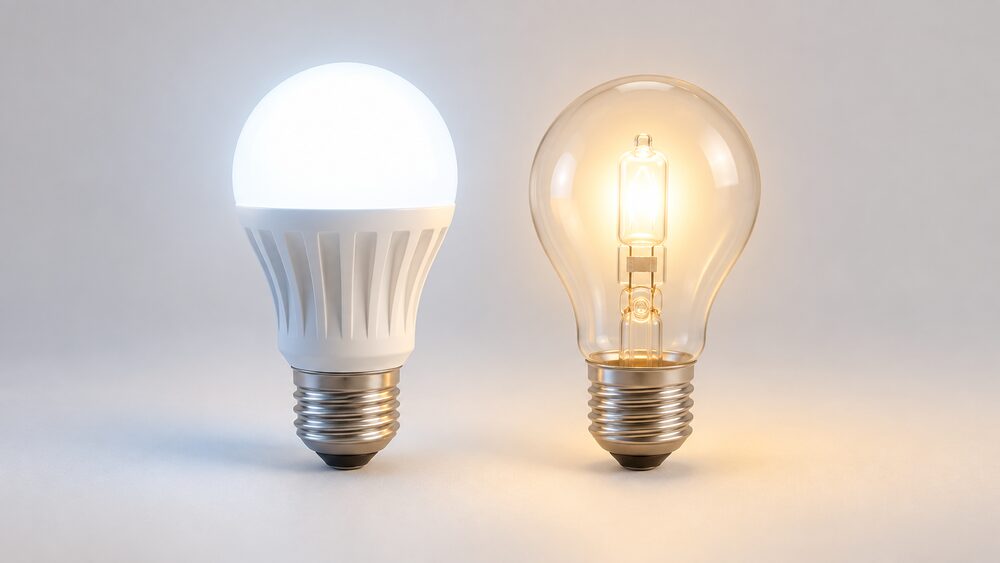
The headline comparison is straightforward. LED light bulbs typically use around 80% less energy than halogen lights, in the Energy Saving Trust's wording1. That single figure sits inside a range that widens or narrows depending on what the LED is being compared against and how the comparison is framed.
Smart Energy GB puts LED bulbs at up to ten times more efficient, and describes halogens as slightly more efficient than traditional bulbs but unable to compare with LEDs in the energy-saving game2. USwitch frames the same gap differently: LEDs use a quarter of the energy of incandescents and can last up to 25 times longer, while halogen bulbs consume around a quarter less electricity than incandescent bulbs without any reduction in brightness6. Read together, those two statements explain the range. A halogen is already an improvement on the old incandescent bulb, so the saving from swapping halogen to LED is smaller than the saving from swapping incandescent to LED, even though both are large.
The Committee of Public Accounts' briefing note gives up to 80% less energy for LED bulbs against traditional incandescent bulbs7, and the Energy Saving Trust's own product guidance repeats the 80% figure for energy-saving lightbulbs, adding that they last up to 10 times longer than regular lightbulbs8. A local authority guidance note goes further on the carbon side, stating that LED bulbs reduce household energy costs by £100 per year on average and have a 75% lower carbon footprint5.
The practical answer for a household is that the saving is somewhere between roughly three quarters and nine tenths of the electricity a halogen would have used, and that the exact proportion depends on which two bulbs are being compared. The direction is never in doubt.
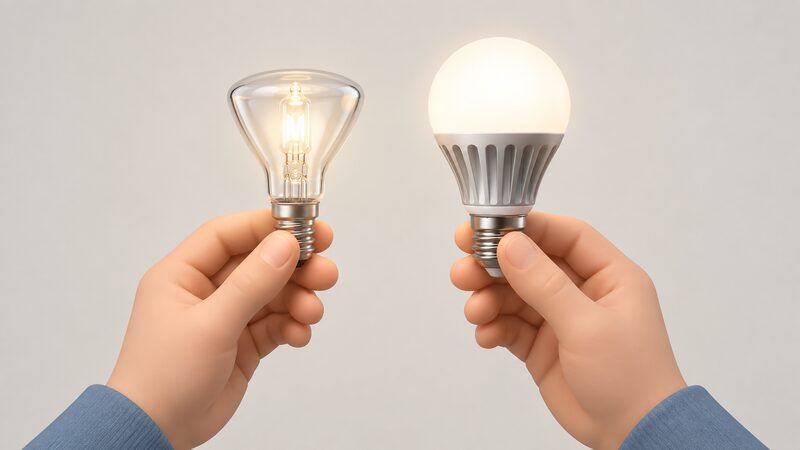
What the switch saves per year: around £55 on a typical household's lighting bill
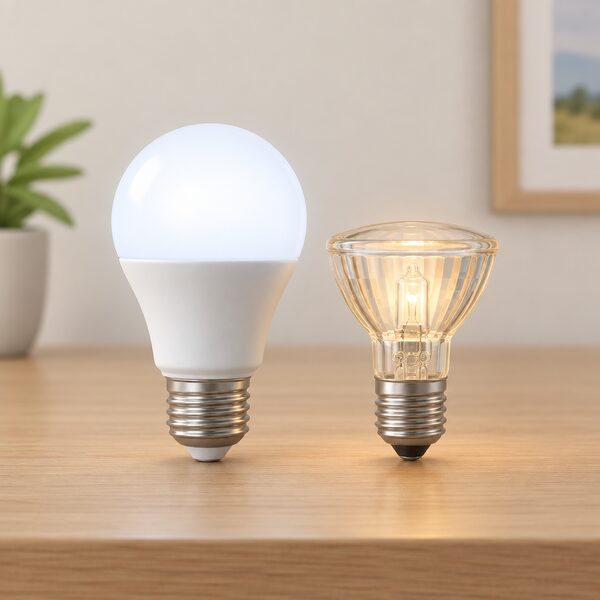
The most quoted figure is the whole-house one. Replacing all of a home's halogen light bulbs with LED bulbs could save £45 a year in Great Britain and £55 a year in Northern Ireland1. The Energy Saving Trust repeats the same pair in its EPC guidance, stating that swapping halogen lightbulbs to energy efficient LED lights should save £45 a year in Great Britain and £55 in Northern Ireland9, and again in its guidance for renters, which puts the saving at up to £45 a year in Great Britain and £55 in Northern Ireland10. Its home improvement guidance gives the same £45 and £55 split11.
The gap between the two nations is consistent across sources and reflects the higher electricity prices in Northern Ireland rather than any difference in the bulbs. Home Energy Scotland, working in the GB price context, puts the saving from replacing a 50W halogen bulb with an LED at £45 a year12.
Other sources land lower. British Gas Energy Trust puts replacing bulbs with LEDs at up to £40 per year13, and Cadent gives around £40 a year for replacing all the light bulbs in the home with LEDs14. British Gas Energy Trust's separate tips page repeats the up to £40 figure15, and Smart Energy GB's in-home display guidance states that replacing all the bulbs in a home with LED lights could save £4016. Confused.com gives the same up to £40 a year17.
The per-bulb figures are more useful for a single fitting. Switching to LED bulbs can save between £4 and £13 per bulb per year, according to the Consumer Council4, a figure the Energy Saving Trust repeats in its electricity saving tips18. National Energy Action describes LED bulbs as using much less electricity and lasting much longer than older incandescent bulbs, while providing the same level of lighting19, and repeats the point in its winter preparation guidance20.
Lifespan: an LED can last 20 times as long as a halogen bulb
Lifespan is where the case becomes hard to argue with. Smart Energy GB states that energy efficient bulbs like LED lights can last between 20 times as long as halogen bulbs2. USwitch gives the underlying hours: halogen bulbs typically have a lifespan of 2,000 hours or two years, while LED bulbs can typically last for up to 20 years3. Citizens Advice puts an LED bulb at over 10 years and a halogen bulb at around two years21.
A local authority grant guidance note gives a specific hour figure for LEDs of 12,000 hours plus, describing them as using little energy5. Electrical Safety First gives energy-saving lightbulbs a lifespan of up to 10 times longer than regular lightbulbs, alongside around 80% less energy use8.
One source gives LED bulbs up to 20 years3; another gives around 15 to 20 years. Both are independent guidance published on the same date, and the difference is not resolved in the material available. What is consistent is the multiple: an LED lasts many times longer than a halogen, whether the comparison is made in hours or in years.
For a household, the practical consequence is that the replacement cycle changes shape. A halogen bulb in a frequently used fitting is a two-year consumable. An LED in the same fitting is closer to a decade-long fixture. That matters for the independence question as much as the bill: fewer replacements means fewer purchases, less waste and less dependence on a supply chain for a consumable that a household currently buys repeatedly.
Independent and maker figures: why they differ and which to trust
The figures above come from independent and official guidance rather than from bulb manufacturers. That matters, because the range across sources is wide: £40, £45, £55, and £4 to £13 per bulb. The differences have identifiable causes.
The first is the price of electricity used in the model. The Energy Saving Trust's saving estimate is based on replacing a 50W incandescent bulb with an LED, and an average standard electricity price of 26p/kWh, correct as of July 202522. A model built on a different price, or on a different starting bulb, produces a different answer. The second is the baseline: a household that has already replaced its most-used bulbs will save less from finishing the job than one starting from all-halogen.
The third is that these are modelled estimates, not measurements. The Consumer Council's appliance cost checker states plainly that the figures presented are an indication and are not the precise amount23. That is a fair description of every saving figure on this page.
Trust in the advice itself is a separate question, and the evidence suggests it is not universal. Ofgem's consumer survey found that 14% of owner occupiers not planning energy efficiency upgrades cited not trusting installers or suppliers to give unbiased information, rising to 18% among those not planning low carbon heating, while 26% cited no guarantee that it would save them money24. Citizens Advice, in its response to a consultation on improving home energy performance through lenders, argued for high quality independent advice about the changes consumers need to make25. For a bulb swap, the stakes are low enough that the advice question barely bites, but the pattern is worth noting for larger measures.
"So the figures presented are an indication and are not the precise amount."
Is it worth replacing halogen bulbs that still work?
The guidance is to replace any broken bulbs and switch to LEDs, on the basis that these use less energy and last much longer20. Halogen bulbs are described as slightly more efficient than the traditional bulbs but unable to compare with LEDs in the energy-saving game2.
That leaves the question of working halogens. The sources do not direct a household to replace bulbs that are still functioning, and no figure is given for the saving from doing so. What can be said is that the saving per bulb per year is between £4 and £134, so a working halogen replaced early begins earning from the day it is swapped, and the halogen it displaces becomes a spare rather than waste.
There is a wider context in which the swap sits. The Planning Portal's self-build sustainability guidance advises incorporating energy-efficient appliances and lighting, such as LED bulbs26, and Tameside Council lists LED lighting among the free simple home energy measures available through the Local Energy Advice Programme, alongside draught proofing27. In Northern Ireland, the NI Energy Advice service funds independent advice on solar panels, heat pumps and other energy efficiency measures, and directs homeowners to seek that independent advice28. The 2024/25 Northern Ireland Sustainable Energy Programme annual report records 164 LED measures funded under innovative schemes in that year29.
For a household working through a plan, lighting is one of the cheapest and fastest measures available. It sits naturally alongside other low-cost steps, and it is worth doing before larger measures because it reduces the baseload that everything else is measured against.

How to work out payback on a single bulb
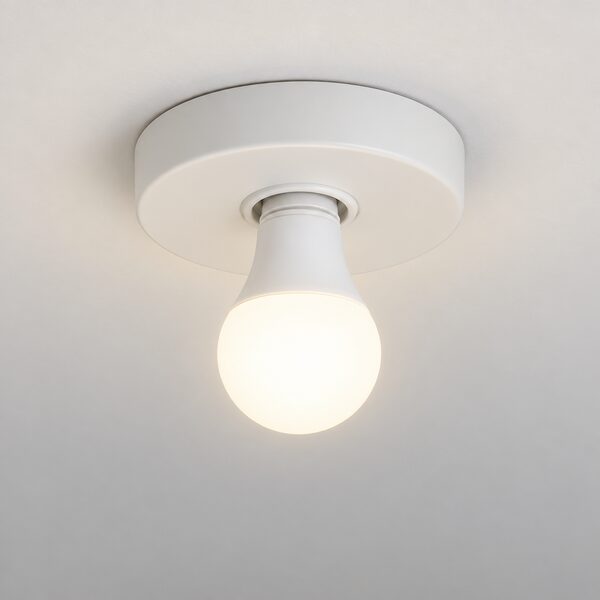
The method is a division: the price paid for the bulb, divided by the annual saving it produces. The saving per bulb is between £4 and £13 per year4. No published bulb price appears in the guidance reviewed here, so the payback depends on what a household pays at the till.
The comparison that puts this in context is plug-in solar, where the Centre for Sustainable Energy gives a payback period of five to ten years, described as the time taken to recover the initial cost of buying the panels30. A bulb swap recovers its cost in a fraction of that time, which is why lighting is treated as a first step rather than a project.
Two cautions apply to the arithmetic. The first is that the per-bulb saving depends on hours of use: a bulb in a hallway used for an hour a day saves far less than one in a kitchen used for five. The Consumer Council's tool allows a household to choose between LED or halogen bulbs and estimate how many hours the lights are on23, which is the right way to get a figure for a specific fitting. The second is that the £4 to £13 range is wide, and the position within it depends on the wattage of the bulb being replaced and the electricity price used.
What a bulb swap does for energy independence
Lighting is a small share of a household's electricity, but it is the measure with the shortest route from decision to result. There is no installer, no assessment, no grant application and no lead time. A household that swaps its halogens has cut its lighting electricity by roughly 80%1 and will not revisit the decision for a decade or more3.
What remains is dependence. The bulbs themselves are bought from a retailer, and the electricity that runs them still comes from the grid and a supplier. A bulb swap reduces the quantity drawn, not the source. It does not generate anything, does not store anything and does not change when or from whom the electricity is bought. For a household thinking about independence in the fuller sense, lighting is a reduction in demand rather than a step towards self-supply, and it belongs with the other low-cost measures that shrink the baseline before generation or storage is considered.
The carbon effect is real but modest in absolute terms. A 75% lower carbon footprint for LED bulbs is stated in local authority guidance5, and the saving is proportional to the electricity avoided. On a grid that is decarbonising, the carbon saving from a bulb swap will shrink over time even as the bill saving persists.
The honest summary is that this is a measure with a fast, quantifiable payback and a very small footprint on the independence question. It is worth doing because it is cheap, quick and certain, not because it changes where the energy comes from.
Sources30 cited
- Christmas energy saving tips, Energy Saving Trust, 2026-05-20
- Choosing the right energy saving lightbulb, Smart Energy GB, 2026-03-16
- Energy saving lightbulbs, USwitch, 2025-01-14
- Energy efficiency, Consumer Council, 2026
- Home and business grants, schemes and advice, East Herts Council, 2026-09-17
- Free energy saving tips, USwitch, 2025-10-14
- Make home more energy efficient, Committee of Public Accounts, 2023-12-01
- 10 ways to go green with electricity, Electrical Safety First, 2026-09-19
- Tips to improve the EPC rating of your home, Energy Saving Trust, 2026-08-03
- How to save energy and money if you rent your home, Energy Saving Trust, 2025-11-14
- Top energy saving ideas for your home improvement project, Energy Saving Trust, 2026-08-03
- Save energy when renting in Scotland, Home Energy Scotland, 2026-07
- What are the best energy saving tips for households in the UK?, British Gas Energy Trust, 2026-04-21
- Energy efficiency, Cadent Gas, 2026-09-20
- Energy savings tips, British Gas Energy Trust, 2026-02-27
- The accessible in-home display, Smart Energy GB, 2026-03-16
- Make your home more energy efficient, Confused.com, 2026-07-06
- Top energy savings tips, National Energy Action, 2026-07-13
- Preparing for winter, National Energy Action, 2025-10-14
- Simple tips for a greener Easter, Home Energy Scotland, 2026-03
- Save money using your electrical appliances, Citizens Advice, 2023-05-10
- Energy saving tips for a greener bank holiday, Home Energy Scotland, 2025
- Appliance cost checker tool, Consumer Council, 2026
- Consumer Survey 2021: Decarbonisation and home energy use report, Ofgem, 2021-08-19
- Citizens Advice response to BEIS consultation on improving home energy performance through lenders, Citizens Advice, 2021-02-16
- Self-build homes: sustainability, Planning Portal, 2026
- Energy saving grants and funding, Tameside Council, 2026-09-17
- Support to generate your own electricity, nidirect, 2025-09-22
- 2024-25 NISEP Annual Report, Utility Regulator, 2024
- Plug-in solar, Centre for Sustainable Energy, 2026-09
 The Full Home Batteries GuideA home battery stores cheap or solar power for later, but will it really cut your bills enough to be worth it?
 The Full New Technology GuideWhich new home energy ideas can you actually buy in the UK right now, and which are still stuck in trials?
 Lead-Acid, AGM and Gel BatteriesAre lead-acid batteries still worth using for solar or an off-grid home?
 Backup Power and EPSWill your lights stay on when the power goes out?
 The Full Solar Panels GuideHow much do solar panels cost, and what could they save you each year?
 The Full Tariffs GuideWhich energy tariff suits how you live, and will switching really save you money?