
In this guide
Sundirect infrared heaters are electric radiant panels sold in the UK by Sundirect Technology Ltd, a company established in 2011 with a distribution network across Europe, the US, New Zealand and Asia1. The range covers far infrared heaters and infrared panel heaters, sold as wall panels, mirror heaters, picture panel heaters, glass heating panels, bathroom heaters and portable units1. Two spellings circulate, Sundirect and Sun Direct, and they refer to one company rather than two.
The panels work by radiant heat, warming people, furniture and surfaces in range rather than the air first, and the maker states that in many cases they can serve as a primary heating solution for well-insulated rooms or as a supplementary system2. There is no combustion and no flue, so no gas supply, no carbon monoxide risk and no annual gas safety check2. What remains is electricity: the panels are resistance heaters, so running cost tracks the electricity tariff, and the household stays on the grid and with a supplier.
Warranties differ by range rather than by brand: 2 years on the Smart 2.0 Pro, 3 years on the SC-Plus series and 5 years on the Hybrid-Pro Series3. Sundirect publishes no list price, so figures come from dealers and from independent cost guidance rather than from a manufacturer price list6.
What the UK range offers
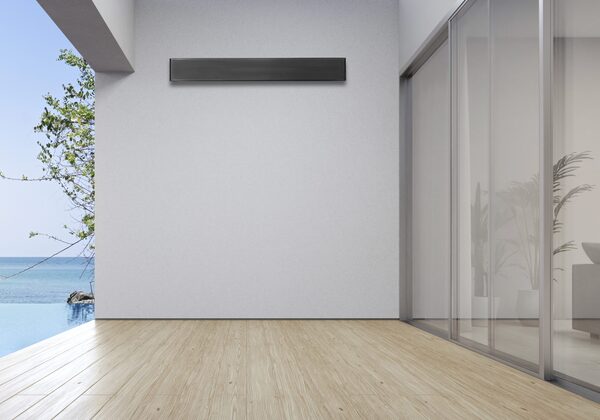
Sundirect's own product index lists a wide spread of far infrared heaters: heating panels with LED light, basic and premium heating panels, glass infrared heaters, a wifi infrared bathroom heater, portable infrared heaters, a round lighting mirror with heat, portable mini tower and tower heaters, the Lux-Plus panel, an infrared lighting mirror, a picture infrared heater in the Art Series, and the SC-Plus space heater1. The company describes its panels as suitable for both indoor and outdoor use, though the maker's own support guidance narrows that: all models other than the OC, OC-Pro and SC-Plus series are designed for indoor use only10.
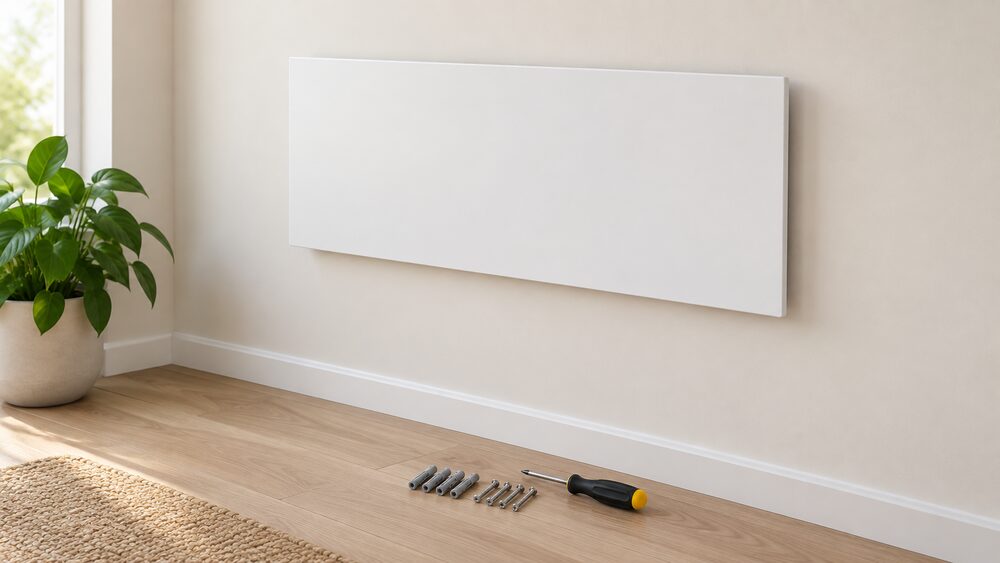
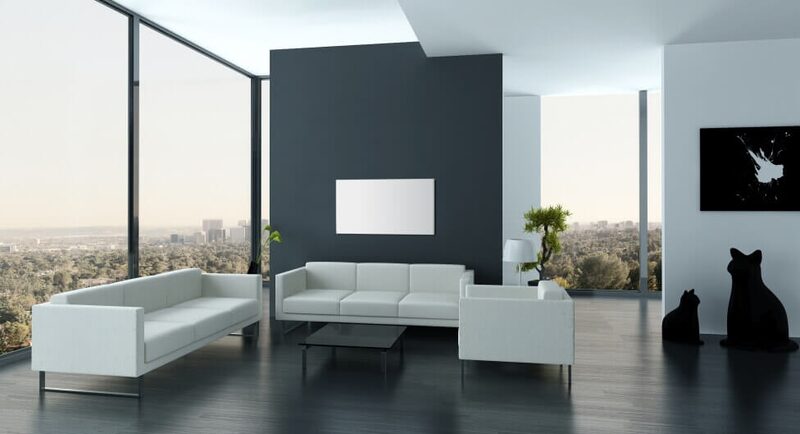
The applications the maker names are domestic and commercial: homes including living rooms, bedrooms, kitchens and bathrooms, plus offices, hotels, restaurants, spas and retail spaces2. Design is part of the pitch. Options include mirror heaters, picture panel heaters and glass heating panels, and the frameless infrared panel heater comes with Sundirect's Easy-Fit mounting solution, described as a unique bracket for secure wall mounting2. Panels can be mounted on a wall or ceiling, which the maker notes saves floor space1.
For bathrooms specifically, the maker's guidance covers infrared panel, portable, ceiling and wall-mounted heaters, and its glass infrared towel heater is available in white and black and can optionally be equipped with one or two towel rails9. Mirror heaters can also be optionally equipped with towel rails9. For European customers, Sun Direct collaborates with a local printing company to offer personalised infrared panels with heat-resistant prints11.
Specifications: 220-240V panels, 120 degree spread
The published technical detail is thin compared with a gas boiler's, and it is all maker-supplied. The Sundirect Plus range runs on 220-240V at approximately 50Hz3. The SC-Plus series is rated at 2400W in the SC2400-Plus model and is described as a premium infrared space heater engineered for large indoor areas and shielded outdoor spaces4. The Hybrid-Pro Series combines infrared heating with convection heating, and the maker states it delivers 35% higher convection performance compared to other hybrid infrared heaters5.
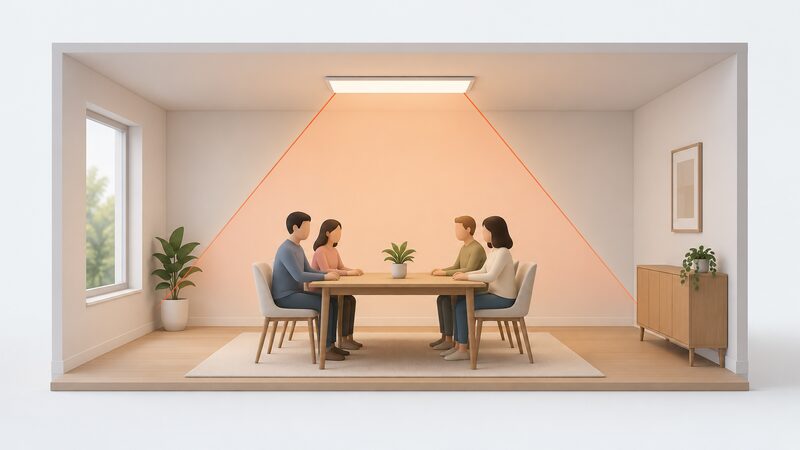
Two figures shape how a panel is placed. The radiation angle of infrared heaters is about 120 degrees, so a panel warms what falls within that spread rather than the whole volume of a room6. The panels are insulated at the back so that there is very little heat at the back, which is what allows wall mounting without cooking the wall behind6. The maker also states that the panels are lead free, citing ROHS and REACH certification, and that Sundirect works closely with the German lab TUV to meet safety requirements12.
| Product or range | Key specification | Warranty |
|---|---|---|
| Sundirect Plus range | 220-240V, ~50Hz3 | Not stated |
| Smart 2.0 Pro | Wifi enabled thermostat3 | 2 years3 |
| SC-Plus series | 2400W in SC2400-Plus; large indoor and shielded outdoor use4 | 3 years product warranty4 |
| Hybrid-Pro Series | Infrared plus convection; 35% higher convection performance claimed5 | 5 years5 |
| Panel heaters generally | About 120 degree radiation angle; back insulated6 | Varies by model |
What the warranty covers, and what it does not
Warranty length is set by the range, and the terms published for the shortest one are the most explicit. The Smart 2.0 Pro carries 2 years, and the maker states that the warranty covers the repair or replacement of the Smart 2.0 Pro only3. The SC-Plus series carries a 3 year product warranty, and the Hybrid-Pro Series carries 5 years4. Nothing in the published material extends these terms for registration, for using a particular installer, or for fitting a filter, which is how boiler warranties are usually structured.
What sits outside the warranty is the installation itself. The maker states that the package contains the complete installation material, and that a heater can be mounted within 15 minutes6. Electrical work is described as hardwiring that can be completed within a few hours for the entire house13. Because the panels are hardwired electric appliances, the fixed wiring side falls to an electrician rather than to the heater warranty, and the maker recommends consulting a Sundirect dealer, who will consult for free, and offers to put buyers in touch with an authorised dealer locally6.
Maintenance obligations are minimal by design. The maker states that an infrared heater requires no maintenance and therefore no additional annual costs for a heating plumber, and describes upkeep as cleaning the heater surface occasionally, ensuring proper installation and checking electrical connections periodically9. There is no combustion, so no flue, no gas safety check and no carbon monoxide risk from the appliance2.
What it costs to buy and run

Sundirect publishes no list price for its panels, so any figure is dealer-quoted or comes from independent cost guidance rather than from a manufacturer price list. Independent guidance puts infrared panel installation at £100 to £200 per heater7. The same source notes that infrared heating panels are approximately twice the price of convection space heaters, which is the clearest relative price signal available14. A separate independent report on the Future Homes Standard gives infra-red heaters a typical cost of under £2,000, without specifying the number of units that covers15.
On running cost, the panels are electric resistance heating, so the cost per hour follows the electricity tariff and the panel's wattage. For scale on electric heating generally, Citizens Advice gives an immersion heater at 75p an hour16. The maker's own efficiency argument is about where the heat lands rather than how much electricity is converted: infrared heaters directly heat objects or bodies in range, meaning the heat is stored much longer, which the company says results in energy savings, and objects retain heat longer than air so a room stays warm for longer periods even after the heater is turned off12.
"Infrared heaters directly heat objects or bodies in range, meaning the heat is stored much longer which results in energy savings"
Two further cost points matter. The maker states that infrared heaters have no operational costs because there is no annual maintenance or upkeep spend, which removes the servicing line that a gas boiler carries13. And the panels can be zoned: infrared panels can be installed in specific rooms where heating is needed, so only the areas occupied are heated, and zones can be created within a single room2. Zoning changes how much of a home is heated at once, which is where the running cost difference is actually made.
Company status and where the products come from
Sundirect Technology Ltd is an active trading company, established in 2011, with a broad distribution network across Europe, the US, New Zealand and Asia2. It sells far infrared heaters and infrared panel heaters, and its own material uses both the Sundirect and Sun Direct spellings for the same business1. There is no administration, insolvency or failure recorded for the company in the material available, and no warranty in the range is presented as at risk.
The manufacturing and testing position is stated by the maker rather than by an independent body. Sundirect says it works closely with the German lab TUV to meet all necessary safety requirements, and that its panels use lead free material with ROHS and REACH certification8. The company also reports that its infrared panels achieved 70.8% radiation efficiency when ceiling mounted in testing with TU Dresden to the IEC 60675-3 standard, against a 40% minimum17. That is a maker-reported test result, not an independent certification listing, and it is the only efficiency figure of its kind in the published material.
What it means for household energy independence
The independence case for infrared panels is real but partial, and it is worth separating the two halves. On the positive side, the panels burn no fuel, so a home using them needs no gas connection, no LPG delivery, no oil tank and no flue2. There is no combustion, so no carbon monoxide is produced and no annual gas safety check applies1. The maker states that infrared heaters do not generate CO2, and that solar energy makes the technology even more environmentally friendly, and recommends combining its heaters with a wind generation or photovoltaic system to create a low carbon footprint13. Some models support smartphone apps that allow remote temperature adjustment, on and off control and energy monitoring2.
What remains is the dependence that matters most for running cost. The panels are electric resistance heaters, so the household stays connected to the electricity grid and to an electricity supplier, and the running cost is set by that tariff rather than by a fuel the household can shop for separately. Independent analysis of household energy argues that insulating homes and running electric heat pumps and cars on an even greener grid would boost energy independence, which places electric resistance heating in a different category from a heat pump on the same grid18. Where a smart app is used, remote control adds a dependence on home broadband and the manufacturer's app, though local control at the panel continues without it.
The maker's own framing is conditional rather than absolute: infrared heaters can serve as a primary heating solution for well-insulated rooms, or as a supplementary system2. That condition is the honest summary. For a well-insulated room, a zoned panel removes the gas connection from that room's heating. For a whole house in winter, the panels remain a grid-fed electric load, and the independence gained is independence from gas rather than from the grid.
Sources18 cited
- Sundirect infrared heating, Sundirect Technology Ltd, 2026
- The efficiency of Sundirect infrared heaters, Sundirect Technology Ltd, 2026-03-16
- Wifi enabled thermostat Smart 2.0 Pro, Sundirect Technology Ltd, 2026-09-20
- Infrared space heater SC-Plus, Sundirect Technology Ltd, 2026-09-20
- Smart hybrid infrared heater, Sundirect Technology Ltd, 2026-09-20
- How to install infrared heating panels, Sundirect Technology Ltd, 2017-11-29
- Electric heating advice, Centre for Sustainable Energy, 2026-06
- Sundirect FAQ, Sundirect Technology Ltd, 2026-09-20
- Infrared bathroom heaters, Sundirect Technology Ltd, 2017-11-26
- Understanding far infrared heating, Sundirect Technology Ltd, 2024-07-03
- The role of design in infrared picture heaters, Sundirect Technology Ltd, 2024-04-19
- Why far infrared heaters, Sundirect Technology Ltd, 2026-09-20
- Infrared heating in new buildings: what are the costs, Sundirect Technology Ltd, 2019-05-27
- Infrared heating panels, HIES, 2018-07-24
- Future Homes Standard Phase 1 Network to Emitter Impact Report, BEAMA, 2023-04
- Save money using your electrical appliances, Citizens Advice, 2023-05-10
- Sundirect heater as supplementary heating, Sundirect Technology Ltd, 2017-11-17
- Household energy: buying British, Energy and Climate Intelligence Unit, 2024-04-15