
In this guide
Devola is a UK brand in the electric heating market, selling infrared panels, portable electric heaters and, from late 2026, a portable air conditioner. The products sit in the same regulatory category as other electric panel heaters: the Building Research Establishment's conventions for SAP assessments state that electric underfloor heating mats and infra-red heaters should be treated as electric panel heaters1. That classification matters, because it determines how the products are modelled for energy performance and what controls they are required to have.
The appeal of an infrared panel is directness. It converts electricity to radiant heat at the point of use, with no boiler, no pipework, no flue and no gas supply. The trade-off is equally direct: every unit of heat comes from the electricity grid at whatever tariff the household is on, and infrared radiant panels are reported to cost around £1,080 a year to run in a flat2. That figure is for a whole flat, not a single panel, and it moves with the tariff and with how the rooms are used.
This page sets out what Devola makes, how the range is specified, what the running costs look like against published figures, where the brand sits among UK infrared suppliers, the pre-order position on the DVAC9KH air conditioner, and what owning an electric heater does and does not do for a household's energy independence.
What Devola makes: infrared panels and electric heaters
Devola's output divides into fixed infrared heating panels and portable electric heaters. The fixed panels are the products that compete with other infrared brands in the UK, and they are installed rather than plugged in. The portable side is a different proposition: the 1500W ceramic fan heater range, sold in black, black and silver, white, and white and silver finishes, is a plug-in appliance for spot heating rather than a whole-home solution4.
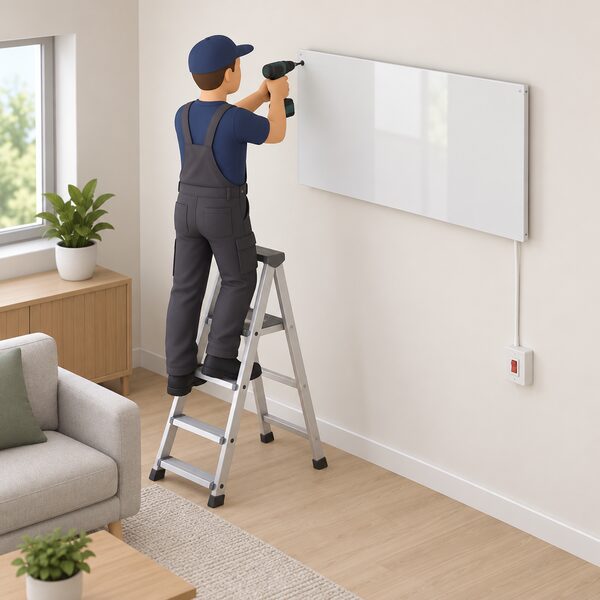
The distinction between portable and fixed matters for how the product is connected. Portable panels can be plugged into the mains, while free standing panels are usually wired into the electricity supply by an electrician3. Professionally installed infrared systems, with panels fixed to walls or ceilings, are a third category: the Energy Saving Trust notes that such systems may be designed for safe use during the night, but advises checking with the installer first, and states that panels should be at a safe height, out of reach of young children or pets3.
For a household, the practical question is which of those three categories the intended room needs. A single portable heater can be moved between rooms and needs no electrical work. A fixed panel needs a supply run to its position, which is why installation is priced per heater rather than per house. The controls requirement also differs: fixed electric panel heaters fall under building regulations that require time and temperature control, for separate control of each room or each appliance, on new systems or replacement components8.
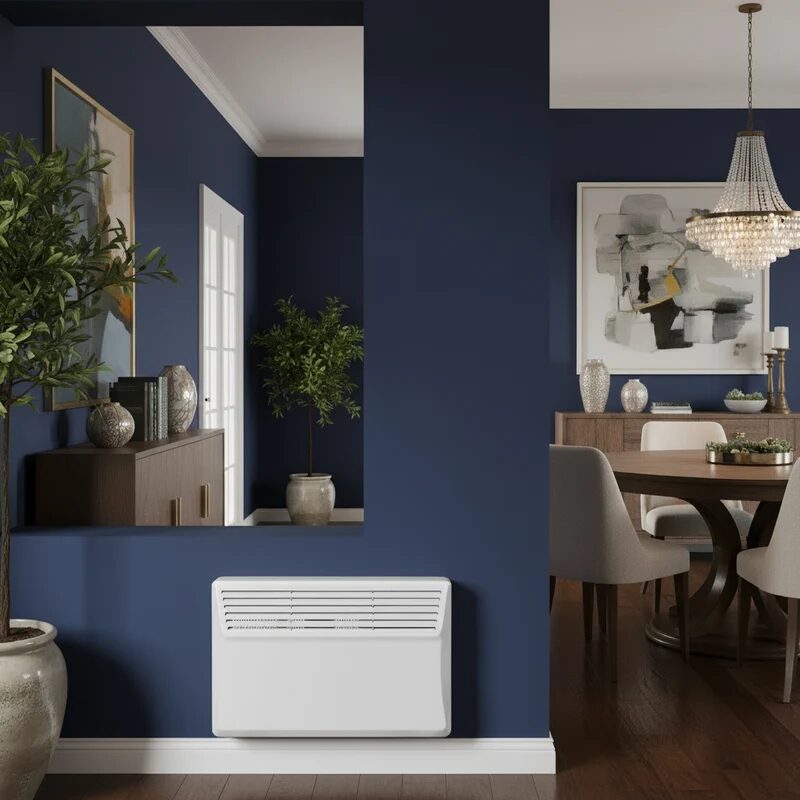
The range: panels, heaters and the DVAC9KH air conditioner
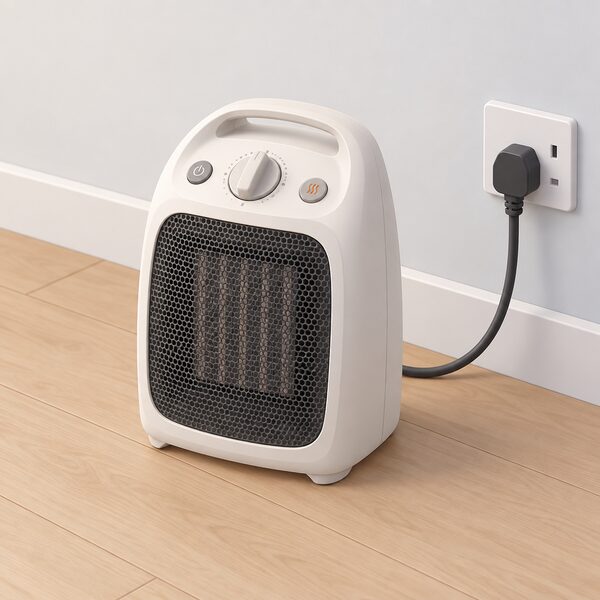
The portable heater range is the best documented part of the Devola line. The 1500W ceramic fan heater models carry a thermostat, three temperature settings at 18°C, 23°C and 28°C, two power settings and three modes, with a plastic casing and no remote control4. Those are modest specifications, and they describe a fan heater rather than a radiant panel: the heat is delivered by moving air over a ceramic element, which is a different experience from the directional radiant warmth of an infrared panel.
The DVAC9KH is the newest addition and the one with the least certainty attached. It is a portable air conditioner with Wi-Fi and two window kits, listed as a pre-order. The buyer is asked to acknowledge that delivery dates are estimates, and the product page states that stock is expected on 18 December 2026. Because that date is described as an estimate rather than a confirmed slot, it should be read as indicative.
The wider Devola catalogue also includes infrared panels in the sizes and finishes common to the category. For comparison, the Herschel range, a longer-established UK infrared brand, runs to eight models from 215W to 1250W in its Comfort line, with glass and blackboard panels available in white or black and a bespoke design option on its picture panels10. That gives a sense of the shape of the market Devola is selling into: a spread of panel sizes, a choice of finishes, and a made-to-order route for non-standard designs11.
Specifications to compare before buying
The specification that matters most on an infrared panel is its wattage, because that sets both the heat output and the running cost. Wall panels designed for homes typically range from 350 to 900 Watts, and some rooms will need more than one panel if they are the main heat source in the room3. A single 350W panel will not heat a large living room on its own; the same room may need two or more units, which changes both the purchase cost and the electrical load.
Sizing guidance is not settled. One maker's product page works to around 60 to 80W per square metre, while another figure from the same maker puts the requirement closer to 100W per square metre. The two figures are not reconciled, and the difference is large enough to change the number of panels a room needs. A household comparing quotes should expect the installer's own calculation to sit somewhere between those two positions, and should ask what assumption it is based on.
| Specification | What to check | Published reference |
|---|---|---|
| Panel output | 350 to 900W for wall panels designed for homes3 | Energy Saving Trust |
| Panels per room | More than one may be needed as the main heat source3 | Energy Saving Trust |
| Sizing density | Around 60 to 80W per m², or closer to 100W per m² | Maker figures, not reconciled |
| Connection | Portable plug-in; free standing wired by an electrician3 | Energy Saving Trust |
| Controls | Time and temperature control required for electric panel heaters8 | Approved Document L |
| Portable heater settings | 18°C, 23°C and 28°C, two power settings, three modes4 | Product listing |
The controls point is a regulatory one rather than a preference. Approved Document L requires time and temperature control for electric panel heaters, with separate control of each room or each appliance, on new systems or replacement components8. The equivalent Welsh document carries the same requirement9. In practice that means a fixed panel installation needs a thermostat and a timer, whether built into the panel or supplied as a separate control, and the choice of control affects how the system performs.
Cost and running costs
There is no published Devola price list for the panels, so prices are installer-quoted. The figures that do exist are for the category rather than the brand. Infrared panels cost £100 to £200 per heater to install, and infrared radiant panels are reported to run at around £1,080 a year for a flat2. Both figures come from independent guidance and both are broad: the installation figure excludes the panel itself, and the running figure depends entirely on the tariff and the number of hours the panels are on.
For context on the wider electric heating picture, a domestic solar panel system of around 4.5 kWp costs around £7,600 to install12. That is not a Devola product and not a like-for-like comparison, but it sets the scale of the alternative route to lower running costs: generating electricity on the roof rather than buying all of it from a supplier.
The running cost of any electric heater is a straightforward multiplication of its wattage by the hours used and the unit price paid. A 900W panel run for five hours uses 4.5 kWh. The published £1,080 a year figure for a flat is the outcome of that arithmetic across a whole property, and it will be higher or lower depending on how many rooms are heated and for how long. Households on a time-of-use tariff can shift some of that load to cheaper periods, which is covered in more detail in electric heating running costs.
Where Devola sits in the market
Devola is one of a number of UK infrared and electric heating brands, alongside longer-established names such as Herschel, and the market divides along a few lines: panel finish and design, control compatibility, warranty length and whether the product is made to order. Herschel's glass and blackboard panels are suitable for home and commercial use, come in white or black, and are used with Herschel iQ thermostat controls13. Its Comfort range runs to eight models from 215W to 1250W with a 10 year warranty10. Its picture panels offer a bespoke design option and carry a 10 year warranty11.
Those are the benchmarks a buyer will encounter when comparing Devola against the alternatives. The relevant questions are the same across brands: what output the room needs, what controls the panel works with, how long the warranty runs and what it covers, and whether the panel is a stock item or made to order. Herschel's panels are recommended for professional installation only, which is a common position for fixed glass panels13.
The wider comparison between infrared and other electric heating is set out in infrared panels vs storage heaters, and the general case for the technology is covered in infrared heating. For a household weighing a fixed panel against a portable heater, the deciding factors are usually the room's use pattern and whether the electrical supply can take a dedicated circuit.
Availability and pre-orders: the DVAC9KH and expected stock
The DVAC9KH is the one Devola product with a dated availability question attached. It is listed as a pre-order, the buyer is asked to acknowledge that delivery dates are estimates, and the product page states that stock is expected on 18 December 2026. The unit is a portable air conditioner with Wi-Fi and two window kits.
Pre-order arrangements of this kind carry a specific risk: the date is the retailer's estimate, not a confirmed delivery commitment, and it can move. A household planning to rely on the unit for winter heating should treat the December date as indicative and keep an alternative in place until delivery is confirmed.
Availability of the fixed panels is a separate matter. Some infrared products in the wider market are made to order rather than held in stock, which affects lead times11. Where a panel is made to order, the lead time runs from the order rather than from a warehouse, and that should be built into any installation schedule.
Owning an electric heater and what it means for energy independence
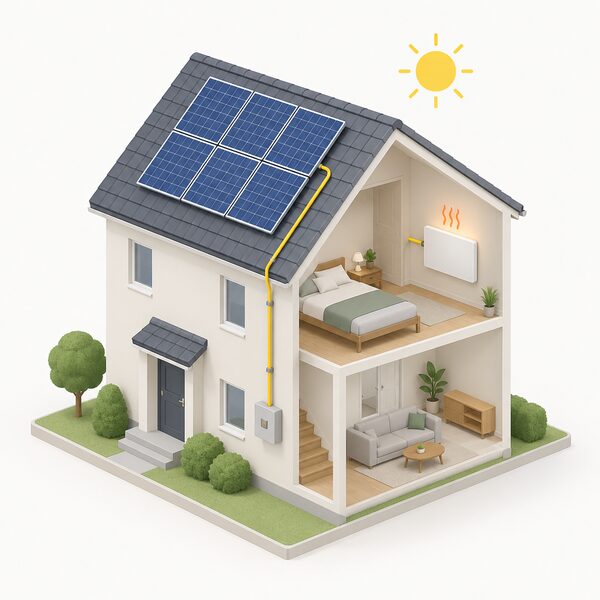
An electric heater changes where a household's heat comes from, but not how independent it is. The panel removes the gas supply, the boiler, the flue and the annual service from the equation. What remains is the electricity supply: the panel runs on grid electricity bought from a supplier, at whatever tariff applies, and it stops when the power is off. There is no stored heat and no fuel store.
The independence case for electric heating rests on what generates the electricity. Independent analysis states that insulating homes and running electric heat pumps and cars on an ever-greener grid would boost energy independence14. A North Devon case study compared homes with solar PV and infrared heating panels against a control property with solar PV and infrared heating panels, examining how the combination performed15. Separately, guidance on home solar notes that a solar panel installation could offset the electricity demand of owning an electric vehicle or heating homes with a heat pump16.
That is the route to genuine independence for an electrically heated home: on-site generation to meet the load. Without it, an infrared panel is a grid-dependent appliance like any other, and its running cost is exposed to whatever the unit price of electricity does. The trade-off is that a panel is cheap to install relative to a heat pump or a boiler replacement, and it needs no fuel deliveries, no tank and no flue.
"If the Government wants to boost energy independence, insulating homes and running electric heat pumps and cars on an ever-greener grid would boost energy independence."
For a household already generating its own electricity, the arithmetic changes. A solar panel installation could offset the electricity demand of heating a home16, and the North Devon work examined solar PV paired with infrared panels as a system rather than as separate purchases15. The limits are the same as for any electric heating: winter output from solar is low, so the grid still carries most of the load in the coldest months, and a battery or a time-of-use tariff is what shifts the balance. More on the general position is in home heating and energy independence.
Warranty, installation and registration
Warranty terms for Devola products are not published in the material available here, so the terms that apply are the ones supplied with the appliance and confirmed by the retailer at the point of sale. What can be said with confidence is the process. Registering an electrical appliance with the manufacturer activates any warranty and means the household can be contacted about a problem or a safety recall17. The information needed to register is your name, your postcode and the make and model of the device18.
Registration deadlines vary by scheme. Under the Barcud Solar Panel Installation Scheme specification, inverter product registrations to activate guarantees and warranties are to be completed within 48 hours of commissioning19. That is a solar scheme rather than a heating product scheme, but it illustrates how tightly some programmes tie registration to the commissioning date. For a domestic appliance, the deadline is normally set by the maker's own terms.
Installation of fixed panels is electrical work. Free standing panels are usually wired into the electricity supply by an electrician3, and fixed glass panels in the wider market are recommended for professional installation only13. The safety rules for connecting electrical equipment are strict: plug-in solar devices must be plugged directly into a permanent wall-socket circuit, and must never be connected to extension leads, cable reels, multiway adapters, travel adapters, RCD adapters, lighting circuits, or circuits supplying fixed equipment such as ovens and hobs20. Official guidance states that AC interconnection of multiple inverter units to the same circuit by means of extension cables, plug couplers or in-line connector systems shall not be permitted21, and an independent safety body has called for these devices to be hard wired into a property via their own dedicated circuit22. Those rules are written for plug-in solar, but the principle they express, that high-draw electrical equipment belongs on a proper circuit rather than an adapter, applies to any fixed electric heater. The general requirements are set out in electrical safety for electric heating.
For a household, the practical sequence is: confirm the panel's output and the room's requirement, confirm the control arrangement meets the time and temperature control requirement8, have the supply installed by a competent electrician, register the product with the manufacturer, and keep the serial number and receipt together. The serial number is normally on the appliance's data plate, and it is the number needed for a warranty claim or a recall.
Sources22 cited
- RDSAP conventions v12, BRE Group, 2025
- Electric heating advice, Centre for Sustainable Energy, 2026
- Infrared heating explained, Energy Saving Trust, 2026
- Devola DVSFH15BB Black 1500W Portable Ceramic Fan Heater, Quiet Mark, 2026
- Devola DVSFH15BS Black & Silver 1500W Portable Ceramic Fan Heater, Quiet Mark, 2026
- Devola DVSFH15WW White 1500W Portable Ceramic Fan Heater, Quiet Mark, 2026
- Devola DVSFH15WS White & Silver 1500W Portable Ceramic Fan Heater, Quiet Mark, 2026
- Approved Document L, Conservation of Fuel and Power, Volume 1, HM Government, 2023
- Approved Document L Volume 1 consultation version, Welsh Government, 2025
- Future ready heating for a 12 bed sit renovation, Herschel Infrared, 2026
- Holiday homes heating, Herschel Infrared, 2026
- Solar panels advice, Energy Saving Trust, 2026
- Inspire glass and blackboard infrared panels, Herschel Infrared, 2026
- Household energy buying British, Energy and Climate Intelligence Unit, 2024
- Evaluating solar PV with electric heating with North Devon homes, National Energy Action, 2025
- Flexi-Orb for my home, Flexi-Orb, 2025
- Plug-in solar consumer guide, Electrical Safety First, 2026
- Plug-in solar panels, Energy Saving Trust, 2026
- Barcud Solar Panel Installation Scheme Specification, Sell2Wales, 2026
- Plug-in solar panels, Which?, 2026
- Plug-in solar interim product specification, HM Government, 2026
- More clarity needed to address potential plug-in solar panel safety concerns, Electrical Safety First, 2026