In this guide
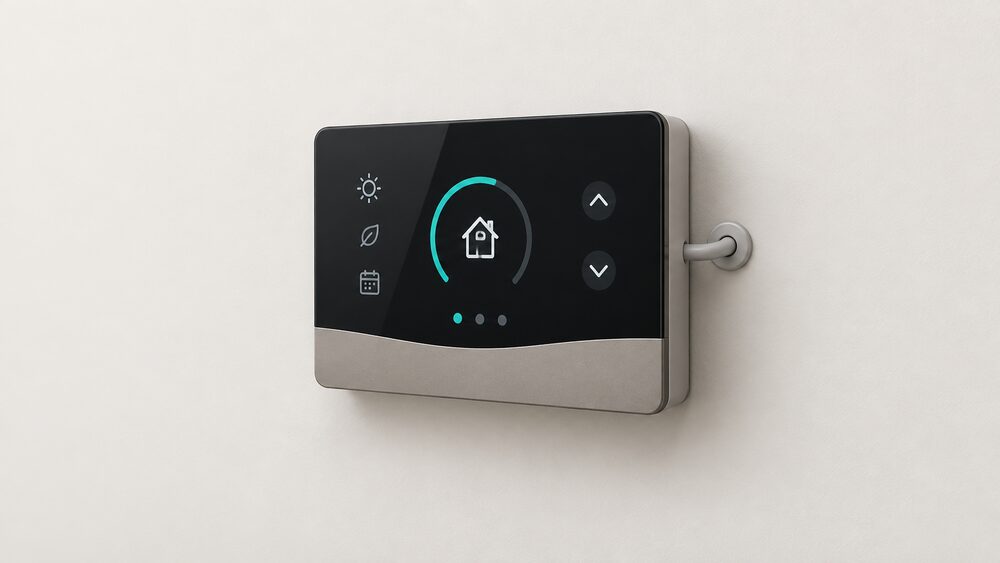
WOLF is a German heating manufacturer based in Mainburg, Bavaria, and the sensoCOMFORT is its system control: a semi touch interface described by the maker as "the intuitive control to manage your heating and hot water"1. It is a system controller rather than a standalone smart thermostat, which means it is designed to sit at the centre of a WOLF installation and manage the boiler, the cylinder and, on larger systems, solar thermal and ventilation as well.
The practical appeal is single point control. WOLF states that on its solar heating systems "you only need a single control unit to operate the entire heating system", and its BM-2 control module is listed as controlling gas heating, a heat pump, solar equipment and living space ventilation from one device2. The sensoCOMFORT itself is available in wired or wireless versions1.
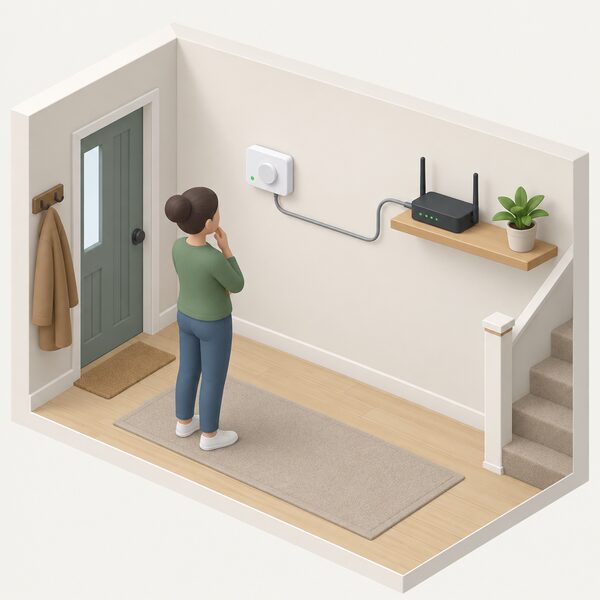
The dependence is the same one that runs through every app-connected control. Remote access, remote diagnostics and remote maintenance all pass through the Smartset app, the Smartset Portal and the Link home or Link pro interface modules, which connect to a router over LAN or WiFi4. Local control continues without a connection; anything done from a phone or by a contractor off site does not.
What the sensoCOMFORT is and what it controls
The sensoCOMFORT is a fixed system controller, not a battery-powered room thermostat that talks to a boiler over a radio link. WOLF describes it as the intuitive control for heating and hot water, and lists it in wired and wireless versions, so the same interface can be mounted on a wall with a cable run back to the wiring centre or sited where a cable is impractical1. The semi touch interface is described by the maker as providing "a simplistic method of navigating the control to undertake simple tasks"1.
What it controls depends on what is installed around it. On a straightforward gas system it manages space heating and the cylinder. On a hybrid or renewable installation the scope widens: WOLF's solar collector pages state that a single control unit operates the entire heating system, and the BM-2 control module is described as controlling heating, ventilation and solar thermal from one device2. The same module is listed as compatible with gas heating, heat pumps, solar equipment and living space ventilation3.
That breadth is the point of a system controller. Rather than a thermostat that only knows about room temperature, the sensoCOMFORT sits above the heat sources and decides which one runs. On a WOLF hybrid system the system controller regulates all the components of the heating, according to the maker's Slovak-language collector page9. For a household, that means the control is the thing that determines whether the boiler, the heat pump or the solar contribution is doing the work at any given moment.
Weather compensation is the mechanism that makes this worthwhile. A compensating control adjusts the flow temperature to the outdoor conditions rather than running the boiler at a fixed high temperature and cycling it, which is the same principle covered in weather compensation controls and in the wider guide to heating controls.
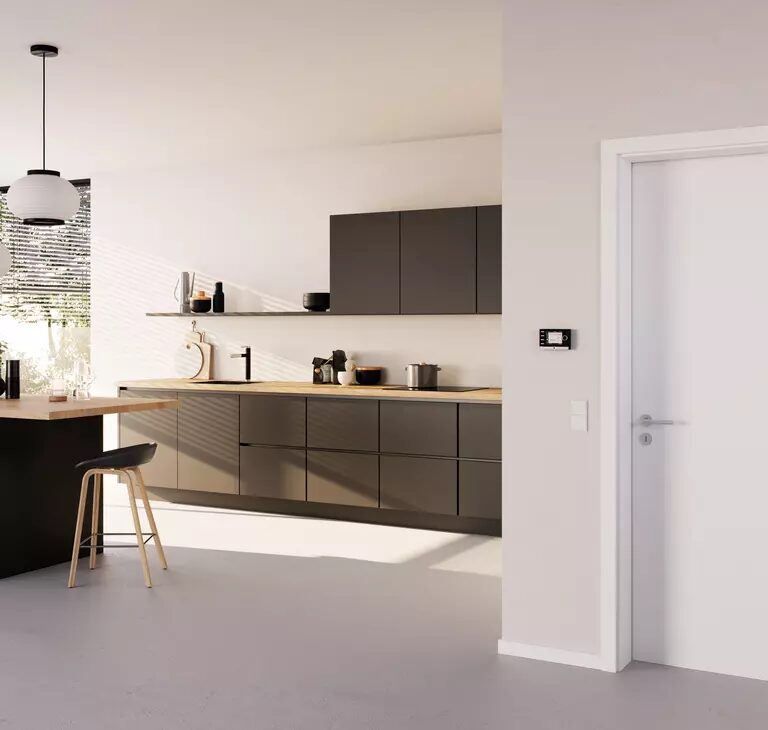
The control range: where the sensoCOMFORT fits
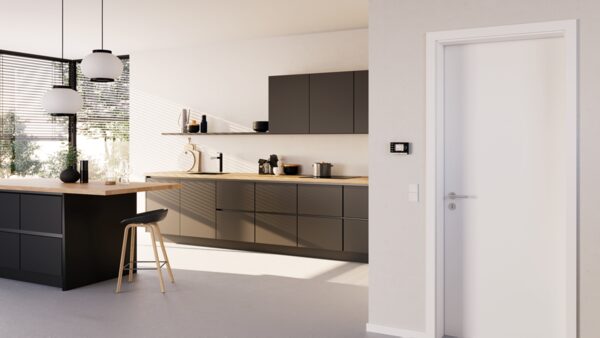
WOLF's controls are modular, and the sensoCOMFORT is one layer in a stack rather than the whole system. The BM-2 programming unit is the module WOLF names as required to use the heating control in a smart home, and it is the device that pulls heating, ventilation and solar thermal together3. Below that sit the interface modules: Link home and Link pro integrate the heating system into a smart home and bring smart heating online, connecting to a DSL router over LAN or WiFi for secure communication4.
The heat pump side has its own manager. The BWW-1 heat pump uses what WOLF calls the Easy Connect System, a plug-in connection from the heat pump to the WPM-1 heat pump manager including a BM control module, expandable through the WOLF WRS control system to further energy sources such as solar3. That is the same pattern: a manager at the plant, a control module for the user, and an expansion route for additional sources.
| Control or module | Role |
|---|---|
| sensoCOMFORT | System control for heating and hot water, wired or wireless1 |
| BM-2 | Programming unit for heating, ventilation and solar thermal from one device3 |
| Link home / Link pro | Interface modules bringing the heating system into the smart home over LAN or WiFi4 |
| WPM-1 with BM module | Heat pump manager on the BWW-1, expandable via WOLF WRS3 |
| Smartset app and Portal | Remote control, diagnostics and maintenance4 |
The range also extends beyond heating. WOLF's CWL-F Excellent ventilation unit is Made in Germany and suited to flats, family and residential houses and offices, and the stationary cylinder range runs from the SE-2-150 through SE-2-200, SE-2-300, SE-2-400, SE-2-500 and SE-2-750 variants8. A household that buys into WOLF controls is buying into a system family, and the control is the part that has to speak to all of it.
Made in Bavaria: who WOLF is
WOLF develops and produces at what it calls "our Bavarian development and production site", and the company is based in Mainburg, Germany2. The Made in Germany claim is repeated across the product range: the TopSon F3-1 solar controller and the F3-1, F3-1Q and CFK-1 collectors carry it, as do the BWW-1 heat pump, the CWL-F Excellent ventilation unit and the stationary cylinders4. WOLF's smarthome pages use the phrase German engineering and production12.
That matters for a UK household in two ways. The first is spares and support: a control built and supported from Bavaria depends on a supply chain that crosses the Channel, so a replacement module or a firmware question runs on German lead times rather than a UK warehouse. The second is documentation. Several of WOLF's product pages are published in German and Slovak as well as English, and the technical detail on a given control may be fuller in one language than another.
The company's own framing is about indoor environment rather than only heating. WOLF states that it has spent decades developing solutions for healthy indoor environments, and describes more than 50 years of experience12. Its project work includes a complete renovation of an MDU modernisation, and the case study for that project records that the clients were won over by "the high quality, good value for money and five-year guarantee"11.
Over 50 years of experience in heating and indoor climate
WOLF states more than 50 years of experience on its solar collector pages and repeats the figure in its smarthome material, where it describes decades of developing solutions for healthy indoor environments2. That is a maker's own claim about its own history, and it is the only longevity figure the company publishes for itself in the material available here.
For context on what half a century means in this industry, the comparison is instructive rather than competitive. Glow-worm, a UK brand, is described as designing and manufacturing dependable, energy efficient heating systems for more than 90 years14. Longevity of that kind is a rough proxy for whether a manufacturer will still be around to honour a warranty and supply a spare part, which is the question a household is really asking when it reads a company history.
The more useful signal is the breadth of the current catalogue. WOLF's controls have to interoperate with solar thermal, heat pumps, gas heating, ventilation and cylinders, and the company publishes product pages across all of those categories2. A manufacturer with a narrow range can drop a control platform quickly; one with a wide range has more reason to keep it supported. That is an inference from the catalogue rather than a published commitment, and no support-period figure for WOLF controls is stated in the material available.
Warranty: 5 years on WOLF products

WOLF's warranty terms are not uniform, and the differences are worth reading carefully before assuming a control is covered for five years. The BSP stationary cylinder carries a five-year guarantee, with two years on electrical and moving parts7. A WOLF case study refers to a five-year guarantee as one of the things that won a project over11. No separate published term for a WOLF control unit appears in the material available, so the term for a sensoCOMFORT or a BM-2 has to be confirmed for the specific product.
Two things follow for a household. First, a warranty on a control is only as good as the installer's registration and the commissioning record, which is the same pattern seen across the industry and explained in does DIY thermostat installation affect my warranty. Second, a control that depends on a cloud service has a second, unwritten lifetime: the app and the remote diagnostics can stop being supported long before the hardware fails, which is the subject of smart heating controls: security, data and product support.
Finding a WOLF engineer in the UK
WOLF does not publish a UK postcode installer search in the material available here, and that is the honest starting point. The practical routes are to approach WOLF's UK operation directly, or to use heating firms that already work with German system brands and can obtain WOLF spares and commissioning support. The controls themselves are not the barrier: the Smartset app allows a heating contractor, with the householder's approval, to analyse faults via remote diagnostics and fix them via remote maintenance4. That means the installing firm needs an account and the householder's consent, not a physical visit for every fault.
On emergency cover, the distinction between the network and the system matters. Gas emergencies in Great Britain are handled by the gas distribution networks, and Wales & West Utilities states that it is available "24 hours a day, 365 days a year"15. That covers the gas supply, not the boiler or the control. For the heating system itself, response times are a matter of the individual firm's terms; one UK installer scheme's complaints procedure commits the installer to contact the customer within 24 hours to arrange an investigation and rectify defects16.
For households that want a control they can maintain themselves, the wider question of who holds the keys is covered in heating controls and energy independence and in open source heating control.
WOLF's reach: sales offices, subsidiaries and partners
WOLF sells into multiple markets and publishes product and professional pages in several languages, including English and Slovak versions of its heating, ventilation, solar and cylinder ranges2. The same model names recur across those markets: the BM-2 control module, the Smartset app, the BWW-1 heat pump and the SE-2 cylinder range all appear in the Slovak catalogue as well as the German one3.
The material available does not give a count of WOLF sales offices, subsidiaries or distribution partners, so no figure for the size of the international network can be stated. What can be said is that the controls are designed for a multi-market product family rather than a single country, which is why the Smartset app and the Link interface modules are described in the same terms across WOLF's pages4.
For a UK household, the practical consequence is that a WOLF control is a European product with European support. That is not a drawback in itself, but it does mean that the local knowledge sits with the installing contractor rather than with a national network of brand-trained engineers. The comparison with brands that run their own UK installer schemes is set out in smart thermostat vs traditional programmer and in the wider heating controls guide.
What owning WOLF controls means for household energy independence
A WOLF control does two useful things for independence and one thing against it. On the positive side, it is a system controller rather than a cloud-first gadget: it manages the heat sources locally, decides which of them runs, and on a hybrid installation regulates all the components of the heating9. It can also bring solar thermal into the same control loop as the boiler or heat pump, which is the arrangement WOLF describes when it says a single control unit operates the entire heating system2. A household with solar thermal and a WOLF controller is getting more of its heat from its own roof and less from a supplier.
The second positive is local operation. The Smartset app is described as a convenient way to control heating and ventilation from a phone, and the Smartset Portal allows control of domestic technology at home and centrally from a computer4. Geofencing works too: WOLF states that if a smart home system has a geofencing function, it can be used with WOLF appliances5. Voice control through Alexa is supported on WOLF heating and ventilation units5.
The dependence is the interface modules. Link home and Link pro connect to a DSL router over LAN or WiFi, and the Smartset app connects the heating system to those modules for remote control4. Remote diagnostics and remote maintenance run through the same chain4. Without broadband, the local control at the unit continues, but scheduling from away, fault reading and contractor access do not. The wider pattern is covered in smart thermostats: how they work and what they do and in smart thermostat subscriptions and app charges.
"With your approval, your heating contractor can analyse faults via remote diagnostics and fix them via remote maintenance"
The remaining dependence is the manufacturer itself. A WOLF control keeps a household on whatever fuel the system burns, on a supplier for that fuel, and on WOLF for firmware, spares and the app. What it changes is how much of the heat can come from the household's own solar thermal and how precisely the system can be run, which is the same trade covered in do heating controls save money and in using heating controls with time-of-use and smart tariffs.
Sources16 cited
- sensoCOMFORT product page, Vaillant, 2026
- Tube collector CRK-12, WOLF, 2026
- BM-2 control module, WOLF, 2026
- Smartset app and Smartset Portal, WOLF, 2026
- Smarthome advice, WOLF, 2026
- WOLF case study: complete renovation, WOLF, 2026
- BSP stationary cylinder, WOLF, 2026
- CWL-F Excellent ventilation unit, WOLF, 2026
- Solar collectors F3-1 and CFK-1, WOLF, 2026
- Stationary hot water cylinders, WOLF, 2026
- Smarthome solutions, WOLF, 2026
- Heat pump centre CHC, WOLF, 2026
- Glow-worm brand page, Quiet Mark, 2026
- Gas emergencies and Dial Before You Dig, Wales & West Utilities, 2026
- CWISC complaints procedure, CIGA, 2026
- Protecting data on the smart meter network, Smart DCC, 2026
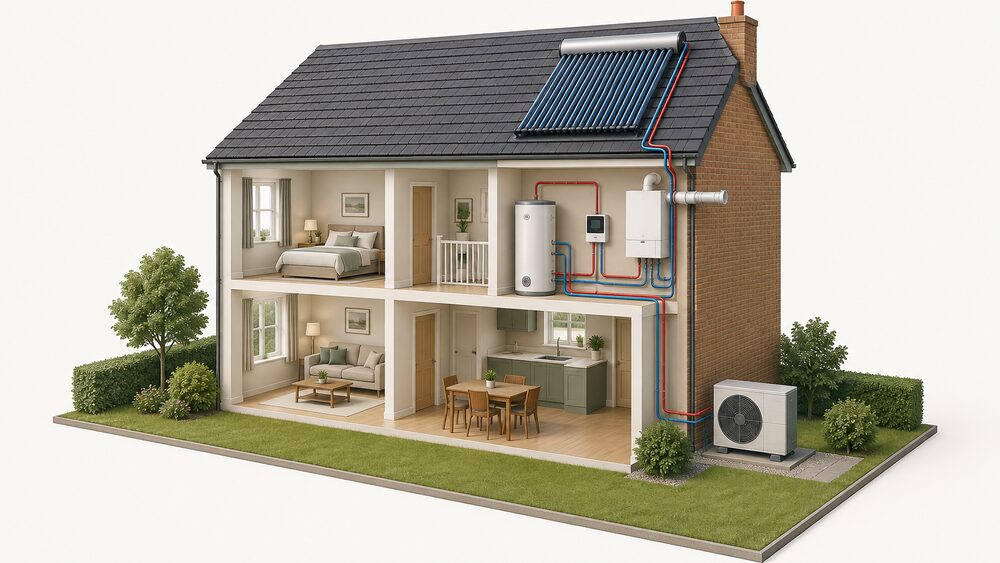 WOLF heatingWOLF is a German heating brand sold in the UK, making gas and oil boilers, heat pumps, solar panels and hot water cylinders.
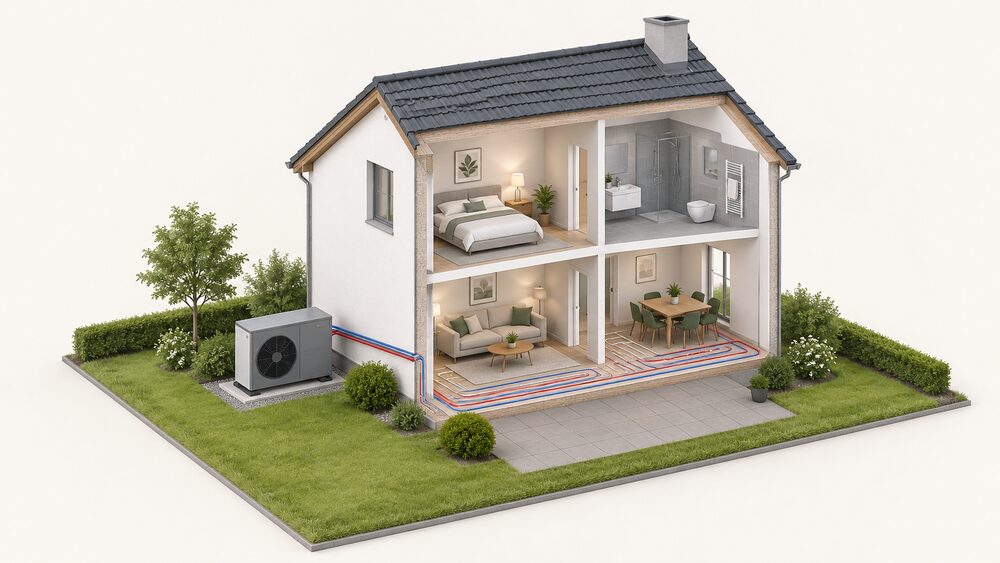 WOLF heat pumpsWOLF heat pumps come in two types: the CHA Monobloc for heating and hot water, and the FHS for hot water only.