
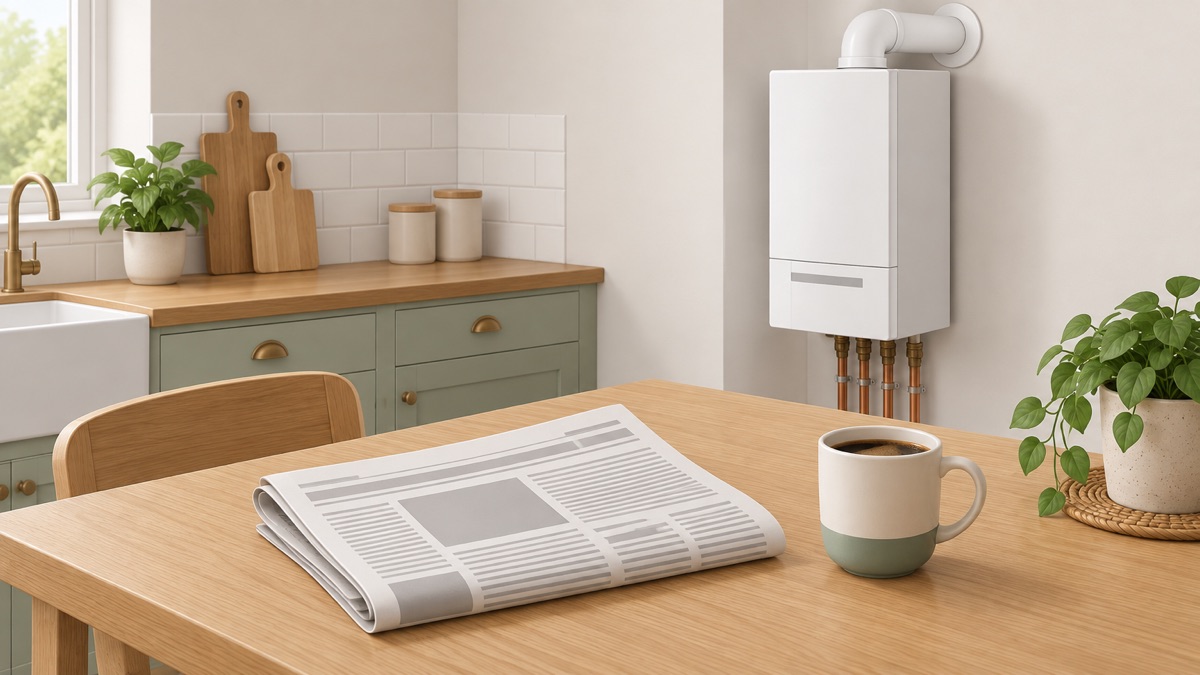
Rinnai UK set out the Sensei N Series range of continuous flow hot water heaters on 2 March 2022. The range has four models, two for internal installation and two for external, and the company states they are the first continuous flow hot water heating units made with stainless steel heat exchangers to be available in the UK1.
The four models and their stated outputs are:
| Model | Position | Output | Load profile |
|---|---|---|---|
| N1300i | Internal | 775 litres per hour | XL |
| N1300e | External | 775 litres per hour at 50 degrees | XL |
| N1600i | Internal | 954 litres per hour | XXL |
| N1600e | External | 954 litres per hour at 50 degrees | XXL |
All four are rated water efficiency class A, according to the announcement1. Rinnai says the stainless steel heat exchangers give "a greatly extended working life at optimum performance levels to each of the four models in the range"1.
"The Rinnai Sensei N Series is the first ever continuous flow hot water heating unit manufactured with stainless steel heat exchangers to be available in the UK"
Other stated features include a flue of up to 30 metres for concentric types, a built-in controller as standard on internal and external models, frost protection to minus 15 degrees Celsius on internal versions and minus 20 degrees Celsius on external versions, and a lockable controller with temperature set up to 75 degrees Celsius1. A cascade cable assembly allows up to 24 water heaters to be connected to work as one system, and Rinnai says any number of N Series units can be manifolded together1.
On emissions, Rinnai states the range has been third-party tested at 28 mg/kWh against a permissible ErP NOx level of 56 mg/kWh, and that all N Series models are low-NOx, using a patented burner with a 13 to 1 turn down ratio1. The company also says its continuous flow systems are proven more energy efficient than conventional storage systems, and that it manufactures over 2 million hot water heating units a year1. Prices for the range are not given in the announcement, and no UK availability date beyond the publication date has been reported1.
Why it matters for households
Continuous flow heaters heat water as it is drawn rather than storing it in a cylinder, so there is no standing volume to keep warm between uses. For a home, the practical questions are how much hot water can be drawn at once and how precisely the temperature holds when more than one outlet is running. The published figures here are outputs at 50 degrees, which is below the 75 degrees Celsius maximum the controller supports, so the flow rates quoted are not directly comparable with a domestic tap temperature1.
The load profiles matter where several bathrooms or outlets are used together: the two 1600 models carry the higher XXL rating and the 1300 models XL1. The stated NOx figure of 28 mg/kWh against the 56 mg/kWh ErP limit is a measure of combustion emissions rather than of gas consumed, so it does not by itself indicate running cost1. The frost protection ratings are relevant to units sited outside, where the external versions are rated to minus 20 degrees Celsius1. Nothing in the announcement covers domestic running costs, servicing intervals or how the units compare with a boilers and heating setup already installed in a home.
What happens next
No installation dates, certification steps or pricing for the UK market are given in the announcement beyond the publication date of 2 March 20221.
Sources1 cited
- Rinnai Sensei N Series: Limitless Hot Water | Temperature Control, rinnai-uk.co.uk